
Boeing's Sonic Cruiser: The Revolutionary Aircraft That Never Took Flight
Breaking airline news and aviation industry updates for 2026.

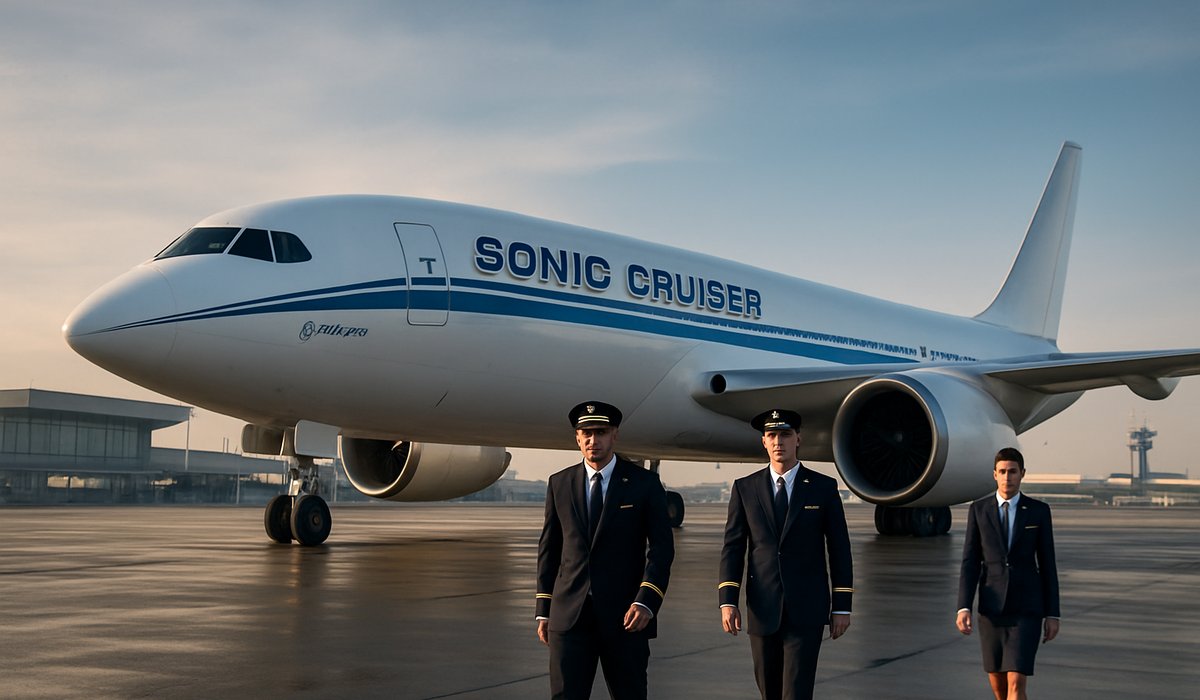
Image generated by AI
Boeing's Sonic Cruiser: The Revolutionary Aircraft That Never Took Flight
How post-9/11 economics and fuel costs derailed aviation's boldest speed experiment
The Ambitious Vision That Couldn't Survive Market Reality
In 2001, Boeing unveiled one of commercial aviation's most audacious concepts: the Sonic Cruiser, an aircraft engineered to cruise at near-supersonic speeds while maintaining the passenger capacity of a conventional wide-body jet. The proposal represented a fundamental reimagining of long-haul air travel, promising to compress intercontinental flight times dramatically while sidestepping the regulatory and technical complexities that have plagued supersonic aviation for decades.
Yet despite its engineering sophistication and potential to revolutionize global connectivity, the Sonic Cruiser never carried a single commercial passenger. The aircraft's collapse from drawing board to cancellation reveals how swiftly geopolitical shocks, rising jet fuel prices, and shifting airline economics can derail even the most transformative aviation innovations.
Why Airlines Rejected Speed for Efficiency
The Sonic Cruiser's downfall began almost immediately after its announcement. The September 2001 terrorist attacks triggered a severe contraction in airline revenue and fundamentally altered industry priorities. Rather than investing in speed-focused aircraft, carriers faced immediate pressure to reduce operating costs and maximize fuel efficiency—the opposite of what the Sonic Cruiser offered.
As jet fuel prices climbed throughout the 2000s, the economic case for a fuel-intensive, speed-optimized aircraft deteriorated further. Airlines realized that reducing operating expenses per seat—not shaving hours off flight times—would determine long-term profitability in an increasingly cost-conscious market.
The 787 Dreamliner: Boeing's Practical Alternative
Boeing redirected its resources toward a fundamentally different solution: the Boeing 787 Dreamliner. Rather than pursuing speed, the 787 emphasized fuel efficiency, advanced materials, and improved passenger comfort on existing flight routes. Airlines could operate the 787 economically on long-haul routes while maintaining competitive flight times.
The market spoke decisively. Airlines ordered hundreds of 787s, while the Sonic Cruiser accumulated zero firm orders. By 2002, less than a year after its announcement, Boeing abandoned the program entirely.
The Broader Lesson for Aviation Innovation
The Sonic Cruiser's failure illustrates a critical principle in commercial aviation: operational economics consistently trump technological ambition. While aerospace engineers can design near-supersonic aircraft, the aviation industry ultimately serves profit-driven airlines operating within finite fuel budgets.
The 787's success vindicated Boeing's pivot toward efficiency over speed, establishing the template for modern wide-body development and proving that sustainable innovation requires alignment with market fundamentals.
FAQ: Understanding Aviation's Speed vs. Efficiency Dilemma
What was the Sonic Cruiser designed to do? Boeing's Sonic Cruiser was conceived to cruise at near-sonic speeds (approximately 0.98 Mach) while carrying standard wide-body passenger loads, reducing long-haul flight times significantly compared to conventional aircraft.
Why did airlines reject the Sonic Cruiser concept? The 2001 terrorist attacks created immediate financial pressure on carriers, while rising jet fuel prices made fuel-intensive aircraft economically unviable. Airlines prioritized cost reduction over speed improvements.
How does the 787 Dreamliner differ from the Sonic Cruiser? The 787 focuses on fuel efficiency, advanced composite materials, and passenger comfort rather than speed. It achieves competitive flight times while consuming substantially less fuel, making it economically attractive to operators.
Could supersonic commercial aviation succeed today? Modern supersonic projects (Boom, Aerion) face similar economic hurdles as the Sonic Cruiser: high fuel consumption, limited market demand, and regulatory uncertainty regarding environmental impact and noise restrictions.
What does the Sonic Cruiser's cancellation reveal about aviation innovation? The project demonstrates that technological feasibility alone cannot guarantee commercial viability in aviation. Market economics, fuel costs, and airline priorities ultimately determine which aircraft concepts reach production.
Related Travel Guides
Flight Delay Compensation Guide 2026
Understanding Airline Route Changes
Airport Security Process Updated (2026)
External Resources
Disclaimer
This article is for informational and educational purposes only. It does not constitute legal, financial, or professional advice. While we strive to provide accurate and up-to-date information, travel policies, regulations, and conditions change rapidly. Always verify information with official sources before making travel decisions. Nomad Lawyer makes no representations about the accuracy, reliability, completeness, or suitability of the information provided. Readers should consult qualified professionals for advice specific to their circumstances. The views expressed in this article are those of the author and do not necessarily reflect the views of Nomad Lawyer.
Raushan Kumar
Founder & Lead Developer
Full-stack developer with 11+ years of experience and a passionate traveller. Raushan built Nomad Lawyer from the ground up with a vision to create the best travel and law experience on the web.
Learn more about our team →