
Netherlands, Italy, Germany Lead Historic EU Entry-Exit System Rollout Across 1,700+ Schengen Border Crossings in 2026
The European Union has fully activated its biometric Entry-Exit System across Schengen's 1,700+ border crossings, replacing passport stamps with unified digital tracking for non-EU travellers.

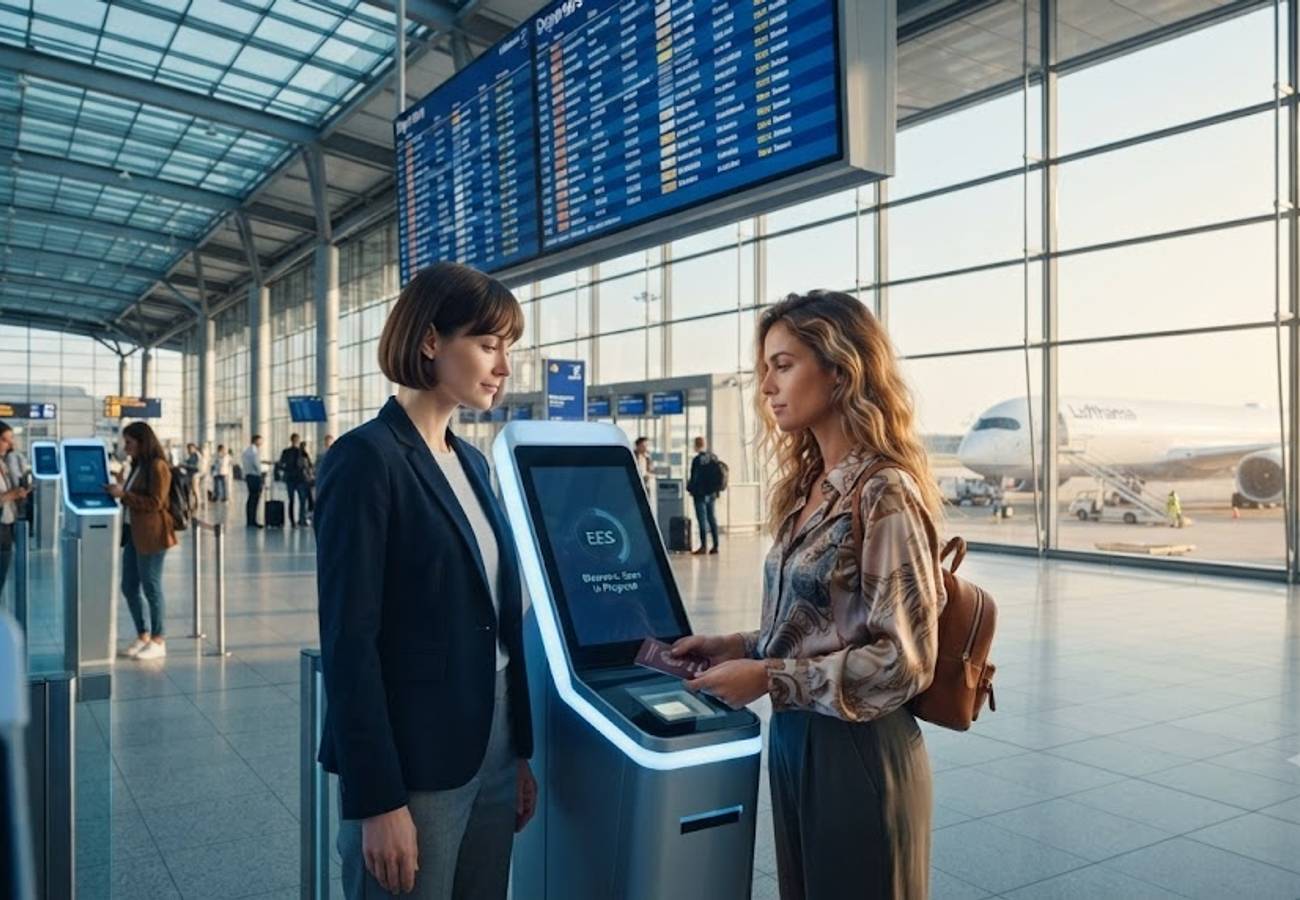
Image generated by AI
Europe's Most Dramatic Border Transformation Is Here—And It Affects Every Traveller Entering the Continent
The European Union has just flipped a historic switch. As of July 2026, the entire Schengen Area—spanning 29 countries including the Netherlands, Italy, Germany, Hungary, and more—has activated the Entry-Exit System (EES), a unified digital border framework that replaces manual passport stamping with biometric tracking across over 1,700 border crossing points.
This is not a small procedural update. This is the most significant transformation in modern global travel infrastructure, fundamentally reshaping how millions of visitors move through Europe's most visited travel region.
The Scale Is Staggering: 1,700+ Border Crossings Go Digital Overnight
Let that number sink in. 1,700 border crossing points—from the tarmac at Paris Charles de Gaulle to the Alpine crossings between Switzerland and Austria, from ferry terminals in the Mediterranean to high-speed rail hubs in Eastern Europe.
Every single one is now part of the same digital ecosystem.
Instead of a passport officer stamping your document and writing in pen, you now stand before a biometric kiosk. Your face is scanned. Your fingerprints are registered. Your data enters a centralised EU database that tracks your entry and exit across all Schengen member states in real time.
The system operates across all official entry and exit points: international airports, seaports, rail stations, and land border checkpoints. For the first time in Schengen history, a traveller's movement through Europe is genuinely unified—no fragmentation, no inconsistent records between nations.
Reddit: "Just got back from Amsterdam. The biometric gates were faster than expected, but knowing my fingerprints are now in an EU database is... different." — r/travel
Which 29 Countries Are Now Operating Under One Digital Border Network?
The rollout covers both EU and non-EU Schengen members:
EU Member States: Austria, Belgium, Bulgaria, Croatia, Czech Republic, Denmark, Estonia, Finland, France, Germany, Greece, Hungary, Italy, Latvia, Lithuania, Luxembourg, Malta, Netherlands, Poland, Portugal, Romania, Slovakia, Slovenia, Spain, Sweden.
Non-EU Associates: Iceland, Liechtenstein, Norway, Switzerland.
These 29 nations have surrendered individual border autonomy in exchange for a coordinated, data-driven travel management system. The Netherlands, Germany, Italy, and Hungary are playing outsized roles as geographic and logistical anchors. Amsterdam Schiphol, Frankfurt, Rome Fiumicino, and Budapest Ferenc Liszt handle colossal passenger volumes and serve as critical testing grounds for system stability.
How the Digital Border Actually Works: From Scanning to Real-Time Tracking
First-time entry triggers mandatory biometric registration:
Step 1: Facial scan and fingerprint capture at entry point
Step 2: Passport scanned; digital record created instantly
Step 3: System calculates permitted stay duration automatically
Step 4: Exit logged when departing any Schengen state
Step 5: Overstaying detected automatically across all member nations
Once your biometric profile is registered, subsequent entries become dramatically faster. The system recognizes you. Automated gates open. You move through in seconds.
This represents a seismic shift from the old model, where a Polish border guard's record-keeping had no real-time connection to an Italian immigration officer's database. Now, every entry, exit, and overstay is instantly visible to all 29 participating nations.
The Traveller Experience: Longer Initial Waits, But Lasting Convenience
The first weeks of rollout are chaotic. Peak airports—Paris, Rome, Madrid, Amsterdam—are experiencing significant queue delays as biometric systems process unprecedented volumes of simultaneous registrations.
Initial impact:
- First-time registrations can add 10-20 minutes to border crossing time
- Kiosks occasionally malfunction under heavy load
- Peak hours (8am-12pm, 4pm-8pm) show the worst congestion
Long-term benefits kick in quickly:
- Repeat travellers bypass registration entirely
- Automated facial recognition gates replace manned checkpoints
- Cross-border movement becomes measurably faster
- Document fraud becomes nearly impossible to execute
Airports across Europe are simultaneously rolling out infrastructure upgrades: automated biometric kiosks, self-service scanning terminals, and integrated border corridors designed to absorb peak volumes. Paris Orly, Frankfurt Hahn, and Barcelona El Prat have already commissioned new facilities.
Why the Netherlands, Germany, Italy, and Hungary Are Critical to System Success
These four nations form the operational backbone of EES implementation.
Netherlands: Amsterdam Schiphol is Europe's fourth-busiest airport and a major global aviation hub. The Dutch infrastructure must handle not just tourists bound for Amsterdam, but connecting passengers heading to every corner of Europe.
Germany: Frankfurt, Berlin, and Munich combined process roughly 200+ million passengers annually. Germany's extensive land borders with eight countries make it a mandatory proving ground for automated land-border integration.
Italy: Mediterranean tourism is non-negotiable. Rome, Milan, and Venice receive millions of cruise passengers and leisure travellers. Italian airports must demonstrate that high-volume leisure travel can coexist with robust security screening.
Hungary: As Eastern Europe's western gateway, Budapest connects Polish, Czech, and Romanian travel flows with Western Schengen corridors. Hungary's strategic position tests the system's ability to manage diverse geographic and linguistic contexts.
If these four nations can synchronize flawlessly, the entire 29-country network becomes resilient.
Country-by-Country Impact: How Europe Balances Security With Tourism Growth
Each participating nation contributes differently to the unified system:
France has digitized major Paris hubs and border crossings, prioritizing speed for leisure and business travel to the capital. Spain has upgraded Mediterranean entry points, essential for its 80+ million annual visitors. Italy has streamlined both air and cruise arrivals, critical for Venice and other port cities. Germany has automated high-speed rail borders, connecting European business corridors. Greece and Portugal have enhanced peak-season tourism control, managing summer influxes. Nordic states operate with minimal congestion, serving as efficiency benchmarks.
The common outcome: travel that is simultaneously more secure and (eventually) more convenient.
This is crucial: the Entry-Exit System is designed to enable tourism, not restrict it. The EU has explicitly framed EES as a "smart border" initiative that protects Schengen's open-travel philosophy while eliminating security vulnerabilities that plagued the old stamping system.
ETIAS Is Coming: The Next Phase of Europe's Digital Border Strategy
The Entry-Exit System is not the endpoint. It's the foundation.
In 2027-2028, the European Travel Information and Authorisation System (ETIAS) will go live, requiring visa-free travellers (including Americans, Australians, Canadians, and others) to obtain pre-travel digital authorization before boarding flights to Europe.
Think of ETIAS as a digital visa for the Schengen Area—similar to the U.S. ESTA system. ETIAS will complement EES by creating a fully digital pre-entry and post-entry travel ecosystem, where authorities know who is coming before they arrive and can track their movement throughout their stay.
Together, EES and ETIAS will constitute the most comprehensive, real-time travel tracking system ever deployed at continental scale.
Global Implications: Europe Sets the New Standard for Border Technology
No other region on Earth has attempted to implement a biometric border system of this scale, across this many countries, simultaneously.
The rollout signals a fundamental shift in global travel governance:
- Fully biometric mobility becomes the standard, not the exception
- Real-time travel data sharing across nations becomes normalized
- Digital tracking replaces paper documentation
- Tourism management becomes algorithmic and predictive
For global travellers, the message is clear: movement through Europe is entering a new era. It will be faster and more convenient for returning visitors. But it will also be more closely monitored than ever before.
For tourism boards, immigration authorities, and travel tech companies watching from outside Europe, the Entry-Exit System is a blueprint. Australia, Canada, and the United States are already studying this model for their own border infrastructure.
The Bottom Line: Europe Has Entered the Age of Smart Borders
The Netherlands, Italy, Germany, Hungary, and 25 other Schengen nations have collectively made a bet: that unified, digital, biometric-controlled borders can simultaneously enhance security, improve tourism management, and streamline travel experience.
The first weeks of operation confirm both the promise and the pain. Peak airports are experiencing real congestion. But repeat travellers already report measurably faster border crossings.
By autumn 2026, the system will have processed hundreds of millions of transactions. By 2027, it will be the operational standard that travellers simply accept as the cost of European mobility.
The age of the passport stamp is officially over.
The future of European travel just went live—and it's watching you.
Related Travel Guides
Disclaimer
This article is for informational and educational purposes only. It does not constitute legal, financial, or professional advice. While we strive to provide accurate and up-to-date information, travel policies, regulations, and conditions change rapidly. Always verify information with official sources before making travel decisions. Nomad Lawyer makes no representations about the accuracy, reliability, completeness, or suitability of the information provided. Readers should consult qualified professionals for advice specific to their circumstances. The views expressed in this article are those of the author and do not necessarily reflect the views of Nomad Lawyer.
Raushan Kumar
Founder & Lead Developer
Full-stack developer with 11+ years of experience and a passionate traveller. Raushan built Nomad Lawyer from the ground up with a vision to create the best travel and law experience on the web.
Learn more about our team →