
NASA, Boom Supersonic, and Major Airlines Accelerate 2030 Mach 1.7 Rollout to Help Premium Passengers Bypass Global Travel Chaos: Latest Airline News
As chronic airport disruptions plague standard long-haul flights, NASA and global airlines race toward a 2030 supersonic rollout to offer a high-speed escape from travel chaos.

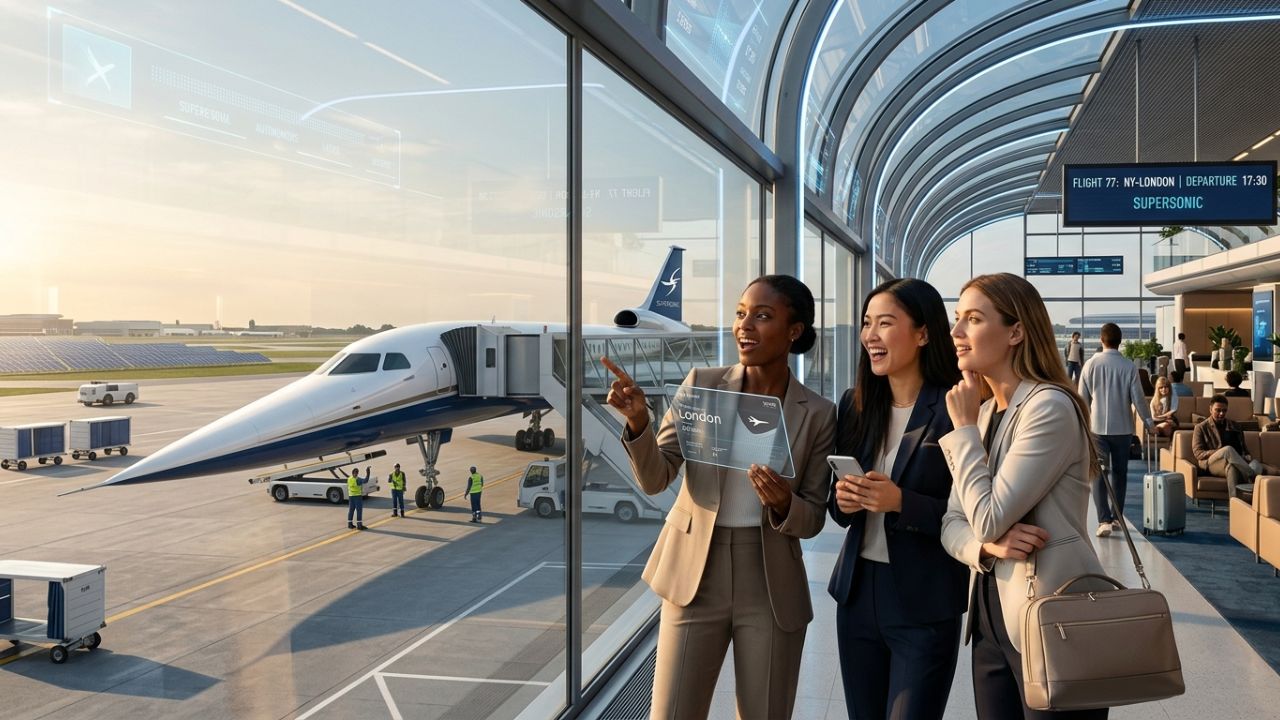
Image generated by AI
In a massive technological pivot designed to permanently alter the economics of intercontinental transit and offer high-yield passengers a definitive escape from chronic travel chaos, a powerful consortium of aerospace giants and legacy carriers is aggressively accelerating the return of supersonic passenger flights. Reported on June 19, 2026, NASA, Lockheed Martin, and Boom Supersonic have officially joined forces with top-tier airlines—including British Airways, Air France, Lufthansa, Emirates, Singapore Airlines, and Japan Airlines—to lead the Mach supersonic passenger race toward a definitive 2030 commercial rollout. As legacy subsonic networks continue to buckle under extreme airspace congestion, triggering rolling airport disruptions and unpredictable flight cancellations, this massive push toward ultra-fast, long-haul travel represents a fundamental shift in global mobility. By successfully overcoming the historic sonic boom barrier and drastically compressing transit times, the impending supersonic era is actively dominating today's most crucial headline in breaking airline news and essential global aviation updates.
By introducing direct passenger coordination and dynamic scheduling backups, the regional aviation hubs target growing passenger demand across vital commerce sectors. The choice to coordinate flight departures in phases helps to manage gate capacity, supporting the country's broader regional transportation network.
Context: Escaping the Subsonic Bottleneck
For the global tourism and aviation industry, the intense, highly organized race to commercialize supersonic travel by 2030 is heavily driven by the increasing failure of standard subsonic networks to provide reliable, stress-free premium travel.
Historically, the aviation market focused entirely on increasing aircraft capacity to squeeze more passengers into crowded skies, inevitably leading to severe terminal gridlock. However, a major paradigm shift is underway. Almost all major airlines are entering the supersonic market to gain a critical early-mover advantage because premium corporate travelers are demanding time compression. When a business executive is forced to endure a grueling 8-hour transatlantic flight that is highly susceptible to sudden airport disruptions and weather-induced flight cancellations, their productivity plummets. The supersonic initiative completely bypasses this exhaustion. By focusing purely on speed rather than mass capacity, carriers aim to eliminate the paralyzing delays of standard intercontinental travel, offering a highly exclusive, time-saving travel model that completely reorganizes international route economics and fundamentally shields premium passengers from standard transit friction.
To view live flight schedules, verify the active delay status of your specific long-haul itinerary, or to track future supersonic route availability, travelers must consult official aviation directories. For direct updates regarding how this massive technological shift will impact future flight cancellations out of major hubs like London, New York, and Dubai, travelers should aggressively utilize the official portals of Boom Supersonic's partner airlines. To explore live flight tracking and monitor the exact severity of the cascading bottlenecks currently plaguing subsonic transatlantic routes, passengers can consult the official FlightAware tracking service.
Section-Wise Breakdown: The Supersonic Consortium
The NASA X-59 QueSST Breakthrough
Making commercial supersonic travel legally and socially possible again hinges entirely on the NASA X-59 project. Developed under the QueSST (Quiet Supersonic Technology) program in direct partnership with Lockheed Martin, this highly advanced aircraft is actively solving the massive sonic boom barrier that killed the Concorde. Because loud sonic booms triggered strict regulatory bans on overland supersonic flights, the X-59 is specifically designed to reduce the explosive sound to a mere “low-thump.” This ongoing testing is heavily focused on proving the absolute safety of supersonic flight over land, a crucial regulatory hurdle for commercialization.
Boom Supersonic’s Overture Aircraft
Boom Supersonic is aggressively leading the private-sector development with its highly anticipated flagship aircraft, the Overture. Engineered for the 2030 commercial rollout, the Overture is designed to cruise at an astonishing Mach 1.7. Featuring a highly exclusive passenger capacity of just 64–80 seats, the aircraft targets the most lucrative business corridors, such as completing the New York to London route in approximately 3.5 hours. With estimated ticket prices ranging from $4,000 to $5,000, the Overture specifically targets the premium business traveler, actively reinstating supersonic travel with vastly improved fuel efficiency compared to Concorde-era aircraft.
The Airline Integration Strategy
The global airline industry is actively reorganizing its future route maps to accommodate this massive technological leap. Partner carriers like Japan Airlines, Emirates, and British Airways recognize that supersonic aircraft will not replace traditional aviation for the masses; instead, it will birth an entirely new ultra-premium travel class. Expected high-demand routes include Los Angeles–Tokyo, Dubai–Singapore, Paris–New York, and Singapore–Sydney. By incorporating the Overture into their premium fleet segments, airlines will fiercely compete on speed, effectively transitioning from a “trip length economy” to a speed-based global travel model.
Technical Roster: Supersonic Aviation Development Data
To ensure absolute factual accuracy regarding the specific aircraft specifications, the targeted commercial rollout, and the corporate partners driving this massive aviation shift, the following matrix details the verified development data:
Supersonic Passenger Aviation Development Matrix
| Metric / Parameter | Verified Development Data |
|---|---|
| Target Commercial Rollout | 2030 |
| Lead Private Manufacturer | Boom Supersonic (Overture Aircraft) |
| Lead Research Partners | NASA & Lockheed Martin (X-59 QueSST Program) |
| Key Airline Partners | British Airways, Air France, Lufthansa, Emirates, Singapore Airlines, Japan Airlines |
| Overture Speed / Capacity | Mach 1.7 / 64–80 Seats |
| Target Transatlantic Time | ~3.5 Hours (New York to London) |
| Estimated Ticket Price | $4,000–$5,000 |
Data strictly reflects the verified specifications of the ongoing supersonic development race, highlighting the Mach 1.7 Overture aircraft and the critical involvement of NASA's quiet supersonic testing.
Passenger Impact: The Rise of Ultra-Premium Time Compression
For the high-net-worth individuals and corporate executives who frequently navigate the globe, the rapid commercialization of supersonic passenger aircraft provides a massive, highly anticipated escape from standard travel chaos.
The primary passenger impact of the 2030 supersonic rollout is the total structural change in how international business is conducted. Currently, transatlantic and transpacific journeys consume entire business days, forcing travelers to navigate massively congested mega-hubs where the risk of flight cancellations and severe airport disruptions is constant. By reducing long-haul flight times by over 50%, supersonic travel effectively eliminates "lost days" in transit. European travelers will be able to fly to the US in under 4 hours, making a same-day intercontinental business trip highly feasible. This ultra-fast travel model insulates the passenger from the exhaustion of standard layovers, allowing them to rapidly bypass the operational friction that routinely paralyzes subsonic airline networks.
Industry Analysis: Overcoming Supersonic Roadblocks
Aviation and aerospace analysts view the intense, coordinated effort between NASA, Boom Supersonic, and global legacy carriers as definitive proof that the premium aviation market is officially pivoting away from massive capacity growth in favor of extreme time compression.
However, analysts note that while the propulsion for supersonic travel is immense, massive, highly complex challenges remain. Because supersonic aircraft require significantly more energy, airlines face terrifying fuel cost calculations. Furthermore, despite NASA's groundbreaking X-59 quiet technology, securing overland sonic boom certifications from the FAA and international regulators remains a highly time-consuming, politically charged process. Environmental concerns regarding carbon outputs are also heavily scrutinized. To succeed, airlines must strictly confine supersonic aircraft to high-yield premium routes—like New York to London—where corporate clients willingly pay $5,000 tickets to secure the absolute highest value of their time, leaving the masses on heavily disrupted subsonic flights.
Actionable Advice for Navigating Premium Aviation Shifts
While standard commercial supersonic flights will not launch until 2030, you must execute this strategic checklist today to actively prepare for how this massive shift will alter premium travel and current subsonic routing:
- Anticipate Subsonic Route Dilution: As major legacy carriers like British Airways and Lufthansa begin to focus heavily on integrating supersonic operations for their highest-paying corporate clients, expect a slow degradation in the quality of standard subsonic business class. Airlines will eventually strip premium amenities from slower flights to incentivize upgrades to the supersonic tier.
- Monitor Hub Reorganizations: Supersonic aircraft like the Overture will require highly specialized boarding protocols and potentially isolated terminal gates. Actively monitor major hubs like New York (JFK), London Heathrow (LHR), and Dubai (DXB) for massive infrastructural construction projects, which routinely trigger localized airport disruptions and security delays for all passengers.
- Understand the Time vs. Money Calculus: When supersonic flights launch, tickets will easily exceed $4,000. If you are a leisure traveler, standard subsonic aviation will remain your primary option. To protect yourself from travel chaos on standard flights, you must aggressively continue to utilize robust travel insurance, monitor live connection buffers, and refuse to book layovers under two hours, as airlines will prioritize recovering delayed supersonic VIPs over standard economy passengers.
FAQ: The 2030 Return of Supersonic Passenger Flights
When will commercial supersonic passenger flights actually return?
Led by Boom Supersonic and supported by NASA testing, the aviation industry is aggressively targeting a limited commercial rollout of the Mach 1.7 Overture aircraft around 2030.
How much will a supersonic passenger ticket cost?
Initial economic models project that a supersonic ticket (such as the 3.5-hour New York to London route) will cost between $4,000 and $5,000, aligning strictly with premium business-class pricing.
Will supersonic jets replace standard passenger airlines?
Absolutely not. Supersonic travel will be a highly exclusive, low-capacity (64–80 seats) service specifically targeting premium business routes, while the vast majority of passengers will continue to utilize standard subsonic airlines.
The Reality of Escaping Subsonic Gridlock
The massive, highly coordinated push by NASA, Boom Supersonic, and legacy airlines to reinstate supersonic passenger travel proves definitively that the premium aviation sector is desperate to escape the severe congestion of the modern subsonic network. By investing heavily in Mach 1.7 technology to drastically reduce flight times, the industry is creating an ultra-exclusive bypass for high-net-worth travelers who refuse to tolerate sudden flight cancellations and chronic travel chaos. Yet, as the world eagerly anticipates the 2030 rollout of the Overture aircraft, the average passenger must accept a critical reality: standard intercontinental travel will remain highly congested. Securing a reliable journey for the masses will still require aggressive itinerary monitoring, a deep understanding of operational bottlenecks, and the tactical awareness to navigate standard airport disruptions while the ultra-wealthy simply fly over them.
Key Takeaways
- Target 2030 Rollout: Boom Supersonic is leading the private sector race to launch the Mach 1.7 Overture commercial passenger aircraft by 2030.
- NASA’s Quiet Technology: The NASA X-59 QueSST program, developed with Lockheed Martin, is actively testing "low-thump" technology to overcome strict overland sonic boom bans.
- Massive Airline Backing: Legacy carriers including British Airways, Lufthansa, Emirates, Air France, Singapore Airlines, and Japan Airlines are actively partnering to secure early supersonic access.
- Extreme Time Compression: The Overture aims to slash transatlantic travel times by 50%, completing the highly lucrative New York to London route in approximately 3.5 hours.
- Premium Market Focus: With just 64–80 seats and estimated $5,000 ticket prices, supersonic flight will not replace mass transit but will serve as an ultra-premium escape from standard travel chaos.
Related Travel Guides
Massive Travel Chaos Paralyzes Chicago O'Hare with 1,425 Disruptions
Disclaimer
This article is for informational and educational purposes only. It does not constitute legal, financial, or professional advice. While we strive to provide accurate and up-to-date information, travel policies, regulations, and conditions change rapidly. Always verify information with official sources before making travel decisions. Nomad Lawyer makes no representations about the accuracy, reliability, completeness, or suitability of the information provided. Readers should consult qualified professionals for advice specific to their circumstances. The views expressed in this article are those of the author and do not necessarily reflect the views of Nomad Lawyer.
Kunal K Choudhary
Co-Founder & Contributor
A passionate traveller and tech enthusiast. Kunal contributes to the vision and growth of Nomad Lawyer, bringing fresh perspectives and driving the community forward.
Learn more about our team →