
Mumbai-Ahmedabad Bullet Train Deploys Revolutionary Tunnel Hoods Across 8 Mountain Passages to Eliminate High-Speed Pressure Waves
India's flagship bullet train corridor introduces first-ever tunnel hood system across eight mountain tunnels, revolutionizing passenger comfort and infrastructure safety through advanced aerodynamic engineering.

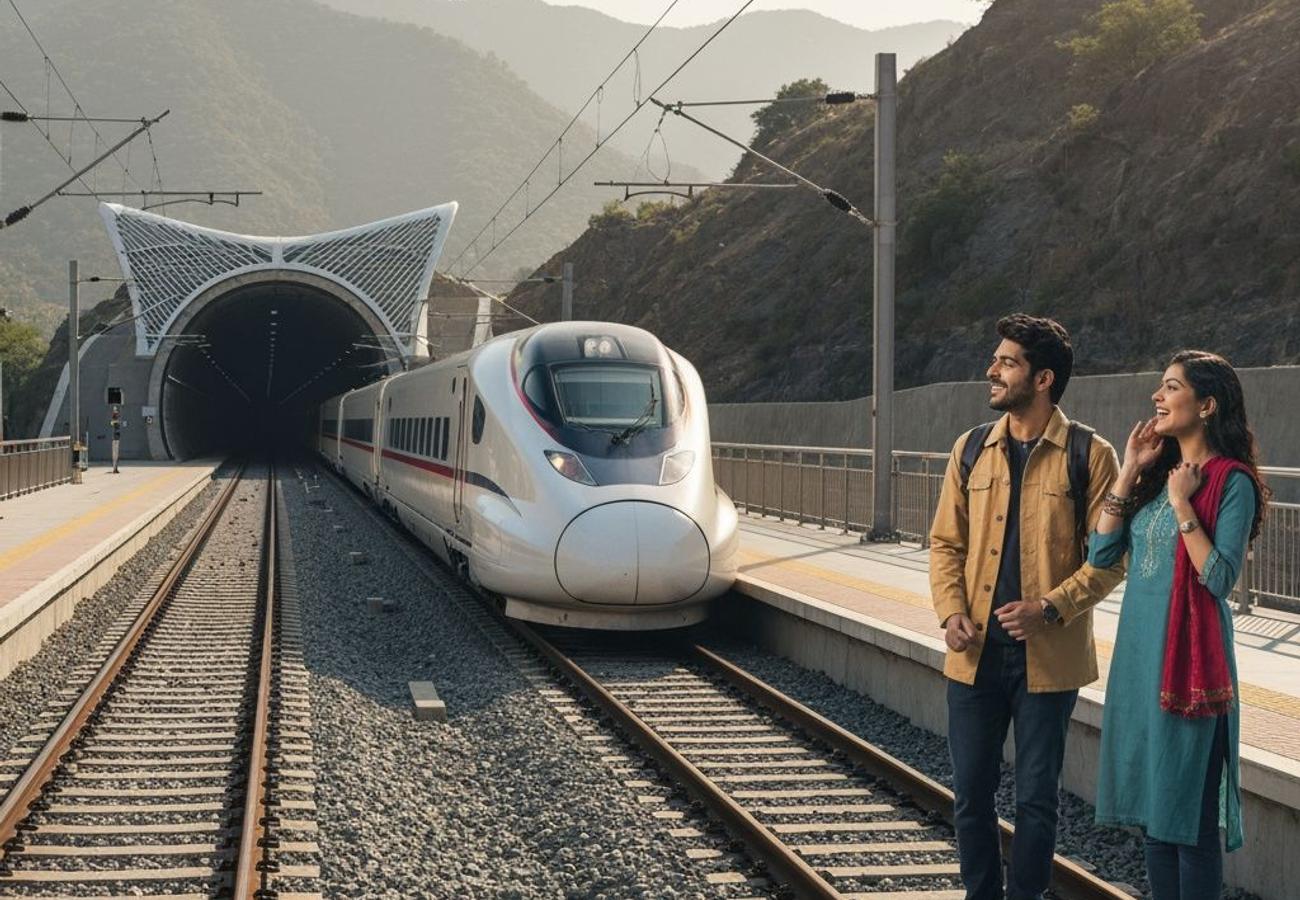
Image generated by AI
India's Bullet Train Gets a Game-Changing Engineering Upgrade
India's race to world-class railway infrastructure just hit a major milestone. The National High Speed Rail Corporation Limited (NHSRCL) has confirmed that the Mumbai–Ahmedabad bullet train corridor will feature tunnel hoods across eight mountain tunnels—a first for India's railway network. Seven installations span Maharashtra's rugged terrain, while one covers Gujarat's transition zone. What sounds like technical jargon is actually a breakthrough that transforms how passengers experience high-speed rail travel.
Reddit: "This is the kind of infrastructure investment India needs. Making trains safer AND more comfortable? That's next-level thinking." — r/IndiaTravel
The question most travelers ask: what exactly do tunnel hoods do? And why should anyone care?
The Physics Behind the Innovation
When a bullet train hurtling at extreme speeds approaches a tunnel, something dramatic happens in physics. The air in front of the train compresses suddenly and violently, creating what engineers call a pressure wave. This isn't just noise—it's a jolt of sudden air compression that affects both passengers and train infrastructure.
Tunnel hoods are aerodynamic structures installed at tunnel entrances and exits. They work like shock absorbers for the air itself, gradually regulating airflow instead of allowing sudden compression. Think of it as the difference between slamming a door and closing it gently. The system stabilizes the pressure transition without requiring any moving mechanical parts—just brilliant structural design.
This engineering approach mirrors what Japan's Shinkansen bullet trains pioneered decades ago. China and Europe have since refined these systems. Now India joins this elite circle of nations mastering high-speed rail aerodynamics.
What This Means for Passengers
Here's where it gets real for travelers. Without tunnel hoods, passengers experience ear pressure changes similar to airplane cabin pressure shifts. Add vibration, noise, and sudden jostling, and you've got an uncomfortable ride—especially across the eight mountain tunnels on this corridor.
With tunnel hoods installed, several benefits emerge:
Reduced pressure fluctuations mean fewer passengers experiencing ear discomfort. Noise levels drop considerably in tunnel sections, creating a quieter cabin environment. Vibration stress decreases, making the journey smoother. Most importantly, trains maintain consistent speed during tunnel transitions without unnecessary braking, improving punctuality and operational flow.
For long-distance travel on a bullet train, these comfort improvements stack up. The journey becomes genuinely pleasant rather than merely tolerable.
Infrastructure Durability and Long-Term Safety
Beyond passenger comfort, tunnel hoods strengthen the actual railway infrastructure. Repeated pressure shock cycles fatigue tunnel structures over years of operation. By controlling these waves, tunnel hoods reduce structural stress and extend tunnel lifespan significantly.
This translates to lower maintenance costs and predictable operational planning for railway operators. Infrastructure remains stable across varying terrain conditions. Signaling systems operate more reliably in enclosed zones. The corridor achieves what engineers call uniform performance across complex geography—a critical advantage in mountainous terrain where conditions change rapidly.
Safety officials have confirmed that tunnel hoods reduce tunnel pressure shock intensity while supporting stable train movement at high speeds. This isn't cosmetic engineering—it's structural reinforcement through intelligent design.
How India Aligns with Global Standards
The Mumbai–Ahmedabad corridor's adoption of tunnel hood technology signals India's commitment to matching international railway benchmarks. Europe's high-speed networks perfected aerodynamic tunnel entry designs for smooth transitions. Japan's bullet trains minimized pressure disturbances through similar innovations. China built the world's largest network of such systems.
Now India isn't copying—it's adapting. Engineers designed these tunnel hoods specifically for India's terrain diversity and climate conditions. The implementation accounts for mountainous passages, transition zones, and varying atmospheric pressures across states.
This adaptation matters. Global engineering solutions don't automatically work in India's context. The NHSRCL's approach demonstrates sophisticated localization of advanced technology.
Operational Efficiency Gains
Speed isn't the only metric that matters. Operational efficiency determines whether a bullet train project truly succeeds commercially.
Tunnel hoods reduce air resistance during high-speed tunnel entry. This means trains maintain higher speeds with fewer interruptions. Energy loss from sudden air compression decreases noticeably, making acceleration and deceleration cycles more efficient. The result? Better punctuality, reduced delays, and improved reliability—the metrics that build passenger confidence.
Railways operate on razor-thin margins. Every efficiency gain compounds across thousands of journeys annually. Over a decade, smoother aerodynamic transitions add up to significant fuel savings and maintenance cost reductions.
The Bigger Picture for India's Rail Expansion
This tunnel hood installation isn't isolated engineering. It establishes a proven model for future high-speed corridors India is planning. As the country develops additional bullet train routes—Delhi-Varanasi, Chennai-Bangalore, and others in proposal stages—these eight tunnel hoods become a template.
The technology demonstrates India's capacity to execute complex, precision-driven railway engineering. It signals to global investors that India can deliver world-class infrastructure. Most importantly, it proves that high-speed rail in India isn't just faster transportation—it's engineered for comfort, safety, and operational excellence.
Passengers boarding the Mumbai–Ahmedabad bullet train when it opens won't see these tunnel hoods. They'll simply notice they feel better during the journey. They'll experience the pressure waves they never knew existed, now elegantly eliminated.
That's the mark of truly excellent engineering: invisible, but transformative.
India's railway revolution quietly achieves what seemed impossible just years ago—marrying cutting-edge technology with passenger-centric design.
Related Travel Guides
Disclaimer
This article is for informational and educational purposes only. It does not constitute legal, financial, or professional advice. While we strive to provide accurate and up-to-date information, travel policies, regulations, and conditions change rapidly. Always verify information with official sources before making travel decisions. Nomad Lawyer makes no representations about the accuracy, reliability, completeness, or suitability of the information provided. Readers should consult qualified professionals for advice specific to their circumstances. The views expressed in this article are those of the author and do not necessarily reflect the views of Nomad Lawyer.
Preeti Gunjan
Contributor & Community Manager
A passionate traveller and community builder. Preeti helps grow the Nomad Lawyer community, fostering engagement and bringing the reader experience to life.
Learn more about our team →