
Modular Runway Lighting Unlocks Evening Flights Across Island Archipelagos
Zero-trenching modular airfield lighting ends daytime flight curfews in Siargao, Lakshadweep, and Maldives, cutting airfares by up to 25% and expanding tourism.

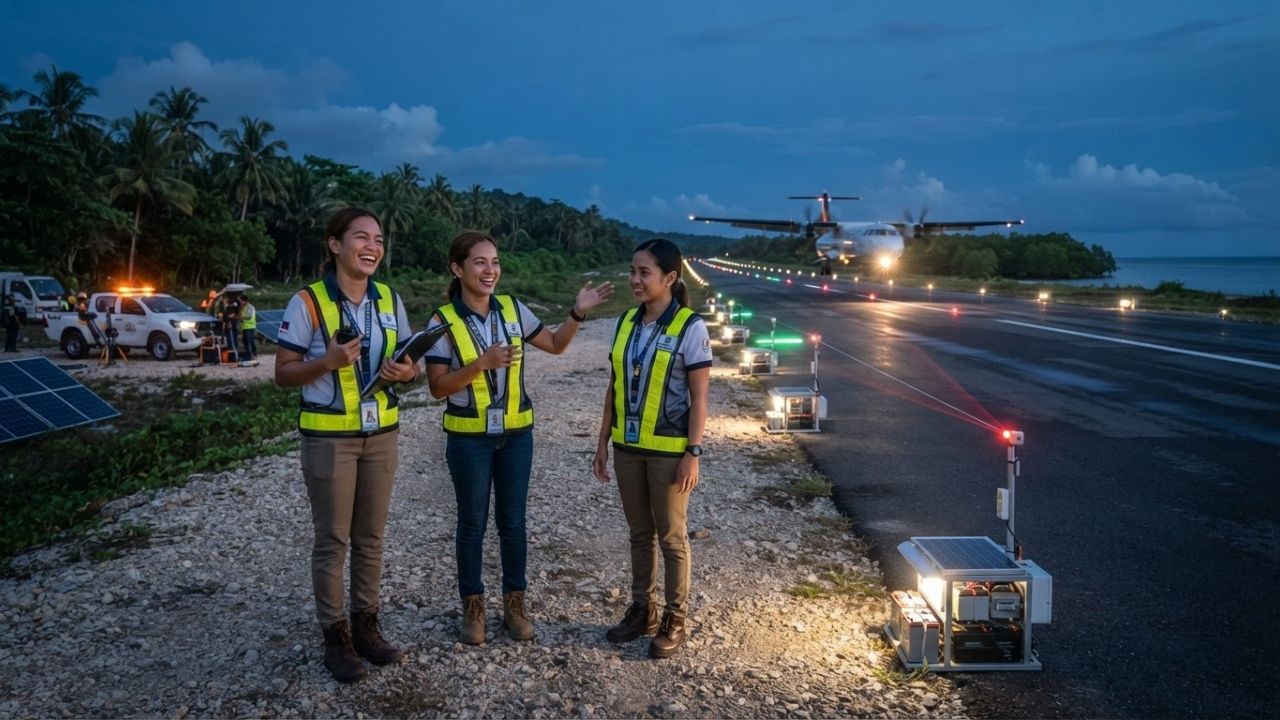
Image generated by AI
By eliminating multi-million-dollar civil trenching and ending rigid sunset curfews, zero-earthwork portable runway lighting is transforming tropical archipelagos—boosting regional airline fleet productivity by 37.5% and saving travelers an entire lost day of transit hotel stays.
The Local Trend: Dismantling the Daylight Aviation Curfew
Across secondary island destinations in the Asia-Pacific and tropical archipelagos worldwide, commercial air travel has long been restricted by daylight-only operations. Lacking certified Airfield Ground Lighting (AGL) or illuminated visual descent aids, island airstrips operate strictly between 06:00 and 17:30. This creates an acute operational bottleneck between 10:00 and 15:00 as regional flights compress into a seven-hour midday window.
This midday stampede triggers cascading congestion across major international transit hubs—including Manila’s Ninoy Aquino International (NAIA), Jakarta’s Soekarno-Hatta (CGK), and Bengaluru’s Kempegowda (BLR)—where returning turboprops compete with international widebody departures for runway slots. Deployable, solar-charged Portable Airfield Ground Lighting (P-AGL) provides an immediate technological solution, extending airport watch hours to 21:00 without requiring disruptive concrete ducting or coral reef excavation.
Traditional Hard-Wired AGL vs. Deployable Modular Airfield Systems
| Engineering Parameter | Traditional Hard-Wired AGL | Portable Modular AGL (P-AGL) | Operational Advantage |
|---|---|---|---|
| Capital Expenditure | ~PHP 400M (~USD 7.1M) per strip | Fraction of civil works cost | Over 80% reduction in capital layout |
| Installation Footprint | Deep trenching & concrete ducting | Surface baseplate / frangible mount | Zero soil excavation or groundwater harm |
| Environmental Impact | High risk of coral & wetland damage | Zero ecological disturbance | Preserves fragile island micro-ecosystems |
| Implementation Window | 18 to 36 Months | 2 to 4 Weeks (Ready in 30 mins) | Immediate regulatory night-rating clearance |
| Power Infrastructure | High-voltage cabling & diesel gensets | Off-grid solar & LiFePO4 batteries | Zero fossil fuel consumption & grid independence |
Technical Architecture: Optical Precision and RF Mesh Automation
Modern portable runway systems comply rigorously with International Civil Aviation Organization (ICAO) Annex 14 standards and Federal Aviation Administration (FAA AC 150/5345-46D / L-861) specifications:
- High-Intensity Optical Output: LED engines deliver up to 800 candelas (cd) of bidirectional white/yellow runway edge lighting and 320 cd of red/green threshold lighting, providing clear visibility exceeding 3 nautical miles under visual meteorological conditions (VMC).
- Wireless RF Mesh Control: Airfield arrays operate via secure wireless radio frequency (RF) mesh networks on 868 MHz, 2.4 GHz, or 433 MHz industrial bands. Controlled directly from an ATC tower dashboard or handheld unit, signals propagate reliably over 1.5 kilometers, with air-to-ground VHF radio activation permitting inbound pilots to trigger landing lights directly from the cockpit.
- Battery Endurance and Durability: Integrated Lithium Iron Phosphate (LiFePO4) or deep-cycle batteries deliver between 40 and 180 hours of continuous illumination. Polycarbonate enclosures feature IP67 waterproof ingress protection, IK10 impact resistance, and aerodynamic stabilization capable of withstanding jet blast velocities exceeding 240 km/h.
Airline Fleet Economics: Unlocking the Evening Flight Rotation
For regional airlines operating aircraft like the ATR 72-600 and Dash 8-400, extending operating watch hours past sunset transforms route profitability:
- Elevating Aircraft Utilization: Daily fleet productivity climbs from 7.5–8.0 block hours up to 11.0–11.5 block hours, representing a 37.5% increase in capital asset utilization.
- Expanding Seat Inventory and Lowering Fares: Adding an evening turnaround flight expands weekly seat capacity by roughly 40% (scaling from ~2,800 to ~3,920 seats per route), compressing peak ticket prices by 15% to 25% through dynamic fare availability.
- Eliminating Forced Transit Layovers: Arriving international passengers can connect seamlessly to evening island flights departing between 17:30 and 19:00, landing at island resorts for dinner instead of paying for an unnecessary overnight airport hotel in Manila or Jakarta.
Case Studies: Asian Island Airports Overcoming Topographical Hurdles
Island gateways across Asia are pioneering modular and visual night-rating solutions to expand connectivity within ecologically sensitive borders:
- Sayak Airport (Siargao Island, Philippines): Flanked by protected mangrove wetlands within the Siargao Islands Protected Reserve (SIPLAS) on one flank and steep rolling hills on the other, physical runway expansion faced environmental hurdles. In the Official Gazette FY 2026 Volume 1-B, the Department of Budget and Management (DBM) allocated PHP 23,000,000 under CAAP Central Office funds for Siargao night-rating. Deployable LED edge and threshold lights eliminate the airport’s former 16:00 curfew, unlocking evening flights to Cebu and Manila.
- Godofredo P. Ramos Airport (Caticlan / Boracay, Philippines): Following CAAP's phased night certification in 2017 with Precision Approach Path Indicators (PAPI) and visual slope aids, Caticlan unlocked evening rotation banks that revolutionized tourist access to Boracay.
- Agatti Airport (Lakshadweep Archipelago, India): Occupying a narrow 1,204-meter coral atoll strip surrounded by the Indian Ocean, physical expansion was restricted by living reefs. The Airports Authority of India (AAI) installed Abbreviated PAPI (APAPI) on Runway 04/22 on a trial basis with the Indian Navy and DGCA, securing 24/7 medical evacuation readiness and evening feeder flights from Kochi.
- Komodo Airport (Labuan Bajo, Flores, Indonesia): Surrounded by volcanic ridges, the Indonesian Ministry of Transportation deployed Category I precision lighting, extending watch hours to 20:00 and allowing Garuda Indonesia and Batik Air to operate evening rotations from Bali and Jakarta.
- Samui Airport (Koh Samui, Thailand): Bangkok Airways’ private eco-boutique airport deployed directional LED threshold lighting that eliminates light trespass into adjacent eco-resorts, enabling operations until a municipal 22:00 environmental curfew.
- Maldives Domestic Atoll Airstrips: At Baa Atoll (Dharavandhoo) and South Ari Atoll (Maamigili), off-grid solar airfield lighting systems compliant with ICAO Annex 14 prevent trenching into fragile coral sands, protecting freshwater aquifers while connecting late-evening long-haul arrivals from Malé.
Destination Specialist Local Insider Tips
Travelers planning vacations across tropical archipelagos can optimize their travel logistics with these expert strategies:
- Book Sunset Flights for Smooth Same-Day Island Transfers: Take advantage of newly scheduled evening flights departing Manila, Cebu, or Jakarta between 17:30 and 19:00 to eliminate costly gateway hotel layovers and arrive at your island retreat on Day 1.
- Take Advantage of Full-Weekend Micro-Breaks: Utilize Friday evening departures (18:30) and Sunday evening returns (20:30) to secure a full 48-hour tropical surf or diving holiday in Siargao or Boracay without taking annual leave days.
- Pack Reef-Safe Mineral Sunscreen in Checked Luggage: In sensitive marine destinations like Siargao and Lakshadweep, local environmental ordinances prohibit non-biodegradable cosmetics; carry certified zinc-based sunblocks that protect living coral beds.
- Verify Inter-Island Baggage Allowances on Evening Turboprops: Regional turboprop aircraft operating into short-strip island destinations enforce strict 10 kg to 20 kg checked baggage limits; pre-purchase extra baggage weight online to avoid gate repacking fees.
- Support Indigenous Coastal Communities Through Farm-to-Table Dining: When dining in Siargao or Labuan Bajo, patronize locally owned eateries serving freshly caught yellowfin tuna, mud crabs, and local tropical produce to ensure tourism spending circulates directly into island fishing villages.
Future Outlook
Modular, solar-powered airfield ground lighting represents a sustainable leap forward for island aviation. By decoupling night flight capabilities from invasive, carbon-intensive earthworks, civil aviation authorities are protecting delicate coastal ecosystems while establishing resilient, around-the-clock air connectivity across the world’s most beautiful island archipelagos.
Related Travel Guides
Disclaimer
This article is for informational and educational purposes only. It does not constitute legal, financial, or professional advice. While we strive to provide accurate and up-to-date information, travel policies, regulations, and conditions change rapidly. Always verify information with official sources before making travel decisions. Nomad Lawyer makes no representations about the accuracy, reliability, completeness, or suitability of the information provided. Readers should consult qualified professionals for advice specific to their circumstances. The views expressed in this article are those of the author and do not necessarily reflect the views of Nomad Lawyer.
Kunal K Choudhary
Co-Founder & Contributor
A passionate traveller and tech enthusiast. Kunal contributes to the vision and growth of Nomad Lawyer, bringing fresh perspectives and driving the community forward.
Learn more about our team →