
Milan Airport Chaos: easyJet Flight Departs With Only 25% of Passengers
Over 100 easyJet passengers missed their Manchester flight after EU's new Entry/Exit System triggered severe border control delays at Milan Linate Airport on April 16, 2026, forcing the aircraft to depart with just 34 of 134 booked travelers aboard.

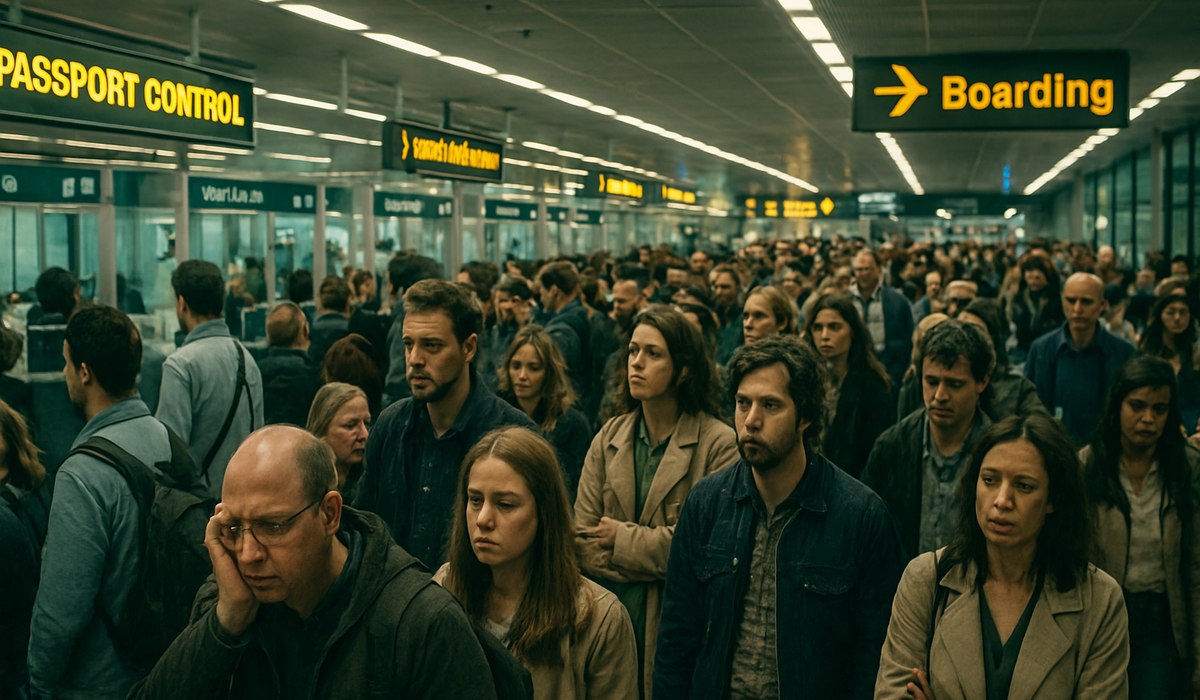
Image generated by AI
Milan Airport Chaos Leaves 100+ easyJet Passengers Stranded
EasyJet flight EJU5420 departed Milan Linate for Manchester on April 16, 2026, with catastrophic understaffing: only 34 of 134 booked passengers boarded before takeoff. The disruption stemmed from three-hour border control queues linked to the EU's newly implemented Entry/Exit System (EES), a biometric screening program designed to track third-country nationals crossing the Schengen border. Non-EU passport holders faced unprecedented delays at Linate's checkpoint, with families and business travelers alike watching helplessly as their gate closed without them. This incident marks one of the most severe instances of Milan airport chaos since the EES rollout began across European hubs.
What Happened: easyJet Flight EJU5420 Departs Severely Understaffed
On the morning of April 16, passengers checking in for the Manchester service encountered an unexpected nightmare at Milan Linate's departure hall. Reports describe snaking lines at border control that extended across the terminal, with passengers reporting wait times exceeding three hours. By the time many travelers reached the passport booth, gate agents had already sealed the departure.
The 100 stranded passengers faced an impossible situation: they had arrived with sufficient time for a standard departure, followed pre-flight guidance to allow extra time, yet still missed their flight. Accounts from the terminal reveal scenes of confusion and frustration as families realized their bookings were closed out. Some travelers described being within sight of the boarding gate when security finally cleared them, only to discover the aircraft had already pushed back.
EasyJet later confirmed the departure occurred at the scheduled time with skeleton-crew passenger loads. The airline emphasized that scheduling decisions were made in accordance with border control timelines outside its direct operational control. For the 100 affected passengers, the immediate challenge became rebooking, accommodation, and managing out-of-pocket expenses that rapidly accumulated.
The Root Cause: EU's New Entry/Exit System Implementation
The Entry/Exit System represents a cornerstone of the EU's revised border management framework, collecting biometric data—fingerprints and facial recognition—for all third-country nationals entering or exiting Schengen countries. While the system aims to enhance security and streamline future border crossings, its April 2026 deployment at busy hubs like Milan Linate has exposed critical infrastructure gaps.
Milan Linate, serving approximately 36 million passengers annually across business and leisure traffic, lacks the physical space for rapid reconfiguration of border queuing areas. SEA Group, the airport operator managing both Linate and Malpensa facilities, has faced challenges integrating biometric processing into existing terminal layouts. Unlike larger international hubs with dedicated expansion zones, Linate's compact footprint constrains checkpoint capacity during system transitions.
The Milan airport chaos directly reflects this mismatch between new regulatory demands and aging infrastructure. Border officers required additional training and processing time to manage the system's complexity, while passenger flows remained unpredictable as travelers struggled to understand lane assignments and documentation requirements. Reports indicate that first-week deployment saw checkpoint throughput drop by 40-60% compared to pre-EES baseline speeds, creating a cascading effect on all downstream operations.
Passenger Impact: Families and Business Travellers Left Behind
The human cost of this travel disruption extended far beyond missed flights. Families traveling during school holidays found themselves separated, with some adults boarding Manchester-bound connections while children remained at Linate. Business travelers missed critical meetings, court appearances, and conference presentations. One passenger group reported incurring €3,200 in collective rebooking fees, overnight hotel stays, and meal costs after missing their original flight.
Under EU Regulation 261/2004, passenger compensation eligibility hinges on whether disruptions fall within airline control or constitute "extraordinary circumstances" beyond the carrier's responsibility. Border control delays and government-mandated systems typically qualify as external factors, meaning easyJet faced reduced liability for compensation claims. However, consumer advocacy groups argue that airlines bear responsibility for building schedule buffers when system transitions are publicly announced in advance.
Stranded passengers pursued multiple recovery paths: some secured rebooking on later easyJet services, others transferred to competing carriers at premium prices, and a subset spent nights in Milan awaiting reduced-cost alternative flights. Documentation requests revealed that many travelers had followed airline-provided pre-flight guidance explicitly, undermining arguments that passenger negligence contributed to the crisis.
Airport and Airline Response to Border Control Bottlenecks
EasyJet's public statement acknowledged the border control congestion while maintaining that passage through Italian security checkpoints fell outside operational control. The carrier indicated it had advised passengers via email and website banners to allocate 3-4 hours for airport procedures at EES-implementing hubs. However, affected travelers disputed this guidance's sufficiency, noting that their arrival times already exceeded these recommendations.
SEA Group, Milan's airport operator, issued limited specific commentary on April 16's incident but acknowledged in broader statements that EES implementation presented "temporary processing challenges." The operator indicated plans to deploy additional border staff, reconfigure queue management signage, and coordinate with Italian border authorities on checkpoint staffing levels. However, these improvements have proceeded incrementally rather than as emergency interventions.
Italian authorities highlighted that EES represents a national security mandate with rollout timelines set by EU directives, constraining local adaptation flexibility. The responsible ministry indicated that officer training and checkpoint staffing would increase progressively through May 2026. This glacial response timeline provided little immediate relief to travelers facing disrupted April and early May bookings.
Key Data: Milan Airport Chaos Impact Summary
| Metric | Value |
|---|---|
| Flight Designation | easyJet EJU5420 (Milan Linate → Manchester) |
| Departure Date | April 16, 2026 (Sunday morning) |
| Booked Passengers | 134 |
| Actual Boardings | 34 |
| Stranded Passengers | 100+ |
| Border Control Wait Times | Up to 3 hours |
| Passenger Load Factor | 25.4% |
| Estimated Rebooking Costs Per Family | €400–€3,200 |
| Primary Cause | EU Entry/Exit System processing delays |
| Airport Capacity Constraint | Linate's limited expansion space for biometric queuing |
What This Means for Travelers
The Milan airport chaos incident illustrates structural vulnerabilities in European border infrastructure during mandatory system transitions. Here's what frequent travelers should do:
-
Monitor EES Rollout Status: Check official EU and airport websites before booking flights through affected hubs. Early May 2026 arrivals and departures carry elevated disruption risk.
-
Extend Airport Arrival Windows: Allocate 4–5 hours for European departure procedures at EES-implementing airports, particularly if you hold non-EU passports.
-
Document Everything: Retain boarding passes, gate closure times, receipt photographs, and timestamp email confirmations. This evidence proves essential if filing compensation or reimbursement claims.
-
Verify Airline Pre-Flight Guidance: Contact your carrier directly to confirm current recommended arrival windows—email guidance may lag operational realities.
-
Purchase Travel Insurance: Policies covering border delay disruptions provide financial protection absent from EU Regulation 261/2004 in external circumstance scenarios.
-
Use Real-Time Flight Tracking: Monitor departures via FlightAware to confirm aircraft boarding status before rushing through checkpoints.
FAQ: Frequently Asked Questions About Milan Airport Chaos
**Q: Am I entitled to compensation if I missed a flight due to border control
Disclaimer
This article is for informational and educational purposes only. It does not constitute legal, financial, or professional advice. While we strive to provide accurate and up-to-date information, travel policies, regulations, and conditions change rapidly. Always verify information with official sources before making travel decisions. Nomad Lawyer makes no representations about the accuracy, reliability, completeness, or suitability of the information provided. Readers should consult qualified professionals for advice specific to their circumstances. The views expressed in this article are those of the author and do not necessarily reflect the views of Nomad Lawyer.
Raushan Kumar
Founder & Lead Developer
Full-stack developer with 11+ years of experience and a passionate traveller. Raushan built Nomad Lawyer from the ground up with a vision to create the best travel and law experience on the web.
Learn more about our team →