Middle East Flight Disruptions 2026: 883 Delays and 70 Cancellations Hit Dubai, Doha, Riyadh, and Jeddah

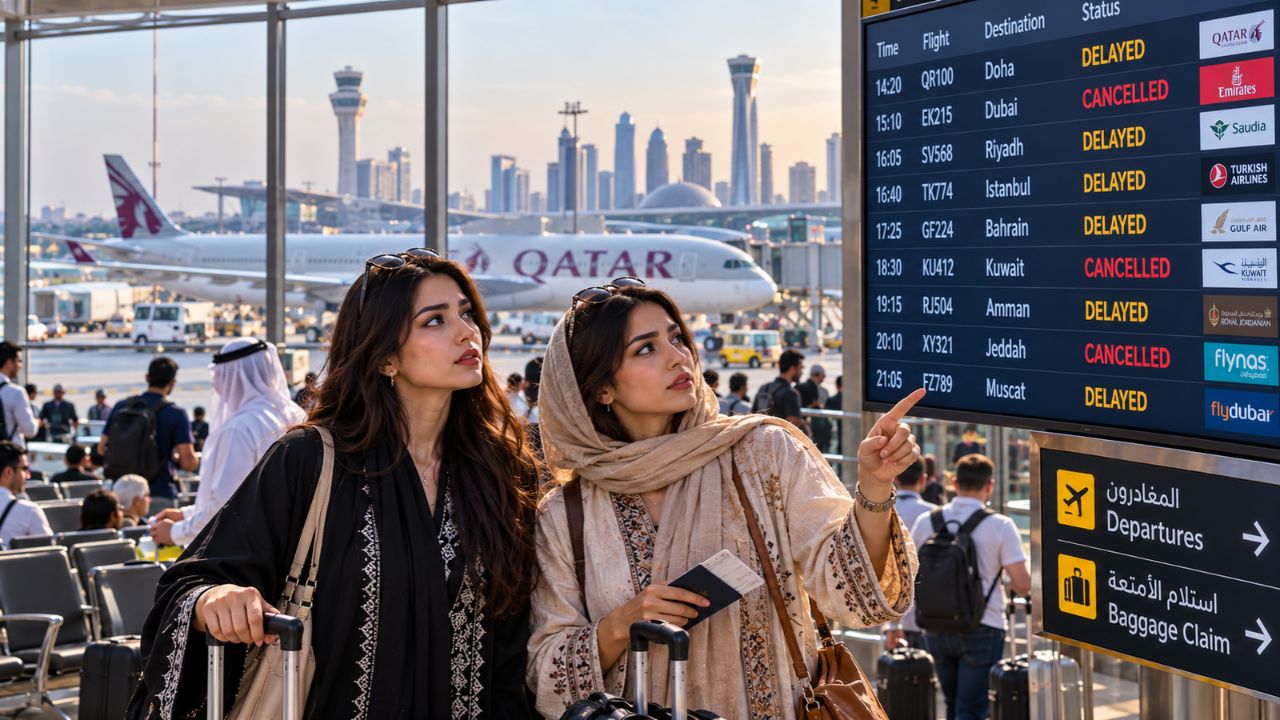
Between October 8 and 25, 2026, an astounding 86% of scheduled flights—totaling 4,071 out of 4,736 services—were cancelled at Riyadh's King Khalid International Airport, triggering a rolling regional aviation disruption that generated 883 delays and 70 cancellations across 12 Middle Eastern hubs on October 29–30. Real-time flight tracking compiled through FlightAware on October 29 at 5:27 PM ET (October 30 at 1:27 AM GST) reveals that while transcontinental super-connectors in Dubai and Doha absorb heavy arrival and departure delays, airports across Saudi Arabia continue to register concentrated flight cancellations stemming from active regional security alerts and military airspace closures.
Security Alerts and EASA Conflict-Zone Directives Alter Air Corridors
The primary catalyst behind the disruption across the Arabian Peninsula involves repeated missile and drone attacks attributed to Yemen's Houthi movement. Reuters documented that across all Saudi commercial airports combined, more than 7,800 flights—representing 45% of total scheduled departures—were cancelled between October 8 and 25. Although King Khalid International Airport in Riyadh has partially reopened, international airlines have extended service suspensions following subsequent strikes, including an incident on October 26 where Saudi air defense units intercepted ballistic missiles over Riyadh and the kingdom's eastern province.
Compounding these localized suspensions, the European Union Aviation Safety Agency (EASA) maintains active conflict-zone advisories across the region valid through November 16, 2026, unless revised earlier. The EASA advisory covering the Persian Gulf and Gulf of Oman specifically identifies airspace over the territorial waters of Bahrain, Kuwait, Qatar, and the United Arab Emirates, alongside northern sectors of Oman's maritime airspace. EASA advises commercial airline operators to avoid designated over-water routes and exercise heightened caution over land due to the threat of surface-to-air missile activity, weaponized drones, active military air defenses, and falling intercept debris.
These airspace restrictions have compressed commercial air traffic into narrower transit corridors. Airliners operating between Europe, the Gulf, and South Asia must navigate lengthened circuitous paths, causing severe air traffic flow management holds, delayed flight rotations, and missed passenger connections across the Middle East.
Contrasting Hub Patterns: Flow Delays in the Gulf vs. Groundings in Saudi Arabia
The operational data reveals two distinctly different patterns of travel disruption across the 12 monitored regional airports:
- High-Volume Congestion Hubs (Dubai, Doha, and Istanbul): Rather than cancelling flights, super-connector airports absorbed extended arrival holding patterns and delayed departures. Dubai International Airport (DXB) logged the highest delay volume in the region with 206 delayed flights and 9 cancellations (0% cancellation rate). Hamad International Airport in Doha recorded 141 delays and 3 cancellations, while Istanbul Airport registered 137 delays and 7 cancellations. Tel Aviv's Ben Gurion Airport recorded 89 delays and 1 cancellation.
- Concentrated Groundings Across Saudi Arabia: Five major airports across Saudi Arabia accounted for 228 delays and 44 cancellations. King Abdulaziz International Airport in Jeddah logged 116 delays and 18 cancellations (1% origin, 2% destination cancellation rate). King Khalid International in Riyadh recorded 18 delays alongside 17 cancellations (4% origin, 2% destination cancellation rate). King Fahd International in Dammam registered 48 delays and 4 cancellations (1% origin, 1% destination cancellation rate). Prince Mohammad Bin Abdulaziz International in Madinah posted 36 delays and 2 cancellations, while Abha Regional Airport logged 10 delays and 3 cancellations (5% origin cancellation rate).
- Levant and Arabian Gulf Gateways: Secondary hubs saw steady delays as regional feeder services slipped behind schedule. Kuwait International Airport registered 33 delays and 2 cancellations, Muscat International Airport recorded 30 delays and 2 cancellations, Bahrain International logged cancellations at a 4% rate, and Amman's Queen Alia International registered 19 delays and 2 cancellations.
Among regional carriers, a separate dataset covering seven major operators logged 513 delayed flights and 32 cancellations. Air Arabia recorded the highest proportional delay rate at 27% (63 delays and 1 cancellation). Emirates absorbed 104 delays (19%) and 2 cancellations, Qatar Airways logged 117 delays (18%) and 3 cancellations, Turkish Airlines recorded 119 delays (8%) and 3 cancellations, Saudia posted 88 delays (16%) and 11 cancellations (2%), Gulf Air logged 12 delays (8%) and 10 cancellations (6%), and Royal Jordanian recorded 10 delays (7%) and 2 cancellations (1%).
Middle East Aviation Disruption and Delay Performance (October 2026)
The table below provides a detailed breakdown of flight delays, cancellations, and operational factors across affected Middle Eastern airports and operating airlines:
| Airport / Airline Entity | Delay Count (Delay Rate) | Cancellations (Cancel Rate) | Operational Context & Airspace Factors |
|---|---|---|---|
| Dubai International (DXB) | 206 delays | 9 cancellations (0%) | Arrival pacing holds and congested Gulf oceanic entry corridors |
| Hamad International, Doha (DOH) | 141 delays | 3 cancellations (0%) | Connecting bank flow management and narrow airspace routing |
| Istanbul Airport (IST) | 137 delays | 7 cancellations | Southbound Middle Eastern routing holds and crew rotation slippage |
| King Abdulaziz Intl, Jeddah (JED) | 116 delays | 18 cancellations (1–2%) | Red Sea military security advisories and adjusted Umrah flight banks |
| Ben Gurion, Tel Aviv (TLV) | 89 delays | 1 cancellation | Mediterranean corridor approach pacing and security protocols |
| King Fahd Intl, Dammam (DMM) | 48 delays | 4 cancellations (1%) | Eastern Province military alert spacing and Gulf airspace holds |
| Prince Mohammad, Madinah (MED) | 36 delays | 2 cancellations | Pilgrim charter adjustments and domestic feeder aircraft delays |
| Kuwait International (KWI) | 33 delays | 2 cancellations | Northern Gulf oceanic boundary holds and rerouted transit traffic |
| Muscat International (MCT) | 30 delays | 2 cancellations | Gulf of Oman EASA advisory spacing and southern detour flows |
| King Khaled Intl, Riyadh (RUH) | 18 delays | 17 cancellations (2–4%) | Post-interception safety protocols following 86% multi-week cancel rate |
| Queen Alia Intl, Amman (AMM) | 19 delays | 2 cancellations | Levant security spacing and Jordan airspace advisory compliance |
| Abha Regional (AHB) | 10 delays | 3 cancellations (5%) | Southern border proximity and tactical air defense advisories |
| Turkish Airlines | 119 delays (8%) | 3 cancellations (0%) | Trans-Eurasian flow balancing and Levant overflight avoidance |
| Qatar Airways | 117 delays (18%) | 3 cancellations (0%) | Extended flight paths around restricted Gulf waters |
| Emirates | 104 delays (19%) | 2 cancellations (0%) | East-west long-haul hub departures held for connecting passengers |
| Saudia | 88 delays (16%) | 11 cancellations (2%) | Domestic route restructuring and aircraft repositioning |
| Air Arabia | 63 delays (27%) | 1 cancellation (0%) | High-frequency regional rotations vulnerable to airway slot delays |
Visitor Insider Tips: Handling Middle East Layovers and Flight Changes
- Avoid Tight 60-Minute Connections in Dubai and Doha: With approach corridors into the UAE and Qatar subject to traffic pacing, incoming long-haul aircraft frequently spend 15 to 25 minutes in holding stacks over the desert. Never book an itinerary with less than a two-hour transfer window at DXB or DOH if your onward journey is on a separate booking.
- Utilize the Haramain High-Speed Train for Western Saudi Travel: If domestic flights between Jeddah (JED) and Madinah (MED) face cancellation or extended gate holds, exit the terminal and take the Haramain High-Speed Railway directly from King Abdulaziz International Airport station. Modern electric trains reach Madinah in under two hours at speeds up to 300 km/h, bypassing regional airspace holds entirely.
- Carry Physical Documentation for Gulf Transit Protection: In the event of a cancellation or missed connection, gate staff at regional airports require physical copies of original e-tickets, boarding passes, and passport entry stamps to issue hotel accommodation vouchers and food coupons. Keep paper printouts in your personal daypack.
- Check Comprehensive Trip Cancellation Insurance Policies: Many standard credit card travel insurance policies contain war risk or conflict-zone exclusion clauses that deny claims caused by military missile interceptions or government airspace closures. Ensure your policy includes explicit 'Cancel For Any Reason' (CFAR) coverage before embarking on travel through the Arabian Peninsula. Plan your journey with updates from official tourism authorities such as the Saudi Tourism Authority.
Cultural and Environmental Context: Faith Pilgrimages, Regional Connectivity, and Open Skies
Commercial aviation across the Middle East represents far more than business and leisure transit; it serves as the spiritual bridge for hundreds of millions of people worldwide. Airports in Jeddah and Madinah handle massive year-round flows of religious pilgrims performing Umrah and preparing for the annual Hajj. When security alerts ground aircraft or reroute regional services, the impact ripples deeply into Muslim communities from Indonesia to West Africa, delaying once-in-a-lifetime pilgrimages and separating families.
Concurrently, Gulf nations have invested billions in positioning their territories as global crossroads linking Europe, Africa, Asia, and the Americas. The delicate geopolitical equilibrium required to maintain safe overflight corridors is central to this economic model. Aviation authorities, defense commands, and international safety agencies must maintain 24-hour coordination to balance military defense requirements with the protection of civilian aircraft.
As civil aviation bodies navigate evolving security advisories through mid-November 2026, preserving open, transparent communication between air carriers and travelers remains the single most effective tool for maintaining passenger confidence across the Middle East.
FAQ: Middle East Flight Disruptions and Airport Delays 2026
What is causing the flight delays and cancellations in the Middle East? Disruptions stem from regional security incidents, including missile and drone attacks in Saudi Arabia, coupled with active EASA conflict-zone advisories across the Persian Gulf, Gulf of Oman, and Levant airspace.
Which Middle East airport experienced the highest flight delays? Dubai International Airport (DXB) recorded the highest delay count with 206 delayed flights, followed by Doha Hamad International with 141 delays and Istanbul Airport with 137 delays.
How severe was the recent flight disruption at Riyadh's airport? Between October 8 and 25, 2026, 4,071 out of 4,736 flights (86%) were cancelled at Riyadh's King Khalid International Airport, with more than 7,800 flights cancelled across Saudi Arabia.
How long are the current EASA conflict-zone airspace advisories valid? Active EASA airspace warnings covering Saudi Arabia, Jordan, the Persian Gulf, Gulf of Oman, Lebanon, Iraq, and Iran remain valid through November 16, 2026, unless amended earlier.
In an interconnected region where ancient pilgrimage paths cross the world's most dynamic air corridors, vigilant flight tracking and generous layovers remain every traveler's most reliable travel companions.
Related Travel Guides
The 10 Best Airport Transit Hotels and Quiet Zones in Dubai and Doha, According To Reddit (Coming Soon)
This article is for informational purposes. Flight routes, passenger regulations, visa rules, and transit advisories are subject to change by airlines and aviation authorities. Readers are advised to verify schedules and travel documentation with relevant carriers and border agencies before departure.
Related Stories

MV Odyssey World Cruise Suspends Operations in Cambodia Stranding 200 Residents Over Fuel Costs 2026

Villa Vie Odyssey Financial Collapse Strands 200 Residents in Cambodia, Canceling India Route