
Middle East Aviation Shock: Over 1,210 Cancellations and 1,300 Delays Paralyze Riyadh, Jeddah, Cairo, and Dubai
An acute Middle East aviation crisis triggered 1,212 flight cancellations and 1,304 delays, with Riyadh recording an 83% origin grounding rate and Saudi carriers absorbing 539 cancellations.

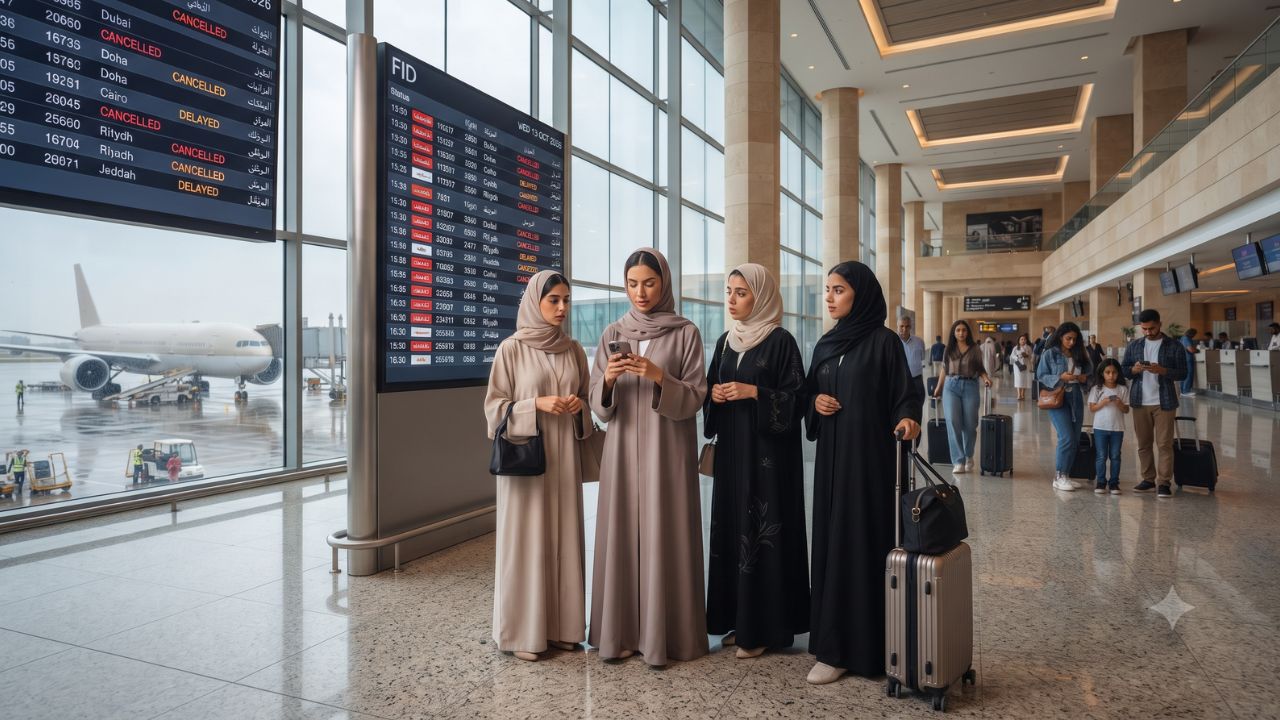
An unprecedented 83% outbound cancellation rate at Riyadh’s King Khalid International Airport anchors a severe aviation crisis that grounded 1,212 flights and delayed another 1,304 across the Middle East within a single operating window. Flight-tracking telemetry compiled from FlightAware as of 5:00 pm ET on 12 October 2026 (1:00 am GST on 13 October) details an acute operational paralysis driven by recent missile and drone incursions targeting Saudi aviation infrastructure, triggering emergency airspace restrictions, military route diversions, and broad preventative schedule withdrawals.
The resulting shockwave has radiated far beyond central Saudi Arabia, overwhelming primary intercontinental hubs in the United Arab Emirates, Egypt, Qatar, and Jordan. With Saudi Arabia accounting for 997 cancellations and 342 delays across 14 separate airports, civil aviation authorities led by the General Authority of Civil Aviation (GACA) have enacted stringent tactical metering that has severed connection banks across Africa, Europe, and South Asia.
The Epicenter: Kingdom-Wide Airfield Freeze Across 14 Facilities
The heaviest concentration of disruptions fell squarely on Saudi Arabia’s primary commercial gateways, where air defense alerts and emergency runway safety protocols forced sweeping groundings:
- King Khalid International (RUH), Riyadh: Recorded 569 cancellations and just six delays, logging an 81% inbound cancellation rate (285 flights) and an 83% outbound cancellation rate (284 flights).
- King Abdulaziz International (JED), Jeddah: As the western hub and religious gateway for Umrah pilgrims, Jeddah logged 179 cancellations alongside 210 delays, registering 88 inbound (23%) and 91 outbound (24%) cancellations.
- King Fahd International (DMM), Dammam: Processed 89 cancellations and 58 delays, with 44 inbound (37%) and 45 outbound (36%) cancellations.
- Prince Mohammad Bin Abdulaziz International (MED), Medina: Recorded 38 cancellations and 32 delays (19 inbound at 21% and 19 outbound at 20%).
- Domestic and Regional Aerodromes: Abha Regional logged 31 cancellations and 20 delays (15 inbound at 37%, 16 outbound at 39%). Prince Sultan Bin Abdulaziz Regional in Tabuk posted 17 cancellations and eight delays. Taif International recorded 16 cancellations and two delays (66% inbound, 61% outbound). Severe localized groundings hit Bisha (100% inbound cancellation rate), Al Qaisumah (100% outbound cancellation rate), Al Jouf (75% outbound), and Guriat (75%).
This systemic shutdown confirms that the operational crisis has immobilized not only international widebody trunk routes but also the regional narrowbody feeder lines connecting interior Saudi governorates.
Trans-Regional Contagion: UAE, Egypt, Qatar, and the Levant
As Saudi air corridors constricted, transit megahubs in neighboring countries absorbed massive holding delays and cancellations as airlines struggled to route aircraft around active conflict alerts:
- United Arab Emirates: Accumulated 409 delays and 78 cancellations. Dubai International (DXB) logged 220 delays and 62 cancellations (31 inbound and 31 outbound, each at 6%). Abu Dhabi’s Zayed International (AUH) recorded 129 delays and eight cancellations, while Sharjah International posted 60 delays and eight cancellations.
- Egypt: Logged 126 delays and 48 cancellations. Cairo International (CAI) processed 118 delays and 42 cancellations (22 inbound at 7%, 20 outbound at 6%), while Alexandria International (ALY) logged eight delays and six cancellations (13% inbound, 14% outbound cancellations).
- Qatar: Hamad International (DOH) in Doha registered 116 delays and 22 cancellations (11 inbound and 11 outbound, each at 3%).
- Jordan and Levant: Queen Alia International (AMM) in Amman reported 32 delays and 21 cancellations (11 inbound at 11%, 10 outbound at 10%). Damascus International in Syria logged three delays and seven cancellations (11% inbound, 12% outbound).
- Gulf and Regional Points: Bahrain International posted 39 delays and 10 cancellations (5% inbound, 5% outbound). Muscat International in Oman logged 31 delays and 12 cancellations (6% inbound, 5% outbound). Kuwait International recorded 14 delays and five cancellations.
- Türkiye Hubs: Istanbul Airport (IST) recorded 192 delays and 12 cancellations, while Sabiha Gokcen (SAW) logged minor cancellations as Turkish airspace absorbed high-altitude detour traffic.
The table below provides a granular comparative breakdown of operational disruptions across major Middle Eastern carriers and key hub airports:
| Aviation Entity | Operational Classification | Flights Cancelled | Flights Delayed | Disruption Share / Key Benchmark |
|---|---|---|---|---|
| King Khaled Intl (RUH) | Saudi Capital Hub | 569 | 6 | 81% inbound / 83% outbound cancellation rate |
| King Abdulaziz Intl (JED) | Western Saudi / Umrah Hub | 179 | 210 | 23% inbound / 24% outbound cancellation rate |
| Dubai International (DXB) | Global Connection Hub | 62 | 220 | 6% cancellation rate; 220 holding delays |
| King Fahd Intl (DMM) | Eastern Province Gateway | 89 | 58 | 37% inbound / 36% outbound cancellation rate |
| Cairo International (CAI) | Egyptian Primary Gateway | 42 | 118 | 7% inbound / 6% outbound cancellation rate |
| Prince Mohammad Intl (MED) | Religious Tourism Gateway | 38 | 32 | 21% inbound / 20% outbound cancellation rate |
| Istanbul Airport (IST) | Eurasian Megahub | 12 | 192 | Heavy detour routing delays |
| Zayed Intl (AUH) | UAE Long-Haul Hub | 8 | 129 | 129 transit holding delays |
| Hamad Intl (DOH) | Qatari Megahub | 22 | 116 | 3% cancellation rate; rotational slippage |
| Riyadh Air (RX) | Saudi Startup Carrier | 29 | 0 | 100% cancellation rate across recorded schedules |
| Flynas (XY) | Saudi Budget Carrier | 138 | 40 | 57% cancellation rate; 16% delay rate |
| Saudia (SV) | Saudi Flag Carrier | 273 | 111 | 53% cancellation rate; 21% delay rate |
| flyadeal (F3) | Saudi Low-Cost Carrier | 64 | 27 | 37% cancellation rate; 15% delay rate |
| Turkish Airlines (TK) | European / Asian Network | 8 | 182 | 12% delay rate; 182 flights slowed by airspace detours |
| Pegasus Airlines (PC) | Turkish Low-Cost Carrier | 3 | 165 | 22% delay rate across regional network |
| Emirates (EK) | UAE Flag Carrier | 15 | 122 | 23% delay rate across long-haul connection banks |
| Etihad Airways (EY) | Abu Dhabi Carrier | 4 | 106 | 32% delay rate across scheduled departures |
| Qatar Airways (QR) | Qatari Flag Carrier | 16 | 104 | 16% delay rate |
| flydubai (FZ) | UAE Regional Carrier | 19 | 78 | 6% cancellation rate; 27% delay rate |
| Air Arabia (G9) | UAE Low-Cost Carrier | 8 | 52 | 3% cancellation rate; 22% delay rate |
| EgyptAir (MS) | Egyptian Flag Carrier | 18 | 35 | 7% cancellation rate; 14% delay rate |
| Air Cairo (SM) | Egyptian Hybrid Carrier | 2 | 37 | 24% delay rate |
| Israir (6H) | Israeli Carrier | 2 | 36 | 51% delay rate across active operations |
Expert Analysis: Airspace Funnels, Equipment Entrapment, and Passenger Legalities
For travelers booking journeys through the Middle East, the direct consequence of 1,212 cancellations is an abrupt contraction of intercontinental transit capacity. When Saudi airspace closes or becomes subject to emergency flight routing bulletins issued in coordination with the International Air Transport Association (IATA), long-haul carriers cannot simply reroute around the Arabian Peninsula without incurring severe operational penalties.
Airlines forced to detour through Egypt, the Red Sea, or northern Turkish corridors must load substantial extra fuel reserves, which in turn reduces maximum allowable passenger and cargo payload on long-range widebodies. In high-density hubs like Dubai and Doha, arrival delays of 60 to 120 minutes routinely shatter connection banks. Passengers heading to Australia, India, or Europe miss their connecting flights, resulting in terminal gate congestion and stranded transit cohorts.
The situation is even more critical for religious and budget travelers. Saudia (53% cancelled), Flynas (57% cancelled), and flyadeal (37% cancelled) have seen hundreds of airframes trapped at outstations or held at maintenance bases. Unlike full-service legacy alliance members, regional point-to-point budget carriers cannot rebook passengers on Emirates, Qatar Airways, or European carriers under interline agreements. Passengers booked on low-cost flights between Egypt and Saudi Arabia, or between Jordan and the Gulf, face multi-day ground delays with zero reciprocal protection.
From a regulatory perspective:
- Compensation Disclaimers: Military conflicts and hostile drone incursions fall strictly under "extraordinary circumstances," releasing airlines from mandatory monetary cancellation compensation under European EC 261, UK 261, and Middle Eastern consumer protection frameworks.
- Inviolable Duty of Care: Regardless of conflict origins, airlines operating departing flights from European airports or carriers operating under local consumer regulations remain legally required to provide complimentary hotel accommodations, ground transfers, and food vouchers during prolonged holding delays.
- Right to Full Refund: Stranded travelers whose flights are cancelled or delayed beyond five hours possess the legal right to decline alternative routing and demand a 100% cash refund to their original payment method.
Key Takeaways
- Widespread Regional Collapse: 1,212 cancellations and 1,304 delays disrupted air travel across the Middle East on 12–13 October 2026.
- Riyadh Effectively Shuttered: King Khalid International Airport registered 569 cancellations, with outbound cancellations reaching 83% following military drone and missile strikes.
- Saudi Carriers Bear the Brunt: Domestic airlines faced catastrophic schedule losses: Riyadh Air grounded 100% of recorded flights, Flynas cancelled 57%, Saudia cancelled 53%, and flyadeal cancelled 37%.
- Dubai and Cairo Suffer Rotational Gridlock: Dubai International logged 220 delays and 62 cancellations, while Cairo International absorbed 118 delays and 42 cancellations.
- Pilgrim and Budget Passenger Exposure: Low-cost airline passengers face extreme vulnerability due to the absence of interline rebooking agreements across alternative Gulf carriers.
FAQ: Middle East Flight Disruptions October 2026
What caused the massive wave of flight cancellations across the Middle East on 12–13 October 2026?
Cancellations and delays were triggered by military missile and drone attacks targeting Saudi aviation infrastructure, prompting emergency airspace closures and safety groundings by regional airlines.
Which airport recorded the highest cancellation rate?
Riyadh's King Khalid International Airport recorded the highest cancellation volume, with 569 flights cancelled, representing an 81% inbound and 83% outbound cancellation rate.
Are passengers entitled to cash compensation for war-related flight cancellations?
No. Armed conflict, missile threats, and government airspace closures are classified as extraordinary circumstances beyond airline control, exempting carriers from cash compensation.
What assistance must airlines provide to stranded passengers?
Under international consumer protection regulations, airlines must provide standard duty of care—including hotel accommodation, meals, and free rebooking or a full cash refund—even during security crises.
As regional airspace funnels narrow under security threats, the fragile machinery of global aviation reveals how swiftly physical conflict paralyzes intercontinental passenger mobility.
Related Travel Guides
Disclaimer
This article is for informational and educational purposes only. It does not constitute legal, financial, or professional advice. While we strive to provide accurate and up-to-date information, travel policies, regulations, and conditions change rapidly. Always verify information with official sources before making travel decisions. Nomad Lawyer makes no representations about the accuracy, reliability, completeness, or suitability of the information provided. Readers should consult qualified professionals for advice specific to their circumstances. The views expressed in this article are those of the author and do not necessarily reflect the views of Nomad Lawyer.
Kunal K Choudhary
Co-Founder & Contributor
A passionate traveller and tech enthusiast. Kunal contributes to the vision and growth of Nomad Lawyer, bringing fresh perspectives and driving the community forward.
Learn more about our team →