
Middle East Aviation Crisis 2026: 611 Delays and 66 Cancellations Hit Dubai and Gulf Hubs
Renewed conflict and airspace restrictions trigger 611 delays and 66 cancellations across Dubai and regional hubs, disrupting global connectivity in late August 2026.

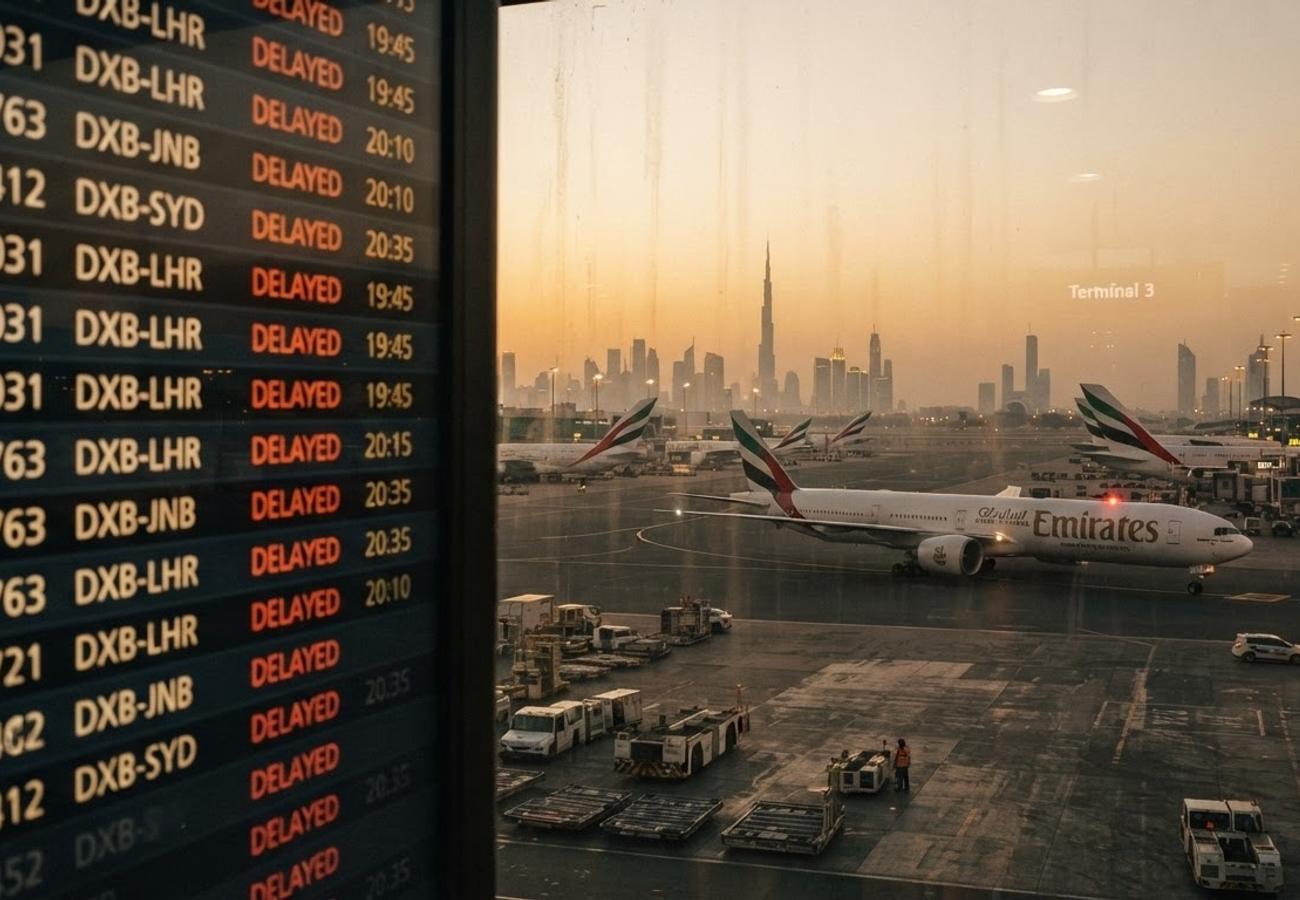
Image generated by AI
Renewed conflict and strategic airspace restrictions have triggered 611 delays and 66 cancellations across Dubai and other major Gulf hubs. This operational instability is severely impacting summer travel schedules and global transit connectivity.
Middle East Airspace Constraints and Operational Fallout
The aviation environment across the Middle East remains volatile in late August 2026, following the renewal of conflict in February 2026. Operational data indicates that strategic hubs are currently absorbing the aftershocks of prolonged airspace closures and stringent risk controls.
Analysis of current flight patterns shows that airspace over Iran, Iraq, Lebanon, and segments of the eastern Mediterranean is subject to heavy restrictions. This has effectively created a "narrow funnel" for long-haul traffic, concentrating aircraft into a limited number of available corridors. When these corridors face tactical closures or flow-control measures, the result is a cascade of knock-on delays across tightly banked hub schedules.
Flight tracking systems indicate that the Middle East is one of the few global regions where conflict-driven disruption continues to materially dictate network planning in 2026. Capacity over the Gulf has been structurally reduced compared to pre-crisis norms, leaving carriers with minimal schedule flexibility.
Impact Breakdown: Dubai and Regional Hubs
Dubai International Airport (DXB), as a primary global transfer point, is currently the epicenter of these disruptions. While runways remain open and long-haul connectivity to North America, Europe, and Asia is maintained, the system is under significant strain.
Key Disruption Statistics:
- Total Delays: 611 recorded across Dubai and regional hubs.
- Total Cancellations: 66 flights cancelled.
- Primary Impact Areas: Eastbound routes avoiding restricted airspace.
- Secondary Hubs Affected: Doha, Abu Dhabi, and major Saudi Arabian airports.
The current disruption is characterized by clusters of late departures and arrivals. These are primarily driven by congested waypoints, extended flight paths to avoid "hot spots," and strict crew duty limits. When a flight is forced into a longer routing, it often misses its assigned slot, triggering rolling delays throughout the operational day.
Passenger Rights & Advisory: Navigating the Disruption
For the affected passenger, these disruptions often manifest as missed connections or sudden flight cancellations. Depending on your ticket and the airline's headquarters, your rights vary significantly.
Compensation and Rebooking Guidance:
- EU261/2004 Framework: If your flight departs from an EU airport or is operated by an EU carrier arriving into the EU, you may be entitled to compensation for delays exceeding three hours. However, airlines often cite "extraordinary circumstances" (such as conflict-driven airspace closures) to avoid payouts. Our analysis suggests that while the conflict is extraordinary, the failure to manage crew rosters or aircraft rotations effectively may still be compensable.
- US DOT Guidelines: For flights involving US carriers or departing from US airports, passengers are entitled to a full refund if a flight is cancelled or significantly changed, regardless of the reason.
- Duty of Care: For passengers stranded in Dubai or other Gulf hubs, airlines are generally expected to provide meals, communications, and hotel accommodation if the delay extends overnight.
Practical Recommendations for Travelers:
- Extend Connection Windows: We advise passengers to allow significantly longer layovers when transiting through the Gulf, particularly for eastbound itineraries.
- Digital Monitoring: Rely on real-time airline apps rather than airport monitors, as same-day retimings and aircraft substitutions are frequent.
- Documentation: Keep detailed records of all delay notifications and expenses incurred during disruptions to support future compensation claims.
Industry Analyst Perspective
The current wave of 611 delays and 66 cancellations represents a fundamental operational reset for Middle East carriers. Extended routings have increased fuel burn and reduced daily aircraft utilization, which shrinks the margin for recovery when a single disruption occurs.
The shift toward selective cancellations—rather than wholesale schedule cuts—indicates that "super-connector" airlines are prioritizing the reliability of core long-haul links over lower-demand regional routes. While passenger volumes remain robust, on-time performance (OTP) has weakened compared to 2025, with average delay minutes per flight trending upward.
As long as regional tensions persist, the aviation system in the Gulf will operate with significantly less "slack" than in previous years, making routine travel more fragile.
The fragility of global transit hubs underscores the lasting impact of geopolitical instability on aviation logistics.
Related Travel Guides
Disclaimer
This article is for informational and educational purposes only. It does not constitute legal, financial, or professional advice. While we strive to provide accurate and up-to-date information, travel policies, regulations, and conditions change rapidly. Always verify information with official sources before making travel decisions. Nomad Lawyer makes no representations about the accuracy, reliability, completeness, or suitability of the information provided. Readers should consult qualified professionals for advice specific to their circumstances. The views expressed in this article are those of the author and do not necessarily reflect the views of Nomad Lawyer.
Kunal K Choudhary
Co-Founder & Contributor
A passionate traveller and tech enthusiast. Kunal contributes to the vision and growth of Nomad Lawyer, bringing fresh perspectives and driving the community forward.
Learn more about our team →