Madrid Expands Christmas Tourism for 2026–2027: 14 Million Lights, Giant Snowman, and International Visitor Growth from UK, US, and Mexico

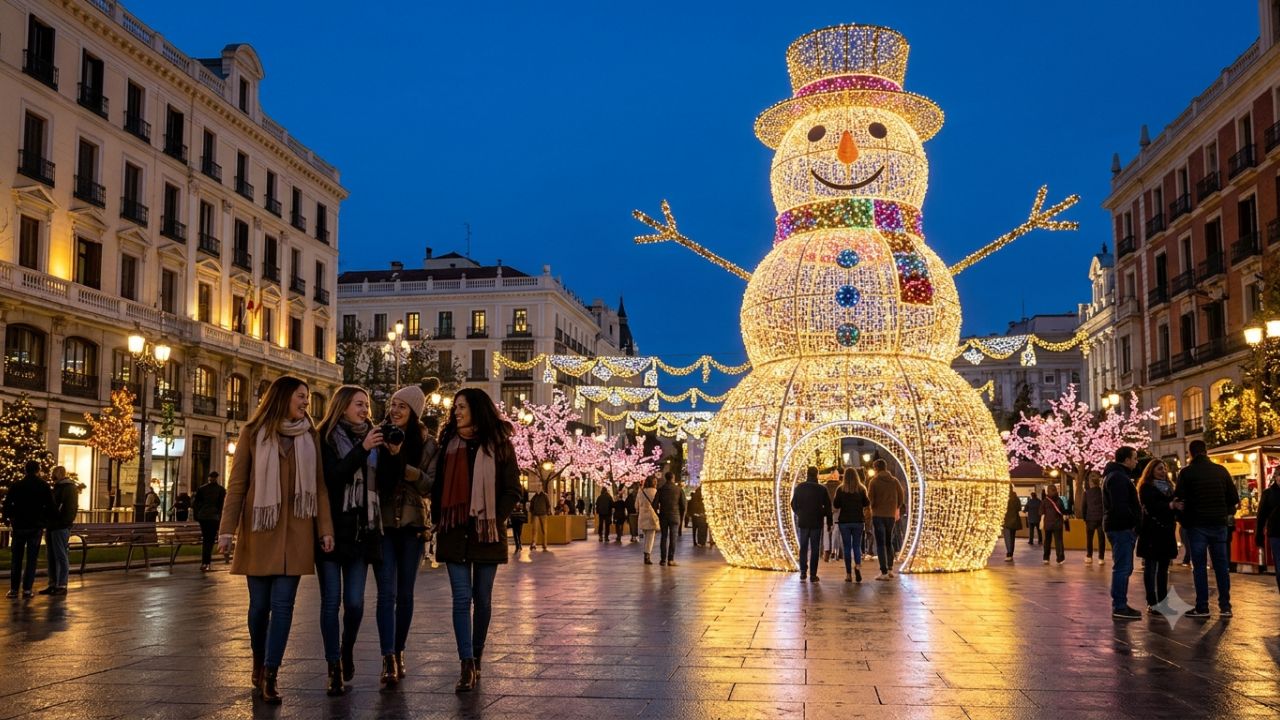
Madrid is launching its most ambitious festive tourism campaign to date for the 2026–2027 winter season, illuminating more than 250 public locations across all 21 municipal districts with 14 million energy-efficient LED bulbs, introducing a 12-metre walk-through illuminated snowman, and capitalizing on double-digit visitor growth from the United Kingdom, the United States, and Mexico.
The extensive festive programme, officially inaugurating on 21 November 2026 and extending through 6 January 2027, represents an estimated municipal investment of €7.3 million by the Ayuntamiento de Madrid. Designed to disperse holidaymakers beyond the historic city centre into diverse residential and commercial quarters, the initiative pairs monumental luminous art installations with traditional seasonal markets, gastronomic programming, and extended retail trading hours.
The winter campaign arrives against a backdrop of exceptional international tourism momentum. Official municipal data from September 2026 reveals substantial growth across key overseas source markets, led by a 28.2 percent year-on-year surge in visitors from the United Kingdom and sustained volume leadership from the United States, which contributed over 115,000 arrivals and 270,000 hotel overnights in a single month. Combined with strong linguistic and cultural demand from Mexico, Madrid is positioning itself as a premier European urban alternative to traditional snow-bound alpine resorts, delivering a vibrant winter city-break environment underpinned by world-class museums, culinary heritage, and accessible continental transit links.
Architectural Illumination: Scale, Distribution, and Municipal Engineering
The scale of Madrid’s 2026–2027 holiday lighting programme reflects a sophisticated urban management strategy that balances festive aesthetics with environmental sustainability and territorial cohesion. Rather than concentrating visual spectacles exclusively along high-density tourist arteries such as Gran Vía and Calle de Alcalá, the municipal government has engineered an expansive network of illuminated installations spanning all 21 administrative districts of the Spanish capital.
A total of more than 14 million high-efficiency LED bulbs will form the visual spine of the public display. The lighting infrastructure encompasses 7,458 individual decorative garlands that stretch across approximately 164 linear kilometres of urban roadways, pedestrian avenues, and residential boulevards. In addition, the municipal public works department has integrated 131 illuminated cherry trees and 14 monumental decorated fir trees positioned at strategic public plazas, creating focal gathering points for neighborhood communities and international sightseers alike.
========================================================================================
MADRID FESTIVE LIGHTING INFRASTRUCTURE: KEY OPERATIONAL METRICS (2026–2027)
========================================================================================
Technical / Physical Indicator       Municipal Specification           Urban Scope
----------------------------------------------------------------------------------------
Total LED Bulbs Deployed             Over 14,000,000 units             100% High-Efficiency LED
Illuminated Urban Locations          Over 250 specific sites           All 21 City Districts
Decorative Garlands Installed        7,458 individual fixtures         164 km combined length
Luminous Cherry Trees                131 illuminated trees             Plazas & Boulevards
Monumental Artificial Fir Trees      14 large installations            Major Civic Squares
Campaign Operating Window            21 Nov 2026 to 6 Jan 2027         47 Consecutive Days
Municipal Capital Investment         Estimated €7.3 million            Ayuntamiento de Madrid
Broader Festive Economic Impact      Estimated €4.1094 billion         Direct/Indirect City Spend
========================================================================================
The geographical dispersion of the lighting across all 21 districts—from northern business sectors in Chamartín and Fuencarral-El Pardo to southern residential hubs in Usera, Villaverde, and Puente de Vallecas—serves deliberate economic and urban planning objectives:
- Decongestion of the Historic Core: By establishing secondary luminous landmarks across districts such as Chamberí, Salamanca, Retiro, and Arganzuela, municipal planners encourage pedestrian distribution, alleviating transit bottlenecks around Puerta del Sol and Plaza Mayor.
- Neighborhood Retail Stimulus: Extending festive illumination into outer municipal rings drives footfall toward local hospitality establishments, neighborhood retail boutiques, and traditional food markets outside the primary tourism core.
- Energy Conservation Standards: All 14 million lighting points utilize next-generation micro-LED technology, ensuring that overall electrical consumption remains strictly capped within the city's sustainable energy framework while delivering superior luminance and color vibrancy.
Plaza de España's Walk-Through Snowman: Monumental Public Art
The marquee standalone architectural novelty of the 2026 festive campaign is a giant walk-through Christmas snowman situated adjacent to Plaza de España and the western entrance of the Sabatini Gardens (Jardines de Sabatini). Positioned within the immediate sightline of the Royal Palace (Palacio Real de Madrid) and the newly redeveloped pedestrian axis connecting the palace to the Temple of Debod, the installation creates a major visual anchor along Madrid's western cultural corridor.
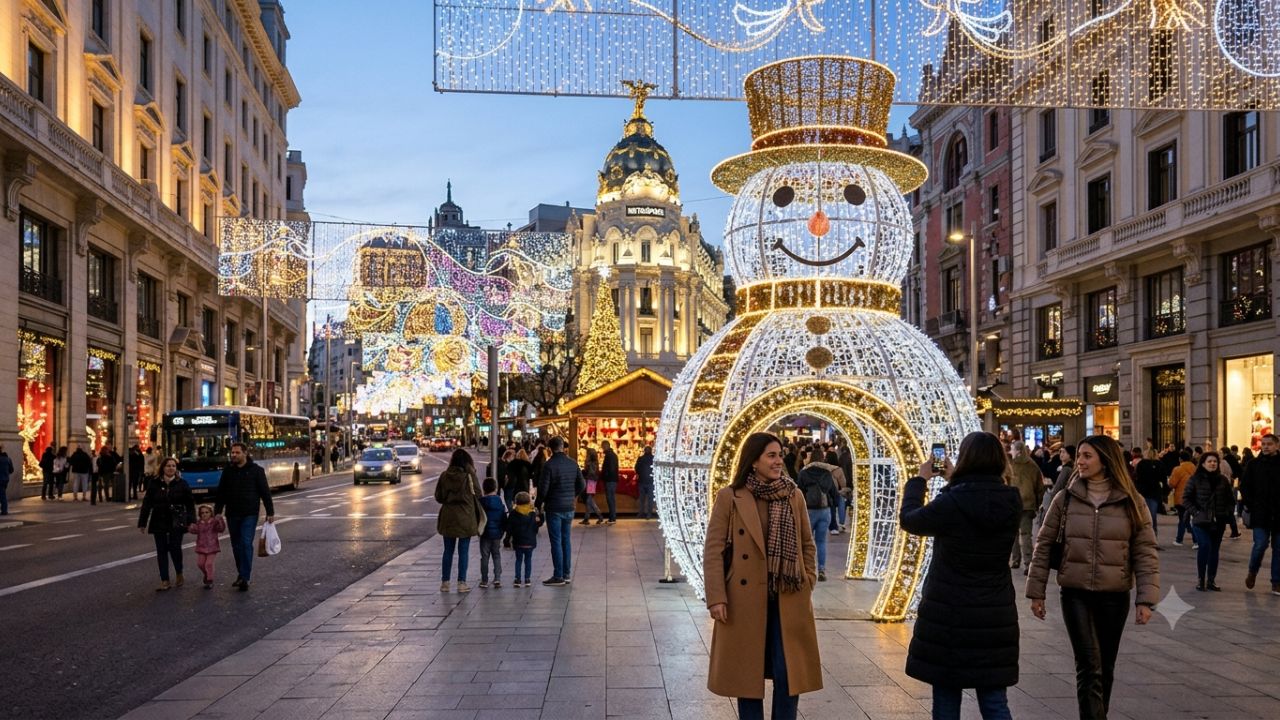
The monumental installation measures 12 metres in total height, 8.1 metres in width, and 6.5 metres in depth. Engineered with an internal walk-through structural archway, the installation allows pedestrians to traverse through the center of the illuminated sculpture, providing immersive visual perspectives and curated photography vantage points. The sculpture incorporates approximately 64,300 independent LED illumination points, which are programmed to execute synchronized chromatic sequences and dynamic lighting animations during evening operating hours.
| Dimension / Technical Attribute | Structural Specification | Contextual Significance |
|---|---|---|
| Total Height | 12.0 Metres (39.4 Feet) | Equivalent to a four-storey residential building. |
| Transverse Width | 8.1 Metres (26.6 Feet) | Broad footprint providing structural stability. |
| Sculptural Depth | 6.5 Metres (21.3 Feet) | Accommodates a spacious internal pedestrian tunnel. |
| Illumination Density | Approximately 64,300 Points | Dedicated micro-LED mapping with programmable hue shifts. |
| Geographic Placement | Plaza de España / Sabatini Gate | Connects Gran Vía shopping to Royal Palace heritage walks. |
| Pedestrian Accessibility | Ground-Level Walk-Through | Free public access designed for family and visitor foot traffic. |
The installation's location bridges two distinct urban dynamics: the energetic commercial shopping precinct extending westward from Gran Vía and the serene, historic grounds of the Royal Palace. Visitors touring the Sabatini Gardens and the surrounding monument zones can easily incorporate the walk-through snowman into evening itineraries that culminate with visits to the traditional artisan holiday stalls established within Plaza de España.
International Source Market Dynamics: UK, US, and Mexico Surges
Madrid’s winter tourism appeal is reinforced by strong visitor inflows from key long-haul and regional feeder markets. Analysis of official municipal statistics compiled by the Ayuntamiento de Madrid for September 2026 demonstrates consistent demand from the United Kingdom, the United States, and Mexico, laying a solid foundation for elevated winter holiday travel.
========================================================================================
MADRID INTERNATIONAL SOURCE MARKET PERFORMANCE (SEPTEMBER 2026 BENCHMARK)
========================================================================================
Source Country     Visitor Volume    Annual Growth     Hotel Overnights   Overnight Growth
----------------------------------------------------------------------------------------
United States      115,868 arrivals  Volume Leader     270,887 nights     High-Yield Outlay
United Kingdom      40,429 arrivals  +28.2% YoY        100,652 nights     +30.8% YoY
Mexico              36,374 arrivals  +22.0% YoY         82,901 nights     +21.8% YoY
========================================================================================
Market Profile: US leads in total spending and room nights; UK drives rapid autumn-to-winter
city-break expansion; Mexico sustains deep cultural, family, and luxury shopping travel.
========================================================================================
The United Kingdom: Accelerating Demand for Cultural City Breaks
The British travel market has demonstrated rapid acceleration in Madrid, recording 40,429 visitor arrivals in September 2026—a 28.2 percent year-on-year increase compared to the corresponding period in 2025. Overnight hotel stays by British nationals grew even faster, climbing 30.8 percent to exceed 100,650 room nights.
This surge reflects a distinct shift among British holidaymakers away from traditional coastal sun holidays toward culturally immersive European urban breaks. Madrid offers direct, high-frequency flight connectivity via Adolfo Suárez Madrid-Barajas Airport (MAD) from major UK airports including London Heathrow, London Gatwick, London Stansted, Manchester, Birmingham, Edinburgh, and Bristol, operated by carriers such as British Airways, Iberia, easyJet, and Ryanair.
With flight durations averaging two to two-and-a-half hours, Madrid provides British travelers with an accessible, high-value alternative to northern European winter market destinations. UK visitors are attracted by the combination of temperate Mediterranean winter weather, extended evening dining hours, major art exhibitions within the "Golden Triangle of Art" (the Prado, Reina Sofía, and Thyssen-Bornemisza museums), and premier shopping districts along Gran Vía and Calle Fuencarral.
The United States: Sustained Leadership in Volume and Economic Yield
The United States maintains its undisputed status as Madrid’s single largest international tourism source market by total visitor volume. American travelers generated 115,868 arrivals and 270,887 hotel room nights in September 2026 alone, outpacing all other foreign inbound nationalities.
American demand is characterized by high average lengths of stay and substantial per-trip expenditures across luxury accommodations, Michelin-starred gastronomy, and private cultural tours. For American travelers journeying to Europe during the Thanksgiving, Christmas, and New Year holidays, Madrid represents an attractive multi-day gateway. Robust nonstop transatlantic flight frequencies—operated by American Airlines, Delta Air Lines, United Airlines, and Iberia from gateways including New York (JFK), Newark (EWR), Miami (MIA), Chicago O’Hare (ORD), Atlanta (ATL), Boston (BOS), and Dallas/Fort Worth (DFW)—provide convenient transit to the Spanish capital.
In addition, American travelers frequently utilize Madrid as an integrated jumping-off point to explore regional Spain via the national high-speed rail network (Alta Velocidad Española - AVE), taking advantage of rapid 300 km/h rail links connecting Madrid's Atocha and Chamartín-Clara Campoamor stations to Seville, Córdoba, Valencia, and Barcelona.
Mexico: Cultural Affinity and Transatlantic Luxury Ties
Mexico represents Madrid’s most influential Latin American inbound market, delivering 36,374 visitors in September 2026—a 22.0 percent annual increase—and 82,901 overnight hotel stays (+21.8 percent YoY). The relationship between Mexico and Madrid is anchored in shared language, deep familial connections, and historic cultural affinity.
Mexican travelers traveling to Madrid during the festive season demonstrate high demand for high-end retail in the upscale Salamanca district (especially along Calle Serrano and Calle Ortega y Gasset), boutique luxury hotels, private dining clubs, and premier theatrical performances along Gran Vía, often termed the "Broadway of the Spanish-speaking world." Direct nonstop air services connecting Mexico City (MEX), Guadalajara (GDL), and Monterrey (MTY) to Madrid via Aeroméxico and Iberia support steady passenger flows throughout the year, peaking during the December and January holiday windows.
Official Festive Lighting Timetable and Visitor Logistics
To facilitate pedestrian exploration and support hospitality operations, the Ayuntamiento de Madrid has established a comprehensive operating schedule for the 2026–2027 festive lighting programme. Operating hours are structured to provide extended viewing windows during weekends and critical holiday eves.
========================================================================================
MADRID CHRISTMAS LIGHTING OPERATING TIMETABLE (2026–2027)
========================================================================================
Operational Day / Date Range         Daily Illumination Window         Strategic Focus
----------------------------------------------------------------------------------------
Sunday through Thursday              6:00 PM to Midnight (00:00)       Standard Weekday Flow
Friday and Saturday                  6:00 PM to 1:00 AM                Weekend Evening Leisure
Monday, 7 December 2026              6:00 PM to 1:00 AM                Constitution Holiday Eve
Thursday, 24 December (Christmas Eve)6:00 PM to 3:00 AM                Nochebuena Family Gatherings
Thursday, 31 December (New Year's Eve)6:00 PM to 6:00 AM (All Night)   Nochevieja Celebrations
Tuesday, 5 January (Three Kings Eve) 6:00 PM to 3:00 AM                Cabalgata de Reyes Parade
========================================================================================
Inaugural Lighting Ceremony: Friday, 21 November 2026 at 6:00 PM.
Final Operating Evening: Tuesday, 6 January 2027 (Día de los Reyes Magos).
========================================================================================
The lighting schedule provides maximum flexibility for international travelers navigating the city:
- Inauguration Weekend (21 November): The official switch-on ceremony on Friday evening initiates 47 consecutive nights of public displays, coinciding with the launch of holiday hotel packages and early Christmas shopping campaigns.
- The December Constitution Long Weekend (Puente de la Constitución): Between 5 December and 8 December, Spain observes national holidays honoring the Constitution and the Immaculate Conception. The extended lighting hours until 1:00 AM on 7 December accommodate the high influx of domestic and international visitors entering the city.
- All-Night New Year's Eve Display (31 December): In keeping with Madrid’s tradition of gathering at Puerta del Sol to eat the twelve lucky grapes (las doce uvas) at the stroke of midnight, the public lighting will remain illuminated continuously from 6:00 PM until 6:00 AM on New Year's Day.
- Three Kings Celebration (5–6 January): The culmination of the Spanish festive cycle revolves around the Three Kings (Los Reyes Magos). On the evening of 5 January, extended lighting until 3:00 AM illuminates the path of the massive municipal Cabalgata de Reyes parade, which traverses Paseo de la Castellana toward Plaza de Cibeles.
Economic Multipliers: Retail, Hospitality, and Commercial Impact
Madrid’s strategic investment of €7.3 million into public Christmas lighting acts as a catalyst for substantial private-sector commerce across the metropolitan area. Municipal economic impact analyses from previous festive campaigns demonstrate that the city’s broader holiday ecosystem generates upwards of €4.1094 billion in total economic activity.
This multi-billion-euro economic footprint permeates multiple sectors of the urban economy:
========================================================================================
ECONOMIC SECTOR IMPACT OF MADRID'S FESTIVE TOURISM CAMPAIGN
========================================================================================
Industry Sector      Primary Activity Drivers                     Economic Multiplier Effects
----------------------------------------------------------------------------------------
Hotels & Lodging     Surging winter room occupancy;               Elevated Average Daily Rates
                     extended weekend and multi-day stays.        (ADR) and Revenue Per Available Room.
----------------------------------------------------------------------------------------
Food & Gastronomy    Evening dining, tapas routes, seasonal       High turnover for traditional tabernas,
                     pastry shops, and historic churrerías.       Michelin-starred venues, & hotel bars.
----------------------------------------------------------------------------------------
Retail Commerce      Holiday gift shopping across Gran Vía,       Substantial tax revenues; heavy
                     Calle Serrano, and artisanal craft markets.  spending by overseas duty-free buyers.
----------------------------------------------------------------------------------------
Urban Transportation Increased evening journeys on Metro de       High ridership on EMT buses and
                     Madrid, commuter Cercanías, and taxis.       regional trains; airport express flow.
----------------------------------------------------------------------------------------
Cultural Attractions Combined ticketing with Prado, Thyssen,      Extended evening museum access;
                     Reina Sofía, and Royal Palace collections.   ticket sales for seasonal concerts.
========================================================================================
Hotel Occupancy and High-Yield Hospitality
Madrid’s hotel sector experiences major occupancy spikes throughout December, with central four-star and five-star establishments routinely recording occupancy figures above 85 percent during holiday weekends. The luxury segment has undergone an extraordinary expansion in recent years, with the opening of flagship luxury properties including the Four Seasons Hotel Madrid at Centro Canalejas, the Mandarin Oriental Ritz, The Madrid EDITION, and the Rosewood Villa Magna. These properties assemble specialized festive culinary programs, private holiday concierge services, and curated viewings of the city lights, attracting high-spending American, British, and Latin American guests.
Culinary and Retail Tourism Dynamics
Gastronomy represents a central pillar of Madrid's festive visitor economy. Visitors exploring the illuminated avenues routinely converge on historic gastronomic establishments such as Chocolatería San Ginés—famed since 1894 for its traditional hot chocolate and churros—and century-old pastry shops like Pastelería La Mallorquina at Puerta del Sol, where lines form for seasonal turrón (nougat), polvorones (almond shortbread), and Roscón de Reyes (epiphany cake).
Simultaneously, retail spending surges across major commercial zones:
- Gran Vía and Calle Preciados: High-density flagship fashion and lifestyle stores catering to international and domestic shoppers.
- Salamanca District (The "Golden Mile"): High-end designer boutiques, fine jewelry ateliers, and luxury department stores like El Corte Inglés Serrano.
- Plaza Mayor Christmas Market: Madrid's historic outdoor artisan market, comprising over 100 traditional red wooden stalls selling handcrafted nativity figurines (belenes), festive decorations, and traditional musical instruments.
Curated Itinerary: Exploring Madrid's Festive Highlights
For international travelers visiting Madrid between late November and early January, structuring an evening walking itinerary provides an efficient way to experience the city's top lighting installations, cultural landmarks, and culinary traditions.
========================================================================================
MADRID FESTIVE EVENING WALKING ROUTE (APPROXIMATELY 3.5 KM)
========================================================================================
Staging Point        Core Attractions & Visual Highlights         Recommended Experience
----------------------------------------------------------------------------------------
1. Puerta de Alcalá  Monumental illuminated neoclassical gate;    Begin at dusk (6:00 PM);
                     view toward Calle de Alcalá luminous canopy. take twilight photographs.
----------------------------------------------------------------------------------------
2. Plaza de Cibeles  Illuminated Cibeles Palace (City Hall) and   Admire panoramic lighting;
                     fountain; entrance to Paseo del Prado.       visit CentroCentro rooftop.
----------------------------------------------------------------------------------------
3. Gran Vía Axis     Dramatic overhead festive garlands;          Holiday retail shopping;
                     iconic Metropolis Building perspective.      architectural sight-seeing.
----------------------------------------------------------------------------------------
4. Puerta del Sol    Massive illuminated fir tree; Kilometre      Observe the historic clock
                     Zero; traditional pastry shops nearby.       tower; enjoy festive crowds.
----------------------------------------------------------------------------------------
5. Plaza Mayor       Traditional Christmas artisan market;        Browse nativity stalls;
                     historic perimeter arcades & lighting.       sample bocadillo de calamares.
----------------------------------------------------------------------------------------
6. Royal Palace &    Monumental 12-metre walk-through snowman;    Pass through illuminated
   Plaza de España   illuminated gardens and skyline vistas.      snowman; end at tapas bistro.
========================================================================================
Practical Travel Intelligence for Winter Visitors
Planning a holiday visit to Madrid requires awareness of local customs, transport networks, and festive operating schedules:
- Public Transport and the Naviluz Festive Bus: Madrid’s public transit network (Metro de Madrid and EMT city buses) provides fast, efficient transit across all illuminated districts. In addition, the city operates the dedicated "Naviluz" Christmas Bus—a double-decker open-top sightseeing service that takes passengers on a 50-minute guided driving route through the most spectacular light installations along Calle Serrano, Puerta de Alcalá, Cibeles, and Gran Vía. Tickets for Naviluz must be booked weeks in advance online due to extreme passenger demand.
- Temperature and Attire: While Madrid avoids the harsh sub-zero conditions of northern and eastern Europe, winter evenings in the central Iberian plateau (meseta) are crisp and dry. Average December temperatures range between 3°C and 11°C (37°F to 52°F). Layered winter coats, scarves, and comfortable walking shoes are essential for evening strolls.
- Museum and Sightseeing Hours: The Prado, Reina Sofía, and Thyssen-Bornemisza museums maintain standard daytime operating hours throughout the festive period, but generally close early on 24 and 31 December, remaining closed on 25 December and 1 January. Booking timed-entry tickets online in advance is essential to avoid lengthy ticketing queues.
- Dining Schedules: Spanish dining hours operate on a later timetable than in the UK or US. Traditional evening dinner service commences around 8:30 PM or 9:00 PM, with locals dining until late. Travelers seeking early dining can take advantage of all-day tapas bars and historic taverns around Mercado de San Miguel and Barrio de las Letras.
Strategic Outlook: Madrid's Ascendance in European Winter Tourism
Madrid's expansive 2026–2027 Christmas campaign marks an important milestone in the Spanish capital's ongoing transformation into a year-round global tourism powerhouse. Traditionally regarded as an autumn and spring destination due to warm summer temperatures, Madrid has systematically developed its winter cultural calendar to capture valuable off-peak international travel flows.
By deploying 14 million LED lights across more than 250 locations, introducing engaging contemporary public installations like the giant walk-through snowman, and preserving deeply rooted holiday traditions like the Plaza Mayor market and Three Kings parade, Madrid offers an urban winter holiday experience that rivals any capital in Europe.
With visitor arrivals from the United Kingdom expanding by over 28 percent, the United States delivering record-setting overnight stays, and Mexico deepening its long-standing cultural and retail bonds with the city, Madrid enters the 2026–2027 festive season with outstanding momentum. The city's balanced integration of sustainable lighting engineering, monumental art, world-class gastronomy, and multi-district economic distribution establishes a modern benchmark for urban holiday tourism across the continent.
Related Travel Guides
- U.S. Virgin Islands Earn Dual Industry Accolades: St. Thomas and St. John Secure Fora 2027 Hot List and Porthole Cruise Honours
- Alaska Airlines Launches Nonstop Anchorage–Tokyo Flights: Boeing 737 MAX 8 Transpacific Operations and Pacific Gateway Strategy
- FAA Proposes Over $228,000 in Civil Penalties Against Sonoma County Airport and Arapahoe Flight Club
- Singapore Airlines Unveils Multi-Billion-Dollar Long-Haul Cabin Overhaul with Sliding Privacy Doors
This article is for informational purposes. Flight routes, passenger regulations, visa rules, and transit advisories are subject to change by airlines and aviation authorities. Readers are advised to verify schedules and travel documentation with relevant carriers and border agencies before departure.
Related Stories
Madrid Unveils 14 Million Christmas Lights, Giant Walk-Through Snowman, and 250 Urban Illuminations Across 21 Districts for 2026–2027 Season
Mexico Beach Tourism Slowdown 2026: Cancún, Tulum, and Cozumel Slump as International Air Arrivals Drop 9.9%