
Lufthansa Brings Oktoberfest 2026 into the Sky: Bavarian Tracht Flights and Munich Travel Guide
Lufthansa celebrates twenty years of airborne Oktoberfest tradition with Spieth & Wensky Bavarian uniforms on flights to Bangalore, Beijing, and Singapore.

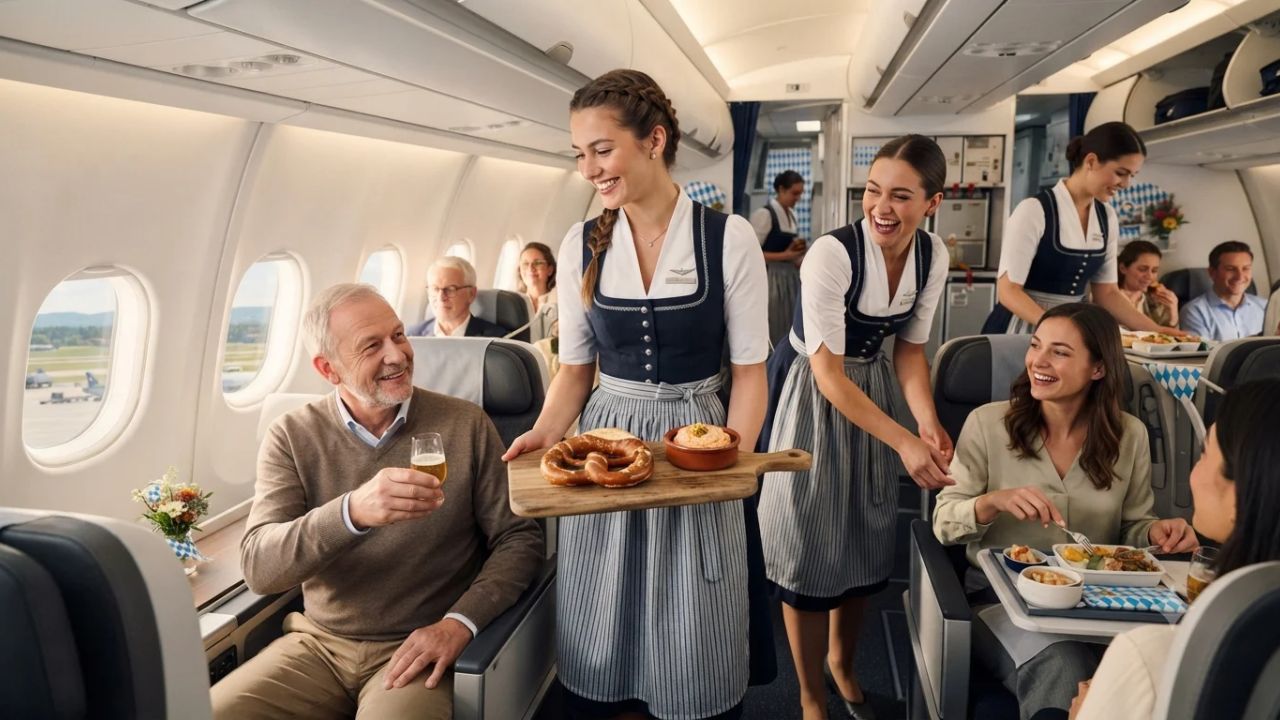
Image generated by AI
Long before international travelers touch down on Bavarian soil to enter the world-famous festival grounds of Munich, the celebratory spirit now ignites at 35,000 feet above the clouds. Commemorating two full decades of its airborne festival heritage, Germany's flagship carrier Lufthansa has rolled out newly commissioned traditional Bavarian attire created in partnership with heritage fashion house Spieth & Wensky. Operating on premier intercontinental routes departing Munich for Bangalore (flight LH764) and Beijing (flight LH722) on 19 September 2026, followed by Singapore (flight LH768) on 27 September, this cultural initiative brings authentic Alpine textile craftsmanship and seasonal gastronomy to long-haul flyers across the globe.
The Airborne Wiesn: Crafting Heritage Tracht for Long-Haul Skies
The practice of transforming aircraft cabins into sky-high beer halls dates back to 2006, when Lufthansa first dispatched a traditionally dressed crew from Munich to New York. For Oktoberfest 2026, the airline deepened this regional connection by collaborating directly with Spieth & Wensky, a historic fashion producer renowned for authentic Bavarian garment construction. This collection marks the first time modern corporate aviation design has been woven directly into regional folk costume: the airline’s storied crane insignia is cast into knitwear buttons, while its signature geometric "Wing Pattern" is subtly integrated into dirndl aprons, skirts, and tailored men's waistcoats.
Rather than treating traditional attire as a disposable festival novelty, the uniforms adhere to strict standards of Bavarian dressmaking while meeting commercial safety and mobility mandates for inflight personnel. This mobile cultural exhibition connects with an extensive calendar: flight LH764 to Bangalore and flight LH722 to Beijing set the airborne celebration in motion on 19 September 2026, with flight LH768 extending the experience to Singapore on 27 September.
The celebration extends across the carrier's culinary program. From 1 September through 30 September, passengers across multiple travel classes on select long-haul departures out of Munich and Frankfurt receive bespoke regional menus. Travelers encounter white sausage terrine, sourdough pretzel creations, slow-roasted festival duck with braised red cabbage, crispy country-style fried chicken, and warm cinnamon-spiced apple strudel. On the ground, premium lounges across German hubs mirror the ambiance with seasonal draft pours from Munich’s historic breweries, Bavarian pretzels, and rustic autumn decor.
What Makes Munich and Bavarian Wiesn Culture Different
To understand why this airborne initiative resonates so strongly, one must grasp how deeply Tracht—the historic folk clothing of southern Germany and the Alpine valleys—is stitched into daily Bavarian life. In Munich, wearing a handcrafted Dirndl or supple deer-leather Lederhosen is not a pantomime costume. It represents an enduring statement of regional pride, ancestral solidarity, and celebration that residents wear to weddings, Sunday parish services, and neighborhood beer gardens.
When millions journey toward the Theresienwiese meadow via Munich Tourism, the visual spectacle is overwhelming. Yet true Bavarian culture thrives on Gemütlichkeit—an untranslatable sense of warmth, conviviality, and unhurried belonging. Beyond the massive, roaring commercial beer tents that dominate foreign postcards, locals gravitate toward the Oide Wiesn at the southern perimeter of the fairgrounds. Here, historic wooden beer casks are tapped with copper mallets, authentic brass folk musicians play without electronic amplification, and generations dance the traditional Schuhplattler on polished timber floors.
Visitor Insider Tips
Experiencing Munich during the height of late September requires tactical local knowledge to avoid getting swept into tourist bottlenecks. When arriving via Munich Airport, bypass crowded regional taxis and board the S-Bahn suburban rail network. Both the S1 and S8 lines deliver you directly to Hackerbrücke station in approximately forty-five minutes. From this elevated railway bridge, a pedestrian walkway leads straight to the north entrance of the Theresienwiese in under ten minutes.
Securing entry into legendary beer tents like Augustiner-Festhalle or Schottenhamel on weekends is impossible without corporate reservations confirmed months prior. Instead, plan your visits on Tuesday or Wednesday mornings between 10:00am and 11:30am, when tents open unreserved wooden table sections to walk-in patrons. Once seated, observe proper beer hall protocol: never stand or dance on the tables—dancing is permitted only on the sturdy wooden benches. Tip your designated server on the very first round to guarantee attentive service throughout the afternoon.
For breakfast, honor Munich’s golden culinary rule: Weißwurst (traditional poached veal sausage seasoned with parsley, lemon zest, and mace) must be consumed before the church bells chime at noon. Head to historic taverns in the Haidhausen or Sendling districts, where these delicate sausages arrive submerged in hot water terrines alongside sweet mustard, fresh lye pretzels, and cloudy wheat beer. For accommodation, avoid the chaotic hotels immediately flanking the central train station; establish your base in quiet, leafy residential quarters like Maxvorstadt or Schwabing, where tree-shaded avenues and neighborhood bakeries offer tranquility after long days on the fairgrounds.
Cultural and Environmental Context
The international projection of Oktoberfest highlights an intricate conversation between mass tourism and municipal sustainability. Every year, over six million global travelers descend upon Munich in a sixteen-day window, testing city sanitation, transit capacity, and residential patience. In response, local authorities and festival coordinators collaborating through the German National Tourist Board have transformed the fairgrounds into a laboratory for ecological tourism.
Today, the entire festival operates on 100 percent renewable green electricity, single-use plastic dishware is banned across all fourteen major tents, and closed-loop wash stations clean millions of glass beer mugs with recycled rainwater. Organic agriculture mandates mean the roast poultry, pretzels, and pork served in historic tents are sourced from certified regional farms in Upper and Lower Bavaria. When international carriers bring traditional craft into flight cabins, it serves as a powerful reminder that global travel can elevate regional heritage, honoring centuries of cultural identity while championing responsible modern practices.
FAQ: Visiting Munich and Oktoberfest 2026
What is the best time of day to enter Oktoberfest tents without a reservation?
Arrive on weekday mornings, preferably Tuesday through Thursday, between 10:00am and 11:30am. During these morning hours, unreserved perimeter tables remain open before corporate groups and evening revelers arrive.
How do travelers reach the festival grounds from Munich Airport?
Take S-Bahn line S1 or S8 directly from the airport terminal to Hackerbrücke station. From the platform, follow marked pedestrian corridors south across the bridge straight to the Theresienwiese entrances in ten minutes.
Do visitors need an admission ticket to enter the Oktoberfest grounds?
No general admission ticket is required to enter the main festival grounds or beer tents. Entry is free, though the nostalgic Oide Wiesn section charges a small nominal fee at its gates.
Is Munich safe for solo travelers during the autumn festival season?
Munich remains one of Europe's safest metropolitan centers. Well-lit transit hubs, strong police presence around festival perimeters, and dedicated safe spaces for solo travelers ensure secure passage day and night.
True Bavarian hospitality is not measured by the size of the crowd, but by the warmth with which a shared bench welcomes a passing stranger.
Related Travel Guides
North America Luxury Winter Travel: Big Sky Heights, Deer Valley Expansion, and Lake Louise Escapes
10 Best Beer Gardens and Traditional Taverns in Munich According to Reddit 2026
Disclaimer
This article is for informational and educational purposes only. It does not constitute legal, financial, or professional advice. While we strive to provide accurate and up-to-date information, travel policies, regulations, and conditions change rapidly. Always verify information with official sources before making travel decisions. Nomad Lawyer makes no representations about the accuracy, reliability, completeness, or suitability of the information provided. Readers should consult qualified professionals for advice specific to their circumstances. The views expressed in this article are those of the author and do not necessarily reflect the views of Nomad Lawyer.
Raushan Kumar
Founder & Lead Developer
Full-stack developer with 11+ years of experience and a passionate traveller. Raushan built Nomad Lawyer from the ground up with a vision to create the best travel and law experience on the web.
Learn more about our team →