
Lucas Museum of Narrative Art Opens in Los Angeles: Insider Guide to Exposition Park's Cultural Transformation
The $1 billion Lucas Museum of Narrative Art debuts September 22, 2026, in Exposition Park with 100,000 square feet of gallery space, rare Star Wars archives, and a free 13-acre park.

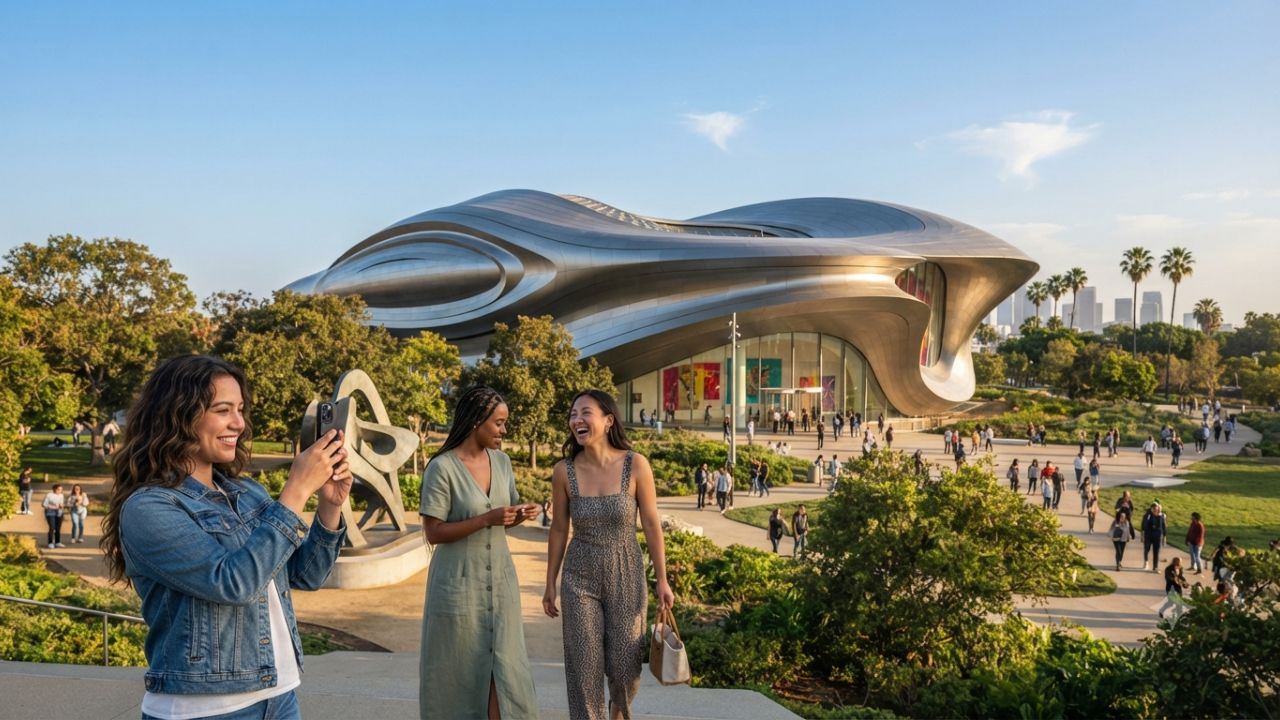
Image generated by AI
Long before its curvaceous, spaceship-like silhouette touched down in South Los Angeles, the Lucas Museum of Narrative Art spent years overcoming cross-country rejections and planning battles in Chicago and San Francisco. When the gates officially open to the public on Tuesday, September 22, 2026, this monumental $1 billion institution established by filmmaker George Lucas and business leader Mellody Hobson will not merely add another museum to Southern California—it will radically redefine how the world validates visual storytelling. Spanning more than 100,000 square feet of dedicated gallery space and housing over 1,300 works across more than 30 individual galleries, the facility bridges the artificial divide separating revered fine art from popular comic strips, cinema crafts, and ancient mythologies.
Located at One Lucas Plaza in Exposition Park, the museum anchors a revitalized cultural district south of Downtown Los Angeles. For travelers who have long relegated Los Angeles to studio backlot tours and coastal drives, this opening signals an unmistakable cultural pivot. By assembling classical oil paintings, Golden Age American illustrations, comic book manuscripts, high-resolution heritage replicas, and screen-used cinema artifacts, the museum constructs a continuous narrative lineage that places twentieth-century science fiction directly beside Renaissance masterworks.
Exposition Park's Historic Shift Toward Global Narrative Arts
The unveiling of the Lucas Museum marks the culmination of an ambitious transformation for Exposition Park, an expansive civic quadrant established in the late nineteenth century that already hosts the Natural History Museum of Los Angeles County, the California Science Center, and the Los Angeles Memorial Coliseum. For decades, daytime crowds arrived for specific exhibits or athletic contests before departing immediately. The addition of One Lucas Plaza introduces an immersive cultural anchor intended to keep curious explorers engaged from morning until dusk.
Travelers planning visits through official channels like Visit California will find an institution designed around the democratizing power of illustration. The foundational first-floor exhibition, titled The History of Narrative Art: Heroes • Myths • The Sacred, tackles the fundamental human impulse to record shared values through pictures. Recognizing that many foundational masterworks cannot safely travel from their native sanctuaries, the curatorial team deployed three-dimensional spatial scanning and high-resolution imagery to construct exact visual reproductions. Visitors can stand beneath an exacting digital facsimile of the Sistine Chapel ceiling, study the monumental relief of ancient Assyrian winged human-headed bulls from the palace of King Sargon II, inspect the intricate iconography of the Aztec Sun Stone, and observe the prehistoric contours of the Altamira cave paintings preserved in northern Spain through records cataloged by the UNESCO World Heritage Centre.
Rather than segregating historical artifacts into isolated vaults, the Lucas Museum intertwines them with populist twentieth-century creations. Walking through the thirty-plus galleries, you move seamlessly from Norman Rockwell's mid-century domestic scenes and N.C. Wyeth's swashbuckling canvas illustrations to the vivid emotional portraits of Frida Kahlo and the raw social realism captured by Gordon Parks and Diego Rivera. The collection gives serious, museum-grade space to children's book illustrations by Beatrix Potter, fantasy masterworks by Boris Vallejo, Julie Bell, and Ken Kelly, and intricate original comic art by Charles Schulz, George Herriman, Frank Miller, and Jim Lee.
What Makes The Lucas Museum Collection Radically Different
Traditional art institutions often draw strict boundaries between highbrow fine art and commercial illustration. The Lucas Museum dismantles that hierarchy completely. Here, American illustrator Maxfield Parrish and regionalist painter Thomas Hart Benton hang in thematic communion with Japanese pop pioneer Takashi Murakami and enigmatic street artist Banksy. The collection is organized not strictly by chronology, but around universal emotional anchors: love, family, labor, sport, community, danger, and adventure.
One gallery highlights monumental public storytelling through the working archives of Judith F. Baca, the visionary artist behind The Great Wall of Los Angeles in the San Fernando Valley. Her studies sit in dialogue with large-scale prints by French photographer JR and revolutionary murals by Diego Rivera, illustrating how public street walls have historically given voice to disenfranchised communities. This curatorial dialogue connects directly to the mural heritage painted across the neighborhoods of East Los Angeles and South Central.
For film historians and pop culture enthusiasts, the dedicated cinema gallery featuring Star Wars in Motion delivers an unmatched archival journey. George Lucas's personal preservation efforts mean travelers can inspect the authentic, weathered exterior of Luke Skywalker's Landspeeder from A New Hope alongside the original full-scale physical build of General Grievous's Wheel Bike from Revenge of the Sith. Displayed alongside developmental concept sketches, hand-sewn costumes, and miniature filming models, these items demonstrate how cinematic world-building relies on traditional sculpting, industrial design, and narrative discipline rather than purely digital computation.
Visitor Insider Tips
Experiencing a cultural venue of this scale requires strategic planning, particularly during its inaugural season when international demand is peaking.
- Secure Timed-Entry Passes Early: General adult admission is $25, seniors aged 65 and older pay $21, while visitors aged 17 and younger and active-duty military personnel enter free of charge. Timed-entry reservations are strictly mandatory for all indoor galleries, and weekend tickets routinely book out weeks ahead.
- Ride the E Line Instead of Driving: Parking lots around Exposition Park charge steep event-day rates and gridlock along the I-110 corridor is notorious. Take the light rail via the Los Angeles County Metropolitan Transportation Authority E Line (Expo) directly to the Expo/Vermont station, which deposits you mere steps from One Lucas Plaza.
- Explore the Free 13-Acre Green Sanctuary: You do not need a paid gallery ticket to enjoy the surrounding 13-acre public park designed by landscape architect Mia Lehrer of Studio-MLA. This sprawling botanical project transformed vast asphalt parking lots into an urban oasis filled with more than 300 native and climate-adapted trees, rolling meadows, an amphitheater, a hanging garden, and an cascading waterfall-like fountain. Ten monumental outdoor sculptures are scattered across the grounds, including striking original works by Fernando Botero and Prune Nourry, alongside life-sized artistic tributes to the Star Wars cinematic universe.
- Spend Quiet Hours in the Research Library: Tucked inside the complex is a free, publicly accessible Research Library containing more than 30,000 comic books, rare archival volumes from the historic Skywalker Ranch Library in Marin County, approximately 3,000 art publications donated by Steve and Ann Martin, and over 2,900 volumes from mythologist Joseph Campbell's personal library. It is one of the most serene, scholarly spots in the entire city for writers, graphic artists, and myth lovers.
- Dine at Skywalker Grill for Sunset: Located on the rooftop, Skywalker Grill serves lunch, dinner, and weekend brunch to both ticket holders and walk-in visitors. The menu showcases California-grown ingredients through elevated American bistro recipes. Secure a sunset table on the terrace for panoramic vistas looking across the Downtown Los Angeles skyline and the Santa Monica Mountains.
Cultural and Environmental Context
The arrival of a $1 billion private museum in South Los Angeles carries deep urban significance. Exposition Park sits within an ethnically diverse, working-class neighborhood that has experienced decades of systemic underinvestment. Unlike cultural centers situated in affluent enclaves like Brentwood or the hills above Malibu, the Lucas Museum places world-class art and education directly at a primary transit intersection accessible to local public school students and neighborhood families. Free admission for anyone 17 and younger ensures that neighborhood youth can return repeatedly to study Joseph Campbell's mythology texts or inspect original comic boards without financial barriers.
Environmentally, the project represents a triumph of climate-conscious urban renewal. By ripping up acres of heat-trapping blacktop parking lots to plant a multi-layered canopy of 300 mature shade trees and drought-resilient California flora, Studio-MLA created a vital cooling zone in the urban heat island of central Los Angeles. Rainwater capture systems, permeable walking paths, and solar integration demonstrate how major cultural developments can heal fractured civic ecosystems while fostering local biodiversity.
FAQ: Visiting The Lucas Museum 2026
What are the ticket prices and booking requirements? Adult admission is $25, seniors 65 and older pay $21, and visitors 17 and younger or active-duty military enter free. All indoor gallery visits require advance timed-entry bookings through the official website.
How do I travel to the museum using public transit? Ride the Metro E Line (Expo) light rail directly to the Expo/Vermont station. The stop brings you to the western edge of Exposition Park, a two-minute walk from One Lucas Plaza.
Can I visit the park, library, or restaurant without buying museum tickets? Yes. The 13-acre botanical park, the Research Library, and the rooftop Skywalker Grill are completely open to the public without requiring a paid gallery admission pass.
When is the best time to visit to avoid crowds? Plan your timed entry for weekday mornings, particularly Wednesday and Thursday right at opening, before school tours arrive and weekend family travelers fill the gallery pavilions.
From ancient mythic scrolls to twentieth-century pop icons, this futuristic sanctuary proves that every society is defined by the visual stories it dares to tell.
Related Travel Guides
Travel California & New York 2026: Rising Costs Reshape US Destination Appeal
California best affordable suburbs near major cities 2026
12 Best Cultural Attractions in Los Angeles, According To Reddit
Disclaimer
This article is for informational and educational purposes only. It does not constitute legal, financial, or professional advice. While we strive to provide accurate and up-to-date information, travel policies, regulations, and conditions change rapidly. Always verify information with official sources before making travel decisions. Nomad Lawyer makes no representations about the accuracy, reliability, completeness, or suitability of the information provided. Readers should consult qualified professionals for advice specific to their circumstances. The views expressed in this article are those of the author and do not necessarily reflect the views of Nomad Lawyer.
Kunal K Choudhary
Co-Founder & Contributor
A passionate traveller and tech enthusiast. Kunal contributes to the vision and growth of Nomad Lawyer, bringing fresh perspectives and driving the community forward.
Learn more about our team →