
LOT Polish Airlines Launches Historic Warsaw–San Francisco Nonstop Flight
LOT Polish Airlines debuts first-ever nonstop Warsaw–San Francisco route on May 6, 2026, reshaping transatlantic connectivity with Boeing 787 Dreamliners and four weekly flights.

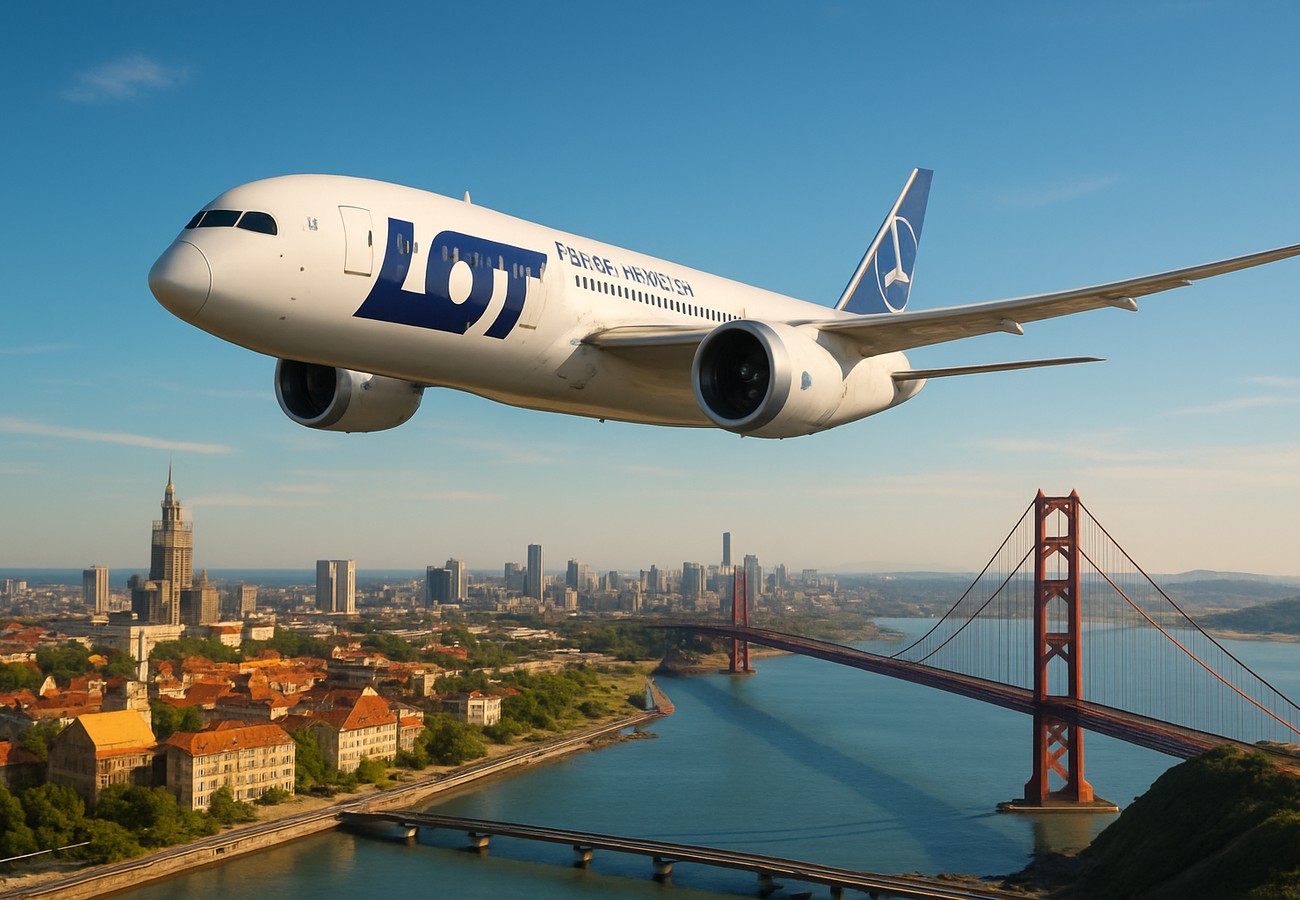
Image generated by AI
LOT Polish Airlines Launches Historic Nonstop Warsaw–San Francisco Route: First-Ever Direct Transatlantic Connection Reshapes Central European–US Travel
A Strategic Game-Changer for Business and Leisure Travelers Seeking Faster Connectivity Between Europe and the U.S. West Coast
WARSAW — In a landmark development for transatlantic aviation, LOT Polish Airlines officially commenced nonstop service between Warsaw Chopin Airport and San Francisco International Airport on May 6, 2026, marking the first-ever direct connection between the two cities. The 12-hour flight represents a major expansion of the Polish carrier's North American network and signals a shift toward more efficient, direct connectivity across one of Europe's most strategically positioned hubs.
The launch arrives as global airlines increasingly recognize the commercial potential of connecting Central and Eastern European passengers with the U.S. West Coast. For travelers, the implications are immediate: shorter journey times, reduced layover fatigue, and improved connections across four continents—North America, Europe, Asia, and the Indian subcontinent.
What's Driving This Historic Route Launch?
LOT Polish Airlines did not arbitrarily select the Warsaw–San Francisco corridor. Market analysis reveals that approximately 26,000 passengers traveled this route annually via connecting flights—a substantial volume that went unserved by nonstop options despite sustained demand. This gap represented both a market opportunity and a strategic liability for the airline industry.
The demand is driven by three distinct passenger segments:
- Polish diaspora in Northern California: A thriving Polish-American community in the Bay Area and Silicon Valley
- Business and technology professionals: Increasing corporate travel between European tech hubs and Silicon Valley
- Leisure travelers: Tourists seeking multi-city itineraries across Europe and the U.S. West Coast
The route's profitability potential attracted LOT's investment. Average fares between Warsaw and San Francisco have historically remained elevated compared to comparable transatlantic pairings, providing premium yield potential that justifies the operational costs of long-haul service.
Operational Details: The Aircraft and Schedule
Fleet Deployment: LOT has deployed its modern Boeing 787 Dreamliner fleet to operate this service, utilizing both 787-8 and 787-9 variants. The 787 series delivers significant operational advantages for 12-hour flights:
- Fuel efficiency: Up to 20% better fuel economy than comparable wide-body aircraft
- Cabin comfort: Larger cabin windows, improved air filtration, reduced cabin pressure for enhanced passenger comfort
- Noise reduction: Quieter engines benefit both passengers and communities near departure/arrival airports
Flight Frequency and Schedule: The initial service operates four times weekly during the peak summer travel season (May–September 2026). This frequency provides meaningful choice for both leisure and business travelers while maintaining operational efficiency.
Split departure timings have been strategically planned to optimize connectivity. Morning and evening departures ensure that arriving passengers can access onward connections to over 40 European destinations within short transfer windows—typically 2–3 hours—making the Warsaw hub increasingly attractive as a consolidation point for North American-bound passengers originating across the European continent.
Geopolitical and Economic Context: Why Warsaw and Why Now?
The timing of this launch reflects broader shifts in global aviation and geopolitics:
Central Europe's Strategic Position: Warsaw has increasingly emerged as a gateway between Western Europe and the United States, supplementing traditional hubs like Frankfurt, Munich, and Paris. By offering a northern routing with competitive connectivity, LOT positions Poland as an alternative to congested Western European airports.
Post-Pandemic Network Restructuring: Airlines globally have reassessed long-haul networks following pandemic-driven capacity reductions. LOT's expansion signals confidence in transatlantic demand recovery and suggests that leisure and business travel patterns favor direct connectivity over traditional hub structures.
Competitive Advantage in a Consolidated Market: While legacy carriers dominate major transatlantic routes, regional hubs like Warsaw offer niche opportunities. LOT's strong Central European network—combined with growing North American infrastructure—allows the airline to compete on connectivity value rather than schedule frequency alone.
Energy and Fuel Considerations: The 787 Dreamliner's superior fuel efficiency is particularly advantageous in 2026, when global jet fuel costs remain elevated relative to historical baselines. Lower fuel burn directly improves route economics and allows competitive pricing.
The Route Structure: Beyond Point-to-Point Service
This isn't merely a point-to-point flight—it's a foundational route for a larger strategic architecture.
European Connectivity Hub: Warsaw serves as the gateway. Passengers arriving from San Francisco can connect to destinations across Central Europe (Prague, Budapest, Kraków), the Balkans (Belgrade, Bucharest), Greece (Athens), Turkey (Istanbul), and the Middle East (Tel Aviv, Dubai). This connectivity transforms the Warsaw–San Francisco flight from a simple city pair into a multi-region access point.
The India Link: An Unexpected Advantage One of the route's most intriguing features is its potential connection to the Indian subcontinent. By incorporating 4–5 hour layovers in Warsaw, San Francisco–Delhi passengers now have a viable alternative to traditional routing via European hubs or Middle Eastern carriers. This creates competitive pressure on established India routes and opens new pricing arbitrage opportunities for travel agencies and online booking platforms.
North American Gateway Function By August 2026, LOT plans to operate approximately 70 weekly departures across North America, with major routes to New York (JFK), Chicago (ORD), Toronto (YYZ), and additional U.S. and Canadian destinations. The Warsaw–San Francisco flight anchors the western flank of this network, while Eastern seaboard routes serve the traditional transatlantic corridor.
Passenger Impact: What Travelers Actually Experience
The Advantages
Time Savings: Passengers eliminate 4–8 hour layovers typical of one-stop itineraries. A Warsaw–San Francisco journey reduces from 15–18 hours (with layovers) to 12 hours direct—a measurable quality-of-life improvement for long-haul travel.
Comfort and Sleep: The 787's superior cabin pressure and humidity control reduce jet lag and fatigue, a critical factor for business travelers who must be productive immediately upon arrival.
Seamless Connections: Passengers connecting beyond San Francisco (to Los Angeles, Seattle, Las Vegas, or Asian destinations) benefit from LOT's growing codeshare arrangements and schedule synchronization.
Competitive Pricing Pressure: The route introduces competitive pressure to existing transatlantic fares. While initial premium pricing is expected, competition from other carriers may stabilize fares within 6–12 months.
The Challenges
Limited Frequency: Four weekly flights restrict options compared to major transatlantic routes (which operate daily or near-daily). Last-minute changes or flight cancellations offer fewer rebooking alternatives.
Seasonal Operation: The summer-focused schedule may not accommodate winter travelers seeking San Francisco connections, forcing off-season passengers back to connecting alternatives.
Premium Positioning: Initial fares are expected to command a premium. Early adopters may pay 15–30% more than equivalent one-stop itineraries, though this typically narrows as markets mature.
Market Dynamics: Competitive Landscape and Strategic Implications
Competitive Position: LOT faces indirect competition from:
- Legacy carriers (Lufthansa, Air France–KLM, United, Delta): Operating multiple daily transatlantic flights with established networks
- Gulf carriers (Emirates, Qatar Airways, Etihad): Offering premium long-haul service with extensive Asia-Pacific networks
- Hybrid competitors (Icelandair, SWISS): Providing alternative transatlantic routings with strong connectivity
However, LOT's advantages are notable:
- Regional network depth: Superior connections across Central and Eastern Europe
- Lower operating costs: Compared to legacy Western European carriers
- Strategic positioning: Neither geographically nor competitively crowded in the San Francisco market
- Growth trajectory: This route represents early-stage expansion, with future frequency increases likely as demand validates the service
Global Trade and Economic Implications
This route extends beyond passenger convenience. It has supply chain consequences:
Tech Industry Connectivity: Silicon Valley's reliance on European talent and components creates direct business demand. Improved Warsaw–San Francisco connectivity facilitates equipment shipments, consultant travel, and corporate site visits between U.S. tech companies and their Central European partners and suppliers.
Tourism and Cultural Exchange: The route incentivizes U.S. West Coast residents to explore Central Europe, potentially increasing tourism spending in Poland, Czech Republic, and neighboring countries—a significant economic benefit for the region.
Hub Competition: Warsaw's improved connectivity may shift hub selection patterns among freight forwarders and logistics companies, influencing cargo routing and supply chain efficiency across transatlantic commerce.
Industry Analysis: What This Signals for Global Aviation
The Trend Toward Distributed Hubs: Historically, transatlantic aviation concentrated on major Western European hubs (Frankfurt, London, Paris) and U.S. gateways (New York, Chicago, Los Angeles). LOT's expansion suggests a shift toward more dispersed, regional hub strategies—leveraging secondary cities with lower congestion and operational costs.
Long-Haul Profitability in Regional Markets: The viability of a 26,000-passenger annual market demonstrates that smaller, underserved city pairs can support profitable long-haul service. This may inspire other regional carriers to evaluate similar opportunities, fragmenting transatlantic capacity in potentially productive ways.
Aircraft Technology as a Competitive Enabler: The 787 Dreamliner's economics make routes like Warsaw–San Francisco viable. Older wide-body aircraft (777, 767) would struggle with profitability on this route at current fuel prices. This underscores how aircraft efficiency improvements directly enable new route launches.
Geopolitical Dimension: LOT's North American expansion reflects Poland's role in the EU and NATO—positioning the country as a bridge between Western Europe and North America. This carries subtle geopolitical implications regarding Central Europe's integration into transatlantic economic structures.
What Happens Next: Future Scenarios and Outlook
Near-Term (Next 6–12 months):
- Frequency increases from 4 to 5–6 weekly flights as demand validates the service
- Additional aircraft allocation to the route if load factors exceed 85%
- Potential codeshare partnerships with U.S. carriers (United, Delta, American) to expand connectivity
- Seasonal winter service may launch if summer performance justifies year-round operation
Medium-Term (12–24 months):
- Route profitability attracting competitive responses from other European carriers
- Fare stabilization as market capacity increases
- Integration of the route into broader transatlantic alliance strategies (Star Alliance, SkyTeam, OneWorld)
Long-Term (2+ years):
- Potential expansion of direct LOT service to additional U.S. West Coast cities (Los Angeles, Seattle)
- Full year-round operation with frequency scaling to 10+ weekly flights
- Strategic significance as part of a broader Central European aviation renaissance
Conclusion: A Milestone for Transatlantic Aviation
The launch of LOT Polish Airlines' nonstop Warsaw–San Francisco service on May 6, 2026, marks more than an airline scheduling decision—it represents a fundamental shift in how transatlantic connectivity is organized. By demonstrating that secondary Central European hubs can viably serve North American routes, LOT has opened a playbook that other regional carriers will study and potentially replicate.
For travelers, the immediate benefit is tangible: 12 hours of direct flight time, improved comfort via modern aircraft, and access to a sprawling European network from a strategically positioned gateway. For the airline industry, the launch signals confidence in transatlantic demand recovery and validates the commercial potential of distributed hub strategies that challenge the dominance of traditional Western European super-hubs.
As global aviation continues to evolve post-pandemic, expect similar route announcements from other European carriers seeking to leverage underutilized regional hubs and modern aircraft economics. The future of transatlantic travel is increasingly direct, increasingly diverse in routing options, and increasingly accessible from cities beyond the traditional major hubs.
Key Takeaways
- Historic Launch: LOT Polish Airlines operates the first-ever nonstop flight between Warsaw and San Francisco, launching May 6, 2026
- Market Gap Addressed: Approximately 26,000 annual passengers previously traveled this route via connections; nonstop service eliminates 4–8 hour layovers
- Modern Fleet: Boeing 787 Dreamliners provide superior fuel efficiency, comfort, and cabin technology for the 12-hour journey
- Strategic Connectivity: Warsaw emerges as a gateway to 40+ Central European destinations and potential connections to India via brief layovers
- Competitive Implications: Route introduces pricing pressure to established transatlantic carriers and validates dispersed hub strategies
- Global Impact: Strengthens Warsaw as a transatlantic hub, incentivizes tourism to Central Europe, and facilitates tech industry travel between Silicon Valley and European innovation centers
- Future Expansion: LOT targets 70+ weekly North American departures by August 2026, signaling sustained transatlantic growth
Related Travel Guides
Disclaimer
This article is for informational and educational purposes only. It does not constitute legal, financial, or professional advice. While we strive to provide accurate and up-to-date information, travel policies, regulations, and conditions change rapidly. Always verify information with official sources before making travel decisions. Nomad Lawyer makes no representations about the accuracy, reliability, completeness, or suitability of the information provided. Readers should consult qualified professionals for advice specific to their circumstances. The views expressed in this article are those of the author and do not necessarily reflect the views of Nomad Lawyer.
Kunal K Choudhary
Co-Founder & Contributor
A passionate traveller and tech enthusiast. Kunal contributes to the vision and growth of Nomad Lawyer, bringing fresh perspectives and driving the community forward.
Learn more about our team →