
Southern Rail Derailment Near Lewes Injures 11 Passengers as Major Safety Probe Launches in 2026
Eleven people were injured after a Southern Rail passenger train derailed near Lewes, East Sussex, on August 13, 2026, triggering an intensive investigation into track stability and heat-related infrastructure failure.

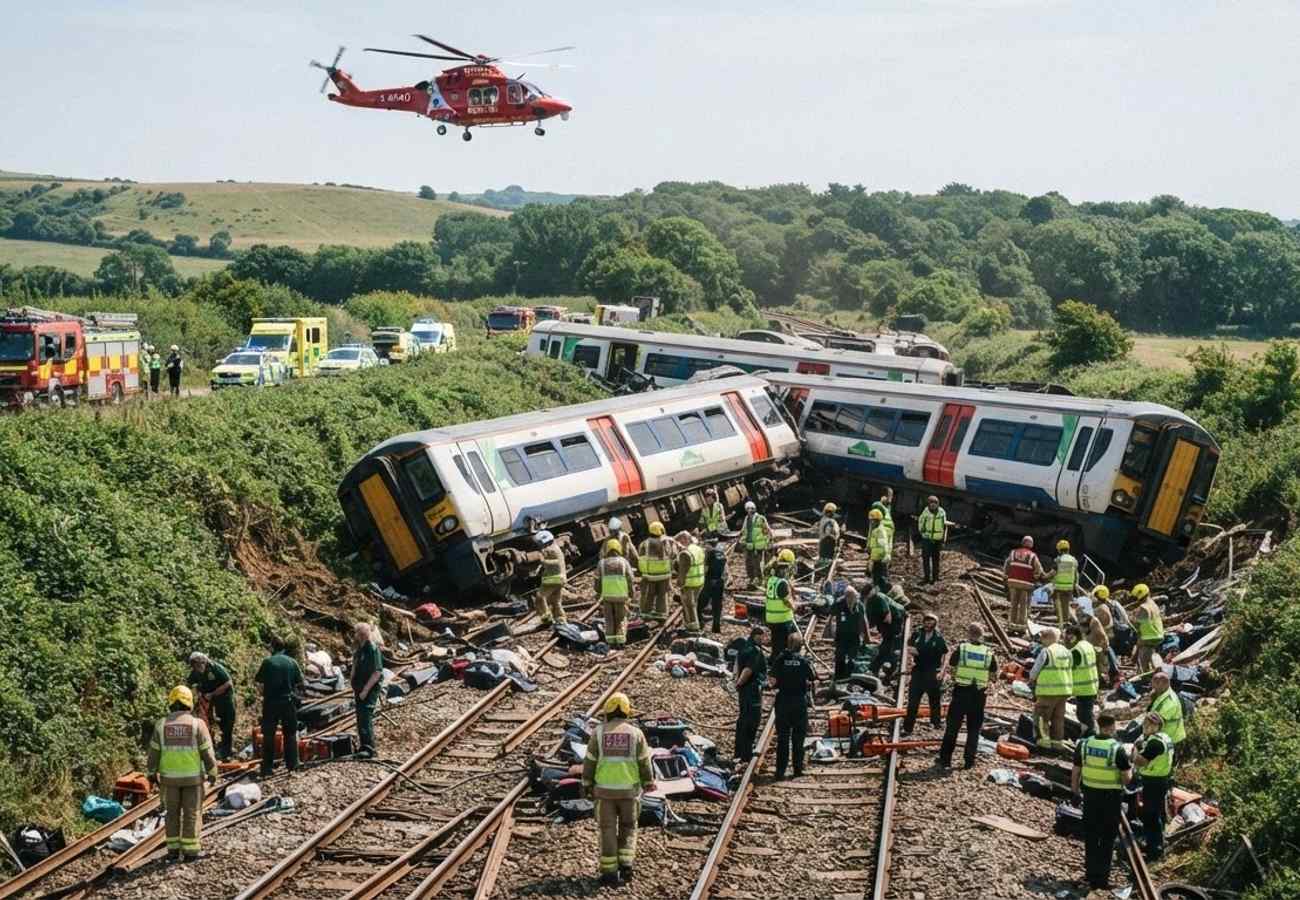
Image generated by AI
[Lewes, August 14, 2026] — A Southern Rail passenger service derailed near Lewes in East Sussex on Thursday, August 13, resulting in injuries to 11 people and causing widespread chaos across the south coast rail network. The incident, which saw several carriages overturn, has triggered a formal safety inquiry to determine if extreme summer temperatures contributed to the infrastructure failure.
The accident occurred during a period of heavy regional travel, leaving multiple carriages resting on their sides against a railway embankment. Emergency services launched a massive mobilization to evacuate passengers from the tilted coaches, while rail operators scrambled to manage the resulting systemic delays across Sussex.
London to Eastbourne Service Leaves Tracks Outside Lewes
The affected train was a Southern Rail service traveling from London Victoria to Eastbourne. According to reports, the derailment happened shortly after the train departed Lewes station, a critical junction for the south coast network. At the time of the incident, approximately 150 passengers were on board.
The derailment involved the rear section of the train, where several carriages jumped the rails and toppled. Because the event took place so close to the station, the train was likely traveling at a lower speed, a factor that industry observers suggest prevented a more catastrophic outcome.
Medical responders treated 11 individuals at the scene. Two of the injured are reported to be in serious condition, while the remaining nine were classified as "walking wounded," suffering primarily from minor impact injuries and cuts caused by broken glass inside the coaches. No fatalities have been reported.
Emergency Response and Rescue Operations in East Sussex
The scale of the response was significant, involving a coordinated effort between fire services, ambulance crews, and specialist rail rescue teams. Due to the steep embankments and limited rail access, responders were forced to operate directly on the tracks, utilizing cutting equipment and ladders to extract passengers from the overturned carriages.
The surge of emergency vehicles caused secondary congestion on local roads, particularly those feeding into the A27. Local residents reported the sound of rescue helicopters circling the town as triage centers were established along the tracks to assess casualties.
Passengers described a terrifying sequence of events where the rear coaches began to rock violently from side to side before lifting off the rails and sliding against the embankment. Some survivors reported being trapped on the sidewalls of the carriages, waiting for rescue teams to guide them to safety. Local health services were placed on major-incident alert as a precaution to handle the potential influx of casualties.
Network Paralyzation and Regional Transit Disruptions
The derailment effectively severed a vital artery of the Southern Rail network. Services between Brighton, Seaford, Eastbourne, and Haywards Heath were either completely suspended or severely curtailed. Because Lewes serves as a pivotal hub where coastal branches and London-bound lines converge, the blockage created a ripple effect of delays throughout the region.
While replacement bus services were deployed to bridge the gap between key stations, they were quickly overwhelmed by the volume of stranded commuters during the evening rush.
| Affected Route | Status | Impact Level |
|---|---|---|
| London Victoria $\rightarrow$ Eastbourne | Suspended | Critical |
| Brighton $\rightarrow$ Lewes | Heavily Reduced | High |
| Haywards Heath $\rightarrow$ Seaford | Diverted/Cancelled | High |
| South Coast Regional Links | Delayed | Moderate |
Network managers are currently working to restore partial service before the upcoming weekend, but full operations remain dependent on engineering assessments and the removal of the damaged rolling stock.
Formal Inquiry Focuses on Heat-Induced Track Buckling
Within hours of the crash, rail accident specialists and engineers arrived at the site to begin a forensic analysis. While official conclusions are pending, early technical discussions have centered on the impact of the intense summer heatwave on the steel rails.
Industry professionals and rail enthusiasts have pointed to potential "track buckling"—a phenomenon where extreme heat causes rails to expand and warp—as a likely cause. Some preliminary images from the scene appear to show distorted rails at the exact point of derailment.
This incident adds to a growing body of evidence regarding the vulnerability of British rail infrastructure to climate stress. Investigators are expected to scrutinize maintenance logs, recent inspection reports, and the exact speed of the train at the moment of failure to determine if systemic negligence or environmental extremes were the primary trigger.
Safety Analysis and Infrastructure Resilience
Despite the visual severity of the overturned carriages, safety specialists have noted that the lack of fatalities is a testament to modern rolling stock engineering. The structural integrity of the carriages remained largely intact, preventing the type of large-scale collapse often seen in high-speed derailments.
However, the event has reignited debates over the adequacy of infrastructure investment in the UK. As the network handles millions of journeys weekly, the Lewes incident serves as a critical case study in how environmental volatility can suddenly compromise operational safety.
Why This Matters (Information Gain & Experience)
For the daily commuter or leisure traveler, this incident highlights a growing risk: the gap between aging infrastructure and increasingly extreme weather patterns. When track buckling occurs, it is often invisible to the driver until the moment of derailment. From a legal and logistical standpoint, this shift puts pressure on rail operators to implement more aggressive "heat-speed restrictions" during summer months, which may lead to more frequent planned delays to ensure passenger safety. For those traveling through the South Coast corridor, this event underscores the necessity of checking real-time transit apps during heatwaves, as infrastructure instability can lead to sudden, total network failures.
The investigation into the Lewes derailment will likely redefine safety protocols for rail travel during extreme weather events.
Related Travel Guides
Disclaimer
This article is for informational and educational purposes only. It does not constitute legal, financial, or professional advice. While we strive to provide accurate and up-to-date information, travel policies, regulations, and conditions change rapidly. Always verify information with official sources before making travel decisions. Nomad Lawyer makes no representations about the accuracy, reliability, completeness, or suitability of the information provided. Readers should consult qualified professionals for advice specific to their circumstances. The views expressed in this article are those of the author and do not necessarily reflect the views of Nomad Lawyer.
Raushan Kumar
Founder & Lead Developer
Full-stack developer with 11+ years of experience and a passionate traveller. Raushan built Nomad Lawyer from the ground up with a vision to create the best travel and law experience on the web.
Learn more about our team →