Kununurra & Australian First Nations Art Hubs: Ethical Cultural Tourism Guide 2026

According to national findings by the Productivity Commission, up to eighty percent of commercial souvenirs sold across Australia bearing Indigenous motifs are inauthentic fakes manufactured offshore, diverting fifty-four million dollars away from Aboriginal creators in a single financial year. While commercial souvenir stalls in transit hubs extract millions through counterfeit merchandise, a sovereign economic transformation is taking root across remote outback homelands. From Miriwoong Country in the East Kimberley town of Kununurra to Arrernte Country in Alice Springs, community-governed Aboriginal art centres are utilizing cryptographic digital provenance, independent governance boards, and high-yield business summits to reclaim Australia's $250 million visual arts economy.
The financial stakes for regional communities are immense. More than 7,300 Aboriginal artists working through community-controlled centres earn an average annual income of $2,700 to $3,200 from art sales, while independent creators average $6,000. Under the community art centre model, 60 to 70 percent of every sale price goes straight to the individual artist, with the remainder funding vital local social infrastructure, including youth leadership programs, elder transport, and community dialysis support. Supported by peak bodies such as WAITOC (Western Australian Indigenous Tourism Operators Council) and Desart, remote outback settlements are moving beyond passive sightseeing to establish commercial self-determination on Country.
| Entity / Route | Metrics | Operational Status |
|---|---|---|
| Economic & Commercial Benchmark | Mass Souvenir Market | Community Art Centre Model |
| National Annual Sector Valuation | $80M–$83M (Consumer Goods) | $30M–$47M (Primary Sales) |
| Prevalence of Inauthentic Items | 60% to 80% Counterfeits | 0% (Protected by Provenance) |
| Average Annual Artist Income | $0 (Brokers Retain Royalties) | $2,700–$3,200 Base Wage |
| Direct Revenue Flow to Community | Negligible Exported Profit | 60%–70% Direct to Artist |
| Provenance Tracking System | Unregulated "Style" Labels | Stories Art Money (SAM) App |
The MICE Spending Advantage and Digital Provenance Shields
Transforming outback tourism economics relies heavily on cultivating high-value business events—the Meetings, Incentives, Conferences, and Exhibitions (MICE) sector. Data from Tourism Research Australia confirms that business events inject $17.2 billion in direct expenditure into the national visitor economy. In regional settings, domestic overnight conference delegates spend an average of $517 per night—representing an expenditure premium 132.9 percent higher than domestic leisure travelers, who average $222 per day. Regional road-trippers average $287.52 per day, while international business delegates deliver a 77 percent daily spending premium over leisure holidaymakers.
To guarantee that cultural spending reaches legitimate custodians, 99 Aboriginal and Torres Strait Islander art centres deploy the Stories Art Money (SAM) database owned by Desart. This software catalogs artist kinship ties, traditional Dreaming narratives, and clan permissions from the moment of creation, issuing tamper-evident Certificates of Authenticity with unique barcodes that ensure zero counterfeit items infiltrate official distribution channels.
On the legislative front, the Western Australian Government has committed $20 million toward the Jina: Western Australian Aboriginal Tourism Action Plan 2026–2030, building on earlier initiatives that expanded operating Aboriginal tourism businesses from 110 to 150 and generated $55.1 million in economic value in 2023–24. Simultaneously, the Commonwealth Government is progressing standalone Indigenous Cultural and Intellectual Property (ICIP) legislation to enforce mandatory disclosure labeling on all retail souvenirs.
What Makes Regional First Nations Art Hubs Distinct
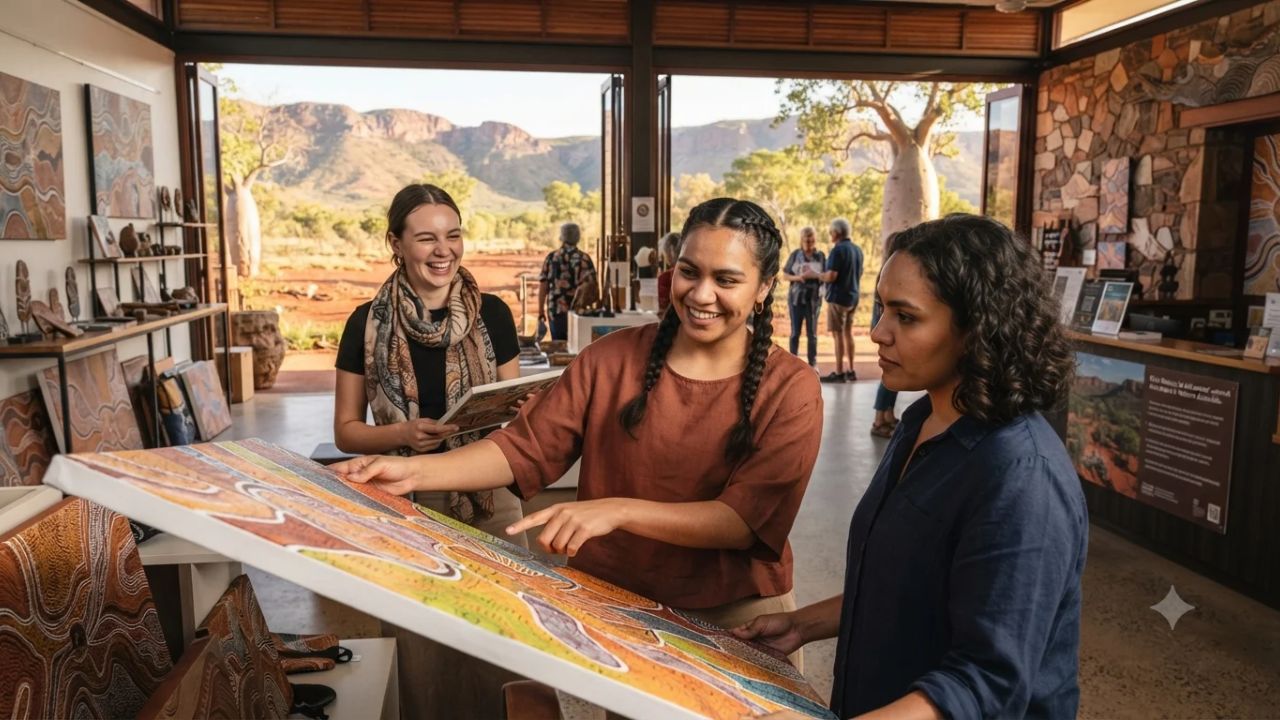
What distinguishes remote Australian art hubs is the deep integration of contemporary fine art with living cultural authority. In Kununurra, Waringarri Aboriginal Arts operates as one of Australia's oldest continuously operating, wholly Aboriginal-owned art centres. Set against the red sandstone ridges of Mirima National Park, Waringarri's artists use local natural ochres mixed with tree resins to depict traditional Miriwoong Country. The centre also organizes guided cultural tours out to the ancient beehive rock towers of Purnululu National Park (Bungle Bungle Range), a UNESCO World Heritage site, connecting art collectors with the geological terrain that inspires canvas motifs.
In Alice Springs (Mparntwe), the annual Desert Mob gathering presented by Desart at the Araluen Arts Centre brings together over 30 Aboriginal-owned art centres representing more than 20 language groups across the Central Desert, Barkly, and APY Lands. The Saturday morning marketplace, known as the "Four Hours of Power," enables collectors to purchase authentic paintings, punu (wood carvings), and woven grass sculptures directly from artists.
In Far North Queensland, the Cairns Indigenous Art Fair (CIAF) partners with Urban Art Projects (UAP) to secure major architectural public art commissions for Cape York and Torres Strait Islander artists like Gail Mabo, Brian Robinson, and Agnes Wotton. In Broome (Rubibi), Yawuru women artists at Nagula Jarndu Designs produce fine hand-printed textiles inspired by coastal saltwater reefs, collaborating with Cable Beach luxury resorts to supply bespoke fabrics and curated printing workshops.
Visitor Insider Tips
- Verifying Authentic Art Purchases: Never purchase Indigenous art from souvenir shops without demanding an official Certificate of Authenticity generated through the SAM database or verifying membership in the Indigenous Art Code; authentic works always identify the artist by name, language group, and community art centre.
- Timing the Kununurra and Alice Springs Art Seasons: Schedule trips to Alice Springs during September to experience Desert Mob at the Araluen Arts Centre, or visit Kununurra in late September during the Our Business showcase when regional artists gather for public exhibitions.
- Respecting Sacred Sites and Photography Rules: When participating in cultural tours on Country, always seek explicit verbal permission from Traditional Owners before photographing rock art, sacred waterholes, or ceremony grounds.
- East Kimberley Transport Logistics: Kununurra Airport (KNX) offers direct jet connections from Perth and Darwin on Virgin Australia and Nexus Airlines. Reserve high-clearance 4WD vehicles months in advance if planning to traverse the Gibb River Road or drive south to Purnululu.
- Engaging in Responsible Cultural Tours: Book tours directly through WAITOC-accredited operators such as Waringarri Arts Tours in Kununurra or Narlijia Experiences in Broome, ensuring tour fees directly support local Aboriginal guides and family enterprises.
Cultural and Environmental Context
First Nations cultural tourism in outback Australia is inseparable from environmental stewardship and native title rights. Traditional Owners hold customary obligations to "care for Country" by conducting seasonal cultural burning (cool burns) to mitigate destructive late-dry-season wildfires, managing waterholes, and monitoring native fauna across Indigenous Protected Areas (IPAs).
Revenues generated by community-owned art centres and cultural tours provide remote communities with the financial autonomy required to live on ancestral homelands rather than being displaced into urban centers. Buying authenticated art directly from community hubs sustains ancient languages, funds intergenerational storytelling workshops between elders and youth, and protects fragile desert and savannah biomes from extractive industrial degradation.
FAQ: Ethical Indigenous Cultural Travel in Australia 2026
How can I be 100% certain an Aboriginal artwork is authentic?
Buy directly from community-controlled art centres or certified Indigenous Art Code member galleries, ensuring each piece comes with an official SAM Certificate of Authenticity.
What percentage of art sales goes directly to the artist?
In community art centres, 60% to 70% of the sale price goes straight to the artist, with the rest funding local community services.
What is the best season to visit Kununurra and the Kimberley?
May through September (the dry season) provides pleasant, sunny days averaging 30°C, open 4WD trails, and active cultural festivals.
What are Australia's premier First Nations art fairs?
Key annual gatherings include Desert Mob in Alice Springs (September), Cairns Indigenous Art Fair (CIAF in July), and the Darwin Aboriginal Art Fair (August).
[When you purchase authentic art directly on Country, you are not buying a souvenir—you are investing in living cultural sovereignty and ancestral storytelling.]
Related Travel Guides
This article is for informational purposes. Flight routes, passenger regulations, visa rules, and transit advisories are subject to change by airlines and aviation authorities. Readers are advised to verify schedules and travel documentation with relevant carriers and border agencies before departure.
Related Stories
Ayodhya Deepotsav 2026 Logistics Guide: Attending the 30 Lakh Lamp Festival in India
WTM London 2026: AI Booking Shifts and Global Tourism Growth Forecasts for 1.57 Billion Arrivals