
Huntington Beach and Florida Coastlines Expand Sensory-Inclusive Tourism With KultureCity

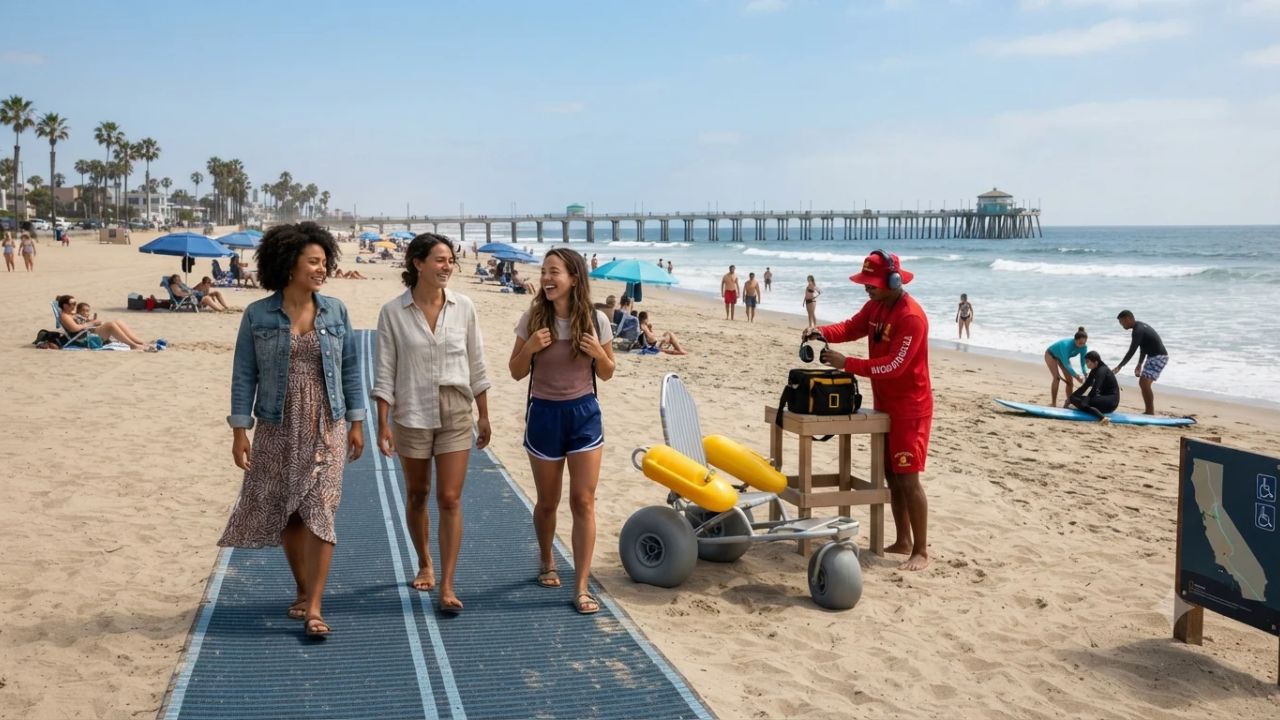
Image generated by AI
With more than 1,538 municipal workers, emergency responders, and hospitality staff trained across Huntington Beach, alongside 170 certified ocean lifeguards patrolling six Florida beach communities, American coastal destinations are transforming the standard for accessible leisure. Backed by non-profit organization KultureCity and substantiated by 1,141 verified accessibility data points gathered across nearly 30 properties by Wheel the World, this coordinated initiative marks a decisive transition from conventional physical access ramps to comprehensive cognitive, neurodivergent, and sensory inclusion.
For more than three decades following the passage of the Americans with Disabilities Act, municipal beach tourism focused almost exclusively on physical mobility. Cities allocated capital toward blue rubberized Mobi-mats, elevated concrete ramps, and balloon-tired beach wheelchairs. While these physical interventions remain indispensable for wheelchair users, they failed to address invisible disabilities, sensory processing differences, autism, post-traumatic stress, and traumatic brain injuries that affect millions of domestic and international travelers.
By engineering whole-destination accommodations, coastal tourism boards are proving that welcoming diverse populations requires transforming human protocols just as rigorously as physical infrastructure. The initiative, spearheaded on the West Coast by Visit Huntington Beach and municipal public safety agencies, creates California’s first certified sensory-inclusive destination, while Greater Fort Lauderdale establishes a continuous corridor of trained beachfront communities on the Atlantic coast.
The Invisible Access Gap: Overcoming Sensory Overload on Public Shorelines
Coastal environments present an intense, volatile sensory reality. The crash of high-energy surf, intense sun reflection across white quartz sand, sudden ambient noise spikes, dense crowds, and emergency sirens can overwhelm travelers living with sensory sensitivities. For families traveling with neurodivergent children or individuals experiencing sensory overload, the inability of service personnel to recognize distress signals often led to truncated vacations and acute travel anxiety.
The traditional hospitality sector frequently treated accessibility as an isolated checklist item rather than an end-to-end journey. If an individual experienced a sensory crisis on the sand, lifeguards without behavioral training might interpret the reaction as behavioral defiance or distress requiring aggressive intervention, rather than an overstimulated sensory system requiring a calm, low-stimulus environment.
Under the framework established by KultureCity, participating destinations deploy specialized sensory kits directly at frontline stations. In Huntington Beach and throughout South Florida, visitors access sensory bags containing noise-cancelling headphones, fidget manipulation tools, verbal cue cards, and specialized strobe-reduction sunglasses. Additionally, certified locations provide weighted lap pads and designated quiet spaces where travelers can decompress without leaving the beach entirely.
Equally significant is the advance trip-planning dimension. Through digital Social Stories published by KultureCity and destination portals, visitors review visual, step-by-step previews of what to expect upon arrival, detailing exact sensory conditions, parking transitions, lighting shifts, and crowd concentrations. This predictability allows families to plan visits around individual tolerance thresholds rather than guessing.
Comparative Implementation: Pacific Surf City vs. Atlantic Broward County
The rollouts across Southern California and South Florida demonstrate two distinct, scalable models of municipal inclusion. Huntington Beach executed a comprehensive civic integration model, training private hospitality personnel alongside police officers, fire department paramedics, and ocean lifeguards. In contrast, Broward County deployed a multi-jurisdictional municipal alliance across six adjacent beach towns.
| Destination | State & Governance Scope | Staff Training Metrics | On-Site Sensory & Physical Provisions | Pre-Arrival & Digital Support |
|---|---|---|---|---|
| Huntington Beach | California (Destination-wide civic & hospitality integration) | 1,538+ visitor-facing staff, police, fire, lifeguards | Mobi-mats, balloon beach wheelchairs, adaptive surf lessons, accessible fire pits | Wheel the World 1,141 data points across ~30 venues; KultureCity Social Stories |
| Fort Lauderdale Beach | Florida (Broward County certified coastal zone) | Certified ocean rescue lifeguards & beach patrol | Sensory bags at lifeguard towers, quiet zones, beach wheelchairs, weighted lap pads | Regional Beaches for All planning guides; KultureCity app integration |
| Hollywood Beach | Florida (Municipal boardwalk & beach corridor) | Frontline ocean rescue and municipal patrol teams | Sensory bags, dedicated calm rest areas, adaptive physical access pathways | Digital Social Stories detailing boardwalk acoustics and crowd flow |
| Pompano Beach | Florida (Municipal pier and public beach district) | 170+ lifeguards trained across participating county beaches | Noise-cancelling headsets, tactile fidget aids, accessible aquatic gear | Pre-visit sensory maps and verified facility access listings |
| Lauderdale-by-the-Sea | Florida (Pedestrian-scale village coastal zone) | Certified public safety & beach inspection staff | Sensory toolkits, low-stimulation rest spaces, beach wheelchairs | Predictable village layouts integrated into regional accessibility portals |
| Dania Beach | Florida (Natural coastal state park & public shore) | Trained ocean rescue lifeguards & park teams | Sensory-friendly signage, calming kits, accessible dune walkways | Online sensory prep materials for changing coastal weather conditions |
| Hallandale Beach | Florida (Southern coastal and civic aquatic center) | Ocean rescue staff and municipal aquatic center teams | Beach sensory bags, calm zones, sensory-friendly municipal public pools | Unified countywide accessibility guides connecting beach to civic pools |
In Huntington Beach, the collaboration between Visit Huntington Beach President and CEO John Urdi and the municipal government bridged private lodging with public safety. Over three years, independent auditors from Wheel the World physically mapped nearly 30 hotels, restaurants, and attractions, generating 1,141 precise data points detailing door clearance widths, bed heights, and step-free bathroom layouts.
Concurrently, Broward County's "Beaches for All" initiative ensures that travelers moving between Fort Lauderdale, Pompano Beach, or Lauderdale-by-the-Sea experience operational continuity. Whether an individual needs a sensory bag at Dania Beach or enters sensory-adapted community pools in Hallandale Beach, frontline personnel utilize identical behavioral response techniques.
Expert Analysis: The Commercial Economics of Sensory-Certified Tourism Corridors
The rapid adoption of sensory certification across premier American beach towns reflects a calculated alignment between civil rights equity and commercial tourism strategy. According to research published by Visit California, accessible travel represents one of the fastest-growing demographic segments in domestic hospitality, with multi-generational families dictating travel choices based on the accessibility needs of their most vulnerable members. When a destination solves the sensory equation, it secures loyalty from high-spending family units who typically book longer stays and exhibit lower seasonal churn.
For travelers booking this route, the direct consequence is that vacation planning shifts from defensive anxiety to predictable logistical certainty, allowing families navigating autism or PTSD to participate in ocean recreation previously deemed unmanageable. Having trained emergency responders stationed alongside hotel concierges eliminates the friction points that historically caused travel cancellations.
The pricing pressure this creates means certified destinations are experiencing sustained demand premiums across oceanfront accommodations and adaptive recreational services. High-end coastal resorts investing in certified staff, quiet-zone lounges, and audited accessibility standards command robust average daily rates (ADR) compared to non-certified competitors. As accessible travel platforms expand, consumer capital gravitates toward audited properties over unverified marketing claims.
Furthermore, integrating civic emergency services establishes a precedent for modern urban risk management. Training over 1,538 personnel in Huntington Beach and 170 lifeguards in Broward County fundamentally alters emergency response dynamics. Ocean rescues and crowd-management operations involving neurodivergent individuals are de-escalated quickly, reducing operational liabilities and hospital transports while fostering community trust.
Key Takeaways
- Comprehensive Training Scale: Huntington Beach has trained more than 1,538 municipal workers, lifeguards, police officers, firefighters, and hospitality staff, establishing California's first destination-wide KultureCity certification.
- Atlantic Coast Alignment: Six Broward County beach communities in Florida have united under Greater Fort Lauderdale's sensory-inclusive program, deploying over 170 certified ocean lifeguards equipped with sensory tools.
- Granular Verification Data: Huntington Beach's three-year collaboration with Wheel the World has produced 1,141 audited accessibility metrics across nearly 30 properties, providing objective room-level data before booking.
- Dedicated Sensory Equipment: Participating beaches supply specialized kits containing noise-cancelling headphones, fidget tools, verbal cue cards, and strobe-reduction sunglasses at designated lifeguard towers and public stations.
- Economic Value Proposition: Multi-generational families navigating neurodivergence represent an expanding market segment that generates higher average lengths of stay for destinations that guarantee reliable inclusion.
FAQ: Sensory-Inclusive Beach Travel 2026
What is a KultureCity Sensory Inclusive certification for beaches?
It is a certified program where frontline staff, lifeguards, and public safety officers receive training to recognize and support visitors with sensory sensitivities, while providing sensory bags, quiet zones, and pre-visit Social Stories.
Which beaches in California and Florida offer KultureCity resources?
Huntington Beach holds California's first destination-wide certification. In Florida, Broward County's certified beaches include Fort Lauderdale Beach, Hollywood Beach, Pompano Beach, Lauderdale-by-the-Sea, Dania Beach, and Hallandale Beach.
What tools are inside a beach sensory bag?
Sensory bags contain noise-cancelling headphones, tactile fidget tools, verbal cue cards, and strobe-reduction sunglasses. Many stations also offer weighted lap pads to help visitors regulate sensory processing in stimulating environments.
How does Wheel the World evaluate accessibility in Huntington Beach?
Wheel the World trained assessors measure physical properties across hotels and attractions, recording 1,141 data points on door clearances, bed heights, roll-in showers, and ramp slopes to give travelers verified pre-trip details.
[By moving beyond concrete ramps to embrace invisible disabilities, American coastal destinations are transforming modern hospitality into an environment where sensory comfort and ocean recreation coexist for every traveler.]
Related Travel Guides
Disclaimer
This article is for informational and educational purposes only. It does not constitute legal, financial, or professional advice. While we strive to provide accurate and up-to-date information, travel policies, regulations, and conditions change rapidly. Always verify information with official sources before making travel decisions. Nomad Lawyer makes no representations about the accuracy, reliability, completeness, or suitability of the information provided. Readers should consult qualified professionals for advice specific to their circumstances. The views expressed in this article are those of the author and do not necessarily reflect the views of Nomad Lawyer.
Kunal K Choudhary
Co-Founder & Contributor
A passionate traveller and tech enthusiast. Kunal contributes to the vision and growth of Nomad Lawyer, bringing fresh perspectives and driving the community forward.
Learn more about our team →