
Korean Air Launches Free Starlink Wi-Fi Across All Cabins as Asiana Merger Prepares for December 2026 Integration
Activated on September 15, 2026, Korean Air rolls out free Starlink satellite Wi-Fi across economy and premium cabins, while Asiana equips ten aircraft ahead of their official December 17 merger.

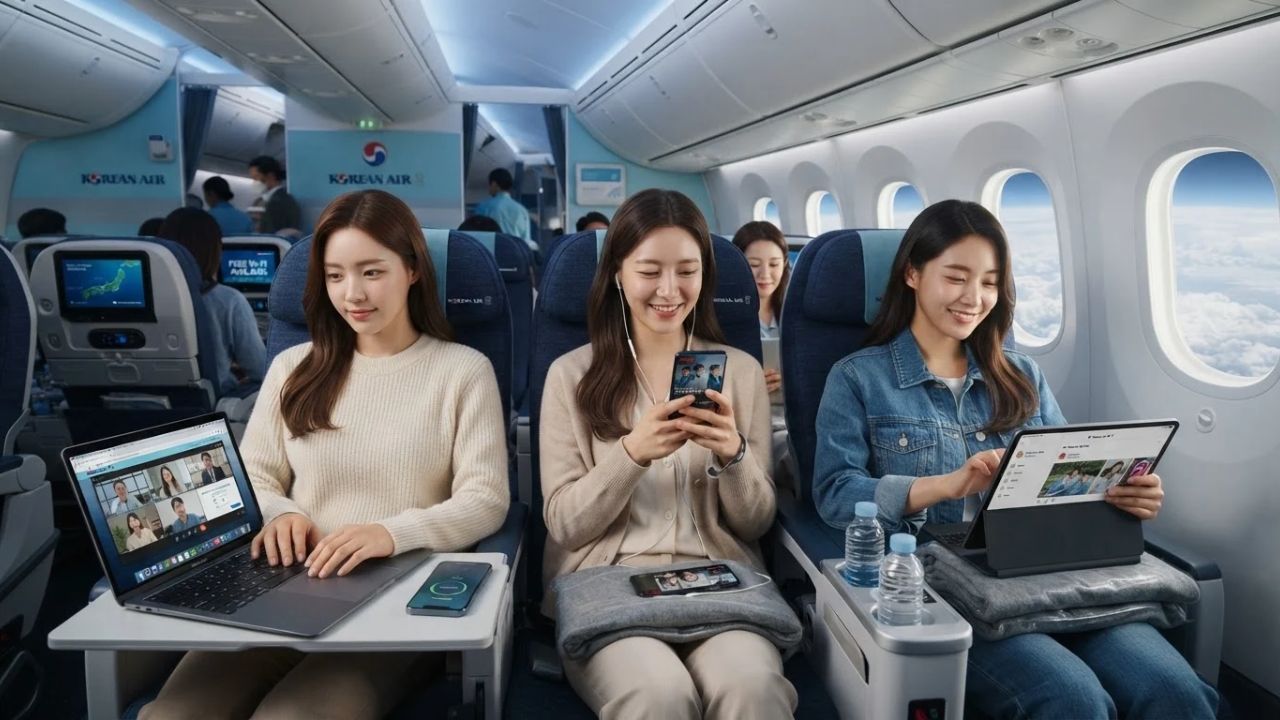
Image generated by AI
While long-haul commercial aviation has spent decades charging passengers steep fees for sluggish satellite connections, Korean Air dismantled the inflight paywall entirely on September 15, 2026, rolling out complimentary, high-speed Starlink Wi-Fi across every single cabin class on its initial fleet of widebody jets. Spanning three Airbus A350-900s and one Boeing 777-300ER, this zero-fee connectivity model requires no subscription packages or credit card entries, allowing travelers flying between Seoul, the Americas, Europe, and Southeast Asia to stream video, work in the cloud, and browse the web without interruption. Even more consequential for transpacific aviation, upcoming merger partner Asiana Airlines is preparing to outfit nine Airbus A350-900s and one Airbus A330-300 with identical technology ahead of their historic, government-approved consolidation scheduled for December 17, 2026.
The Low-Earth Orbit Breakthrough: How Starlink Rewires Transpacific Flight
The deployment of Starlink on Korean Air represents a major generational upgrade in inflight connectivity. Traditional aircraft satellite systems rely on geostationary satellites positioned nearly 36,000 kilometers above the equator, resulting in high latency that renders real-time collaboration, video streaming, and responsive cloud computing practically impossible. Starlink’s low-Earth-orbit (LEO) constellation circles just hundreds of kilometers above the planet, slashing signal latency and maintaining high data throughput even when crossing polar and transoceanic flight corridors.
The initial rollout phase centers on four operational long-haul aircraft serving flagship routes connecting Seoul Incheon with premier gateways across North America, Europe, and Southeast Asia. The airline has committed to progressively outfitting the majority of its operating fleet with Starlink by the end of 2027, with legacy paid Wi-Fi remaining active on unequipped airframes during the transition. The onboarding procedure is remarkably streamlined: passengers simply place their personal devices into airplane mode, connect to the onboard Wi-Fi network, input their name and seat number as printed on their boarding pass, and watch a single promotional message before gaining unrestricted internet access.
Crucially, this connectivity revolution coincides with the seismic restructuring of South Korea’s aviation sector. In June 2026, South Korea’s Ministry of Land, Infrastructure and Transport (MOLIT) formally approved the landmark merger between Korean Air and Asiana Airlines, establishing an official integration date of December 17, 2026. Asiana is actively preparing for this union by outfitting ten widebody aircraft—comprising nine Airbus A350-900s and one Airbus A330-300—with Starlink systems. Supported by the Ministry of Science and ICT (MSIT), which established the regulatory framework in May 2025 approving cross-border satellite communications under the nation's Radio Waves Act, South Korea is uniting its flag carriers while redefining passenger expectations across the Asia-Pacific.
What Makes the Incheon and Seoul Journey Different: High-Tech Elegance and Historic Rhythms
For travelers arriving aboard a Starlink-connected flight, landing at Seoul Incheon International Airport (ICN) reveals an aviation hub that mirrors the country’s balance of ultra-modern infrastructure and deep cultural heritage. Terminal 2 functions as a living cultural gallery rather than a sterile transit warehouse. Travelers walking through the terminal regularly encounter authentic recreations of the Joseon-dynasty Royal Family Walk, tranquil indoor pine-tree gardens, and complimentary traditional craft workshops where international guests can try their hand at crafting delicate Korean mulberry paper (hanji).
Connecting to the capital is equally frictionless. The dedicated non-stop AREX (Airport Railroad Express) train departs directly from the airport terminal basements, whisking travelers to Seoul Station in forty-three minutes. Stepping outside into the capital reveals an astonishing urban environment where hyper-speed 5G networks and neon-lit towers frame serene royal palaces.
Just minutes from central transit corridors sits the Changdeokgung Palace Complex, inscribed on the UNESCO World Heritage Centre register. Constructed in the early fifteenth century, Changdeokgung is celebrated for its harmonious integration with natural topography, particularly its secluded Secret Garden (Huwon), where centuries-old lotus ponds, pavilions, and ancient ginkgo trees offer an oasis of absolute silence. Within walking distance lie the preserved wooden residences of Bukchon Hanok Village, where travelers wander narrow granite alleys lined with traditional tile-roofed homes that have housed scholars and artisans for over six hundred years.
Visitor Insider Tips: Navigating Seoul and Connected Long-Haul Flights Like an Expert
To make the most of your transpacific flight and explore South Korea with genuine local insight, adopt these practical travel strategies:
- Verify Your Specific Aircraft Tail: Starlink is initially active on four specific Korean Air widebodies (three A350-900s and one 777-300ER), with fleetwide expansion continuing through 2027. Check your flight’s assigned aircraft type on the Korean Air app twenty-four hours before departure. If your flight is operated by an unequipped airframe, the existing paid satellite Wi-Fi remains available.
- Book the AREX Express Train: When arriving at Incheon Airport, bypass the all-stop commuter train and purchase a reserved seat ticket for the AREX Express Train. The non-stop express features dedicated overhead luggage racks, free onboard Wi-Fi, and comfortable reclining seating directly into Seoul Station.
- Essential Navigation Apps: Google Maps does not support turn-by-turn walking or public transit routing in South Korea due to national security spatial data laws. Download Naver Map or KakaoMap (both offer comprehensive English interfaces) before landing to navigate subways, buses, and pedestrian alleys. Pick up a rechargeable T-money transit card at any airport convenience store (CU, GS25, or 7-Eleven) to tap seamlessly through transit gates nationwide.
- Embrace Solo Dining (Honbap): If traveling alone, take full advantage of South Korea's vibrant honbap (solo eating) culture. In university districts like Sinchon and Hongdae, neighborhood eateries feature touchscreen ordering kiosks and single-diner counter seating, serving piping-hot stone-pot bibimbap, savory pork bone soup (gamjatang), and handmade noodles without imposing extra surcharges.
- Savor Authentic Culinary Traditions: Skip international fast-food chains and head to historic Euljiro to enjoy chimaek—crispy, double-fried Korean fried chicken served alongside pickled radish and cold draft beer. For breakfast, seek out a traditional restaurant serving seolleongtang, a rich, milky ox-bone soup simmered for over sixteen hours, seasoned at your table with sea salt, ground black pepper, fresh scallions, and spicy radish kimchi (kkakdugi).
Cultural and Environmental Context: Digital Nomadism, Energy Stewardship, and Aviation Consolidation
The introduction of complimentary low-Earth-orbit connectivity reflects the realities of modern travel, where digital nomads, remote corporate professionals, and creative travelers view connectivity as an essential utility rather than an optional luxury. However, Korean Air enforces sensible social boundaries: voice and video phone calls, as well as live social media broadcasting, remain strictly barred to preserve cabin comfort, quietude, and privacy across long transpacific flight sectors.
From an environmental perspective, the deployment of new-generation widebody aircraft like the Airbus A350-900 delivers substantial sustainability dividends. Built with advanced carbon-composite materials and high-efficiency Rolls-Royce Trent XWB engines, the A350 reduces fuel burn and carbon emissions by roughly 25% compared to previous-generation widebodies, supporting South Korea’s national emissions-reduction targets overseen by the Ministry of Land, Infrastructure and Transport.
Furthermore, the pending consolidation of Asiana Airlines into Korean Air on December 17, 2026, marks the end of an era of domestic rivalry, creating a consolidated mega-carrier capable of competing effectively against global aviation giants. By combining modern satellite technology with fleetwide environmental investments and deep cultural pride promoted by Visit Korea, South Korea is ensuring that its aviation gateway remains an innovative, culturally grounded bridge linking East Asia with the world.
FAQ: Korean Air Starlink and Seoul Travel 2026
Is Korean Air's Starlink Wi-Fi completely free for Economy passengers?
Yes. On Starlink-equipped aircraft, free high-speed internet is available across all cabin classes, including Economy, without subscription fees, credit card entries, or separate service packages.
When will the Korean Air and Asiana Airlines merger take full effect?
The Ministry of Land, Infrastructure and Transport approved the merger in June 2026, with the full operational integration of Asiana under Korean Air scheduled to take effect on December 17, 2026.
Are voice or video calls permitted using Starlink inflight?
No. To preserve cabin comfort and prevent noise disturbances, Korean Air strictly prohibits voice calls, video chats, and live social media broadcasting over the onboard Wi-Fi network.
How fast is the non-stop AREX train from Incheon Airport to central Seoul?
The non-stop AREX Express Train travels directly from Incheon Airport Terminal 1 to Seoul Station in 43 minutes (51 minutes from Terminal 2), providing comfortable reserved seating and luggage space.
Soaring across the Pacific at thirty-five thousand feet, seamless connectivity bridges continents, but the true journey begins the moment you step into the timeless soul of Seoul.
Related Travel Guides
Disclaimer
This article is for informational and educational purposes only. It does not constitute legal, financial, or professional advice. While we strive to provide accurate and up-to-date information, travel policies, regulations, and conditions change rapidly. Always verify information with official sources before making travel decisions. Nomad Lawyer makes no representations about the accuracy, reliability, completeness, or suitability of the information provided. Readers should consult qualified professionals for advice specific to their circumstances. The views expressed in this article are those of the author and do not necessarily reflect the views of Nomad Lawyer.
Raushan Kumar
Founder & Lead Developer
Full-stack developer with 11+ years of experience and a passionate traveller. Raushan built Nomad Lawyer from the ground up with a vision to create the best travel and law experience on the web.
Learn more about our team →