
Korean Air Flight Delays and Incheon Hub Congestion: The Insider Guide to Navigating South Korea Travel
Understand the hidden causes behind Seoul Incheon flight delays, explore Korean Air's hub operations, and discover essential travel hacks for smooth South Korea transit.

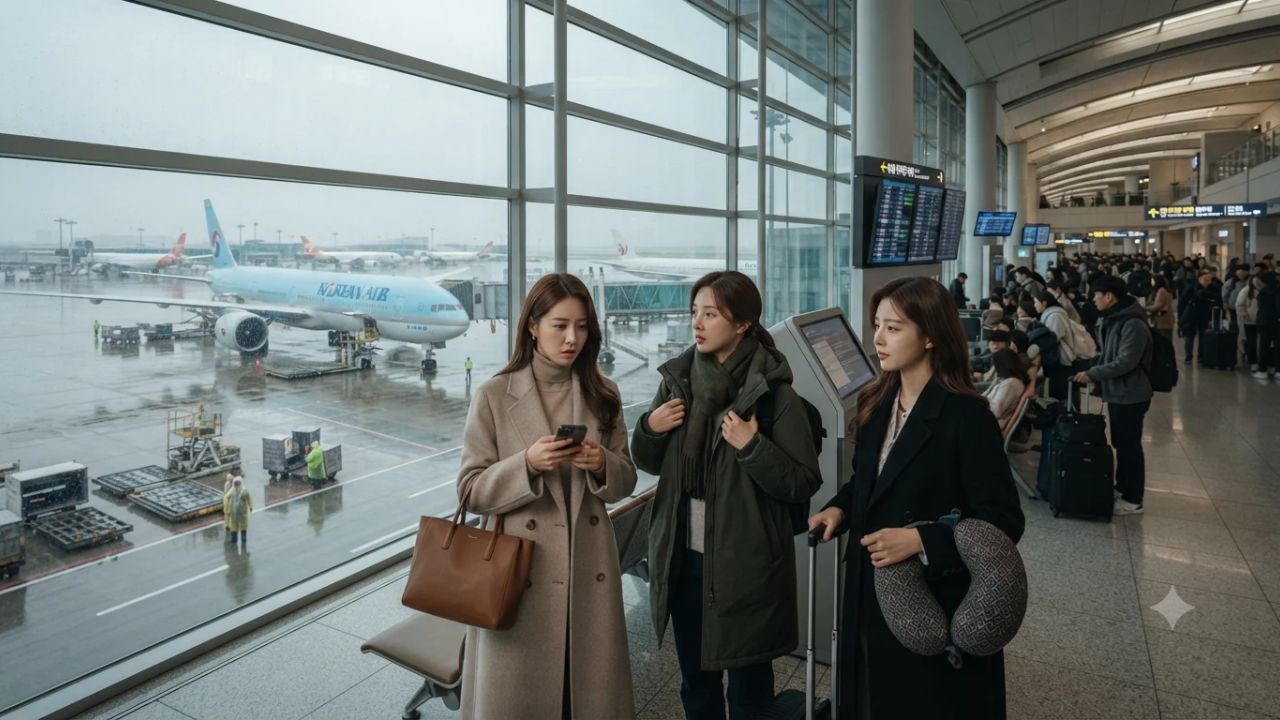
Image generated by AI
When travelers confront a flashing delay notification across the departure monitors of Seoul Incheon International Airport, the root disruption rarely originates on the South Korean tarmac. Instead, that late boarding call is frequently the delayed shockwave of an unseasonal thunderstorm that passed over Chicago twelve hours earlier or a typhoon diversion over the East China Sea. While Incheon handled a staggering 74.07 million passengers and 425,760 aircraft movements in 2025, and flagship carrier Korean Air carried 16.49 million passengers, global aviation monitoring by the U.S. Bureau of Transportation Statistics through June 2026 documented 32,942 late-arriving-aircraft incidents accumulating over 2.27 million delay minutes. Mastering how this cascading mechanism operates transforms how smart travelers navigate East Asia's premier aviation gateway.
The Anatomy of Hub Congestion: Inside Incheon’s High-Velocity Terminal Grid
Understanding flight timing requires examining the massive scale of Seoul Incheon, which expanded its passenger volume by 4.1 per cent from 71.16 million in 2024 to 74.07 million in 2025, alongside a 3.0 per cent rise in aircraft movements from 413,200 to 425,760 while processing 2.95 million tonnes of cargo. During peak operational months, the passenger tempo reaches fever pitch: August 2025 alone recorded 37,553 aircraft movements and 6.60 million passengers, mirrored closely by December with 37,318 movements and 6.57 million travelers, and January exceeding 6.58 million.
When an inbound long-haul aircraft touches down behind schedule, it compresses the ground servicing window. Cleaning crews, catering teams, fueling technicians, and baggage handlers must service widebody jets under intense time deficits. According to federal transportation metrics, 62.26 per cent of delay minutes within the late-arriving-aircraft category stem directly from air-carrier turnaround strain, followed by volume bottlenecks at 12.82 per cent, ambient weather at 10.69 per cent, and extreme atmospheric disturbances at 7.92 per cent. This mirrors broader Federal Aviation Administration observations showing that weather triggers 74.26 per cent of system delays exceeding 15 minutes across major air networks, with volume compounding another 14.92 per cent.
To mitigate these pinch points, Korean Air introduced an innovative "Incheon Airport Preview" feature into its passenger mobile application in 2025. By harvesting public terminal feeds, the tool provides travelers with real-time visibility into security checkpoint lines, departures hall density, and parking availability. On transpacific routes, Korean Air and Delta Air Lines instituted International Remote Baggage Screening on select Incheon–Atlanta services in August 2025, transmitting luggage imaging data directly to U.S. customs authorities mid-flight and shaving approximately 20 minutes off onward passenger transfers.
What Makes Incheon and Seoul Transit Different
Incheon International Airport is engineered as an architectural and cultural destination in its own right. Situated on reclaimed land off the coast of Yeongjong Island, the complex separates its operations into two distinct domains. Terminal 1 hosts international budget airlines and global alliances, while Terminal 2 functions as the luminous, light-filled showcase for Korean Air and its SkyTeam partners.
Unlike austere global transfer hubs, the Incheon International Airport Corporation weaves traditional heritage directly into passenger transit zones. Twice daily, costumed royal guards stage solemn Joseon Dynasty royal procession re-enactments along the departure concourses, accompanied by traditional court music. At the Traditional Korean Cultural Experience Centers located past security in both terminals, international passengers with layovers can participate in complimentary artisan workshops, handcrafting mother-of-pearl trinkets or traditional mulberry paper fans.
For travelers who venture into the capital, the airport connects directly to central Seoul, where modern high-speed trains transport visitors toward historic palace quarters like Changdeokgung Palace, preserved under the UNESCO World Heritage Centre for its exquisite balance with nature.
Visitor Insider Tips
Navigating Incheon requires trading generic airport assumptions for hyper-local transit strategies. When booking connecting flights, never accept a connection window under 75 minutes if your itinerary requires transferring between Terminal 1 and Terminal 2. The free inter-terminal shuttle bus takes twenty minutes to loop around the perimeter, and re-clearing transit security during morning departure banks between 7:30am and 9:30am can consume another half hour.
For ground transportation into Seoul, bypass standard highway taxis, which often become immobilized in morning gridlock along the Olympic-daero riverside expressway. Instead, descend to the basement transit hub and board the AREX Express Train. This dedicated non-stop train whisks passengers from Terminal 2 to Seoul Station in 51 minutes (and from Terminal 1 in 43 minutes) for KRW 11,000, offering allocated seating, onboard Wi-Fi, and luggage racks. If your hotel sits in Gangnam or eastern Seoul, choose the premium K-Limousine coach network, which drops passengers directly at major luxury hotel entrances.
If flight delays result in an unexpected layover, do not sleep on departure gate benches. Check into Darakhyu, the stylish capsule hotel operated by Walkerhill, located within both terminal transit centers, offering soundproof private cabins and hot rain showers bookable in three-hour blocks. For longer daytime delays, enroll in the complimentary transit tours organized through the Korea Tourism Organization, which whisk eligible layover passengers on guided mini-excursions to nearby coastal temples or the futuristic eco-parks of Songdo International City.
When hunger strikes, avoid Western fast-food counters on the upper departures level. Venture down to the basement level (B1) of Terminal 2 to the Korean Food Street (Hansik Midan). Here, regional culinary legends operate satellite kitchens, serving sizzling stone bowls of Jeonju bibimbap, spicy seafood soft tofu stew (soondubu jjigae), and hot handmade dumplings at local street prices.
Cultural and Environmental Context
Incheon’s development reflects South Korea’s miraculous economic transformation, yet its continuous expansion highlights an ongoing ecological dialogue. The airport was constructed across tidal mudflats in the Yellow Sea—a delicate marine wetland system that forms an irreplaceable sanctuary for migratory shorebirds navigating the East Asian-Australasian Flyway.
In response to international conservation concerns, municipal planners and aviation authorities have established ecological buffer zones around Yeongjong Island. Korean Air has simultaneously modernized its long-haul fleet, introducing composite-fuselage aircraft that cut carbon emissions by up to 25 per cent while lowering external engine noise over coastal residential communities. Inside the terminals, traveler efficiency is governed by the Korean cultural philosophy of "palli-palli" (quick-quick action), ensuring that baggage handling, automated immigration biometric gates, and aircraft pushbacks operate with surgical precision to minimize unnecessary fuel burn on active taxiways.
FAQ: Visiting South Korea via Incheon 2026
What is the recommended minimum connection time at Incheon Airport?
Allow at least 75 to 90 minutes for single-terminal connections. If transferring between Terminal 1 and Terminal 2, reserve a minimum of two hours to account for shuttle transit and security screening.
What is the fastest way to get from Incheon Airport to downtown Seoul?
The AREX Express Train is the fastest option, running non-stop from Terminal 2 to Seoul Station in 51 minutes without traffic delays for KRW 11,000.
Do international transit passengers need a visa for layovers in South Korea?
Passengers transiting within the airside international zone do not need a visa. Travelers wishing to exit the airport for layover tours must meet national entry rules or hold an approved K-ETA.
Can delayed passengers find comfortable sleep options inside Incheon Airport?
Yes. Both terminals offer Darakhyu capsule hotels, free 24-hour quiet rest zones with reclining leather loungers, and paid transit lounges equipped with private shower suites.
The secret to effortless world travel lies not in escaping every delay, but in choosing the airports that know how to turn waiting into an art.
Related Travel Guides
Seoul to Jeju Flight Shifts: Insider Travel Guide to Jeju Air’s Incheon and Gimpo Winter Reset
Lufthansa Brings Oktoberfest 2026 into the Sky: Bavarian Tracht Flights and Munich Travel Guide
10 Best Things to Do in Seoul During an Incheon Layover According to Reddit 2026
Disclaimer
This article is for informational and educational purposes only. It does not constitute legal, financial, or professional advice. While we strive to provide accurate and up-to-date information, travel policies, regulations, and conditions change rapidly. Always verify information with official sources before making travel decisions. Nomad Lawyer makes no representations about the accuracy, reliability, completeness, or suitability of the information provided. Readers should consult qualified professionals for advice specific to their circumstances. The views expressed in this article are those of the author and do not necessarily reflect the views of Nomad Lawyer.
Raushan Kumar
Founder & Lead Developer
Full-stack developer with 11+ years of experience and a passionate traveller. Raushan built Nomad Lawyer from the ground up with a vision to create the best travel and law experience on the web.
Learn more about our team →