
Kenya Airport Staff Strike 2026: Thousands Stranded at Jomo Kenyatta International Airport (JKIA)
Aviation workers' industrial action at Nairobi's Jomo Kenyatta International Airport has entered its second day, causing widespread flight cancellations and stranding thousands of international and domestic passengers.

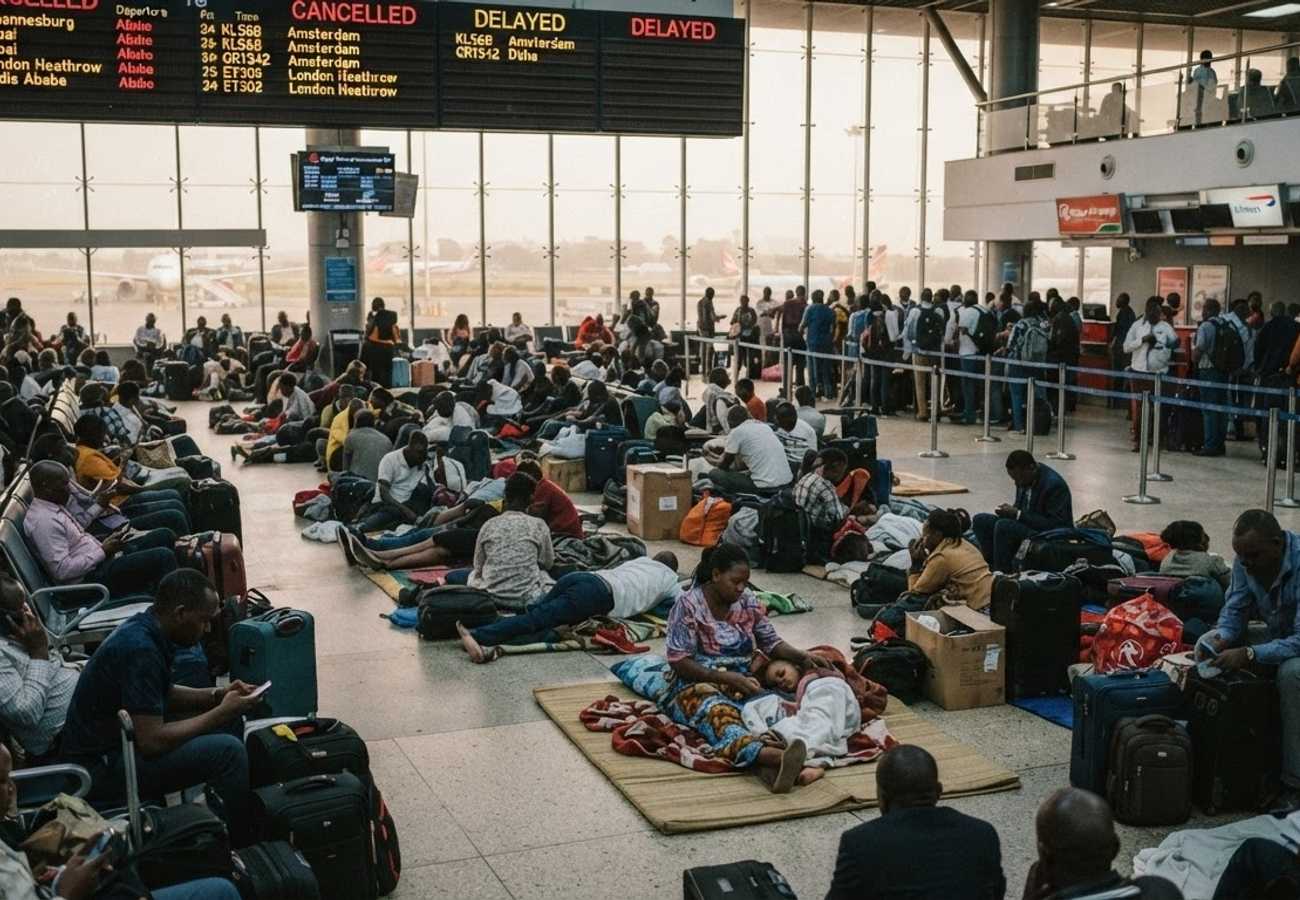
Image generated by AI
Industrial action by aviation workers at Nairobi’s Jomo Kenyatta International Airport (JKIA) has entered its second consecutive day, leaving thousands of passengers stranded and disrupting East Africa's primary aviation hub.
The crisis began on Sunday, August 31, 2026, starting as a "go-slow" before escalating into a full-scale stoppage. The strike is led by the Kenya Aviation Workers Union, involving critical personnel from the Kenya Airports Authority (KAA) and the Kenya Civil Aviation Authority.
The stoppage is driven by stalled negotiations over a collective bargaining agreement, specifically regarding pay, allowances, and deteriorating working conditions. Union leaders have highlighted severe staffing shortages among air traffic controllers, ground handling teams, and airport operations staff.
While government representatives and union leaders continued negotiations into Monday evening, no immediate breakthrough was reported, leaving the airport operating on a limited "work-to-rule" basis.
Our analysis of regional reports and airport status updates indicates the following impact:
- Primary Hub: Jomo Kenyatta International Airport (JKIA) is the main flashpoint, with departure boards showing systemic delays and cancellations.
- Regional Reach: Disruption has spread to domestic airports across Kenya, as airlines are unable to reposition aircraft and crew.
- Passenger Impact: Thousands of travelers are affected, with many forced to spend the night in terminals due to postponed or rerouted flights.
- Transit Risks: Long-haul connections between Europe, the Middle East, and Africa are severely interrupted, as JKIA serves as the primary gateway for the region.
- Operational Status: Many critical staff remain off-duty, significantly reducing the airport's capacity to process departures and arrivals.
Passenger Rights & Advisory
For the affected passenger, this disruption creates a complex legal and logistical situation. Because this is an industrial action by airport staff (third parties) rather than the airline itself, the "extraordinary circumstances" clause is often invoked by carriers to avoid paying cash compensation.
Our analysis of aviation policy suggests the following for stranded travelers:
- Duty of Care: Regardless of the cause of the delay (strike or otherwise), airlines are generally required to provide "duty of care." This includes vouchers for meals and refreshments, and hotel accommodation if an overnight stay is required.
- Rebooking Rights: Passengers are entitled to be re-routed to their final destination at the earliest opportunity or receive a full refund if they choose not to travel.
- EU261/2004 Applicability: For passengers flying into or out of the EU on an EU-based carrier, the strike may be classified as an "extraordinary circumstance," exempting the airline from fixed compensation. However, the airline must still provide care and assistance.
- Actionable Steps:
- Keep all receipts for food, water, and hotels if the airline fails to provide them.
- Request a written statement from the airline confirming the reason for the cancellation.
- Check mobile apps and official KAA channels before traveling to the airport to avoid further congestion.
The timing of this strike is particularly damaging, occurring during a peak period for both business and leisure travel. The concentration of Kenya's international traffic through a single primary hub (JKIA) creates a systemic vulnerability; when Nairobi stops, East African transit flows collapse.
Beyond the immediate passenger frustration, this prolonged standoff threatens Kenya's tourism sector and broader economic stability. Even after a settlement is reached, the industry faces a significant "recovery lag." Clearing the backlog of stranded passengers and repositioning aircraft and crew globally will likely take several days, meaning disruptions will persist even after the strike ends.
The stability of East African aviation depends on the immediate resolution of these labor disputes.
Related Travel Guides
Disclaimer
This article is for informational and educational purposes only. It does not constitute legal, financial, or professional advice. While we strive to provide accurate and up-to-date information, travel policies, regulations, and conditions change rapidly. Always verify information with official sources before making travel decisions. Nomad Lawyer makes no representations about the accuracy, reliability, completeness, or suitability of the information provided. Readers should consult qualified professionals for advice specific to their circumstances. The views expressed in this article are those of the author and do not necessarily reflect the views of Nomad Lawyer.
Raushan Kumar
Founder & Lead Developer
Full-stack developer with 11+ years of experience and a passionate traveller. Raushan built Nomad Lawyer from the ground up with a vision to create the best travel and law experience on the web.
Learn more about our team →