
JKIA Staff Go-Slow Triggers Massive Flight Delays for Kenya Airways, Qatar Airways, and Emirates in 2026
Industrial action and air traffic control bottlenecks at Jomo Kenyatta International Airport have caused systemic delays for Kenya Airways and major international carriers.

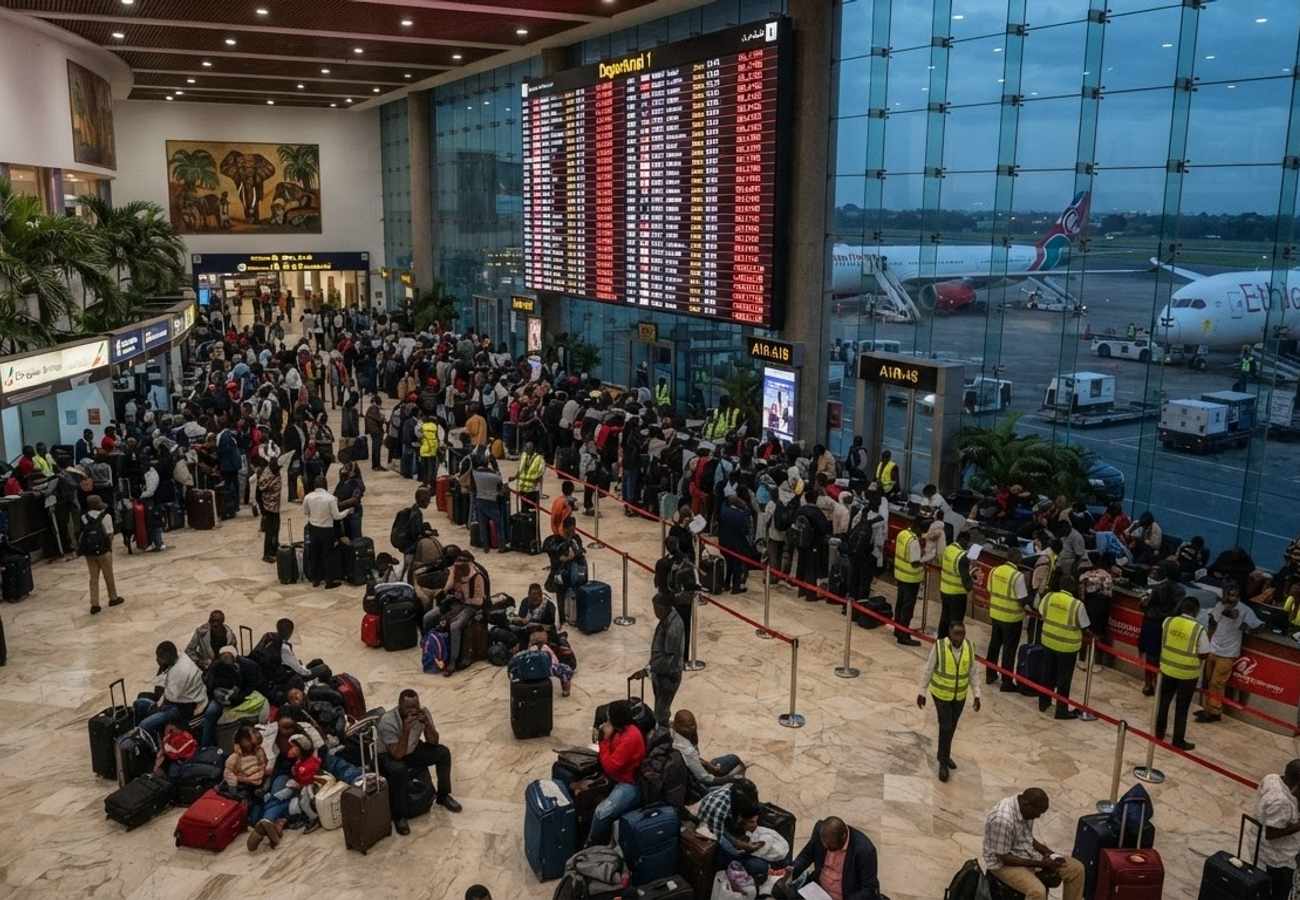
Image generated by AI
[Nairobi, August 31, 2026] — A coordinated staff "go-slow" and severe air traffic control bottlenecks at Jomo Kenyatta International Airport (JKIA) have paralyzed operations, leaving thousands of passengers stranded and causing multi-hour delays for Kenya Airways, Emirates, and Qatar Airways. The disruption, which peaked on August 30 and 31, 2026, has highlighted the fragility of East Africa's primary aviation hub during periods of industrial unrest.
The current crisis stems from a strategic operational slowdown enacted by employees of the Kenya Civil Aviation Authority and the Kenya Airports Authority. This labor action has directly impeded the flow of departures, creating a ripple effect that has stalled flights from as early as 8 am. Passengers have reported massive congestion at security checkpoints, check-in counters, and boarding gates, with many remaining in uncertainty for hours regarding their actual departure times.
Air Traffic Control Gridlock Paralyzes JKIA Departures
The industrial action has manifested most severely within air traffic control (ATC) services. Because ATC manages the critical sequencing of take-offs and landings, the go-slow has resulted in a drastic reduction of available departure slots. Aircraft are currently being held on the apron for extended periods, unable to taxi to the runway.
Industry reports indicate that the disruption is not limited to a single terminal or airline. As the central node for air travel in East Africa, any friction within JKIA's ground or air operations immediately impacts domestic, regional, and long-haul networks. This has led to a cascade of missed connections and aircraft being positioned incorrectly across multiple African nations, complicating recovery efforts for all operating carriers.
Kenya Airways Reports Systemic Network Disruptions
As the dominant carrier at the hub, Kenya Airways has borne the brunt of the operational collapse. The airline officially acknowledged "2 to 3 hour" delays for both inbound and outbound flights. In a corporate notice issued on August 30, 2026, the carrier attributed these setbacks to "operational constraints within Air Traffic Control services."
The scale of the disruption was particularly evident during the afternoon of August 30. Data indicates that by early afternoon, only approximately 30 percent of Kenya Airways' scheduled flights had successfully departed. As the day progressed, the backlog grew, with some departures facing delays exceeding three hours. These disruptions have affected a wide array of services, ranging from short-haul regional hops to critical long-haul routes that rely on precise timing to maintain global schedule integrity.
Qatar Airways and Emirates Face Cascading Connection Failures
The labor unrest has extended beyond the national carrier to impact major global airlines that utilize Nairobi as their primary gateway into the region. Qatar Airways and Emirates have both reported significant delays, with some flights departing more than three hours behind schedule on August 30, 2026.
For international travelers, these delays are particularly damaging due to the nature of "banked" scheduling. Since Emirates and Qatar Airways operate tight connection windows in Dubai and Doha, a three-hour delay in Nairobi often results in a missed connection in the Middle East. This forces airlines to initiate costly rebookings and provide overnight accommodations for stranded passengers.
The interconnected nature of these flights is further complicated by codeshare agreements. For example, passengers flying on Kenya Airways flight KQ471 from Kigali to Nairobi reported being stranded for nearly 10 hours because the subsequent outbound leg from JKIA was blocked by the go-slow. In such cases, a traveler ticketed under a Qatar Airways or Emirates code may still be subject to the operational failures of the Kenya Airways-operated leg.
Terminal Shifts and Infrastructure Complexity
Adding to the chaos is a series of pre-planned infrastructure changes at JKIA. According to a travel alert released on August 27, 2026, several regional departures are being relocated to Terminal 1C starting in early September to facilitate ongoing renovations. This shift affects routes to:
- Johannesburg
- Entebbe
- Kigali
- Lusaka
- Dar es Salaam
While these moves are part of a long-term strategy to streamline the airport, they create additional confusion for passengers currently navigating the go-slow. Travelers must now verify not only if their flight is delayed but also whether their departure terminal has changed, as check-in and security protocols differ across the airport's various sectors.
Passenger Guidance and Operational Outlook
The Kenya Airports Authority and Kenya Airways have issued urgent recommendations for all travelers utilizing JKIA in the coming days. The primary directive is to bypass third-party flight tracking platforms and verify flight status directly through official airline mobile apps or SMS notifications, as airport display screens may not be updated in real-time.
Travelers are strongly advised to arrive at the airport significantly earlier than usual. The staff go-slow has lengthened queues at baggage drop and security, meaning the standard two-to-three-hour arrival window may no longer be sufficient.
From a logistical standpoint, the current situation creates a high-risk environment for those with tight connections. Aviation analysts suggest that until a formal resolution is reached between the labor unions and the airport authorities, schedule volatility will remain high. Passengers should prepare for the possibility of overnight stays in Nairobi if their onward connections are disrupted.
Why This Matters: The Traveler's Perspective
For the modern traveler, this situation underscores the risk of relying on a single-hub connection in regions prone to industrial instability. When a primary hub like JKIA falters, the "domino effect" is not just a corporate inconvenience—it is a personal logistical nightmare.
From a legal and consumer rights standpoint, passengers should document every delay and communication from the airline. Because these delays are attributed to "operational constraints" and labor actions rather than "extraordinary circumstances" like weather, passengers may have stronger grounds for claiming compensation or reimbursement for hotel and meal expenses under various aviation passenger rights frameworks.
Furthermore, the overlap of labor strikes and terminal relocations demonstrates how "compounding disruptions" can occur. For the user, this means that the information provided at the check-in counter may contradict the information on the app. The only reliable strategy in this environment is proactive communication and building significant buffers into travel itineraries.
The situation at JKIA remains fluid as labor negotiations continue.
Related Travel Guides
Disclaimer
This article is for informational and educational purposes only. It does not constitute legal, financial, or professional advice. While we strive to provide accurate and up-to-date information, travel policies, regulations, and conditions change rapidly. Always verify information with official sources before making travel decisions. Nomad Lawyer makes no representations about the accuracy, reliability, completeness, or suitability of the information provided. Readers should consult qualified professionals for advice specific to their circumstances. The views expressed in this article are those of the author and do not necessarily reflect the views of Nomad Lawyer.
Naina Thakur
Contributor & Travel Specialist
Travel enthusiast and legal writer covering visa regulations, responsible tourism, and cultural journeys across global destinations.
Learn more about our team →