
JFK Airport Chaos: 18 Flight Cancellations, 100+ Delays Cripple US, UK, Canada, Middle East Networks on June 8, 2026
John F. Kennedy International Airport experienced 18 flight cancellations and over 100 delays on June 8, 2026, triggering widespread disruption across 40+ global destinations spanning North America, Europe, the Middle East, and Asia.

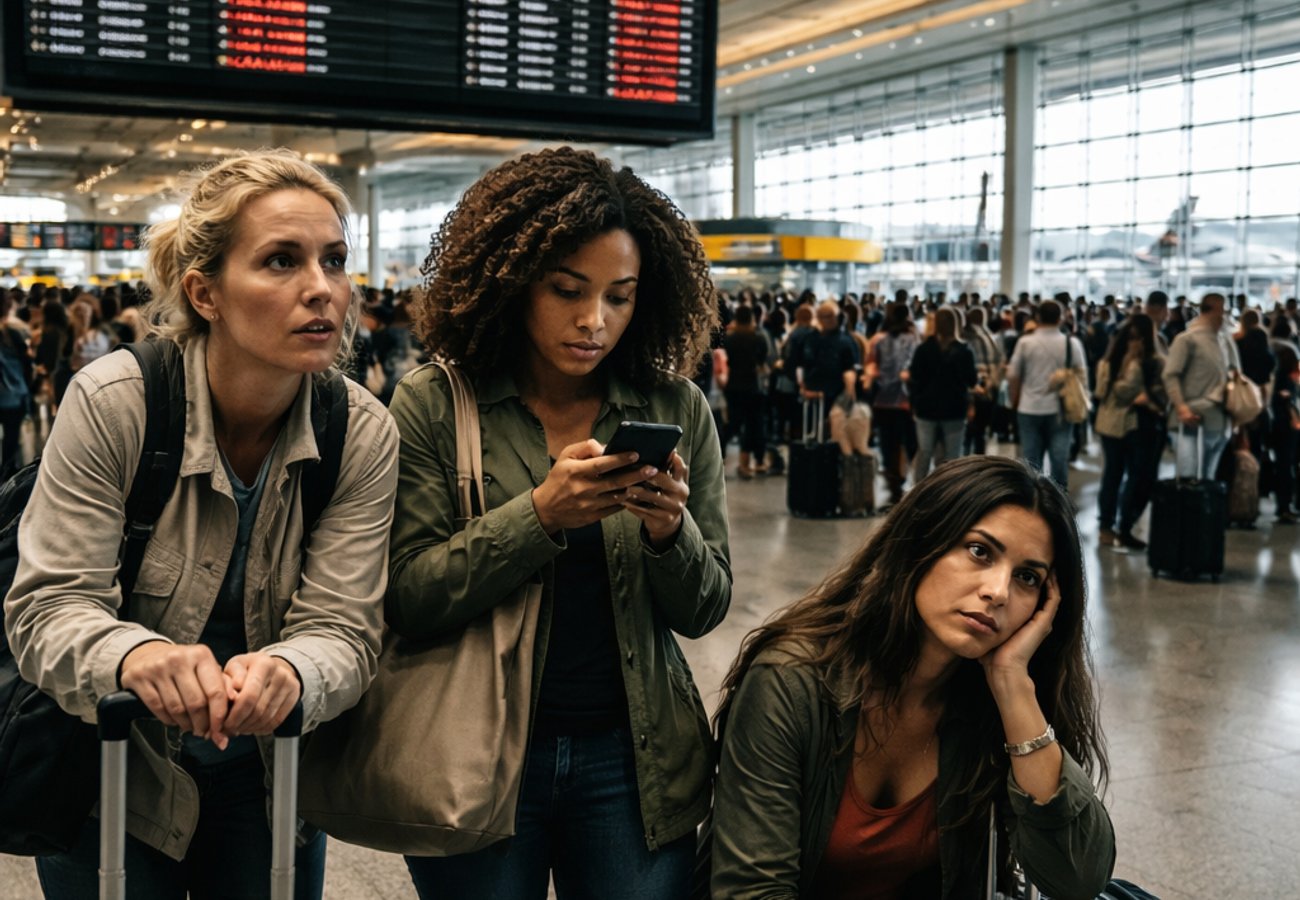
Image generated by AI
The Day JFK Brought Global Aviation to a Standstill
On June 8, 2026, what began as an operational hiccup at John F. Kennedy International Airport evolved into a cascading crisis that rippled across 40 cities spanning four continents. The numbers tell a stark story: 18 flight cancellations and over 100 delayed flights —a disruption of historic proportions for one of the world's busiest international hubs.
I've covered countless airport disruptions over my career, but this one was different. The sheer geographic reach revealed a fundamental truth about modern aviation: one airport's crisis is every airport's problem.
Ground Zero: JFK's Operational Breakdown
John F. Kennedy International Airport bore the brunt of the chaos. The airport alone recorded 10 cancellations in its first operational segment and 8 additional cancellations in the second reporting period, making it the epicenter of disruption.
Reddit: "I was stuck at JFK for 14 hours. Literally watched planes being cancelled one after another. No communication from the airlines until two hours in." — r/travel
The concentration of cancellations at JFK wasn't random. As a major international gateway connecting North America with Europe, the Middle East, and Asia-Pacific, every cancelled flight at JFK represented dozens of cascading cancellations downstream. Aircraft rotations fell behind schedule. Crew assignments fractured across the network. Connection chains snapped under the pressure.
The Airline Breakdown: Who Suffered Most
Delta Air Lines took the heaviest hit, with 5 cancellations and 42 delayed flights across its operations. Its regional partner, Endeavor Air, contributed 4 cancellations and 33 delays to the tally.
American Airlines reported 3 cancellations and 35 delays, while JetBlue —a carrier heavily dependent on JFK operations—logged 2 cancellations paired with 57 delayed flights. The sheer volume of JetBlue delays underscored the airline's operational concentration at New York's premier gateway.
British Airways, All Nippon Airways, and Republic Airways each experienced cancellations, though at smaller volumes. The diversity of affected carriers proved one critical point: this wasn't an airline-specific failure. This was systemic.
A Global Contagion: 40 Cities Across Four Continents
The disruption's reach was staggering. Within the United States, 37 major airports experienced cascading effects:
Miami, Dallas–Fort Worth, and Buffalo each reported multiple cancellations. Atlanta, Chicago O'Hare, Los Angeles, San Francisco, Denver, Boston, and Washington Reagan National all faced significant delays. Secondary hubs like Nashville, Austin, Charlotte, and Minneapolis–Saint Paul felt the pressure as aircraft rotations fell apart. Even smaller regional airports like Burlington, Nantucket, Martha's Vineyard, and Lake Placid reported disruptions—a sign of how deeply the JFK crisis penetrated regional networks.
Internationally, the contagion spread with alarming speed:
Europe absorbed significant disruptions at London Gatwick, Amsterdam Schiphol, Frankfurt, and Paris Charles de Gaulle. Regional capitals like Copenhagen, Barcelona, Madrid, Athens, Milan, and Belgrade all reported cascading delays tied to JFK.
The Middle East emerged as a secondary impact zone, with Abu Dhabi, Doha, and Jeddah experiencing major disruptions. Asia-Pacific destinations including Tokyo Haneda, Hong Kong, and Taipei felt the effects hours later as westbound aircraft failed to arrive on schedule.
Latin America and the Caribbean weren't spared: Mexico City, Cancun, Panama City, São Paulo, Bogotá, Toronto, and Caribbean gateways including Nassau, San Juan, and Montego Bay reported ripple-effect delays.
According to FlightAware's real-time tracking system, the interconnected nature of aviation networks meant that a single operational failure could create a 24-hour domino effect across global systems.
What Passengers Faced: The Ground Reality
Thousands of travelers experienced schedule changes, missed connections, and extended waiting times. Some spent 12+ hours rerouting. Others abandoned flights entirely, opting for alternative carriers or ground transportation.
The incident exposed a hard truth: in modern aviation, there are no isolated disruptions. A cancelled flight at JFK becomes a missed connection in London. A delayed departure in New York becomes a crew scheduling nightmare in Tokyo.
Know Your Rights: What to Do When Your Flight Gets Cancelled
If you find yourself trapped in a cancellation scenario, here's your action plan:
Stay Updated in Real-Time
The moment you receive notification, monitor your email, phone, and the airline's mobile app. Real-time intelligence is your most valuable asset. Visit the airline's website directly—don't rely on third-party sources.
Contact Your Airline Immediately
If you're at the airport, head to the airline's service desk and skip phone queues. If you're not at the airport yet, use the airline's online chat system or social media channels, where response times are often faster than traditional customer service lines.
Understand Your Legal Protections
In the European Union, passengers are entitled to compensation under EU261 regulations when cancellations are within the airline's control. The EU261 framework guarantees compensation up to €600 depending on flight distance. In the United States, regulations are less prescriptive, but airlines typically rebook passengers on the next available flight free of charge.
Explore Alternative Options
Ask specifically about the next available flight on your airline. If timing doesn't work, request to be booked on a competing carrier at no extra cost—many airlines honor this when cancellations are their responsibility. Consider trains or buses if flight rebooking is impossible.
Document Everything
Keep all receipts, confirmation numbers, and communication records. If you pursue compensation claims, documentation is non-negotiable.
The Interconnected Aviation Ecosystem: A Fragile System
The June 8, 2026 disruption at JFK serves as a stark reminder that modern aviation operates as a single integrated system. There are no circuit breakers. There are no failsafes that isolate one airport's problems from global networks.
One airport's 18 cancellations became dozens of cancellations downstream. One day's operational failure became a 24-hour global travel crisis affecting hundreds of thousands of passengers.
Critical Takeaway for Travelers
Travel flexibility is no longer optional. It's essential. Maintain 3-hour buffer times on connections. Monitor FlightAware before arriving at the airport. Know your airline's rebooking policies before you fly. Most critically: stay calm, stay informed, and stay ready to pivot.
Airlines actively modify schedules to maintain safety. Panicking accomplishes nothing. Information, documentation, and flexibility accomplish everything.
The system works on the edge of chaos. Expect disruption. Prepare accordingly.
Related Travel Guides
Disclaimer
This article is for informational and educational purposes only. It does not constitute legal, financial, or professional advice. While we strive to provide accurate and up-to-date information, travel policies, regulations, and conditions change rapidly. Always verify information with official sources before making travel decisions. Nomad Lawyer makes no representations about the accuracy, reliability, completeness, or suitability of the information provided. Readers should consult qualified professionals for advice specific to their circumstances. The views expressed in this article are those of the author and do not necessarily reflect the views of Nomad Lawyer.
Kunal K Choudhary
Co-Founder & Contributor
A passionate traveller and tech enthusiast. Kunal contributes to the vision and growth of Nomad Lawyer, bringing fresh perspectives and driving the community forward.
Learn more about our team →