
USA Air Travel Costs Surge as JetBlue Increases Baggage Fees to Fifty Dollars Ahead of Peak Holiday Rush

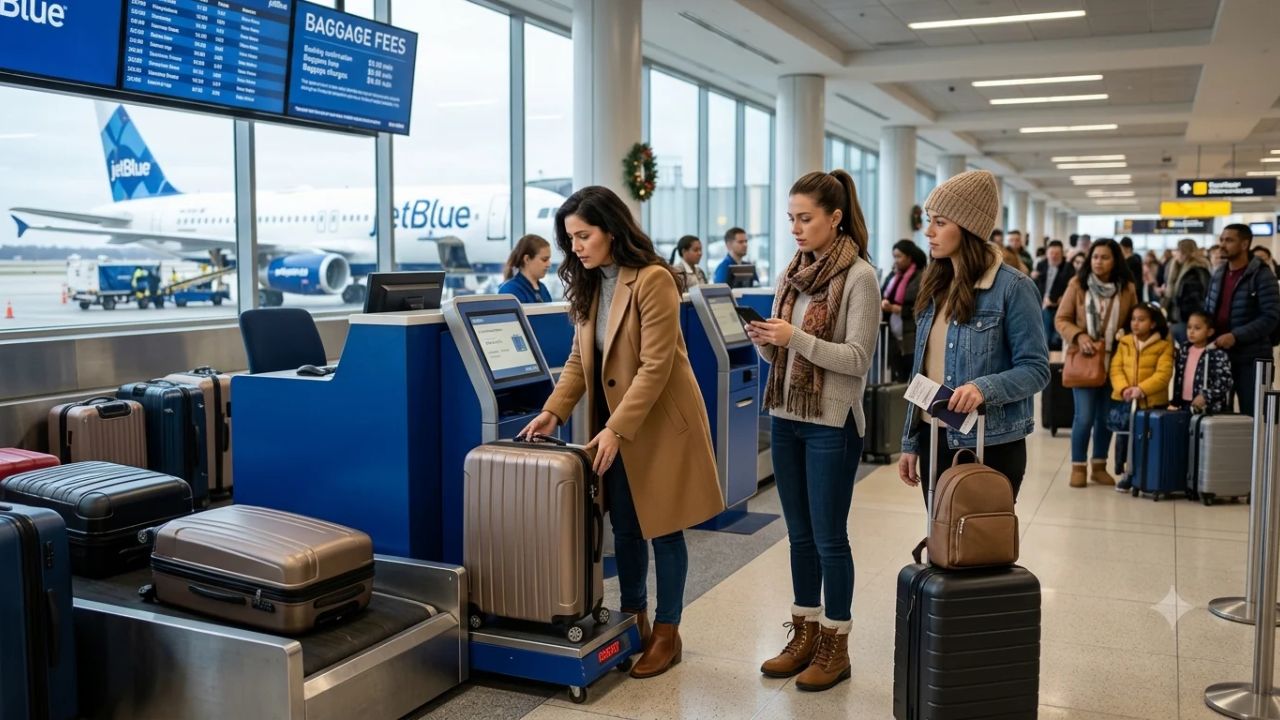
NEW YORK — Millions of American holiday travelers are confronting sharp increases in out-of-pocket flying expenses as JetBlue Airways officially implemented higher checked baggage fees for all tickets purchased from November 3, 2026 onward. Under the carrier’s revised fee schedule, checking a standard first suitcase on domestic, Canadian, Caribbean, and Latin American routes now starts at an unprecedented $50 each way during off-peak windows when prepaid in advance, jumping to $55 during designated peak holiday travel periods. Travelers who delay paying for luggage until the 24-hour departure check-in window face even steeper financial penalties, with first-bag charges escalating to $60 off-peak and $70 during peak dates.
The price adjustments arrive precisely as American households finalize travel logistics for Thanksgiving, Christmas, and New Year family gatherings. The escalating baggage fees highlight the deepening structural tension between airline operating expenses and consumer budgets. Official benchmark data released on November 4, 2026 by the US Energy Information Administration (EIA) reveals that wholesale Gulf Coast aviation jet fuel prices averaged $4.483 per gallon in October 2026—a stunning 108 percent increase compared to the $2.154 per gallon recorded in October 2025. While JetBlue has not positioned the fee revision as an explicit fuel surcharge, the combination of elevated energy expenditures, aircraft maintenance inflation, and unbundled ancillary revenue strategies is making standard airline luggage one of the fastest-growing expenses in commercial aviation.
       JETBLUE BAGGAGE PRICING DYNAMICS & ESCALATION LADDER (2026–2027)
       ===============================================================

       [ PAYMENT TIMING: PREPAID (>24 HRS BEFORE FLIGHT) ]
       ---------------------------------------------------
       * First Checked Bag (Off-Peak):     $50 each way ($100 return)
       * First Checked Bag (Peak Dates):   $55 each way ($110 return)
       * Second Checked Bag (Off-Peak):    $70 each way ($140 return)
       * Second Checked Bag (Peak Dates):  $75 each way ($150 return)
                                      |
                                      v
       [ PAYMENT TIMING: AT AIRPORT / CHECK-IN (<24 HRS BEFORE FLIGHT) ]
       -----------------------------------------------------------------
       * First Checked Bag (Off-Peak):     $60 each way ($120 return)
       * First Checked Bag (Peak Dates):   $70 each way ($140 return)
       * Second Checked Bag (Off-Peak):    $75 each way ($150 return)
       * Second Checked Bag (Peak Dates):  $85 each way ($170 return)
                                      |
                                      v
       [ THE PEAK HOLIDAY MULTIPLIER (FAMILY OF FOUR: 1 BAG EACH) ]
       * Prepaid Off-Peak Return Trip:     $400 total luggage fee
       * Prepaid Peak Holiday Return Trip: $440 total luggage fee
       * Airport Peak Holiday Return Trip: $560 total luggage fee
The Economics of Ancillary Revenue: Why Airlines Unbundle Baggage
To understand why airline baggage fees continue their inexorable upward climb across the United States, travelers must look beyond individual flight tickets to the broader macroeconomic mechanics of airline revenue management. Over the past two decades, commercial carriers have shifted away from all-inclusive airfares toward an aggressively "unbundled" pricing model.
In an unbundled marketplace, the advertised base fare covers only passenger transportation from Point A to Point B, alongside a standard carry-on personal item. Every supplementary element of the air travel journey—checked suitcases, overhead carry-on bags on basic economy tickets, assigned seating, extra legroom, early boarding priority, and in-flight refreshments—is unbundled and monetized as a discretionary ancillary fee.
THE DUAL ECONOMIC ENGINE OF UNBUNDLED BAGGAGE FEES
| Commercial Driver | Operational & Tax | Metasearch Engine | Airline Operating |
|---|---|---|---|
| & Industry Mechanism | Advantage | Consumer Impact | Financial Benefit |
| Federal Excise Tax | Baggage fees are | Lowers base ticket | Increases net operating |
| (FET) Exemption | exempt from the | price on Google | margin by shielding non- |
| 7.5% passenger tax | Flights and Kayak | fare revenue from taxes | |
| Metasearch Ranking | Base airfare strips | Secures top rank in | Preserves high booking |
| Algorithm Placement | out baggage costs | price-sensitive | conversion while fees |
| for search engines | consumer displays | are collected post-sale | |
| Fuel Expense Hedge | Ancillary fees can | Creates flexible | Insulates balance sheet |
| & Inflation Buffer | be raised instantly | pricing mechanisms | against sudden energy |
| without DOT notice | to cover fuel spikes | price spikes in market |
This pricing strategy offers airlines a major structural and fiscal advantage. Under US tax law, standard commercial airline ticket sales are subject to a mandatory 7.5 percent Federal Excise Tax (FET) that flows into the federal Airport and Airway Trust Fund. However, optional ancillary charges, including checked baggage fees, are legally classified as non-transportation ancillary revenues and are entirely exempt from the 7.5 percent tax. By shifting revenue from the base fare into baggage fees, airlines retain 100 percent of the collected baggage charge, dramatically improving net profit margins.
Additionally, unbundling allows carriers like JetBlue to maintain competitive parity on online travel metasearch platforms like Google Flights, Expedia, and Kayak. Because metasearch algorithms rank flight options based on headline base fares, an airline that includes checked bags in its ticket price would appear artificially expensive compared to competitors advertising stripped-down economy fares. Unbundling enables airlines to win the consumer click with a low entry fare, only to collect lucrative baggage fees later in the reservation sequence.
According to global airline revenue benchmarks compiled by aviation consultancy IdeaWorksCompany, worldwide airline ancillary revenue surged past $118 billion annually, with checked luggage fees representing more than a third of all non-fare collections. In the United States alone, the Bureau of Transportation Statistics (BTS) confirmed that major commercial airlines collected over $7.1 billion in baggage fees in the preceding fiscal year. As inflation across pilot labor agreements, technical maintenance contracts, and third-party ground handling services erodes underlying ticket profitability, ancillary charges have evolved from optional service fees into the primary structural buffer keeping modern carriers financially stable.
The Jet Fuel Pressure: Analyzing the EIA 108% Benchmark Surge
The timing of JetBlue’s baggage fee escalation is intimately tied to severe cost volatility across international energy markets. Aviation turbine kerosene—commonly referred to as jet fuel—represents an airline's largest single operational expense, typically accounting for between 25 and 35 percent of total airline operating expenditures.
According to official weekly and monthly petroleum statistics published on November 4, 2026 by the US Energy Information Administration (EIA), wholesale Gulf Coast jet fuel averaged $4.483 per gallon in October 2026. Exactly twelve months earlier, in October 2025, the identical benchmark recorded an average price of $2.154 per gallon. This represents an astonishing 108 percent year-on-year surge in wholesale fuel expenses.
       US GULF COAST JET FUEL BENCHMARK ESCALATION (2025–2026)
       =======================================================

       October 2025 Average: $2.154 per gallon
                                |
                                v (108% Surge Over 12-Month Window)
                                |
       September 2026 Average: $4.388 per gallon
                                |
       October 2026 Average:   $4.483 per gallon
                                |
       November 2, 2026 Daily: $4.019 per gallon
                                |
       November 3, 2026 Daily: $4.198 per gallon
The underlying causes of this energy price escalation stem from complex geopolitical and industrial pressures. Escalating regional hostilities in the Middle East disrupted critical crude transit corridors and refinery logistics throughout 2026. Simultaneously, global refining capacity has faced acute bottlenecks: the "crack spread"—the commercial refining margin that represents the cost of converting raw unrefined crude oil into specialized aviation kerosene—widened dramatically due to scheduled refinery maintenance, regulatory transitions, and secondary supply disruptions.
While daily readings on November 2 and November 3, 2026 dipped slightly to $4.019 and $4.198 per gallon respectively, prices remain at historically elevated levels. Airlines do not buy fuel on a daily retail basis; rather, they secure fuel through bulk commercial wholesale supply contracts, pipeline off-take agreements, and financial derivative hedging strategies. When sustained wholesale fuel prices hover above $4.00 per gallon for multiple consecutive quarters, airlines face severe margin compression unless they adjust pricing across both airfares and ancillary fees.
For carriers with substantial operational footprints in the US Northeast—such as JetBlue’s primary bases at New York JFK, Boston Logan, and Newark Liberty—fuel delivery expenses are compounded by pipeline tariff surcharges and regional distribution premiums. While airlines operating out of Texas or the Gulf Coast enjoy direct refinery connectivity via local pipelines, East Coast airports depend heavily on the Colonial Pipeline and maritime barge shipments. When refining margins expand and regional pipeline capacity tightens, the delivered cost of jet fuel at JFK often exceeds the quoted Gulf Coast benchmark by an additional 15 to 25 cents per gallon, intensifying the financial pressure on regional route networks.
The Dynamic Peak-Pricing Calendar: Seasonal Surcharges Formalized
One of the most consequential structural developments in JetBlue’s revised policy is the formalization of dynamic "peak" and "off-peak" baggage pricing windows. Rather than maintaining a flat, predictable baggage fee throughout the year, JetBlue now applies surge pricing to checked luggage during high-demand holiday travel periods.
For the 2026 and 2027 calendar cycles, JetBlue has established an extensive schedule of peak baggage windows that capture major national holidays, school recesses, and seasonal vacation peaks:
JETBLUE PUBLISHED PEAK BAGGAGE PRICING CALENDAR
| Entity / Facility | Delays | Cancellations | Details |
|---|---|---|---|
| Seasonal Holiday | Designated Peak | Calendar Duration | Holiday Travel |
| & Travel Window | Date Range | & Operational Scope | Impact Analysis |
| Early November | November 5 to | 7 consecutive days | Captures autumn school |
| Fall Travel Surge | November 11, 2026 | during early month | breaks and Veterans Day |
| Thanksgiving Holiday | November 19 to | 12 consecutive days | Covers nationwide peak |
| Travel Period | November 30, 2026 | surrounding holiday | Thanksgiving movement |
| Christmas & New Year | December 1, 2026 to | 49 consecutive days | Full seasonal holiday |
| Winter Break Surge | January 18, 2027 | unbroken peak rate | window through MLK Day |
| Presidents' Day & | Mid-February 2027 | Scheduled peak | Winter ski and Florida |
| Winter School Break | (Specific dates) | holiday window | seasonal travel peak |
| Spring Break & | April through May | Multi-week peak | Easter, Passover, and |
| Memorial Day Travel | 2027 (Scheduled) | holiday calendar | Memorial Day gateways |
| Summer Peak Travel | Mid-June through | Multi-month summer | High-volume family |
| Season 2027 | September 2027 | holiday schedule | vacation operations |
The design of the calendar reveals strategic revenue engineering. For example, in November 2026, JetBlue designates two distinct peak windows: an initial window from November 5 to November 11 (capturing early autumn breaks and Veterans Day weekend), followed by the primary Thanksgiving holiday period running from November 19 through November 30.
Even more striking is the winter holiday schedule. JetBlue has designated every single day of December 2026 as peak baggage pricing, continuing without interruption through January 18, 2027. This means that any passenger flying on JetBlue during the entire month of December and the first half of January will automatically pay peak rates on checked bags, regardless of whether their specific flight operates on a Tuesday afternoon or a Sunday evening.
The Procrastination Penalty: Last-Minute Airport Baggage Spikes
Alongside seasonal peak dates, JetBlue enforces a sharp financial penalty on travelers who postpone paying for their checked luggage until the final 24 hours prior to flight departure.
       BAGGAGE FEE VARIANCE: ADVANCE PURCHASE VS. AIRPORT CHECK-IN
       ===========================================================

       [ OFF-PEAK BAGGAGE FEES ]
       * First Bag Prepaid (>24 Hrs):   $50   |   First Bag Late (<24 Hrs):   $60  (+$10)
       * Second Bag Prepaid (>24 Hrs):  $70   |   Second Bag Late (<24 Hrs):  $75  (+$5)
                                     |
                                     v
       [ PEAK HOLIDAY BAGGAGE FEES ]
       * First Bag Prepaid (>24 Hrs):   $55   |   First Bag Late (<24 Hrs):   $70  (+$15)
       * Second Bag Prepaid (>24 Hrs):  $75   |   Second Bag Late (<24 Hrs):  $85  (+$10)
                                     |
                                     v
       [ ROUND-TRIP IMPACT PER PASSENGER (2 CHECKED BAGS AT PEAK) ]
       * Prepaid in Advance (>24 Hrs):  $130 each way = $260 round-trip
       * Paid at Airport (<24 Hrs):     $155 each way = $310 round-trip
       * Pure Procrastination Penalty:  $50 wasted on identical luggage!
This tiered structure is intentionally designed to alter consumer behavior. In modern airline ground operations, airport check-in lobbies are severe operational choke points. When passengers arrive at terminal kiosks or ticket counters without prepaid baggage allowances, check-in transaction times multiply as gate agents process credit card payments, answer fee inquiries, and tag bags. By imposing a $10 to $15 penalty on bags purchased within 24 hours of departure, JetBlue incentivizes passengers to register and prepay their luggage through the mobile app or website, reducing airport staffing requirements and accelerating lobby throughput.
For travelers, however, failing to prepay can turn an ordinary family vacation into a major financial headache. A traveler checking two bags on a peak holiday flight who pays at the airport will incur a staggering $155 one-way charge—amounting to $310 for a standard round-trip journey, representing an expense that often exceeds the base ticket fare itself.
Transatlantic Rules, Overweight Penalties, and Caribbean Embargoes
JetBlue’s baggage fee architecture extends beyond domestic routes, applying specialized fee schedules to international transatlantic flights, heavy luggage, and high-density regional routes.
INTERNATIONAL & SPECIALTY BAGGAGE FEE STRUCTURE
| Entity / Facility | Delays | Cancellations | Details |
|---|---|---|---|
| Route Category | First Bag Allowance | Second Bag | Heavy / Oversized |
| & Travel Segment | & Pricing Rates | Allowance & Rates | Excess Penalty Fees |
| Transatlantic Routes | Off-Peak: $80 / | Off-Peak: $115 / | Third Bag: $200-$210 / |
| (US to UK & Europe) | £70 / €75 prepaid | £95 / €105 prepaid | £150-£160 / €185-€195 |
| Peak: $90/£80/€85 | Peak: $125/£105/€115 | per additional suitcase | |
| Overweight Luggage | Standard bag rate | Not permitted at | $150 / £120 / €140 |
| (51 to 70 lbs) | plus flat penalty | standard rates | flat surcharge per bag |
| Severe Overweight | Standard bag rate | Maximum certified | $150 / £120 / €140 |
| (71 to 99 lbs) | plus heavy penalty | limit: 99 pounds | flat surcharge per bag |
| Oversized Luggage | Bags 63 to 80 | Bags over 80 linear | $150 / £120 / €140 |
| (Linear Dimensions) | linear inches | inches rejected | flat surcharge per bag |
| Destination Embargo | Maximum 2 checked | Applies Nov 16 to | Enforced to Guyana, |
| & Bag Limits | bags per passenger | Jan 15 season | Haiti, Trinidad & Ecuador |
1. Transatlantic Services to Europe
On JetBlue’s transatlantic services connecting New York (JFK) and Boston (BOS) with London Heathrow, London Gatwick, Paris Charles de Gaulle, Dublin, Edinburgh, and Amsterdam, baggage fees follow a separate multi-currency schedule.
For passengers traveling on unbundled Main Base and EvenMore Base tickets, a first checked bag costs $80, £70, or €75 off-peak, rising to $90, £80, or €85 during peak dates. A second checked bag costs $115, £95, or €105 off-peak and $125, £105, or €115 at peak times. Adding a third checked bag on a transatlantic flight triggers a prohibitive charge of $200 to $210 each way, making excessive packing exceptionally costly.
2. Overweight and Oversized Surcharges
Travelers must exercise extreme vigilance regarding suitcase weight and physical dimensions. JetBlue enforces a strict 50-pound (22.6 kg) weight limit on standard checked bags.
If a suitcase weighs between 51 and 70 pounds, JetBlue levies a punitive $150 overweight fee (or £120 / €140). If the suitcase weighs between 71 and 99 pounds, a separate $150 surcharge applies. Luggage exceeding 99 pounds is rejected entirely. Similarly, suitcases measuring between 63 and 80 linear inches (length plus width plus height) incur a $150 oversized fee, while items exceeding 80 inches cannot be accepted as checked baggage.
3. Regional Destination Embargoes
For flights serving Latin America and the Caribbean, physical cargo hold capacity constraints prompt JetBlue to enforce seasonal baggage embargoes.
On flights to and from Ecuador, passengers are restricted to a maximum of two checked bags year-round. Between November 16, 2026 and January 15, 2027, JetBlue applies an identical strict two-bag limit on all flights serving Guyana, Haiti, and Trinidad and Tobago. During these embargo windows, excess baggage requests cannot be purchased at any price, preventing diaspora travelers from transporting oversized holiday gifts.
Fare Hierarchy and Upgrades: Doing the Math Before Booking
The escalating cost of checked luggage has fundamentally altered the mathematical calculus of booking airline tickets. When comparing airfares, purchasing the cheapest entry-level ticket is often no longer the most economical decision.
       FARE COMPARISON MATHEMATICS: BASIC VS. PREMIUM BUNDLES
       ======================================================

       SCENARIO: Traveler checking 1 suitcase during peak holiday window
       -----------------------------------------------------------------
       * Option A: Main Base Fare ($180) + Round-Trip Bag ($110) = $290 Total
       * Option B: BlueFirst Base ($245, Includes 1 Free Checked Bag) = $245 Total
       * NET SAVINGS BY UPGRADING: $45 in cash, plus extra legroom and priority!
JetBlue offers a tiered fare hierarchy across its domestic and international network:
- Main Base & Main Fares: Standard economy seating. Checked bags are unbundled and require full fee payment.
- EvenMore Fares: Includes up to 7 inches of extra legroom, early boarding, and expedited security, but standard baggage fees still apply on domestic routes.
- BlueFirst Base & Mint Base: Includes one complimentary checked bag up to 50 pounds.
- BlueFirst, BlueFirst Flex, Mint & Mint Flex: Includes two complimentary checked bags up to 50 pounds each, alongside priority check-in, priority baggage handling, and full ticket flexibility.
Before completing a reservation, travelers carrying luggage should calculate the price differential between a basic fare and an upgraded tier. In many instances, upgrading to BlueFirst or Mint Base costs less than purchasing a basic economy ticket and subsequently paying $100 to $260 in round-trip baggage fees. In addition, the upgraded fare provides secondary benefits such as seat selection, complimentary in-flight snacks, and accelerated boarding.
This fee dynamic also alters how JetBlue compares against legacy rivals. Major full-service competitors—including Delta Air Lines, American Airlines, and United Airlines—previously raised their domestic first-bag fees from $30 to $35 or $40 when paid online. By pushing the baseline first-bag fee to $50 off-peak and $55 at peak periods, JetBlue has broken through a significant psychological threshold in American commercial aviation. For passengers comparing cross-country routes from Boston to Los Angeles or New York to Miami, an ostensibly cheaper $150 JetBlue base fare can quickly become less economical than a $190 legacy carrier fare once luggage and seat assignments are factored into the final booking ledger.
Loyalty Waivers and Cardholder Shields: How to Avoid Baggage Charges
Despite the widespread fee increases, several proven mechanisms allow frequent travelers and savvy consumers to bypass JetBlue's baggage charges entirely.
JETBLUE BAGGAGE FEE WAIVER & EXEMPTION DIRECTORY
| Entity / Facility | Delays | Cancellations | Details |
|---|---|---|---|
| Loyalty / Card Tier | Complimentary Bag | Companion Coverage | Essential Booking & |
| & Exemption Path | Allowance Limit | & Family Benefits | Eligibility Conditions |
| TrueBlue Mosaic 1 | 1 free checked bag | Applies to member | Must include TrueBlue |
| Elite Tier Member | on all flights | on reservation | number on booking |
| TrueBlue Mosaic 2, | 2 free checked | Applies to member | Up to 50 pounds each; |
| 3, and 4 Members | bags on all flights | on reservation | priority bag tags |
| JetBlue Plus & | 1 free checked bag | Extends to up to 3 | Must purchase tickets |
| Premier Cardholders | per passenger | companions on same | using the co-branded card |
| reservation | on JetBlue metal | ||
| Premium Travel Card | $200 to $300 annual | Covers baggage fees | Requires selecting |
| Incidentals Credit | statement credit | via reimbursement | JetBlue as preferred |
| (Amex Plat / Chase) | for airline fees | on credit card | airline before billing |
1. TrueBlue Mosaic Elite Status
Members of JetBlue’s TrueBlue loyalty program who have earned Mosaic status receive automatic baggage fee exemptions. Mosaic 1 members receive one complimentary checked bag on all flights. Members holding Mosaic 2, Mosaic 3, or Mosaic 4 status receive two complimentary checked bags per flight, alongside priority baggage tagging that ensures their luggage is among the first delivered to the airport baggage carousel.
2. Co-Branded JetBlue Credit Cards
Holding an eligible co-branded credit card—specifically the JetBlue Plus Card or JetBlue Premier Card—serves as one of the most cost-effective shields against baggage fees.
The primary cardholder receives their first checked bag free on all JetBlue-operated flights. Importantly, this benefit extends to up to three travel companions booked on the same reservation, creating immense value for families. On a single peak holiday round-trip flight, a family of four utilizing the cardholder waiver saves $440 in luggage fees, far exceeding the card's modest annual fee.
3. Premium Travel Card Airline Incidentals Credits
Travelers holding premium credit cards such as The Platinum Card from American Express or the Chase Sapphire Reserve can leverage their annual airline fee credits to offset JetBlue baggage charges. By selecting JetBlue as their designated airline before purchasing luggage allowances, these charges are automatically credited back to the cardholder's statement.
Traveler Action Guide: Mastering Holiday Flight Budgets in 2026/2027
To navigate the revised JetBlue baggage fee landscape and avoid unexpected airport charges during the 2026 and 2027 holiday rush, travelers should execute the following strategic steps:
        STRATEGIC BAGGAGE BUDGETING WORKFLOW
        ===================================

        [ 1. AUDIT RESERVATION CREATION DATE ]
        * Bookings made BEFORE Nov 3, 2026: Governed by legacy lower fee schedule
        * Bookings made ON OR AFTER Nov 3, 2026: Subject to $50–$55 new baseline
                               |
                               v
        [ 2. VERIFY TRAVEL DATES AGAINST PEAK CALENDAR ]
        * Peak Windows: Nov 5–11, Nov 19–30, All of December, Jan 1–18
        * Expect $55 prepaid or $70 late-airport charges during these windows
                               |
                               v
        [ 3. PREPAY BAGGAGE AT LEAST 24 HOURS IN ADVANCE ]
        * Never wait until the airport lobby or check-in kiosk
        * Prepaying saves $10 to $15 per bag each way ($50 per family round-trip)
                               |
                               v
        [ 4. WEIGH AND MEASURE CASES AT HOME ]
        * Keep total weight strictly under 50.0 pounds (avoid $150 overweight fee)
        * Ensure linear dimensions do not exceed 62 inches
                               |
                               v
        [ 5. MAXIMIZE CARRY-ON ALLOWANCES ]
        * Utilize standard personal item (under seat) + full overhead carry-on
        * Consolidate bulky winter outerwear and electronics into carry-on bags
- Verify Your Booking Creation Date: Check the date your ticket was issued. If your reservation was completed prior to November 3, 2026, your booking is governed by JetBlue’s legacy fee schedule. Access "Manage Trips" on the JetBlue portal to confirm your grandfathered baggage rate rather than assuming the higher charges apply.
- Prepay Without Exception: Never wait until arriving at the airport to purchase luggage allowance. Prepaying your baggage allowance more than 24 hours prior to departure via the JetBlue mobile app or website guarantees the lowest applicable rate, saving between $20 and $30 per suitcase on a standard round-trip itinerary.
- Weigh Luggage Before Leaving Home: Invest in an inexpensive digital luggage scale. A suitcase that registers 51 pounds at the airport curb will trigger a $150 overweight penalty, transforming a $55 bag into a $205 expense. Redistribute heavier clothing items into carry-on bags to ensure checked cases remain strictly under the 50.0-pound threshold.
- Leverage Carry-On Dimensions Efficiently: JetBlue continues to permit one free personal item (such as a purse, laptop backpack, or small duffel that fits beneath the seat in front of you) alongside one free standard carry-on suitcase for all Blue, Blue Plus, and EvenMore passengers. Pack dense, heavy items in your carry-on luggage to minimize checked weight.
The escalation of JetBlue’s baggage fees to $50 and $55 marks an important turning point in American commercial aviation pricing. As airlines manage elevated fuel expenses and unbundled revenue structures, travelers must approach flight booking with strategic financial awareness—remembering that in modern air travel, the price on the ticket is merely the beginning of the journey.
Related Travel Guides
- Vietnam Airlines Implements Strict US Travel Rules and CDC Ebola Health Declarations
- Emirates Explores First Class Suites for Airbus A350-1000 Amid Widebody Fleet Modernization
- Virgin Australia Unveils Major Lounge Network Expansion with 100-Seat Brisbane Upgrade and Perth Beyond Reopening
- Air Canada Drops Toronto–Mumbai Flights from 2027 Network Amid Widebody Fleet Realignment
- Koh Yao Noi and Historic Global Capitals Gain Wider Luxury Reach as Wyndham Expands Registry Collection
This article is for informational purposes. Flight routes, passenger regulations, visa rules, and transit advisories are subject to change by airlines and aviation authorities. Readers are advised to verify schedules and travel documentation with relevant carriers and border agencies before departure.
Related Stories
Southwest and JetBlue Launch $59 Winter Airfare War: 2026–2027 US Travel Deals & Booking Guide
JetBlue Launches Fort Lauderdale Routes to Indianapolis and Columbus: Winter Flight Guide 2026
