
Jeonju Teams Up With Gwangju and More as Iconic Food Destinations of Korea Take Centre Stage for an Ultimate Culinary Journey
Image generated with Ai Jeonju Teams Up With Gwangju and more iconic food destinations as Korea invites global travellers on an unforgettable culinar

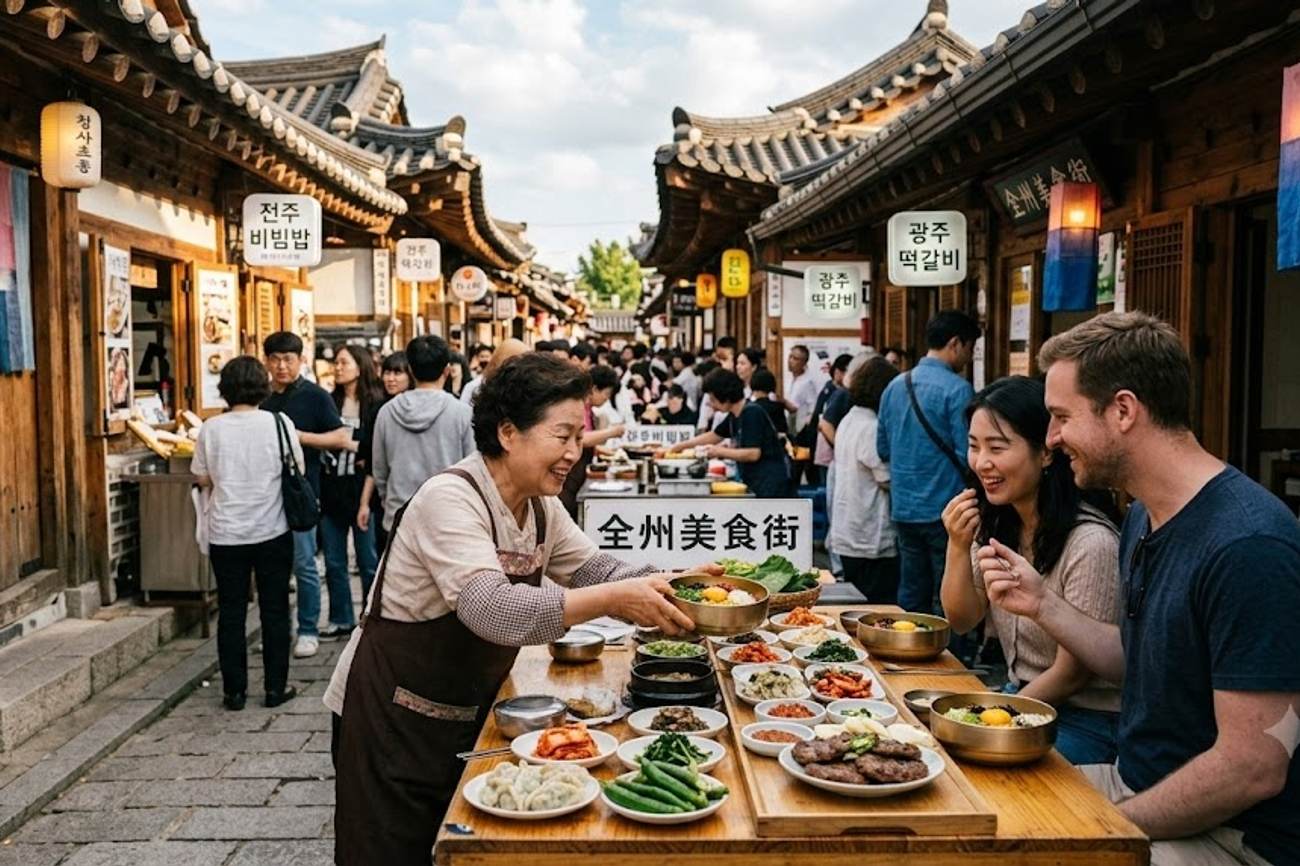
Image generated by AI
**Image generated with Ai
Jeonju Teams Up With Gwangju and more iconic food destinations as Korea invites global travellers on an unforgettable culinary journey. From Jeonju’s celebrated flavours to Gw**
Image generated with Ai
Jeonju Teams Up With Gwangju and more iconic food destinations as Korea invites global travellers on an unforgettable culinary journey. From Jeonju’s celebrated flavours to Gwangju’s rich food traditions, these iconic destinations take centre stage for travellers seeking authentic Korean cuisine. Moreover, every food destination adds a distinctive taste, story and cultural experience to the journey. Jeonju and Gwangju connect traditional recipes with vibrant markets, while more Korean destinations offer equally memorable culinary discoveries. For food-loving travellers, this ultimate culinary journey opens new ways to experience Korea beyond its famous landmarks. Travel And Tour World urges readers to explore the entire story and discover these remarkable food destinations.
6 Food Destinations in South Korea Every Traveller Should Explore for Authentic Korean Flavours
South Korea‘s food culture gives travellers a reason to move beyond the country’s most famous landmarks. From Seoul’s bustling markets to Jeju’s island produce, different regions offer distinctly local dishes, ingredients and eating traditions.
The wider tourism picture also shows why food-led travel matters. South Korea recorded 16.37 million inbound tourists in 2024, compared with 11.03 million in 2023, 3.20 million in 2022 and 967,000 in 2021. The Ministry of Culture, Sports and Tourism reported that 2024 arrivals reached 93.5% of the 2019 level.
For destination-level comparisons, however, travellers should be careful. Korean tourism statistics use different measures, including inbound visitors, regional visitors and attendance at major tourist attractions. The Korea Tourism Organization explains that its national tourism statistics are compiled from approved government statistics and administrative data.
Advertisement
Advertisement
The following guide therefore uses officially published destination or attraction visitor figures where available, rather than creating unsupported citywide estimates.
South Korea Food Tourism at a Glance Indicator 2021 2022 2023 2024 2025 South Korea inbound tourists 967,000 3,198,000 11,032,000 16,370,000 Official annual figure should be checked against final MCST release Recovery compared with 2019 Pandemic period Partial recovery Strong recovery 93.5% Continued recovery Seoul foreign visitors — 2.19m 8.03m* 13.14m 18.94m** Jeju total visitors 12.01m 13.89m 13.37m — — Gwangju major-attraction visitors 3.68m 6.30m 6.68m 7.47m — Gangneung total visitors 30.44m 35.74m 34.21m 33.23m 34.37m Busan foreign visitors — — — — 3.64m
- Seoul’s 2023 figure is reported in one Seoul government tourism publication as 8.86 million for the full year, while another presentation uses a different statistical series. The distinction reflects differing measurement periods and sources. ** Seoul’s 2025 figure is listed by Seoul’s official open-data statistics as 18,936,562 foreign tourists. Jeju’s published series in a Jeju government report runs through 2023. Gangneung’s 2025 figure is reported as 34,369,053. Gwangju’s figures represent visitors to designated major attractions and are therefore not directly equivalent to citywide visitor counts.
- Seoul: The Best Starting Point for a Multi-Regional Korean Food Journey
Seoul works particularly well as the first stop because travellers can sample food from across Korea without leaving the capital.
Start around Gwangjang Market, one of the city’s best-known traditional markets. Korea Tourism Organization information highlights bindaetteok, yukhoe, mayak gimbap, handmade noodles and bibimbap among its food experiences. The market’s food area operates late into the evening, making it suitable for travellers arriving after sightseeing.
Three foods should sit high on a first-time traveller’s list. Bindaetteok is a mung-bean pancake cooked with ingredients such as sprouts and pork. Mayak gimbap consists of small seaweed rice rolls traditionally paired with mustard sauce. Yukhoe is Korean-style seasoned raw beef and should be purchased only from reputable establishments with appropriate food-handling standards.
For a second market experience, explore Gyeongdong Market. The Korea Tourism Organization’s government-supported traditional-market guide identifies cold noodles and other Korean specialities there.
A practical one-day food route begins with breakfast near Jongno, followed by Gwangjang Market for lunch. Spend the afternoon around Gyeongbokgung and Bukchon before returning to the market district for an evening meal.
Seoul’s tourism recovery provides substantial context. Seoul recorded 13.14 million foreign tourists in 2024, following 8.86 million in 2023 and 2.19 million in 2022 in the cited city-government series. In 2025, Seoul’s official statistics list 18,936,562 foreign tourists.
Seoul Visitor Comparison Year Foreign visitors Context 2021 Not comparable in available series Pandemic restrictions 2022 2.19m Tourism reopening 2023 8.86m Strong recovery 2024 13.14m Continued international recovery 2025 18.94m Official Seoul statistics 2. Busan: Seafood, Fishcake and Coastal Korean Street Food
Busan gives travellers a completely different food experience because its culinary identity is closely connected with the sea.
Begin around Jagalchi Market, where travellers can encounter fresh seafood and raw fish. Visit Busan identifies Jagalchi, Gijang, Gukje and Bupyeong Kkangtong markets as important food stops.
The three essential foods are fresh seafood, Busan eomuk and milmyeon. Busan’s fishcake tradition is especially distinctive. Korea Tourism Organization material notes that Busan fishcakes use ground fish and appear in numerous shapes and flavours.
For milmyeon, Visit Busan lists long-established restaurants including Gaegeum Milmyeon, Daeseong Milnaengmyeon and Naeho Naengmyeon. The same official tourism platform also highlights pork soup as another signature Busan dish.
A traveller can build a two-day food itinerary around Nampo-dong and the old market district. Start at Jagalchi in the morning, explore BIFF Square around midday and visit Bupyeong Kkangtong Market later. The second day can move towards Gijang for seafood before finishing around Haeundae or Gwangalli.
Busan recorded 3.64 million foreign tourists in 2025, according to Visit Busan. The city also promoted a wider tourism target of three million international visitors and 100 million domestic travellers.
A 2024 Busan tourism analysis found that food was becoming particularly important to destination choice. It reported that the share selecting food exploration as a reason for visiting Busan increased from 55.7% to 81.7% following the city’s Michelin-related exposure.
Busan Food Plan Stop Food Recommended area Morning Seafood Jagalchi Market Lunch Fishcake/eomuk Bupyeong Kkangtong Market Afternoon Snacks Gukje Market Dinner Milmyeon Established local restaurant Next morning Seafood Gijang Market 3. Jeonju: Korea’s Traditional Food Capital for Slow Travellers
Jeonju is particularly suitable for travellers who want food combined with heritage.
The city is strongly associated with Jeonju bibimbap, kongnamul gukbap and hanjeongsik. Korea Tourism Organization describes these as signature foods and also recommends the city’s makgeolli alleys for a traditional evening experience.
The three essential foods are Jeonju bibimbap, kongnamul gukbap and makgeolli with assorted side dishes.
Jeonju bibimbap is particularly suitable for first-time visitors because it brings together rice, vegetables, egg, meat and Korean seasoning in one dish. VISITKOREA lists specialist restaurants including Han Kook Jib and Gapgi Hoegwan. Han Kook Jib dates back to 1952 and provides English, Japanese and Chinese menu information.
Travellers can spend the morning walking through Jeonju Hanok Village before stopping for bibimbap. The afternoon can include Gyeonggijeon Shrine and the surrounding historic streets. Dinner can focus on kongnamul
Related Travel Guides
- Qantas Asia Sale 2026 Opens Japan Snow Season Trips and Asia Holidays With Flights From $1,349 Return
- Discover the 13th Asian Tourism Fair 2026: Your Ultimate 3-Day Guide to Exclusive Travel Deals in Dhaka
- Australia-Europe Travel Growth Set for a Major Boost as Canberra Explores Deeper EU Partnership
Disclaimer
This article is for informational and educational purposes only. It does not constitute legal, financial, or professional advice. While we strive to provide accurate and up-to-date information, travel policies, regulations, and conditions change rapidly. Always verify information with official sources before making travel decisions. Nomad Lawyer makes no representations about the accuracy, reliability, completeness, or suitability of the information provided. Readers should consult qualified professionals for advice specific to their circumstances. The views expressed in this article are those of the author and do not necessarily reflect the views of Nomad Lawyer.
Raushan Kumar
Founder & Lead Developer
Full-stack developer with 11+ years of experience and a passionate traveller. Raushan built Nomad Lawyer from the ground up with a vision to create the best travel and law experience on the web.
Learn more about our team →