
Japan Issues Pacific Tsunami Advisory After 7.8 Magnitude Mindanao Earthquake: Evacuations From Okinawa to Tokyo on June 8, 2026
A powerful 7.8 magnitude earthquake off Mindanao, Philippines triggered tsunami advisories across Japan's Pacific coast on June 8, 2026, forcing evacuations of 195,000+ residents and disrupting coastal tourism operations from Okinawa to Ibaraki Prefecture.

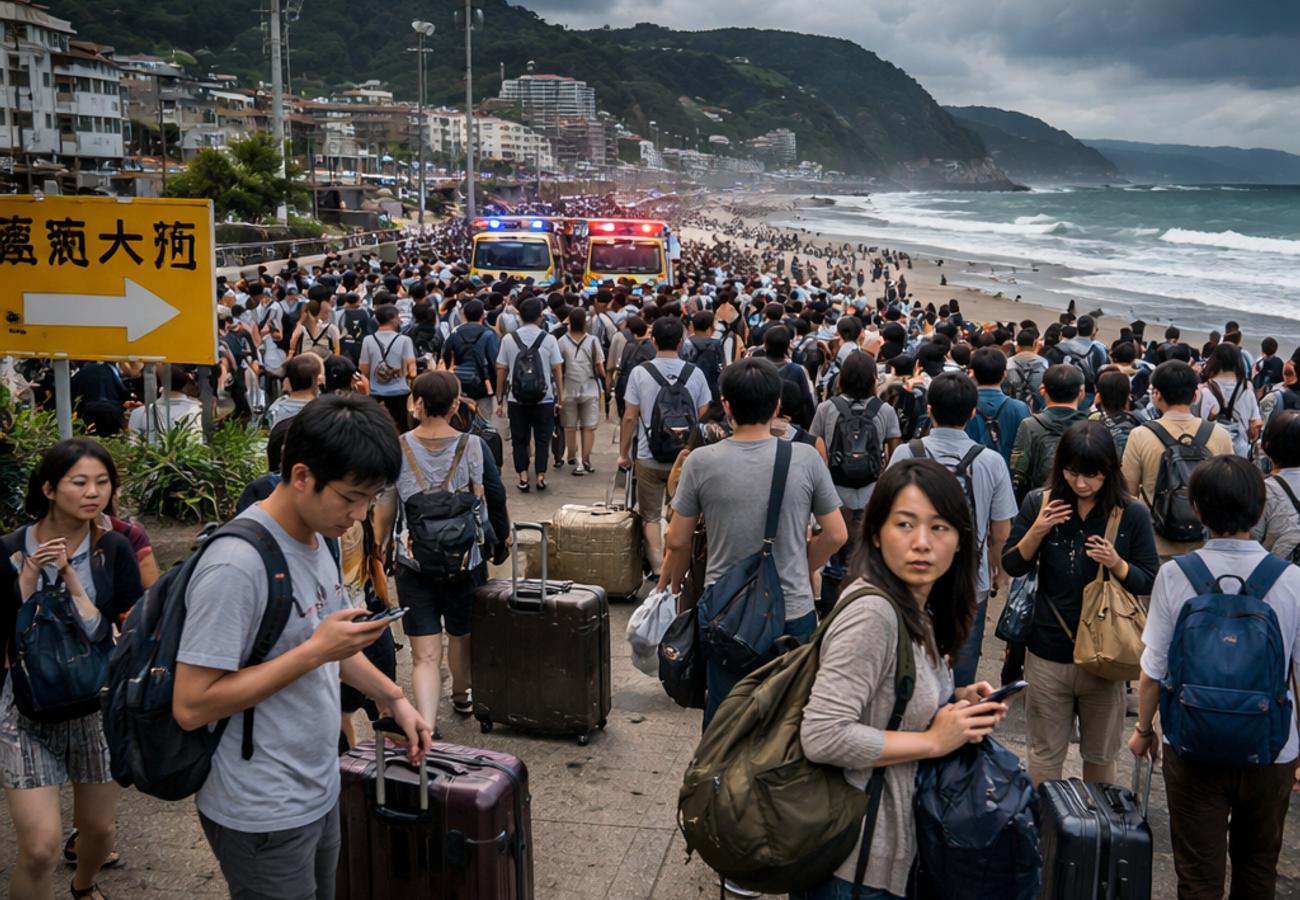
Image generated by AI
Cross-Pacific Seismic Shock Disrupts Japan's Tourism Corridor
A magnitude 7.8 earthquake struck off the coast of Mindanao, Philippines on June 8, 2026, sending shockwaves across the Pacific. Within hours, Japan's Meteorological Agency (JMA) activated its national tsunami alert system, placing coastal regions from Okinawa to Ibaraki Prefecture under official advisories. The event exposed how distant seismic activity thousands of kilometres away can instantly paralyze Japan's tourism infrastructure and disrupt the travel plans of hundreds of thousands.
The earthquake's oceanic waves, though ultimately modest, triggered one of Japan's most geographically expansive evacuation operations in recent memory. What started as a warning from the Philippines rippled through Japanese society within minutes, transforming ordinary beach days into emergency evacuations and converting thriving coastal tourism destinations into temporary ghost towns.
Reddit: "I was checking into my hotel in Okinawa when staff suddenly told us to evacuate to the third floor. Nobody expected an earthquake in the Philippines to affect our travel plans." — r/travel
Seven Prefectures Placed Under Active Tsunami Advisory
The JMA issued tsunami warnings spanning multiple prefectures: Okinawa, Kagoshima, Miyazaki, Kochi, Wakayama, Shizuoka, and Ibaraki. Official projections estimated potential wave heights of up to one metre—seemingly minor on the surface, but capable of creating dangerous currents in enclosed bays, harbours, and narrow estuaries where small vessels and low-lying infrastructure are particularly vulnerable.
Beach resorts shuttered their operations. Ferries connecting island communities halted sailings. Cruise ship operators diverted vessels to deeper waters or held them in port. Recreational diving excursions, coastal sightseeing tours, and beachfront dining establishments implemented immediate evacuation protocols. The tourism sector's response was instantaneous and comprehensive.
Local authorities issued clear directives: move to higher ground, avoid beaches and harbours, and remain at designated evacuation centres until the all-clear signal. Travel agencies fielded countless calls from concerned tourists. Hotels in low-lying areas adjusted check-ins and confined guest access to upper floors.
195,000 Residents and Travellers Evacuated Across Ten Prefectures
Evacuation numbers told the story of scale. Over 195,000 residents across ten prefectures were advised to relocate to higher ground. Evacuation centres opened rapidly. Emergency response teams coordinated with local governments to ensure that both long-term residents and international travellers unfamiliar with Japanese evacuation procedures could reach secure locations.
The logistical challenge was immense. Port authorities instructed vessels—from massive cargo ships to small fishing boats—to either remain docked or navigate to deeper waters. Public transport systems in coastal cities monitored track and road conditions continuously. Traffic management authorities adjusted routes to facilitate smooth evacuation flows and prevent bottlenecks.
Hotels became emergency coordination hubs. Staff assisted tourists through unfamiliar evacuation procedures, translating safety announcements, and directing people to designated assembly points. Many hospitality workers were executing disaster protocols they'd trained for but hoped never to deploy with actual international guests present.
Travel Infrastructure Paralyzed Along Pacific Corridor
The economic impact was immediate. Okinawa, Kochi, and Miyazaki—among Japan's most important coastal tourism destinations—experienced near-total operational shutdowns. Ferry services connecting islands ceased. Diving excursions were cancelled. Coastal sightseeing tours evaporated from schedules.
Airports near affected coastal prefectures monitored sea and wind conditions to determine flight schedule continuity. Some operations continued under modified protocols; others were suspended entirely. For travellers planning visits along Japan's Pacific corridor, the government issued explicit travel warnings: stay informed through official channels and avoid non-essential coastal travel until the advisory was lifted.
According to Japan's official disaster preparedness guidelines, hotels and resorts were instructed to inform guests of emergency exits, evacuation routes, and assembly points within the first hour of the advisory. Tourism boards scrambled to contact international travel agencies with updated information, fearing significant booking cancellations.
Real-Time Seismic Monitoring and Coordinated Government Response
The JMA deployed its sophisticated network of real-time seismic monitors and oceanic sensors to track tsunami waves propagating from the Mindanao epicentre. Data flowed continuously. Scientists calculated wave arrival times with remarkable precision. Coastal communities received minute-by-minute updates as waves approached.
When the waves finally arrived, they proved less dramatic than initial projections suggested. Minor surges were observed on Okinawa and other coastal islands, but no significant structural damage occurred. Infrastructure held. Casualties were avoided. The evacuation apparatus—tested and proven—performed exactly as designed.
The coordinated response between JMA, local disaster management offices, port authorities, and transport operators demonstrated Japan's systematic approach to managing cross-Pacific seismic hazards. Travel services were instructed to align operations with official bulletins. Safety protocols were consistently applied across all affected regions. Japan's comprehensive tsunami early warning system has been refined through decades of experience and investment.
Critical Guidance for Travellers in Coastal Japan
Government-issued guidance emphasized crucial restrictions: travellers should stay away from beaches, harbours, and low-lying coastal areas while advisories remain active. Maritime operators warned that even small surges could pose serious risks to ferries, small ships, and leisure boats. Travel agencies advised postponing coastal tours and excursions entirely.
Inland sightseeing and cultural visits continued under normal safety conditions. Temples, museums, restaurants, and shopping districts away from coastlines remained operational. Savvy travellers quickly pivoted their itineraries, trading beach days for Kyoto's historic districts or Tokyo's urban attractions.
Hotels distributed printed advisories in multiple languages. Staff conducted briefings explaining the difference between tsunami advisories and warnings. Guests were assured that contemporary early warning systems provide hours of preparation time—not the minutes of warning available in vulnerable developing nations.
Regional Pacific Connectivity: One Earthquake, Multiple Nations Affected
The Mindanao earthquake underscored a sobering geographic reality: seismic activity in the Philippines can trigger emergency measures in Japan, affecting maritime travel, coastal tourism, and hotel occupancy in key tourism hubs. Pacific nations exist in interconnected vulnerability.
This event highlighted the importance of travellers monitoring official government updates before visiting coastal destinations anywhere in the Pacific rim. Tourism operators, tourism boards, and international travellers were reminded that natural disaster risk management extends far beyond individual country borders.
Future coastal travel planning must incorporate awareness of seismic activity throughout the entire Pacific region, not just immediate local conditions.
Monitoring Channels and Ongoing Safety Protocols
The JMA continues providing real-time updates on tsunami risks and earthquake aftershocks for travellers and residents. Public advisories are available through official government platforms and local municipal channels. Travellers planning Pacific coast visits should consult these bulletins and adhere to all evacuation and safety instructions.
Subscription to JMA official alert services provides real-time notifications in multiple languages. Hotel concierge staff maintain constant contact with local authorities. Tourist information centres broadcast updates continuously during active advisories.
The June 8, 2026 Mindanao earthquake served as a reminder that Japan's Pacific coastlines remain vulnerable to distant seismic events—and that rapid, coordinated response saves lives while minimizing tourism sector disruption.
Distant earthquakes demand immediate respect; preparedness turns tragedy into managed inconvenience.
Related Travel Guides
Disclaimer
This article is for informational and educational purposes only. It does not constitute legal, financial, or professional advice. While we strive to provide accurate and up-to-date information, travel policies, regulations, and conditions change rapidly. Always verify information with official sources before making travel decisions. Nomad Lawyer makes no representations about the accuracy, reliability, completeness, or suitability of the information provided. Readers should consult qualified professionals for advice specific to their circumstances. The views expressed in this article are those of the author and do not necessarily reflect the views of Nomad Lawyer.
Raushan Kumar
Founder & Lead Developer
Full-stack developer with 11+ years of experience and a passionate traveller. Raushan built Nomad Lawyer from the ground up with a vision to create the best travel and law experience on the web.
Learn more about our team →