
Japan Aviation Network Shaken by 12 Flight Cancellations and 353 Delays in Tokyo Haneda, Narita, Fukuoka, and Osaka Kansai: Jetstar Japan, Japan Airlines, and KLM Hit by Travel Chaos
A wave of 12 flight cancellations and 353 delays has hit major Japanese airports today, causing moderate travel chaos for Jetstar Japan, JAL, and KLM passengers.

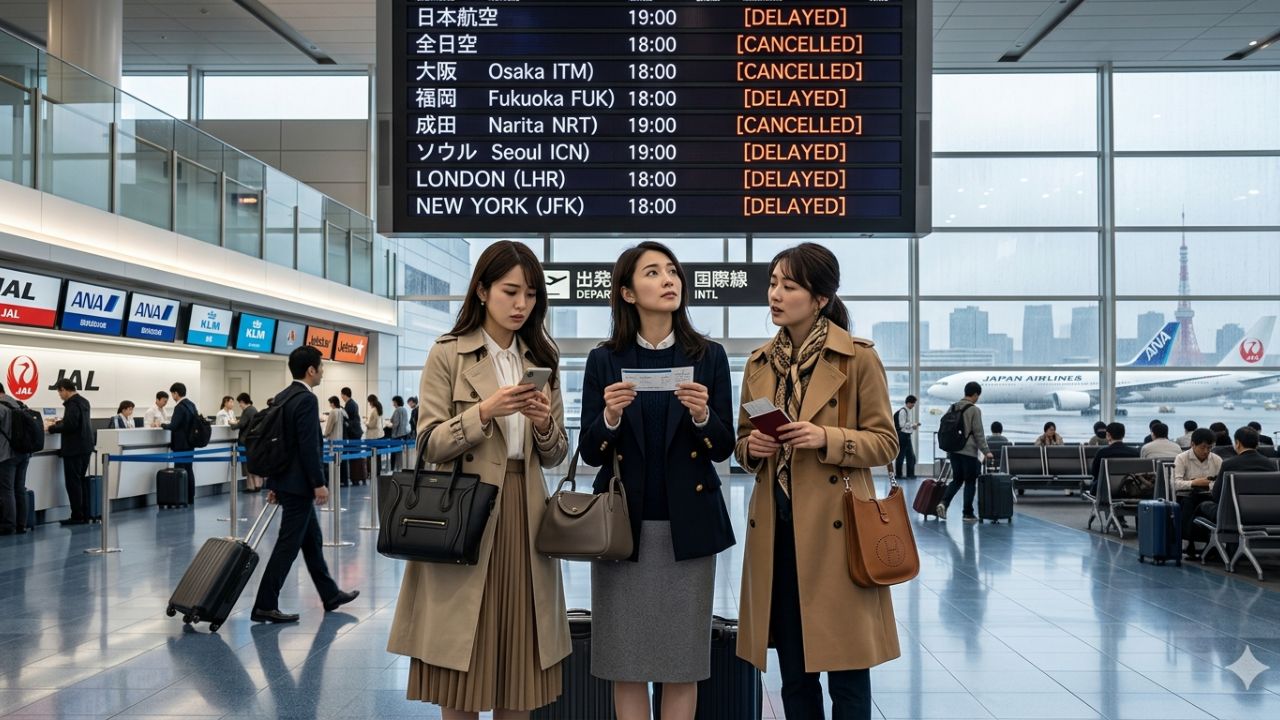
Image generated by AI
In an operational environment celebrated for its Swiss-watch precision and peerless transport reliability, the Japanese aviation network has experienced a highly unusual scheduling setback. This critical airline news update, breaking this May 17, 2026, reveals that on May 16, 2026, a wave of schedule disruptions resulted in at least 12 flight cancellations and 353 delays across the country’s primary gateways. Prominent domestic and international carriers—including Jetstar Japan, Japan Airlines (JAL), American Airlines, KLM Royal Dutch Airlines, and All Nippon Airways (ANA)—were forced to adjust their fleets as cascading airport disruptions swept through Tokyo Haneda, Tokyo Narita, Fukuoka, and Osaka Kansai. The widespread operational bottlenecks triggered moderate travel chaos for hundreds of travelers, putting the resilience of the nation’s transport infrastructure to the test and sending ripples through the global travel ecosystem.
Breaking: The 'Japan Hub Squeeze' and the Deviation from Precision
According to real-time status dashboards compiled from FlightAware, the scheduling pressure was distributed across the country's most critical aerial gateways on May 16. The consolidated logs confirm 353 delayed flights and exactly 12 cancellations, representing a notable operational divergence for an airspace traditionally recognized for exceptional punctuality.
This is a vital aviation update for the 2026 East Asian travel corridor. Because Japan’s primary hubs serve as massive international transit nodes for broader Asian and transpacific itineraries, any gate or runway backlog in Tokyo quickly propagates. A late pushback at Haneda or Narita does not merely delay the immediate sector; it disrupts subsequent narrowbody rotations, crew duty limits, and ground handling logistics, causing compounding delays at regional hubs like Fukuoka and Osaka.
Expanded Overview: Gateway Breakdown and Regional Interdependence
The total of 12 cancellations and 353 delays was distributed across four primary gateways, with varying degrees of scheduling strain reported at each terminal complex:
- Tokyo Haneda (HND): Located directly in the bustling capital, Haneda experienced the most severe logistical backlog of the day, logging 2 cancellations and 173 delays.
- Tokyo Narita (NRT): Serving as the primary transcontinental gateway, Narita faced considerable operational strain, recording 4 cancellations and 84 delays that heavily impacted long-haul connections.
- Fukuoka Airport (FUK): Positioned as a vital gateway in Southern Japan, Fukuoka confirmed 5 cancellations and 52 delays.
- Kansai International (KIX): The primary offshore gateway serving the wider Osaka region managed the lowest cancellation rate of the group, recording 1 cancellation and 44 delays.
Airlines are urging travelers to utilize their official mobile applications to monitor gate assignments and departure status, as airport ground logistics personnel work to clear the departure queue.
Section-Wise Breakdown: Airport Operations and Carrier Impact
Tokyo International Airport (Haneda - HND): The Capital Squeeze
Haneda experienced the most severe terminal congestion, with boarding gate bottlenecks and ground delays peaking during afternoon departure windows. Flag carrier Japan Airlines recorded 1 cancellation and 60 delays (representing 13% of scheduled operations), while transpacific partner American Airlines logged 1 cancellation and 1 delay (both at 11%). Saturated narrowbody routes operated by All Nippon Airways faced rolling delays, with the carrier logging 54 delayed flights (13%), while its regional shuttle subsidiary ANA Wings registered 13 delays (14%). Other regional domestic operators—including Skymark (9 delays), Air Do (8 delays), and Solaseed (5 delays)—faced minor scheduling backlogs, while premium international arrivals like Delta Air Lines (4 delays) navigated air traffic control holds.
Narita International Airport (NRT): Transcontinental Gateway Pressures
Narita Airport’s widebody terminals faced significant scheduling friction, complicating transatlantic and regional connections. Low-cost giant Jetstar Japan bore the brunt of Narita's cancellations, recording 4 cancellations (4% cancellation rate) and 22 delays (26%). Major Asian carriers experienced substantial delays, with Korean Air logging 4 delays (22%), China Airlines reporting 4 delays (30%), and China Eastern facing 4 delays (50%). Freight operations also faced minor backlogs, with Nippon Cargo reporting 5 delays (27%), while long-haul transpacific shuttle runs managed by United Airlines (2 delays) and emerging leisure carrier ZIPAIR (1 delay) faced minor gate adjustments.
Fukuoka Airport (FUK): Southern Commuter Squeezes
Fukuoka Airport’s highly constrained urban runways faced notable bottlenecks today. Jetstar Japan experienced its highest cancellation rate here, logging 5 cancellations (representing 20% of its scheduled operations) alongside 5 delays (20%). Japan’s regional domestic operators bore the brunt of Haneda-Fukuoka scheduling backlogs, with flag carrier Japan Airlines recording 10 delays (12%), All Nippon Airways logging 9 delays (18%), and regional commuter service Oriental Air Bridge registering 4 delays (7%). The runway congestion also rippled into local schedules for Skymark (5 delays) and regional low-cost operator Peach Aviation (1 delay).
Kansai International Airport (KIX): Osaka Gateway Delays
Kansai International managed the most stable cancellation rate, but was not immune to the wider scheduling backlogs. European carrier KLM Royal Dutch Airlines faced a severe scheduling setback, logging 1 cancellation (a massive 50% cancellation rate) and 2 delays (100%) on its Amsterdam sector. Regional international lines experienced moderate friction, with Cathay Pacific reporting 6 delays (40%), Peach Aviation logging 9 delays (10%), and Thai AirAsia X recording 2 delays (66%), while domestic cargo operations managed by China Postal Airlines logged 2 delays (100%).
Flight Details: Japan Airport Disruption Profiles
The following tables detail the precise, uncompromised operational metrics of the flight delays and cancellations recorded across Japan on May 16, 2026, under FlightAware tracking.
1. Tokyo Haneda (HND) Disruption Matrix
| Operating Carrier | Cancellations Recorded | Cancellation % | Delays Logged | Delayed % / Performance |
|---|---|---|---|---|
| Japan Airlines | 1 | 0% | 60 | 13% |
| American Airlines | 1 | 11% | 1 | 11% |
| All Nippon Airways | 0 | 0% | 54 | 13% |
| ANA Wings | 0 | 0% | 13 | 14% |
| Skymark | 0 | 0% | 9 | 11% |
| Air Do | 0 | 0% | 8 | 8% |
| Solaseed | 0 | 0% | 5 | 4% |
| Delta Air Lines | 0 | 0% | 4 | 33% |
| StarFlyer | 0 | 0% | 2 | 1% |
| United Airlines | 0 | 0% | 2 | 16% |
| Asiana Airlines | 0 | 0% | 2 | 25% |
| Air France | 0 | 0% | 1 | 16% |
| Air Japan | 0 | 0% | 1 | 6% |
| Peach Aviation | 0 | 0% | 1 | 16% |
| British Airways | 0 | 0% | 1 | 25% |
| China Eastern | 0 | 0% | 1 | 14% |
| Cathay Pacific | 0 | 0% | 1 | 25% |
| Shanghai Airlines | 0 | 0% | 1 | 25% |
| China Southern | 0 | 0% | 1 | 16% |
| Lufthansa | 0 | 0% | 1 | 25% |
| Finnair | 0 | 0% | 1 | 50% |
| Hawaiian Airlines | 0 | 0% | 1 | 25% |
| SAS | 0 | 0% | 1 | 50% |
| Thai Airways | 0 | 0% | 1 | 25% |
2. Tokyo Narita (NRT) Disruption Matrix
| Operating Carrier | Cancellations Recorded | Cancellation % | Delays Logged | Delayed % / Performance |
|---|---|---|---|---|
| Jetstar Japan | 4 | 4% | 22 | 26% |
| Nippon Cargo | 0 | 0% | 5 | 27% |
| All Nippon Airways | 0 | 0% | 4 | 7% |
| China Airlines | 0 | 0% | 4 | 30% |
| China Eastern | 0 | 0% | 4 | 50% |
| Korean Air | 0 | 0% | 4 | 22% |
| Japan Airlines | 0 | 0% | 3 | 5% |
| Air Japan | 0 | 0% | 2 | 22% |
| Air New Zealand | 0 | 0% | 2 | 100% |
| Air Seoul | 0 | 0% | 2 | 33% |
| Cebu Pacific Air | 0 | 0% | 2 | 20% |
| Cathay Pacific | 0 | 0% | 2 | 14% |
| Turkish Airlines | 0 | 0% | 2 | 66% |
| Tigerair | 0 | 0% | 2 | 33% |
| United Airlines | 0 | 0% | 2 | 9% |
| Peach Aviation | 0 | 0% | 2 | 4% |
| Asiana Airlines | 0 | 0% | 2 | 25% |
| Air Busan | 0 | 0% | 1 | 16% |
| Air Canada | 0 | 0% | 1 | 16% |
| SriLankan Airlines | 0 | 0% | 1 | 50% |
| Spring Airlines | 0 | 0% | 1 | 50% |
| Hong Kong Airlines | 0 | 0% | 1 | 10% |
| XiamenAir | 0 | 0% | 1 | 25% |
| Ethiopian Airlines | 0 | 0% | 1 | 50% |
| Garuda Indonesia | 0 | 0% | 1 | 50% |
| Vietnam Airlines | 0 | 0% | 1 | 16% |
| Jin Air | 0 | 0% | 1 | 8% |
| Parata Air | 0 | 0% | 1 | 25% |
| Spring Airlines Japan | 0 | 0% | 1 | 5% |
| Thai AirAsia X | 0 | 0% | 1 | 33% |
| Thai Lion | 0 | 0% | 1 | 50% |
| ZIPAIR | 0 | 0% | 1 | 6% |
| Emirates | 0 | 0% | 1 | 50% |
| VietJet Air | 0 | 0% | 1 | 50% |
3. Fukuoka (FUK) Disruption Matrix
| Operating Carrier | Cancellations Recorded | Cancellation % | Delays Logged | Delayed % / Performance |
|---|---|---|---|---|
| Jetstar Japan | 5 | 20% | 5 | 20% |
| Japan Airlines | 0 | 0% | 10 | 12% |
| All Nippon Airways | 0 | 0% | 9 | 18% |
| Skymark | 0 | 0% | 5 | 13% |
| Oriental Air Bridge | 0 | 0% | 4 | 7% |
| ANA Wings | 0 | 0% | 2 | 4% |
| China Airlines | 0 | 0% | 2 | 33% |
| Cathay Pacific | 0 | 0% | 2 | 50% |
| Spring Airlines | 0 | 0% | 2 | 50% |
| EVA Air | 0 | 0% | 2 | 33% |
| StarFlyer | 0 | 0% | 2 | 3% |
| Air Do | 0 | 0% | 1 | 25% |
| Peach Aviation | 0 | 0% | 1 | 3% |
| Vietnam Airlines | 0 | 0% | 1 | 50% |
| Ibex | 0 | 0% | 1 | 3% |
| Jin Air | 0 | 0% | 1 | 6% |
| Japan Transocean Air | 0 | 0% | 1 | 8% |
| Thai Airways | 0 | 0% | 1 | 50% |
4. Osaka Kansai (KIX) Disruption Matrix
| Operating Carrier | Cancellations Recorded | Cancellation % | Delays Logged | Delayed % / Performance |
|---|---|---|---|---|
| KLM Royal Dutch | 1 | 50% | 2 | 100% |
| Peach Aviation | 0 | 0% | 9 | 10% |
| Cathay Pacific | 0 | 0% | 6 | 40% |
| China Postal | 0 | 0% | 2 | 100% |
| Thai AirAsia X | 0 | 0% | 2 | 66% |
| Tigerair | 0 | 0% | 2 | 25% |
| Asiana Airlines | 0 | 0% | 2 | 16% |
| Air Busan | 0 | 0% | 1 | 8% |
| Air Seoul | 0 | 0% | 1 | 16% |
| Cebu Pacific Air | 0 | 0% | 1 | 25% |
| Spring Airlines | 0 | 0% | 1 | 12% |
| China Southern | 0 | 0% | 1 | 50% |
| Juneyao Airlines | 0 | 0% | 25% | |
| Finnair | 0 | 0% | 1 | 50% |
| Hawaiian Airlines | 0 | 0% | 1 | 50% |
| Hong Kong Express | 0 | 0% | 1 | 10% |
| Central Airlines | 0 | 0% | 1 | 50% |
| Japan Airlines | 0 | 0% | 2 | 11% |
| Jeju Air | 0 | 0% | 1 | 3% |
| Jetstar Japan | 0 | 0% | 1 | 5% |
| Japan Transocean Air | 0 | 0% | 1 | 9% |
| Korean Air | 0 | 0% | 1 | 7% |
| Parata Air | 0 | 0% | 1 | 50% |
| Thai Vietjet Air | 0 | 0% | 1 | 25% |
| VietJet Air | 0 | 0% | 1 | 25% |
| AirAsia X | 0 | 0% | 1 | 25% |
Passenger Impact: Responding to Airport Disruptions in Japan
For travelers in Japan, navigating flight delays requires structured planning and immediate coordination:
- Antidote to Travel Chaos: Do not head to Haneda or Kansai without verifying your flight status. Prioritize carrier mobile apps over terminal flight boards, as airlines push gate and rebooking updates to digital channels first.
- Rebooking and Accommodation Rights: Under standard aviation protocols, passengers affected by cancellations or extensive delays at major Japanese hubs are typically offered rebooking on the next available flight. Depending on carrier policies (and international consumer rules for carriers like KLM), overnight accommodations and meal vouchers may be provided.
- Bullet Train Alternatives: If your domestic flight between Tokyo, Osaka, or Fukuoka is canceled, consider utilizing the Shinkansen (bullet train) network as a highly efficient alternative. Bullet train tickets can be booked directly at major stations.
- Travel Insurance Claims: Retain all boarding passes, delay statements, and expense receipts. Many comprehensive travel insurance policies cover delay-related expenses and bullet train rebooking costs.
Industry Analysis: Root Causes of Japanese Airspace Strain
Aviation specialists believe today's disruptions demonstrate a classic "Congestion Cascading" pattern:
- Urban Runway Capacity Constraints: Fukuoka Airport operates on a single highly constrained runway in an urban zone, meaning that a minor scheduling delay quickly compounds, leading to immediate flight cuts.
- Cascading Hub Rotations: Because major domestic operators like Japan Airlines and All Nippon Airways run tight shuttle services between Haneda and regional gateways, a minor delay at Haneda instantly cascades across the country.
- Transpacific Widebody Interdependence: Narita and Haneda operate as major transpacific transit nodes. Delays in inbound aircraft arriving from North America or Europe propagate into subsequent departures, creating gate bottlenecks.
Conclusion: A Highly Precise System Working Toward Recovery
The current state of aviation updates for May 17, 2026, confirms that while Japan’s primary gateways faced significant operational friction on May 16, the country’s transport infrastructure remains exceptionally robust. The 353 delays and 12 cancellations represent a highly unusual day, but the coordinated response of Japan’s air traffic controllers, terminal staff, and airline dispatchers is successfully clearing the passenger backlog. As aircraft continue to push back into the skies over Mount Fuji, the focus remains firmly on ensuring that passenger safety remains the ultimate measure of the regional recovery.
Key Takeaways
- The Numbers: 353 delays and exactly 12 cancellations recorded across Japan's primary gateways.
- Most Impacted Airport: Tokyo Haneda (HND) logged 173 delays and 2 cancellations.
- Severe Regional Cancellations: Fukuoka Airport (FUK) confirmed 5 cancellations; Jetstar Japan hit by 20% cancellation rate.
- International Squeezes: Narita (NRT) recorded 4 cancellations and 84 delays; Kansai (KIX) logged 1 cancellation (KLM hit by 50% cancellation).
- The Cause: Saturated urban runway capacities, cascading shuttle rotations, and transpacific widebody delays.
- Advice: Monitor carrier mobile apps closely, coordinate bullet train rebookings if domestic slots fail, and retain comprehensive insurance receipts.
- Status: Moderate regional delays have successfully cleared.
Related Travel Guides
Disclaimer
This article is for informational and educational purposes only. It does not constitute legal, financial, or professional advice. While we strive to provide accurate and up-to-date information, travel policies, regulations, and conditions change rapidly. Always verify information with official sources before making travel decisions. Nomad Lawyer makes no representations about the accuracy, reliability, completeness, or suitability of the information provided. Readers should consult qualified professionals for advice specific to their circumstances. The views expressed in this article are those of the author and do not necessarily reflect the views of Nomad Lawyer.
Kunal K Choudhary
Co-Founder & Contributor
A passionate traveller and tech enthusiast. Kunal contributes to the vision and growth of Nomad Lawyer, bringing fresh perspectives and driving the community forward.
Learn more about our team →