
Airbus A350F's Revolutionary Cargo Door: How Engineers Fit Entire Jet Engines Into a Freighter
Breaking airline news and aviation industry updates for 2026.

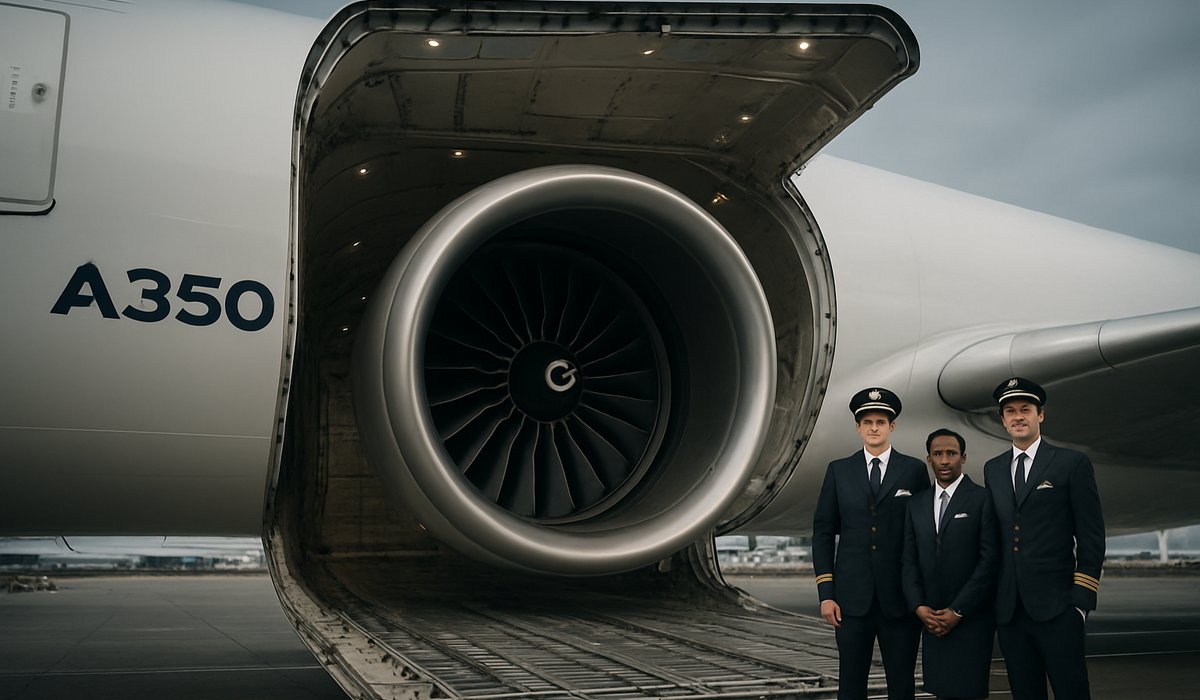
Image generated by AI
Airbus A350F's Revolutionary Cargo Door: How Engineers Fit Entire Jet Engines Into a Freighter
The aerospace giant's engineering breakthrough addresses a critical challenge in modern cargo aviation—maximizing payload capacity without sacrificing aircraft durability
Record-Breaking Scale Meets Engineering Excellence
Airbus has unveiled a transformative achievement in cargo aviation with the completion of the first full-size main deck cargo door for its A350F freighter variant. The opening measures an unprecedented 4.5 meters wide by 4.3 meters tall—dimensions expansive enough to accommodate entire aircraft engines as single cargo units. But the true engineering feat extends far beyond these impressive dimensions.
The challenge facing Airbus engineers was deceptively complex: how to create a massive aperture in the aircraft's pressurized fuselage while maintaining structural robustness, safety compliance, and long-term operational durability. This problem represents one of aviation's most counterintuitive design puzzles.
Solving the Structural Integrity Paradox
Cutting a garage-sized opening into any pressurized aircraft fuselage inherently weakens the load-bearing structure. Traditional aircraft design treats the fuselage as a pressure vessel—a continuous, sealed tube that distributes aerodynamic and pressurization stresses evenly across its surface.
Airbus engineers resolved this paradox through advanced reinforcement techniques and innovative door mechanisms. Rather than simply removing fuselage material, the design incorporates sophisticated load-path management systems that redirect structural stresses around the cargo opening. This approach preserves the aircraft's integrity during pressurized flight while enabling rapid cargo loading and unloading on the ground.
Strategic Implications for Global Cargo Operations
The A350F's enhanced cargo capacity positions it as a competitive alternative to aging freighter fleets in an increasingly strained global supply chain. With the ability to transport oversized engine components, industrial equipment, and heavy machinery as single units, the aircraft reduces handling complexity and transportation costs for shippers worldwide.
This capability arrives at a critical moment in aviation history. Cargo operations have become increasingly vital to airline profitability since the pandemic, with freight revenues offsetting weakening passenger demand in several markets. The A350F's engineering innovations directly address shipper demand for larger payload envelopes.
The Broader Implications for Aviation Manufacturing
Airbus's advancement in cargo door engineering signals a broader industry trend toward maximizing freighter efficiency. Competitors, including Boeing with its 777F variant, are similarly focused on improving volumetric and weight capacity. The A350F represents a full-scale response to the cargo industry's evolving requirements.
The successful completion of this cargo door component also demonstrates Airbus's commitment to the freighter segment—a market projected to grow substantially as international trade patterns shift and supply chain resilience becomes paramount.
Frequently Asked Questions
What makes the A350F's cargo door different from other aircraft? The A350F's cargo opening measures 4.5 by 4.3 meters, making it one of aviation's largest main deck cargo doors. This size permits the transport of entire jet engines as single units, a capability unavailable on most competing freighter platforms.
How does a massive cargo door maintain aircraft structural integrity? Airbus engineers use advanced load-path reinforcement systems that redirect fuselage stresses around the opening rather than through it, preserving aircraft durability during pressurized flight operations.
When will the A350F enter commercial service? While specific delivery timelines vary, the completion of the cargo door represents a significant milestone toward the aircraft's operational certification and entry into airline fleets.
How does the A350F compare to competing cargo aircraft? The A350F's cargo capacity and engine-transport capability position it competitively against Boeing's 777F freighter and Airbus's own A330-200F, offering superior payload efficiency for certain cargo types.
What impact will the A350F have on global shipping costs? By enabling larger single-unit cargo loads and reducing handling complexity, the A350F could lower per-unit transportation costs for heavy industrial equipment and engine components, benefiting shippers globally.
Related Travel Guides
Flight Delay Compensation Guide 2026
Understanding Airline Route Changes
Airport Security Process Updated (2026)
External Resources
Disclaimer
This article is for informational and educational purposes only. It does not constitute legal, financial, or professional advice. While we strive to provide accurate and up-to-date information, travel policies, regulations, and conditions change rapidly. Always verify information with official sources before making travel decisions. Nomad Lawyer makes no representations about the accuracy, reliability, completeness, or suitability of the information provided. Readers should consult qualified professionals for advice specific to their circumstances. The views expressed in this article are those of the author and do not necessarily reflect the views of Nomad Lawyer.
Preeti Gunjan
Contributor & Community Manager
A passionate traveller and community builder. Preeti helps grow the Nomad Lawyer community, fostering engagement and bringing the reader experience to life.
Learn more about our team →