
IndiGo Flight 6E-445 Makes Emergency Landing in Lucknow After Mid-Air Smoke Alarm

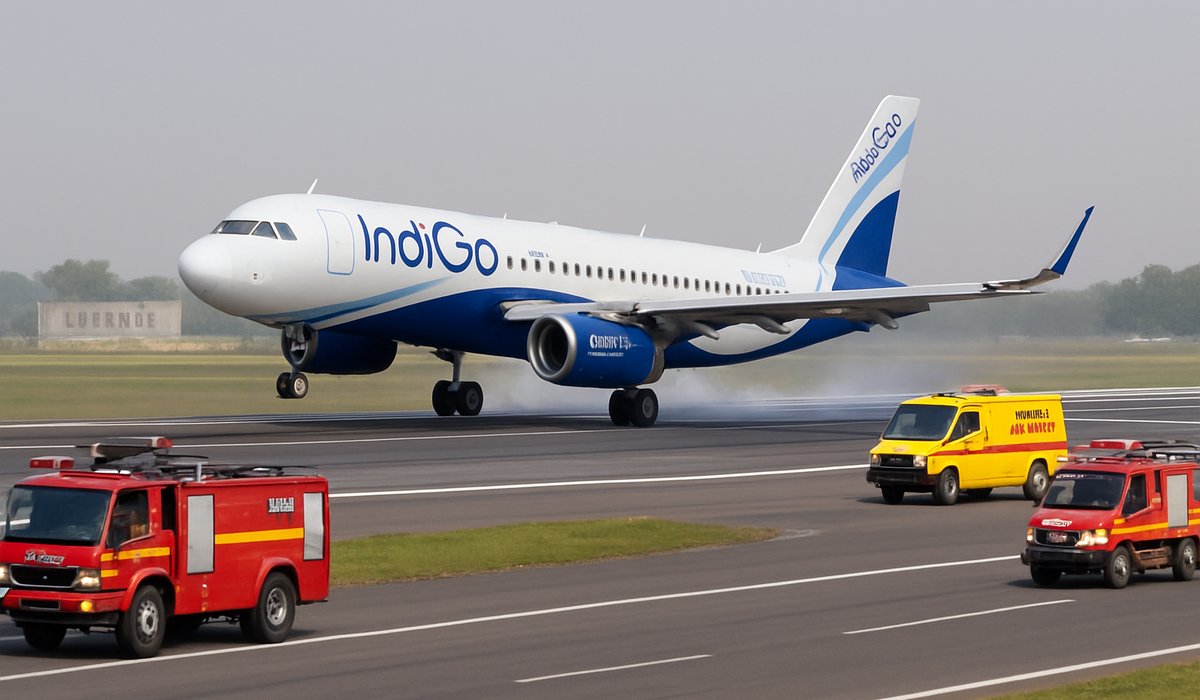
Image generated with AI
**> Quick Summary
- IndiGo flight 6E-445, operating Patna–Delhi, made an emergency landing at Lucknow Airport on March 31, 2026
- A cargo hold smoke alarm triggered at approximately 6:00 PM, prompting the pilot to request priority landing clearance
- All 180 passengers were safely evacuated in an orderly manner — no injuries recorded
- Technical inspection confirmed the alarm was a false trigger — no actual fire was detected
- A replacement aircraft was dispatched from Lucknow; passengers arrived in Delhi several hours late**
A significant aviation safety event unfolded over Indian airspace on March 31, 2026, when an IndiGo aircraft operating as Flight 6E-445 was forced to make an emergency landing at Chaudhary Charan Singh International Airport in Lucknow while en route from Patna to New Delhi. The incident, which was resolved safely without any injury to the 180 passengers on board, has highlighted the rigorous safety protocols that govern India's commercial aviation sector.
How the Incident Unfolded
Flight 6E-445 had departed Patna and was cruising toward its destination, Delhi, when cockpit instruments registered a warning indicating the presence of smoke within the aircraft's cargo compartment. The notification was received at approximately 6:00 PM local time.
Following established safety protocols with no hesitation, the pilot-in-command immediately communicated with Air Traffic Control at Lucknow to request priority landing clearance. Such alerts — whether confirmed fires or suspected sensor activations — are treated with identically urgent responses under Indian and international aviation safety frameworks. Getting the aircraft on the ground as quickly as possible is always the mandated first response.
Ground teams at Lucknow Airport were placed on high alert within minutes of the distress call being made. Runway clearance was established rapidly, and fire tenders along with emergency medical services were positioned and ready before the Airbus A320 touched down.
The Evacuation: Safe, Orderly, and Efficient
Upon the aircraft's successful touchdown, it was taxied away from the main terminal to a remote bay, where emergency services had pre-positioned in readiness. The evacuation of all 180 passengers was then conducted in an orderly and controlled fashion.
No injuries were sustained during the evacuation process. Each passenger received direct assistance from IndiGo's ground staff during the transition from the aircraft to the terminal building. The rapid mobilization of the Lucknow Airport ground crew — who had the runway cleared and emergency services staged within minutes of the distress call — was specifically noted as a key factor in the efficient resolution of the situation.
Technical Inspection: A False Alarm Confirmed
Following the evacuation, a thorough technical examination of the cargo area was conducted by IndiGo's engineering team to identify the root cause of the alarm. The investigation concluded that the smoke detector had been triggered despite the complete absence of any actual fire.
Such events — commonly referred to as false positive alarms — are well-documented in aviation maintenance literature. Critically, however, aviation safety philosophy is built on the principle that such alerts are always treated with the same urgency as confirmed fires. The risk of ignoring or dismissing a warning and being wrong is far greater than the operational cost of an unnecessary precautionary landing.
The integrity of the smoke detection system itself was fully reviewed during the inspection. Tests confirmed that the electronic sensors were functioning within specified operational parameters — meaning the system was working correctly, it simply generated an alert for a condition that did not materialize into an actual fire.
IndiGo representatives confirmed publicly that the airline's standard procedure requires landing the aircraft at the earliest available opportunity whenever such a warning is triggered, regardless of the probability that it may prove false.
Passenger Care: Accommodation and Onward Travel
Following the landing, passengers were brought to the Lucknow Airport terminal lounge, where IndiGo staff provided regular updates on the evolving situation. Refreshments and seating arrangements were organized for the approximately 200 affected individuals during the waiting period.
Critically, IndiGo dispatched a replacement aircraft to Lucknow to collect the passengers and complete their journey to New Delhi, minimizing the delay as much as operationally possible. The logistical challenge of transferring nearly 180 passengers was managed efficiently by airport authorities and airline staff working in coordinated fashion.
Passengers largely remained calm throughout the process, reflecting — according to observers on the ground — a high degree of confidence in the emergency procedures executed by the flight crew and ground support team.
Why This Incident Matters for Aviation Safety
The event serves as an important reminder of the layered safety architecture that governs modern commercial aviation. Every alert — confirmed, suspected, or ultimately false — is met with a pre-defined, standardized response that eliminates any possibility of catastrophic failure due to a missed warning.
By choosing to divert to Lucknow rather than continuing the short remaining distance to Delhi, the pilots demonstrated the conservative safety philosophy that places human life categorically above schedule adherence — the foundational principle of commercial aviation safety.
Formal Reporting and Future Oversight
A formal statement was released by IndiGo confirming the landing was purely precautionary. The aircraft involved was retained in Lucknow for comprehensive diagnostic checks before being returned to service — a step that only occurs following full certification by the airline's maintenance department.
Documentation of the incident was formally submitted to the Directorate General of Civil Aviation (DGCA) for a standard regulatory review. Such reports form the backbone of ongoing safety improvement within India's commercial aviation system. Observations regarding the frequency of sensor-related alerts are routinely monitored by aviation regulators to determine whether specific hardware updates or fleet-wide modifications are warranted across an operating carrier's fleet.
Conclusion
The journey for Flight 6E-445's 180 passengers eventually resumed late in the evening, with the replacement aircraft completing the Lucknow-to-Delhi leg several hours behind the original schedule. The aircraft involved in the incident remained in Lucknow for continued diagnostic evaluation.
The successful resolution of a potentially dangerous situation — without injury to life or significant damage to property — stands as evidence of the effectiveness of the emergency response systems currently embedded in India's commercial aviation framework. It also reinforces that the most important safety decision on any flight is always the one the flight crew makes next.
FAQ
Was there an actual fire on IndiGo Flight 6E-445? No. Technical inspection after the emergency landing confirmed that the cargo hold smoke alarm was a false positive — no fire or smoke was found in the cargo compartment.
What happened to the 180 passengers? All passengers were safely evacuated at Lucknow Airport without injury. IndiGo provided refreshments and dispatched a replacement aircraft to continue their journey to Delhi.
Who has jurisdiction over this incident in India? The Directorate General of Civil Aviation (DGCA) received a formal incident report and is conducting a standard regulatory review as required by Indian aviation law.
Is IndiGo Flight 6E-445 safe to fly again? The aircraft was retained in Lucknow for comprehensive diagnostic checks. It may only return to service after receiving full maintenance certification — a standard requirement after any emergency diversion.
Source: Travel And Tour World
Related Travel Guides
IndiGo Launches 30 New Routes Including Navi Mumbai Services in 2026
India Aviation Safety: A 2026 Traveler's Complete Guide
IndiGo Emergency Landing Delhi: Full Coverage of Recent Aviation Incidents in India
Disclaimer
This article is for informational and educational purposes only. It does not constitute legal, financial, or professional advice. While we strive to provide accurate and up-to-date information, travel policies, regulations, and conditions change rapidly. Always verify information with official sources before making travel decisions. Nomad Lawyer makes no representations about the accuracy, reliability, completeness, or suitability of the information provided. Readers should consult qualified professionals for advice specific to their circumstances. The views expressed in this article are those of the author and do not necessarily reflect the views of Nomad Lawyer.
Kunal K Choudhary
Co-Founder & Contributor
A passionate traveller and tech enthusiast. Kunal contributes to the vision and growth of Nomad Lawyer, bringing fresh perspectives and driving the community forward.
Learn more about our team →