
Legendary A-10 Warthog: How Unconventional Design Prioritizes Pilot Protection in Combat Zones
Breaking airline news and aviation industry updates for 2026.

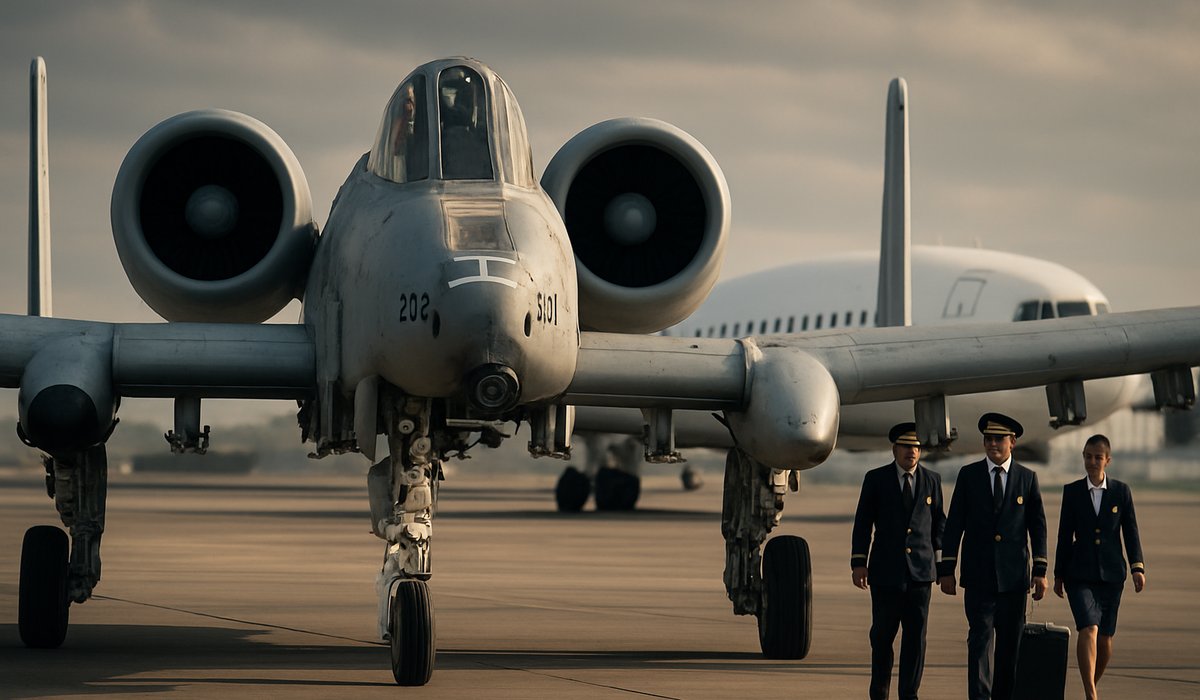
Image generated by AI
Legendary A-10 Warthog: How Unconventional Design Prioritizes Pilot Protection in Combat Zones
The military's most distinctive close-air-support aircraft achieves survivability through revolutionary engineering focused on human resilience
A Purpose-Built Machine for Extreme Conditions
The Fairchild Republic A-10 Thunderbolt II—widely known as the "Warthog"—remains one of aviation's most recognizable platforms nearly five decades after its introduction. Unlike sleek fighter jets designed for speed and altitude dominance, the A-10 represents a fundamentally different philosophy: purpose-built redundancy and pilot survivability in the most hostile ground-combat environments.
The aircraft's distinctive appearance—often dismissed as unglamorous by conventional standards—actually reflects deeply intentional design choices prioritizing crew protection. Its twin turbofan engines mount high on the fuselage, separated widely to prevent a single hit from catastrophic engine failure. This redundancy principle permeates every system.
Engineering for Survival
At the A-10's core sits an armored titanium "bathtub" surrounding the pilot, capable of withstanding direct hits from armor-piercing rounds. The flight control systems feature manual backup hydraulics, ensuring pilots maintain control authority even during catastrophic hydraulic failure—a feature that has proven decisive in countless combat scenarios.
The aircraft's legendary GAU-8 Avenger cannon—a seven-barreled rotary weapon mounted prominently beneath the nose—generates significant recoil forces. Yet the airframe's robust construction, reinforced landing gear, and weight distribution absorb these stresses while maintaining structural integrity during sustained combat operations.
Combat-Proven Legacy
Beyond its armor protection and mechanical redundancy, the A-10's design philosophy extends to accessibility. Large panels enable rapid field maintenance, while standardized components reduce logistics complexity in forward-deployed conditions. Pilots consistently report the aircraft's forgiving handling characteristics, even when partially damaged.
The high-mounted engines, coupled with the wide landing gear stance, provide exceptional visibility and maneuverability at low altitudes where close-air-support missions occur. The airframe tolerates asymmetric loading, battle damage, and extreme G-forces that would compromise less robustly engineered platforms.
Enduring Relevance
Military analysts attribute the A-10's continued operational relevance—despite predictions of obsolescence—to this unwavering focus on pilot protection and mission reliability. Recent conflicts have demonstrated that survivability matters more than raw speed in contested airspace where threats originate from multiple directions simultaneously.
The Warthog's "unglamorous" appearance ultimately reflects sophisticated engineering priorities: redundancy over elegance, protection over performance metrics, and proven reliability over theoretical advancement.
FAQ: A-10 Warthog Design and Pilot Safety
What makes the A-10 Warthog's design unique compared to modern fighter jets? The A-10 prioritizes survivability and redundancy over speed and altitude capabilities, featuring separated twin engines, armored cockpit protection, and manual flight control backups—design choices reflecting close-air-support missions rather than air superiority requirements.
How does the A-10's armor protect pilots during combat operations? A titanium-alloy bathtub surrounds the pilot's cockpit, capable of withstanding armor-piercing projectiles and fragmentation. Critical flight systems feature independent hydraulic backups, enabling pilots to maintain aircraft control even after severe battle damage.
Why are the A-10's engines positioned so high on the fuselage? The elevated, widely-separated engine mounting ensures that single-engine failure or combat damage to one powerplant doesn't compromise flight safety—a critical redundancy feature for low-altitude missions over hostile territory.
What role does the GAU-8 cannon play in the A-10's overall design? Beyond its formidable firepower, the seven-barreled rotary cannon's design and mounting integrate with the airframe's robust construction to manage recoil forces while maintaining structural integrity during continuous-fire engagements.
Has the A-10 Warthog's design philosophy influenced modern military aircraft development? Yes—the A-10 demonstrated that specialization and survivability-focused engineering can outperform multi-role platforms in specific operational contexts, influencing current discussions about close-air-support platform requirements.
Related Travel Guides
Flight Delay Compensation Guide 2026
Understanding Airline Route Changes
Airport Security Process Updated (2026)
External Resources
Disclaimer
This article is for informational and educational purposes only. It does not constitute legal, financial, or professional advice. While we strive to provide accurate and up-to-date information, travel policies, regulations, and conditions change rapidly. Always verify information with official sources before making travel decisions. Nomad Lawyer makes no representations about the accuracy, reliability, completeness, or suitability of the information provided. Readers should consult qualified professionals for advice specific to their circumstances. The views expressed in this article are those of the author and do not necessarily reflect the views of Nomad Lawyer.
Kunal K Choudhary
Co-Founder & Contributor
A passionate traveller and tech enthusiast. Kunal contributes to the vision and growth of Nomad Lawyer, bringing fresh perspectives and driving the community forward.
Learn more about our team →