
Airbus A350-1000 Significantly Outsize Boeing 787-10 in Head-to-Head Aircraft Comparison
Breaking airline news and aviation industry updates for 2026.

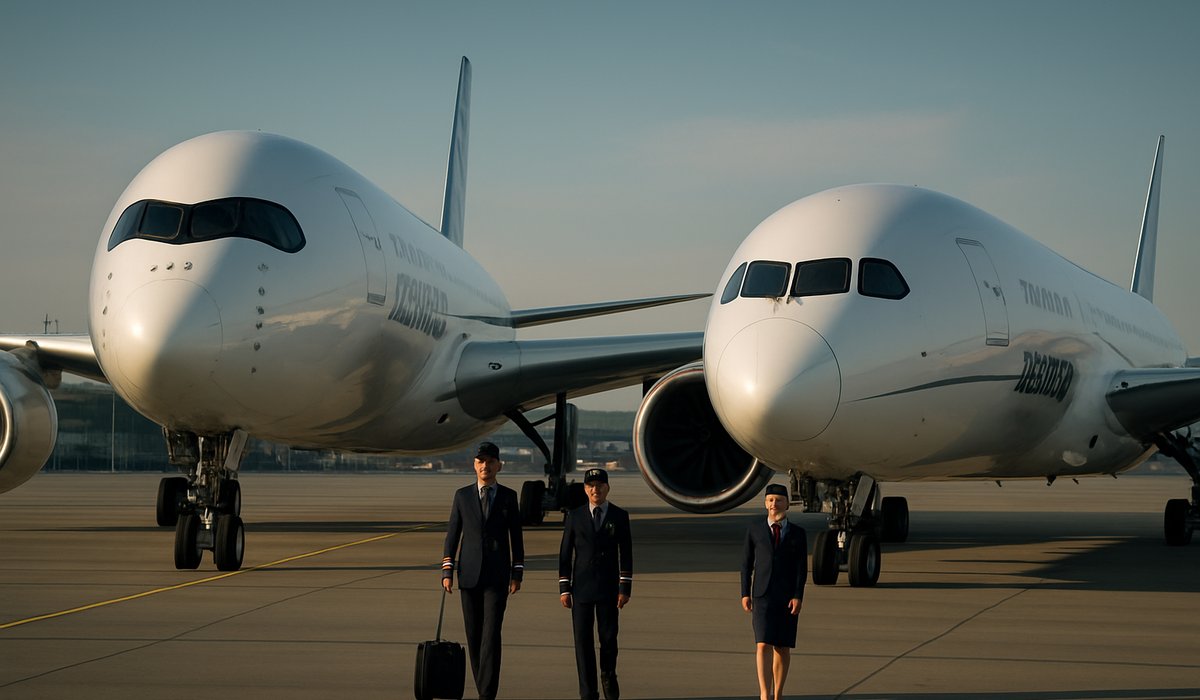
Image generated by AI
Airbus A350-1000 Significantly Outsize Boeing 787-10 in Head-to-Head Aircraft Comparison
European widebody jet extends advantage in capacity and range as airlines reassess fleet strategies for long-haul operations
Size Advantage Defines Modern Widebody Competition
The Airbus A350-1000 has emerged as the larger and more capable counterpart to Boeing's flagship 787-10 Dreamliner, marking a decisive shift in how global carriers approach ultra-long-haul operations. Both aircraft represent the cutting edge of commercial aviation technology, leveraging advanced composite construction and fuel-efficient engines. However, when measured across critical dimensions—length, capacity, and operational range—the European manufacturer's offering demonstrates clear superiority in the competitive widebody segment.
Comparative Specifications: A Decisive Gap
The A350-1000 extends its advantage over the 787-10 across multiple performance metrics. The French-built aircraft is physically larger, accommodating greater passenger loads while maintaining superior range capabilities for demanding intercontinental routes. Both jets feature modern composite airframes and next-generation propulsion systems designed to reduce fuel consumption and operating costs, yet the A350-1000's engineering prioritizes extended range and capacity—critical factors for airlines operating on competitive premium routes between Asia, Europe, and North America.
Industry Implications for Fleet Planning
Airlines worldwide are increasingly scrutinizing aircraft selections as fuel prices remain volatile and route profitability becomes tighter. The A350-1000's larger dimensions translate directly into revenue advantages on premium routes, where seat capacity and range combine to enhance per-flight returns. Meanwhile, the 787-10, despite its smaller footprint, offers operational flexibility on medium to long-haul networks where maximum efficiency supersedes raw capacity.
The contrast between these two platforms underscores a broader aviation industry trend: manufacturers are tailoring widebody designs to address distinct market segments. As jet fuel prices continue affecting operating margins, carriers must balance cabin size with fuel economics—a calculation where the A350-1000's scale increasingly favors high-density, ultra-long-haul operations.
Market Positioning and Future Orders
Both Airbus and Boeing continue receiving significant order backlogs for these respective aircraft classes, indicating sustained global demand for modern widebody capacity. The A350-1000's dimensional advantages position it as the premium choice for flag carriers and network airlines requiring maximum flexibility on flagship routes, while the 787-10 maintains appeal for operators prioritizing efficiency and operational versatility.
Frequently Asked Questions
How much longer is the Airbus A350-1000 compared to the Boeing 787-10? The A350-1000 extends significantly beyond the 787-10 in overall length, contributing to greater passenger capacity and cargo flexibility on long-range operations.
Which aircraft carries more passengers—the A350-1000 or 787-10? The Airbus A350-1000 accommodates more passengers in comparable configurations, offering airlines higher revenue potential on identical routes.
What is the maximum range difference between these two widebody jets? The A350-1000 offers superior range capabilities, making it better suited for ultra-long-haul routes between distant continents with minimal fuel stops.
Why do airlines choose one aircraft over the other? Selection depends on route networks, passenger demand, fuel costs, and operational priorities—the A350-1000 suits high-capacity long-haul needs while the 787-10 excels in efficiency-focused strategies.
How do composite airframes impact the operating costs of these aircraft? Advanced composite construction reduces fuel consumption and maintenance requirements for both jets, though the A350-1000's larger size requires more fuel per flight despite greater efficiency improvements.
Related Travel Guides
Flight Delay Compensation Guide 2026
Understanding Airline Route Changes
Airport Security Process Updated (2026)
External Resources
Disclaimer
This article is for informational and educational purposes only. It does not constitute legal, financial, or professional advice. While we strive to provide accurate and up-to-date information, travel policies, regulations, and conditions change rapidly. Always verify information with official sources before making travel decisions. Nomad Lawyer makes no representations about the accuracy, reliability, completeness, or suitability of the information provided. Readers should consult qualified professionals for advice specific to their circumstances. The views expressed in this article are those of the author and do not necessarily reflect the views of Nomad Lawyer.
Kunal K Choudhary
Co-Founder & Contributor
A passionate traveller and tech enthusiast. Kunal contributes to the vision and growth of Nomad Lawyer, bringing fresh perspectives and driving the community forward.
Learn more about our team →