
Heathrow Airport Issues New Passenger Arrival Guidelines to Combat Terminal Congestion in 2026
Heathrow Airport has updated its travel guidance, requesting passengers adhere to strict arrival windows for European and long-haul flights to reduce terminal crowding and improve passenger flow.

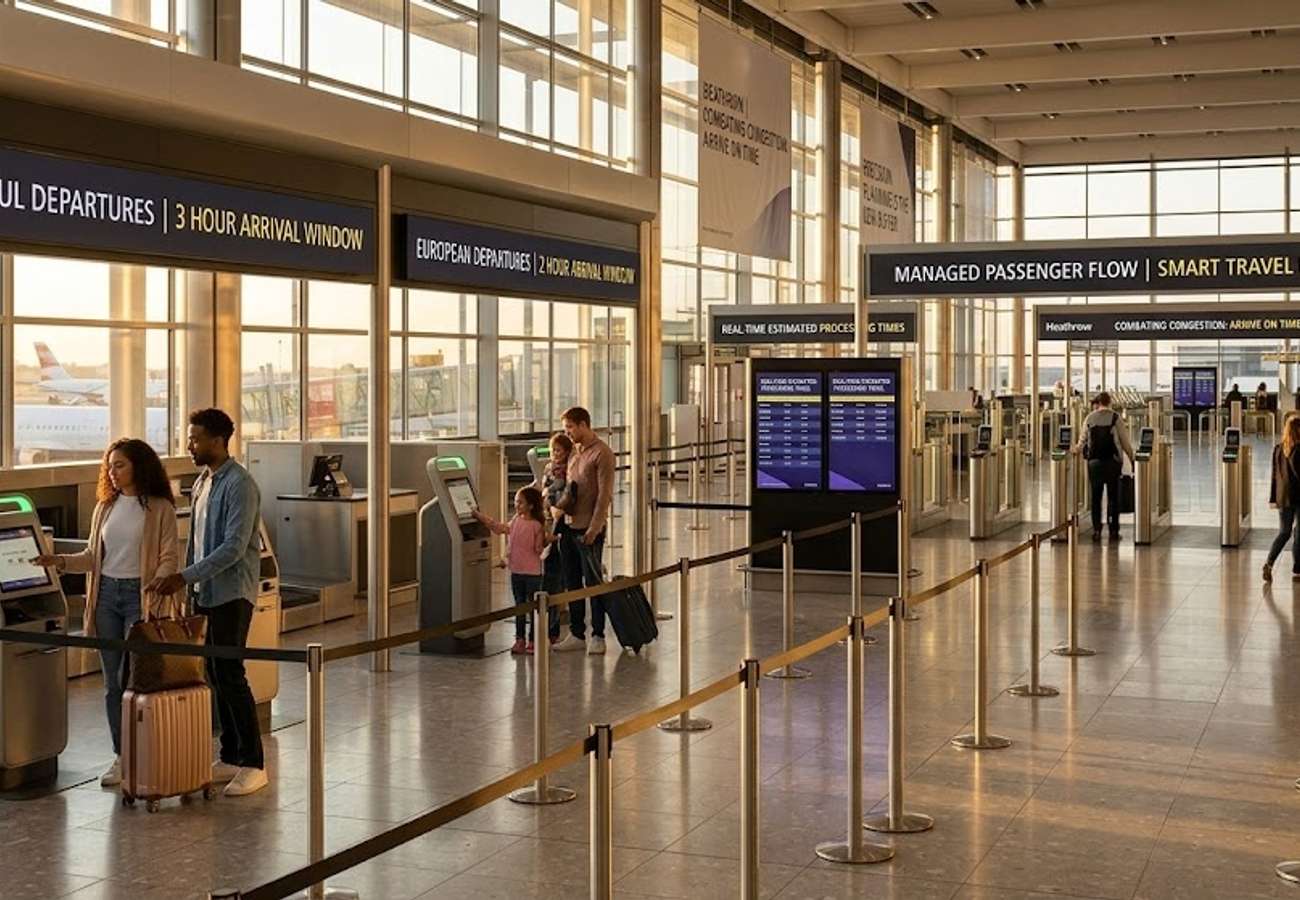
Image generated by AI
Heathrow Airport is implementing new passenger arrival protocols to mitigate terminal overcrowding and optimize operational efficiency.
The airport has issued a formal reminder to travelers regarding the negative impact of arriving excessively early. While passengers often arrive hours ahead of schedule to avoid stress, Heathrow reports that this behavior creates unnecessary congestion and places undue pressure on terminal facilities and passenger movement.
The updated guidance shifts the focus from "arrive as early as possible" to "arrive at the appropriate time." By synchronizing passenger arrivals with actual processing capacity, the airport aims to balance passenger preparation with streamlined operations.
Arrival Time Requirements by Flight Type
To maintain a smooth flow through security and boarding gates, Heathrow has established the following mandatory arrival windows:
- European Flights: Passengers are advised to arrive two hours before the scheduled departure time.
- Long-Haul Flights: Passengers are advised to arrive three hours before the scheduled departure time.
These timeframes are calculated to allow sufficient room for check-in, security screenings, and transit to departure gates without causing bottlenecks in the terminal.
Operational Impact of Early Arrivals
Market trends indicate a growing tendency for passengers to arrive far in advance of their flights. From a logistical perspective, this creates a "clustering" effect where terminals reach peak capacity regardless of the actual flight schedule.
When passenger volume exceeds the designed capacity of waiting areas and corridors, it degrades the experience for all travelers and complicates the movement of airport staff. Heathrow's current strategy is to spread passenger arrival more evenly across the day to avoid these artificial peaks.
Recommended Passenger Preparation
The airport emphasizes that following these arrival windows does not mean rushing. Instead, it encourages "smarter travel planning," which includes:
- Verifying flight timings via official channels prior to departure.
- Organizing all travel documents and visas in advance.
- Planning transport to the airport based on the specific two or three-hour windows.
Summary of Passenger Guidelines
| Flight Category | Recommended Arrival Window | Primary Objective |
|---|---|---|
| European | 2 Hours Before Departure | Efficient processing; reduced waiting |
| Long-Haul | 3 Hours Before Departure | Sufficient time for complex documentation |
| General | Avoid excessive early arrival | Prevent terminal overcrowding |
Why This Matters
For the frequent traveler, this shift indicates that Heathrow is prioritizing "flow management" over "buffer time." In the past, the industry standard was to encourage maximum early arrival to protect the airline from late passengers. However, as passenger volumes hit record highs in 2026, the physical constraints of the terminal have become the primary bottleneck.
Our analysis suggests that if passengers ignore these guidelines and continue to arrive five or six hours early, the airport may eventually implement more rigid entry controls or tiered access to terminals. For those traveling during peak seasons, adhering to these windows is no longer just a suggestion—it is essential for maintaining a functional airport environment.
Industry Outlook
We expect other major global hubs to adopt similar "just-in-time" arrival models. As biometric boarding and automated security checkpoints reduce processing times, the need for massive four-hour buffers is diminishing.
The next phase of this evolution will likely involve real-time arrival notifications sent to passengers' mobile devices, alerting them exactly when to leave for the airport based on current security queue lengths and traffic data.
Precision in planning is now the primary driver of a seamless airport experience.
Related Travel Guides
Disclaimer
This article is for informational and educational purposes only. It does not constitute legal, financial, or professional advice. While we strive to provide accurate and up-to-date information, travel policies, regulations, and conditions change rapidly. Always verify information with official sources before making travel decisions. Nomad Lawyer makes no representations about the accuracy, reliability, completeness, or suitability of the information provided. Readers should consult qualified professionals for advice specific to their circumstances. The views expressed in this article are those of the author and do not necessarily reflect the views of Nomad Lawyer.
Preeti Gunjan
Contributor & Community Manager
A passionate traveller and community builder. Preeti helps grow the Nomad Lawyer community, fostering engagement and bringing the reader experience to life.
Learn more about our team →