
Gulf Aviation Crisis: 1,315 Flight Delays and 36 Cancellations Disrupt Riyadh, Dubai, and Bahrain Hubs
Massive operational strain across Gulf airports has led to 1,315 delays and 36 cancellations in 24 hours, leaving thousands of passengers stranded at major hubs including Riyadh.

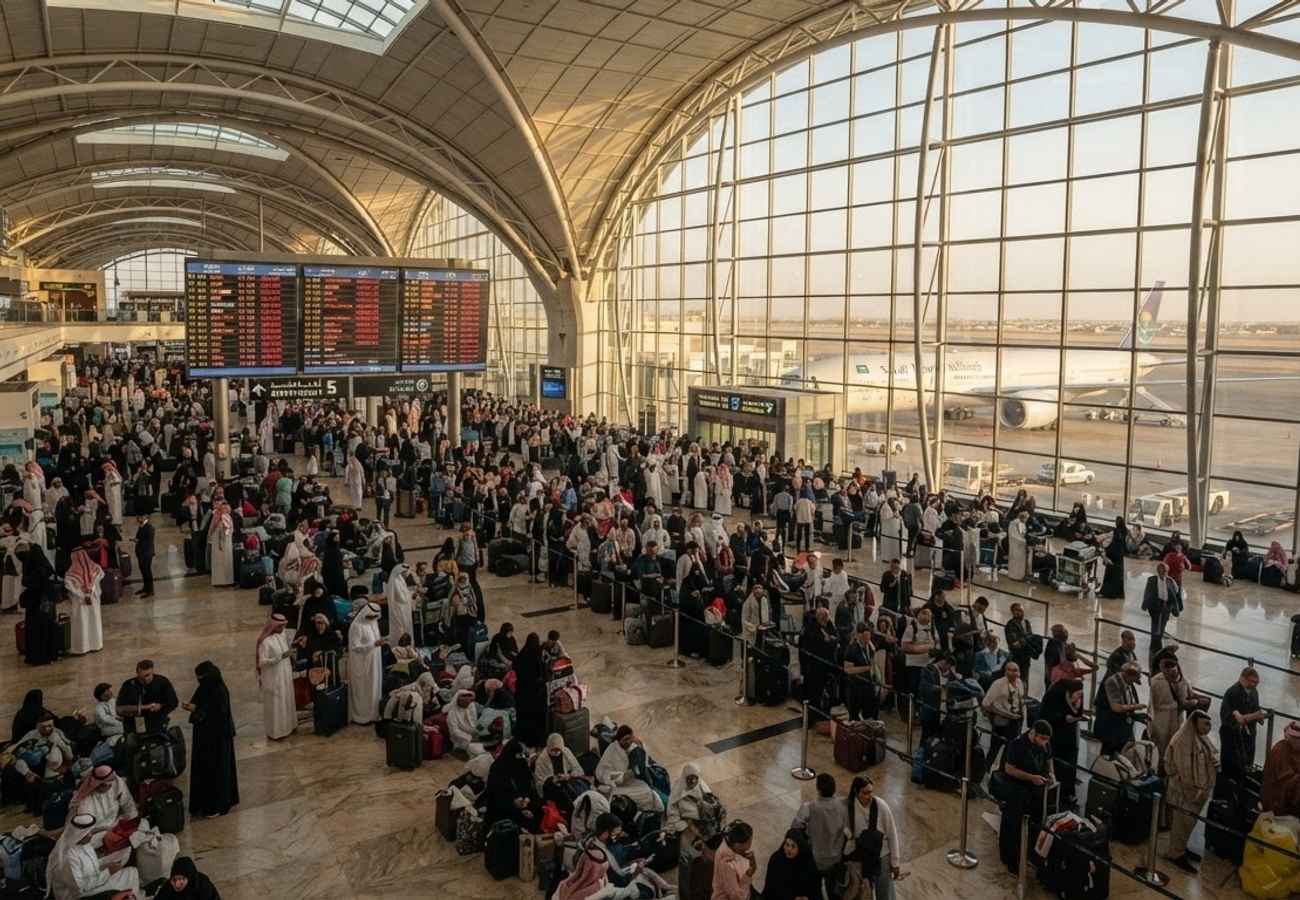
Image generated by AI
A sudden surge in operational failures has paralyzed air travel across the Middle East, with flight-tracking data revealing 1,315 delays and 36 cancellations across major Gulf hubs within a single 24-hour window. This disruption has left thousands of passengers stranded in Riyadh, Dubai, and Bahrain during one of the year's most demanding travel periods.
The instability is creating a ripple effect across the region, as the interconnected nature of Gulf aviation means a failure in one primary hub quickly degrades the performance of neighboring airports. Travelers are currently facing a volatile environment where routine schedules are being discarded in favor of emergency aircraft rotations and precautionary cancellations.
Riyadh’s King Khalid International Under Severe Pressure
Aviation statistics highlight Riyadh’s King Khalid International Airport as a central point of failure during this recent spike. As a primary gateway for Saudi Arabia, the airport has been managing an intense volume of traffic throughout August 2026, with an average of 849 flights operating daily over the last month.
The scale of the disruption is evident when analyzing the broader monthly data. In the 30 days leading up to the current crisis, more than 25,000 flights transitioned through Riyadh. During this period, approximately 18 percent of all departing services experienced delays exceeding 15 minutes, while just over 2 percent were cancelled entirely.
When these baseline failure rates collide with peak-season demand, the result is a systemic collapse of timing. For the passenger, this manifests as missed international connections, overcrowded terminals, and a surge in unplanned overnight stays. Reports from July and August 2026 indicate that routes connecting Saudi airports to Kuwait, Bahrain, and other Middle Eastern destinations have been particularly unstable.
Convergence of Weather, Security, and Infrastructure Failures
Industry reports suggest that the current chaos is not the result of a single catalyst but rather a "perfect storm" of coinciding factors. At King Khalid International, officials have pointed to a mix of maintenance issues—specifically involving refueling infrastructure—and the sudden influx of diverted traffic from other regional airports.
Beyond infrastructure, environmental and geopolitical factors are playing significant roles:
- Severe Weather: Heavy rainfall episodes across the Gulf have triggered immediate diversions and delays. Because aircraft and flight crews are often displaced during these storms, airlines struggle to realign their networks, leading to "knock-on" cancellations that persist for days.
- Regional Tensions: Heightened geopolitical instability in the Middle East has prompted a rise in precautionary schedule adjustments. Security advisories have led to the sudden scrubbing of Riyadh-linked routes to ensure passenger safety.
- Network Fragility: In mid-August 2026, flight summaries recorded over 1,000 delays and 100 cancellations in a single day across the region, proving that the aviation network is currently operating with almost no margin for error.
Quantifying the Impact on Global Transit
The 1,315 delays and 36 cancellations are more than just statistics; they represent a breakdown in the "hub-and-spoke" model that the Gulf relies upon. Because airports like Dubai International and Zayed International in Abu Dhabi serve as intercontinental bridges, a short-haul delay between two Gulf cities can cause a passenger to miss a long-haul flight to North America, Europe, or Asia.
In Riyadh, the average departure delay over the past month has remained just above 20 minutes. While this seems negligible on paper, the clustering of these delays creates a cascade effect. When an aircraft arrives late, its subsequent "turnaround" is pushed back, delaying every subsequent flight assigned to that airframe for the rest of the day.
Passengers are reporting massive queues at rebooking kiosks and a visible shortage of customer service personnel. Even those whose flights depart on time are experiencing "secondary friction," such as saturated security checkpoints and overcrowded airport lounges.
Legal Recourse and Passenger Protections in Saudi Arabia
For travelers caught in this disruption, legal protections vary by jurisdiction. In Saudi Arabia, the Passenger Rights Protection Regulations, which became effective in late 2023, provide a framework for compensation.
These regulations mandate that airlines provide specific tiers of assistance and financial redress based on the following:
- Ticket Value: Compensation for cancellations or denied boarding is often linked to the cost of the fare.
- Duty of Care: Airlines are required to provide refreshments, hotel accommodation, and alternative transport if they fail to move passengers to their destination within a reasonable timeframe.
- Jurisdiction: These rules apply to all flights departing from any airport within the Kingdom, regardless of whether the airline is a Saudi carrier or a foreign entity.
In other Gulf nations, the framework is less standardized, often relying on the airline's own "conditions of carriage." This creates a complex legal landscape for passengers on multi-leg journeys who may be protected by Saudi law on one segment and only by basic airline policy on the next.
Strategic Navigation for High-Risk Travel Windows
Aviation experts warn that volatility in the Gulf is likely to persist. The combination of seasonal demand and regional instability means that the "buffer" usually built into flight schedules has vanished.
To mitigate the risk of being stranded, travelers are advised to adopt the following strategies:
- Extend Connection Windows: Avoid "tight" connections. A three-hour layover that was once sufficient may now be inadequate given the current 18 percent delay rate in hubs like Riyadh.
- Digital Monitoring: Utilize real-time flight tracking aggregators rather than relying solely on airport monitors, which often update too late to allow for proactive planning.
- Minimize Checked Luggage: Traveling with carry-on only reduces the risk of luggage being separated from the passenger during emergency re-routing.
The current instability in Gulf aviation serves as a stark reminder of how fragile global transit hubs become when infrastructure limits and geopolitical tensions collide.
Related Travel Guides
Disclaimer
This article is for informational and educational purposes only. It does not constitute legal, financial, or professional advice. While we strive to provide accurate and up-to-date information, travel policies, regulations, and conditions change rapidly. Always verify information with official sources before making travel decisions. Nomad Lawyer makes no representations about the accuracy, reliability, completeness, or suitability of the information provided. Readers should consult qualified professionals for advice specific to their circumstances. The views expressed in this article are those of the author and do not necessarily reflect the views of Nomad Lawyer.
Kunal K Choudhary
Co-Founder & Contributor
A passionate traveller and tech enthusiast. Kunal contributes to the vision and growth of Nomad Lawyer, bringing fresh perspectives and driving the community forward.
Learn more about our team →