
Greece's Paros Faces Overtourism Backlash Over 46-Pool Luxury Hotel as Visitor Numbers Hit Record 970,000 in 2025
A 46-pool luxury hotel near Marcello Beach has ignited overtourism fears on Greece's Paros as record arrivals strain infrastructure and threaten the island's Cycladic identity.

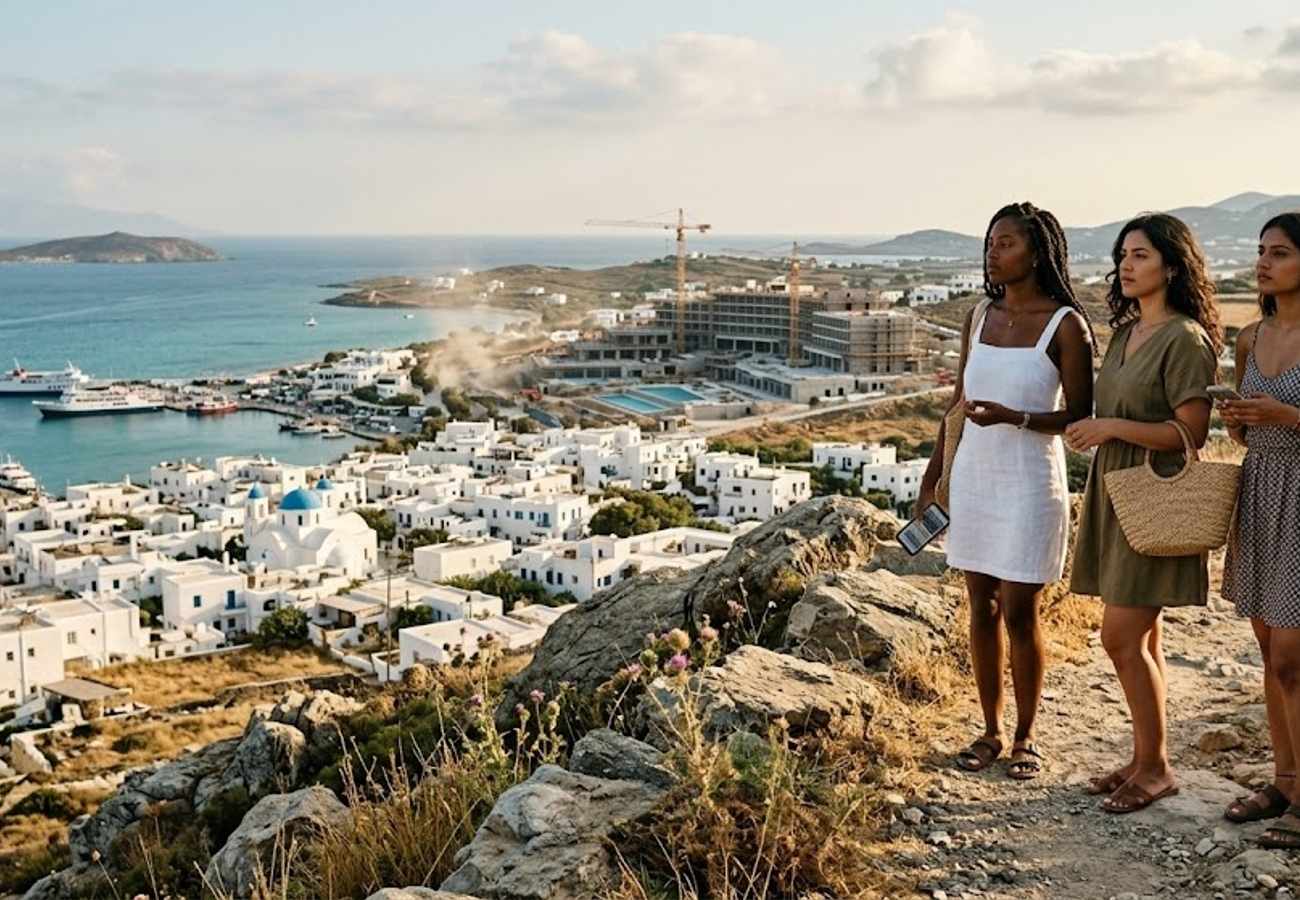
Image generated by AI
[Paros, Greece — July 31, 2026] A five-star hotel featuring forty-six private pools is nearing completion near Marcello Beach in Paroikia, and it has become the lightning rod for a community asking how much more development their island can absorb. With nearly nine hundred and seventy thousand arrivals recorded in 2025 — the highest in Paros' history — residents are confronting a question that goes beyond any single building: can this Cycladic gem sustain its tourism boom without losing the very character that made it famous?
Paros Records Historic Visitor Numbers as Tourism Boom Accelerates
The numbers tell a story of explosive growth. Paros welcomed almost nine hundred and seventy thousand arrivals through air and sea transport in 2025, setting an all-time record for the island. The port alone handled approximately seven hundred and eighty-nine thousand passenger movements, an 8.6 per cent increase over the roughly seven hundred and twenty-six thousand recorded in 2024. Paros National Airport saw its own bump, reaching nearly one hundred and eighty-one thousand arrivals compared with approximately one hundred and seventy-seven thousand the previous year.
Those figures represent more than a statistical milestone. They signal that Paros has crossed a threshold from emerging destination to mainstream Mediterranean hotspot, and the island's roads, water systems, and public services are feeling the weight of that transition.
Forty-Six-Pool Hotel Near Marcello Beach Becomes Focal Point of Development Debate
The project at the center of the controversy sits close to Marcello Beach in Paroikia, the island's principal port town. The five-star property was expected to open during the summer season and is designed around exclusivity: forty-six individual swimming pools for guest units, plus two communal pools. One shared pool spans nearly seven hundred square metres, while the second measures around fifty-seven square metres.
For investors and high-end travellers, the development represents the premium direction Paros is heading. For many residents, it represents something else entirely — a scale of construction that feels disconnected from the island's traditional Cycladic architecture and way of life. The hotel has become shorthand in local conversations for a broader worry: that Paros is being reshaped by projects designed for international luxury demand rather than for the communities that call the island home.
Luxury Hotel Expansion Has Doubled Five-Star Capacity Since 2019
The shift toward premium accommodation has been swift. Tourism industry figures show that Paros ended 2025 with one hundred and forty-one hotel establishments offering a combined three thousand eight hundred and twenty rooms. Within that total, the island now counts fifteen five-star hotels with seven hundred and thirty rooms, alongside twenty-two four-star hotels providing nine hundred and seven rooms.
The contrast with pre-pandemic figures is stark. In 2019, Paros had one hundred and thirty-seven hotel units — only marginally fewer than today — but the composition was dramatically different. At that point, the island had just six five-star hotels with three hundred and sixty rooms and nineteen four-star hotels with eight hundred and fifty rooms. In six years, five-star room capacity has more than doubled, and four-star rooms have grown by nearly seventy.
That trajectory reflects surging international investor interest in Paros. It also raises a practical question: if this rate of luxury expansion continued for another five years, what would the island look like — and who would it be for?
Kolympithres Project Exposes Infrastructure Limits as Water Authority Raises Concerns
The Marcello Beach hotel is not the only development drawing scrutiny. A separate planned five-star tourism project in the Kolympithres area has run into direct resistance from local authorities over whether the island's infrastructure can handle it.
The concerns are specific and technical. Local officials have questioned whether existing water and sewage networks possess the capacity to support the development. The island's water management authority has separately expressed reservations about connecting the project to the municipal network, citing limitations in meeting the expected demand.
These objections matter because they move the conversation from abstract worry about "overdevelopment" into concrete territory: Paros' utilities, roads, and public services were built for a smaller island, and the pace of construction is outstripping the pace of infrastructure investment.
Cycladic Identity Under Pressure as Paros Weighs Economic Gains Against Cultural Preservation
The tension on Paros mirrors a broader pattern across the Cyclades and the wider Greek island network. Destinations that built their reputations on whitewashed villages, blue-domed churches, and a slower pace of life are now absorbing record international demand, and the economic benefits are real — jobs, investment, and global recognition have followed the visitor surge.
But so have the costs. Residents point to overcrowding during peak months, strain on natural resources, and a gradual visual transformation as large-scale hotel complexes replace smaller, family-run accommodations. The traditional character of Paros — the fishing villages, the narrow stone streets, the low-slung architecture — is not just a cultural asset. It is the primary reason travellers choose the island over competing destinations. Erode that, and the economic engine weakens too.
Why This Matters: What the Paros Debate Means for Travellers and the Future of Greek Island Tourism
For the traveller planning a Cycladic holiday in 2026 or beyond, the situation on Paros carries direct implications. Islands facing overtourism pressures often respond with tighter regulations — caps on short-term rentals, restrictions on new hotel construction, or even visitor limits at sensitive sites. That could mean higher prices during peak season as accommodation supply tightens, or it could mean a better-preserved experience if local authorities succeed in managing growth responsibly.
From a logistical standpoint, the infrastructure concerns raised by the water management authority are worth paying attention to. If utility systems are already stretched, travellers may encounter water usage restrictions, traffic congestion, or service disruptions during high-season months. Booking outside the July–August window — when arrivals peak — may offer both better value and a less strained island experience.
For the local community, the stakes are existential. The decisions made in the next year or two about projects like the Marcello Beach hotel and the Kolympithres development will set a precedent. Approve them, and Paros signals that large-scale luxury construction is welcome. Reject or scale them back, and the island draws a line around what it is willing to sacrifice for tourism revenue.
The broader Greek tourism sector is watching. Paros is not the first Cycladic island to face this reckoning, and it will not be the last. How the island balances investment with preservation could influence how other destinations approach their own development crossroads.
Paros Stands at a Defining Moment for Sustainable Island Tourism
Paros remains one of Greece's most magnetic destinations, and the economic data underscores why — visitor numbers are climbing, hotel investment is flowing, and international recognition is growing. But the forty-six-pool hotel near Marcello Beach has crystallized a fear that statistics alone cannot capture: that the island is being loved to death.
The path forward is not a simple choice between growth and preservation. It is a question of calibration — how much development, at what scale, in which locations, and with what infrastructure investment to support it. Sustainable planning, upgraded utility networks, and development decisions grounded in community input will determine whether Paros remains a destination that travellers dream about or becomes a cautionary tale of what happens when tourism expansion outruns everything else.
The pools may be private, but the future of Paros belongs to everyone who calls it home — or visits it.
Related Travel Guides
Disclaimer
This article is for informational and educational purposes only. It does not constitute legal, financial, or professional advice. While we strive to provide accurate and up-to-date information, travel policies, regulations, and conditions change rapidly. Always verify information with official sources before making travel decisions. Nomad Lawyer makes no representations about the accuracy, reliability, completeness, or suitability of the information provided. Readers should consult qualified professionals for advice specific to their circumstances. The views expressed in this article are those of the author and do not necessarily reflect the views of Nomad Lawyer.
Kunal K Choudhary
Co-Founder & Contributor
A passionate traveller and tech enthusiast. Kunal contributes to the vision and growth of Nomad Lawyer, bringing fresh perspectives and driving the community forward.
Learn more about our team →