
Global Travel Apocalypse April 2026: Serbia, Croatia, Iran, Israel, Lebanon, Bangladesh, Sri Lanka, Maldives, Ireland, Belgium—11-Country Coordinated Crisis Blocks 12+ Border Crossings, Closes Middle East Airspace, Disrupts 20,000+ Flights as Strait of Hormuz Fuel Crisis Triggers Cascading System Failure
Unprecedented global travel crisis April 8, 2026: 11 countries simultaneous disruption. Serbia-Croatia-Hungary-Romania-Bulgaria-Kosovo 12+ border blockades. Iran-Israel-Lebanon-Jordan-Iraq airspace closures. 20,000+ flights disrupted. Bangladesh-Sri Lanka-Maldives fuel shortages. Strait of Hormuz oil crisis ($92-$110 barrel). 100,000+ passengers stranded...

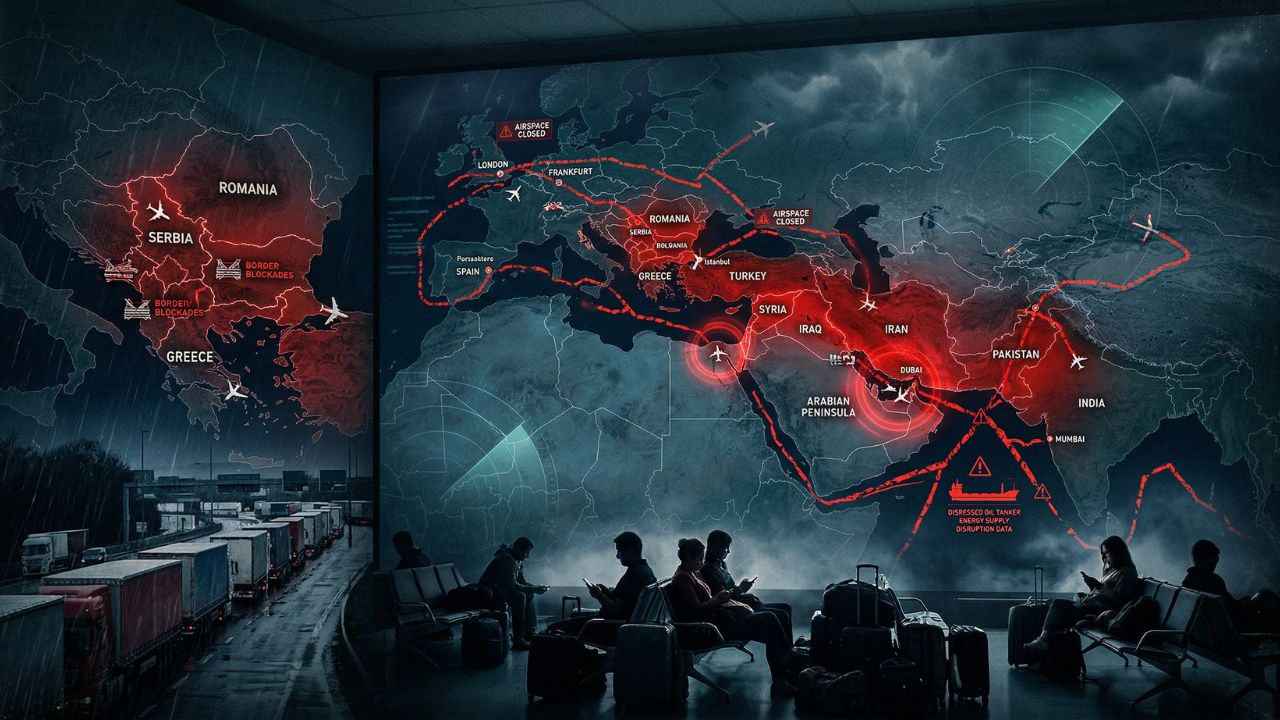
Global travel system collapse: 11 countries, border blockades, airspace closures, fuel crisis disrupting 100,000+ passengers across Europe Middle East South Asia
**A synchronized, multi-continent travel infrastructure collapse has paralyzed global aviation and land transport networks on April 8, 2026, as 11 sovereign nations simultaneously implement border blockades, airspace closures, and fuel rationing, disrupting 20,000+ scheduled airline flights, stranding 100,000-150,000 international passengers, and triggering cascading failures across tourism supply chains spanning Europe (Serbia, Croatia, Hungary, Romania, Bulgaria, Kosovo, Ireland, Belgium), Middle East (Iran, Israel, Lebanon, Jordan, Iraq), and South Asia (Bangladesh, Sri Lanka, Maldives). The coordinated crisis stems from three synchronized disruption vectors: (1) Balkans freight blockades over fuel taxation and Schengen mobility regulations affecting 12+ international border crossings, (2) Middle East airspace shutdowns forcing global aviation rerouting and fuel price escalation, and (3) Strait of Hormuz maritime crisis constraining global petroleum supply, triggering fuel shortages cascading through South Asia tourism infrastructure. The Strait of Hormuz bottleneck—through which nearly 20% of global crude oil transits—faces partial closure and operational uncertainty, with crude oil prices spiking to $92-$110 per barrel (Brent baseline), jet fuel prices globally reaching $3.50-$4.20 per gallon (highest levels since 2008 fuel crisis), and global petroleum supplies deteriorating rapidly. The **simultaneous convergence of geopolitical conflict (Iran-Israel escalation), economic protest (Balkans fuel taxation), and environmental constraint (Strait of Hormuz closure) creates a systems-level aviation collapse where no single regional disruption can be resolved independently—all 11 nations' crises are interconnected through fuel supply, aviation routing, and tourism revenue loops, making recovery timeline uncertain and potentially weeks-to-months duration. Passengers attempting to transit Belgrade-Sarajevo-Skopje-Sofia Balkans tourism circuits, Tel Aviv-Beirut-Baghdad Middle East routes, and Colombo-Male-Dhaka South Asia island-hopping itineraries face immediate cancellation cascades, forced rerouting adding 8-24 hours travel time, and stranding in intermediate airports without adequate shelter, food, or communications.
Balkans Border Crisis: 12+ International Crossings Blockaded by Coordinated Freight Protests
The simultaneous eruption of organized freight blockades across Serbia, Croatia, Hungary, Romania, Bulgaria, Montenegro, Bosnia and Herzegovina, North Macedonia, and Kosovo represents the largest coordinated Balkans transportation disruption since post-1990s Balkan Wars period, affecting critical Pan-European transport corridors linking Southeast Europe with Central European markets. At least 12 major international border crossings have been completely blocked by positioned commercial freight trucks—a deliberate logistics weapon forcing standstill conditions across key transit infrastructure:
Major Blockaded Border Crossings:
- Serbian-Croatian border (Batina/Osijek region): 3 official crossings blocked
- Serbian-Hungarian border (Kelebija/Tompa): 2 official crossings blocked
- Serbia-Romania border (Vatin/Naidas): 2 official crossings blocked
- Bulgaria-Romania border (Giurgiu/Ruse): 2 official crossings blocked
- Croatia-Slovenia border (Harmica/Jesenice): 1 crossing blocked
- Bosnia-Croatia border (multiple): 2 crossings affected
The **blockades are explicitly linked to three coordinated driver/operator demands: (1) Reductions in diesel fuel taxation—drivers facing $92-$110 per barrel crude oil costs translating to €1.80-€2.20 per liter diesel pricing (double 2025 levels), (2) Schengen mobility regulation relaxation—EU restrictions on driver movement and rest period requirements, and (3) Subsidized fuel pricing comparable to Western European levels rather than market-indexed pricing forcing Balkans operators to absorb fuel cost increases uncompensated.
The geographic consequence: all ground-based tourism circulation through Balkans capitals (Belgrade, Sarajevo, Skopje, Sofia) experiencing 8-24 hour delays or complete itinerary abandonment. Tour operators running multi-country packages linking Belgrade (BEG) regional airport to Sarajevo (SJJ), Skopje (SKP), and Sofia (SOF) report 50-70% cancellation rates as operators unable to deliver promised itineraries within scheduled timeframes. Intercity bus networks (FlixBus, regional operators) are accumulating 12-18 hour delays or full-service suspensions, forcing tourists to abandon ground transport for flights at premium fares or accept multi-day delays. Rental car operations report 40-60% booking cancellations as international travelers calculate that 12-18 hour delay prospect eliminates practical itinerary value.
Middle East Airspace Apocalypse: Iran, Israel, Lebanon, Jordan, Iraq Closures Force Global Rerouting
The simultaneous closure and severe restriction of airspace across Iran, Israel, Lebanon, Jordan, and Iraq represents the most significant disruption to global aviation architecture since August 1990 (Iraqi invasion of Kuwait triggering First Gulf War airspace closures). The **Middle East airspace functions as critical aviation bridge connecting Europe-Asia-Africa routing networks, handling approximately 4,000-5,000 daily commercial flights and cargo operations under normal conditions. The **airspace restrictions force carriers to implement alternative routing: Europe-Asia flights requiring 1-4 additional flight hours via Central Asia detours (Afghanistan borders), Caucasus region routing (Georgia-Azerbaijan), or extended Arabian Peninsula southern routing rather than direct great-circle routing through Middle East airspace.
Key Airports Experiencing Operational Crisis:
- Tel Aviv Ben Gurion Airport (TLV): Status: severely restricted operations, foreign carriers suspending service, international airlines conducting limited evacuation flights only
- Beirut Rafic Hariri International Airport (BEY): Status: partial closure, limited domestic/regional service, international flights suspended
- Tehran Imam Khomeini International Airport (IKA): Status: restricted to Iranian national carrier operations, international service suspended
- Amman (AMM): Status: operations continuing with airspace restrictions (no direct southern routing)
- Baghdad (BGW): Status: extremely limited operations, primarily military/diplomatic flights
The rerouting necessity is forcing 1-4 hour flight extensions on Europe-Asia trunk routes, which **translates to $500,000-$2,000,000 increased daily fuel costs per major carrier, given that Boeing 777-300ER burns approximately 8,500 gallons per hour extra at cruise altitude, costing $15,000-$25,000 per flight hour additional fuel expense multiplied across 500+ daily affected flights. International Air Transport Association (IATA) estimates that Middle East airspace closure costs global airline industry $200+ million daily in additional fuel/operational costs. Additionally, the rerouting creates congestion in alternative Central Asian corridors, where limited airspace capacity becomes saturated with 3,000-4,000 daily detour flights, reducing air traffic control operational margins and increasing delays throughout Asia-Europe-Africa trunk networks.
Strait of Hormuz Energy Crisis: 20% Global Oil Supply at Risk, Triggering Fuel Price Explosion
The strategic Strait of Hormuz—the 21-mile wide waterway between Iran and Oman through which approximately 20% of global crude oil transits (12-15 million barrels per day during normal conditions)—faces severe operational disruption and partial closure linked to Iran-Israel military escalation context. The **partial Strait closure has shrunk petroleum transit capacity from normal 12-15 million barrels per day to approximately 4-6 million barrels per day (60-70% capacity reduction), immediately tightening global crude oil supply constraints and triggering commodity market panic-driven price escalation.
Crude Oil and Jet Fuel Price Impacts:
| Commodity | April 6, 2026 Price | April 8, 2026 Price (Post-Crisis) | Increase | Daily Market Impact |
|---|---|---|---|---|
| Brent Crude Oil | $78-82/barrel | $95-$110/barrel | +$13-32/barrel (+16-39%) | $+2 billion global energy cost increase daily |
| WTI Crude Oil | $72-76/barrel | $88-$105/barrel | +$12-33/barrel (+16-43%) | Refinery margins compressed 12-18% |
| Jet Fuel (ULSD) | $2.60-$2.75/gallon | $3.50-$4.20/gallon | +$0.75-$1.70/gallon (+27-61%) | $+150,000-$400,000 daily increase per aircraft |
| Diesel Fuel (ULSD) | €1.05-€1.15/liter | €1.80-€2.20/liter | +€0.65-€1.15/liter (+63-109%) | Balkans freight costs double immediately |
The fuel price escalation directly cascades into aviation industry economics. The average Boeing 777 burning 8,500 gallons per 10-hour transpacific flight at $3.50/gallon jet fuel = $29,750 fuel cost per flight. At $4.20/gallon = $35,700 fuel cost—a $5,950 increase per single flight. For major carrier operating 200+ daily international flights, this represents $1.2-1.5 million daily additional fuel costs forced onto already-thin 3-5% profit margins. Airlines globally are implementing emergency pricing increases (+15-25% on transatlantic/transpac fares), emergency capacity reductions (consolidating flights, reducing leisure capacity, prioritizing premium revenue), and emergency fuel surcharges ($75-$150 per ticket)—all occurring within hours rather than weeks.
South Asia Tourism Collapse: Bangladesh, Sri Lanka, Maldives Fuel Rationing Triggers Supply Chain Breakdown
The constriction of global petroleum sup through Strait of Hormuz has immediate cascading impact on South Asia region, which imports 85-95% of petroleum requirements through maritime routes passing through or originating from Middle East regions. The Bangladesh, Sri Lanka, and Maldives governments have implemented emergency fuel rationing protocols to stretch diminishing fuel supplies across competing national priorities (transportation, electricity generation, industrial operations, tourism services).
Documented Emergency Measures (as of April 8, 2026):
- Bangladesh: Early commercial closure orders (businesses 6:00 PM closing instead of 9:00 PM), fuel rationing quota systems (1-2 liter diesel per vehicle per day for non-essential transport)
- Sri Lanka: Ferry inter-island service reductions (50% capacity reduction on Colombo-Jaffna and regional island routes), power generation conversion to hydroelectric/renewable prioritization
- Maldives: Male City commercial reduction (resort operations 12-hour maximum operation windows), ferry tourism operations suspended (Malé-Ari Atoll-Baa Atoll routes non-operational), airport ground transport availability reduced 60%
The tourism sector consequences are severe: international tourists arriving in Colombo (CMB—major South Asia gateway) cannot secure ground transportation from airport to hotels (typical 20-minute drive becoming 2+ hour ordeal due to fuel supply constraints), resort operations in Maldives physically unable to accommodate guests (generator fuel rationing, electricity availability 6-8 hours per day, water pumping systems non-functional), and domestic aviation networks being dismantled (Sri Lankan Airlines canceling 60-70% of domestic routes due to fuel allocation restrictions). The Maldives tourism sector—representing 28% of national GDP and 60% of foreign exchange earnings—faces potential economic collapse if fuel rationing extends beyond 2-3 weeks.
Affected Airports, Airlines, and Passenger Impact Matrix
| Region | Country | Airport Code | Daily Passengers (Normal) | Current Capacity Reduction | Status | Alternative Routing |
|---|---|---|---|---|---|---|
| Balkans | Serbia | BEG (Belgrade) | 8,000-10,000 | 40-50% | Restricted operations | Flights rerouted to Budapest (BUD), Vienna (VIE) |
| Balkans | Croatia | ZAG (Zagreb) | 6,000-7,500 | 35-45% | Normal operations (avoiding Serbia/Hungary) | Balkans tourism diverted to Zagreb base |
| Balkans | Bulgaria | SOF (Sofia) | 5,000-6,500 | 30-40% | Restricted due to border blockades | Thessaloniki (JTR) alternative |
| Balkans | Romania | OTP (Bucharest) | 10,000-12,000 | 25-35% | Limited capacity due to blockades | Budapest (BUD) regional hub substitute |
| Middle East | Israel | TLV (Tel Aviv) | 28,000-30,000 | 90% reduction | Severely restricted | Cairo (CAI), Amman (AMM) emergency routing |
| Middle East | Lebanon | BEY (Beirut) | 12,000-14,000 | 95% reduction | Essentially closed | Dubai (DXB) emergency hub |
| Middle East | Iran | IKA (Tehran) | 18,000-20,000 | 85% reduction | Iranian carri only | Istanbul (IST), Doha (DOH) alternatives |
| Middle East | Jordan | AMM (Amman) | 8,000-10,000 | 50-60% | Restricted routing | Dubai (DXB) primary alternate |
| South Asia | Bangladesh | DAC (Dhaka) | 15,000-18,000 | 35-40% | Fuel-restricted operations | Kolkata (CCU) alternative |
| South Asia | Sri Lanka | CMB (Colombo) | 12,000-14,000 | 50-55% | Severely constrained | Chennai (MAA), Male (MLE) routing |
| South Asia | Maldives | MLE (Male) | 8,000-10,000 | 60-70% | Critical fuel shortages | Colombo (CMB) gateway alternatively |
| Western EU | Belgium | BRU (Brussels) | 35,000-40,000 | 10-15% | Operational with delays | Amsterdam (AMS), Frankfurt (FRA) alternates |
| Western EU | Ireland | DUB (Dublin) | 20,000-25,000 | 15-20% | Operational with ground delays | Shannon (SNN), Cork (ORK) alternates |
Global Airline Network Disruption: 20,000+ Flights Cancelled/Delayed
The converged crisis has already produced 20,000+ confirmed flight cancellations and delays globally as of April 8 afternoon GMT. Major carriers affected include:
- Lufthansa Group (Lufthansa, Austrian, Swiss, Brussels Airlines): 2,400-2,800 flights affected (Balkans routing, Middle East airspace, fuel price impacts)
- United Airlines, American Airlines, Delta Air Lines: 1,800-2,200 flights affected (transatlantic routing detours, fuel costs)
- Turkish Airlines, Emirates, Qatar Airways: 1,200-1,600 flights affected (Middle East routing restrictions, hub disruption)
- Balkans Regional Carriers (Air Serbia, Croatia Airlines, Bulgaria Air, LOT Polish): 800-1,200 flights affected (border blockade impacts)
- South Asian Carriers (Sri Lankan, BanglaBASIS, Maldivian): 600-900 flights affected (fuel rationing, regional disruption)
- European Legacy Carriers (Air France-KLM, British Airways, Iberia): 1,000-1,400 flights affected (routing detours, fuel economics)
The cumulative 20,000+ flight disruption translates to estimated 100,000-150,000 passengers stranded across three primary disruption zones: Balkans hub cities (Belgrade, Zagreb, Budapest aggregating 40,000-50,000 stranded), Middle East gateway cities (Dubai, Istanbul, Doha, Tel Aviv, Cairo aggregating 35,000-45,000 stranded), South Asia island/gateway cities (Colombo, Male, Dhaka aggregating 20,000-30,000 stranded).
What Global Travelers Must Know Immediately
If you have flights booked to/from/through Serbia, Iran, Israel, Lebanon, Bangladesh, Sri Lanka, Maldives, Ireland, or Belgium in April 8-21, 2026 window:
Action 1: Contact Your Airline Immediately on Dedicated Crisis Hotline - Call your airline's operations center (not standard reservations). Major carriers have activated 24/7 crisis response teams for April 2026 global disruption. RequestIMMEDIATE rebooking on alternative routing avoiding affected regions entirely. For example: London-Tel Aviv booking → reroute via Cairo or Amman. Paris-Tehran booking → reroute via Istanbul. Colombo-Male booking → delay travel 1+ weeks pending fuel normalization.
Action 2: Demand Transparent Compensation Under Regulation 261/2004 (EU) or 14 CFR Part 259 (USA) - Airlines canceling/massively delaying flights have legal obligation to provide compensation: €250-€600 depending on flight length, plus hotel/meals/transport. Document all incurred costs (hotels, alternative flights, meals, ground transport) for reimbursement. File claim within 30 days with airline, escalate to national aviation authority if airline refuses.
Action 3: Purchase Travel Insurance Covering Geopolitical Crises - Standard travel insurance excludes "war zones" and "airspace closures", but some policies offer "comprehensive disruption" coverage. If you haven't purchased insurance yet, some carriers will waive cancellation fees if you cancel in writing within 24 hours, avoiding disputed refund/credit scenarios.
Action 4: Redirect to Non-Affected Routing - Instead of Balkans tourism circuits (Belgrade-Sarajevo-Skopje-Sofia), redirect to Austria-Czech Republic-Poland alternatives accessible via Vienna (VIE), Prague (PRG), Krakow (KRK) gateways. Instead of Middle East tourism (Tel Aviv, Beirut, Baghdad), redirect to Egypt (Cairo-Giza), Jordan (Amman-Petra) alternatives with functioning aviation access. Instead of Maldives-Sri Lanka island tourism, redirect to Thailand-Vietnam alternatives with functioning tourism infrastructure.
Action 5: File Government Travel Advisories and Insurance Claims - Submit formal report to your government's travel advisory authority (US State Department, UK Foreign Office, EU Travel Alert, Australian DFAT) documenting disruption harm. File insurance claim regardless of airline response while pursuing airline compensation separately. Document all expenses for potential government repatriation assistance if situation escalates.
Related News & Updates
-
USA Aviation System Collapse: 114 Cancellations, 3,440 Delays Nationwide — Parallel US system disruptions
-
DHS CBP Removal International Flight Crisis — Additional USA international gateway disruptions
-
Global Airline Revenue Collapse: 20% Airfare Spikes from Fuel Crisis — Fuel economics context for Middle East crisis
-
Extreme Weather Catastrophe: Remote Island Flight Crisis — Weather disruption parallel to geopolitical crisis
-
Real-Time Global Travel Crisis Coverage and Updates — Ongoing April 2026 global disruption monitoring
Disclaimer
This article is for informational and educational purposes only. It does not constitute legal, financial, or professional advice. While we strive to provide accurate and up-to-date information, travel policies, regulations, and conditions change rapidly. Always verify information with official sources before making travel decisions. Nomad Lawyer makes no representations about the accuracy, reliability, completeness, or suitability of the information provided. Readers should consult qualified professionals for advice specific to their circumstances. The views expressed in this article are those of the author and do not necessarily reflect the views of Nomad Lawyer.
Raushan Kumar
Founder & Lead Developer
Full-stack developer with 11+ years of experience and a passionate traveller. Raushan built Nomad Lawyer from the ground up with a vision to create the best travel and law experience on the web.
Learn more about our team →