
French Guiana Travel Guide: Spaceports, Penal History, and Amazonian Wilderness in Europe's South American Outpost
A detailed overview of French Guiana, from the Guiana Space Centre in Kourou to the penal archipelago and Amazonian trai

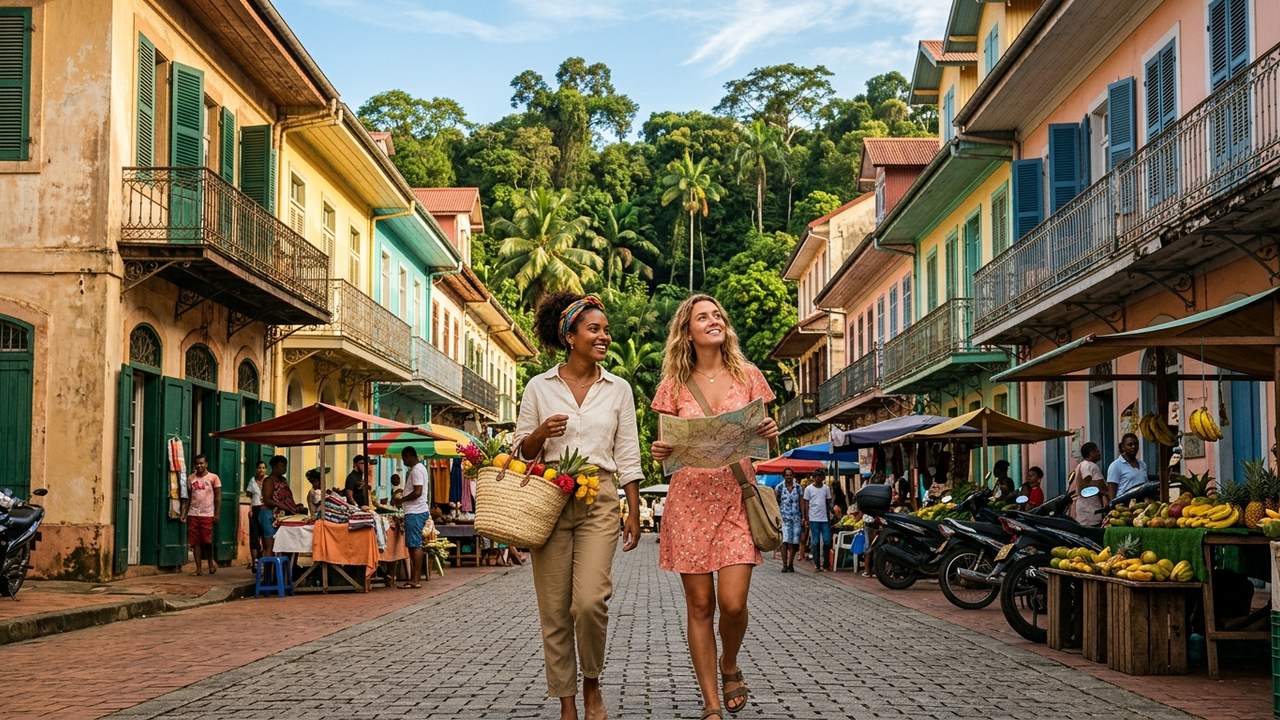
Image generated by AI
French Guiana occupies a unique position in the global geography: it is an overseas department of France situated in the northeast corner of South America. This distinct location creates a remarkable geographical anomaly; France's longest land border, spanning approximately 700 kilometers, lies with Brazil, over 7,000 kilometers from mainland Europe.
The territory is defined by a landscape of dense tropical rainforest intersected by extensive river networks. Although the territory features a 350-kilometer coastline, it is not marketed as a beach destination. The coastal waters remain brown and silty year-round due to sediment discharge from the Amazon River basin.
Cultural and administrative life centers on three primary coastal towns. Cayenne, the departmental capital, sits furthest east and features narrow, grid-like streets lined with low-rise colonial architecture. Kourou lies centrally along the coast and serves as the hub for the European space industry, hosting the scientific and technical workforce. Saint-Laurent-du-Maroni is located to the far west; originally established as a penal settlement in the mid-19th century, it remains home to a significant correctional facility that attracts visitors today.
Climate and Seasonal Travel
French Guiana lies between latitudes 2° and 6° North, resulting in an equatorial climate characterized by high humidity and consistent temperatures ranging from 22°C to 31°C (71.6°F to 87.8°F). The territory's stability is a key factor in its selection for space operations; it is not subject to earthquakes, hurricanes, typhoons, or other major climatic disruptions.
The optimal window for travel is the dry season, extending from July to mid-November, which offers reliable sunshine and minimal rainfall. This period coincides with the peak tourist influx, particularly during the French school holidays from early July through late August. Visitors during these months should anticipate higher accommodation rates and increased crowds at major sites.
Logistics: Flights and Regional Transport
International access is primarily via Cayenne. Direct flights to Cayenne take approximately nine hours and are operated by Air France and Air Caraïbes from Paris. Regional connectivity includes direct flights from Fort-de-France in Martinique, as well as services from Brazilian cities including Belém and Fortaleza. Travelers originating in North America typically route through Toronto, Montréal, or Miami to connect via Martinique.
Within the territory, ground transport is limited to the coastal corridor. The TIG5 bus service operates hourly between Cayenne and Kourou, covering the 62-kilometer distance in one hour at a fare of €10. Travel westward to Saint-Laurent-du-Maroni, located 189 kilometers from Kourou, requires a journey of roughly four hours by public transport, making car rental a practical alternative for those targeting the western coast.
The RN1 highway connects the main coastal towns, while the RN2 extends southeast to the border town of Saint Georges de l'Oyapock. Traffic congestion is generally light outside Cayenne, though rush-hour delays occur in the capital.
Interior Access and Aviation
Road infrastructure does not extend into the interior. Travel to settlements such as Saül requires air travel. Other interior destinations, including Camopi on the Brazilian border and Maripasoula or Grand Santi near the Suriname border, are accessible by small aircraft or by dug-out canoe (pirogue). Overland canoe expeditions are time-intensive; for example, a journey from Saint-Laurent-du-Maroni to Maripasoula by water takes approximately four days.
Space Operations and Science Tourism
Kourou hosts the Centre Spatial Guyanais (CSG), the primary spaceport for European space launches. The facility offers public access through the Guyaspace Experience center, which features interactive exhibits and multimedia displays available in French and English. Visitors can explore a planetarium, view satellite technology, and observe launch operations. Note that the site may close for short periods preceding scheduled rocket launches; advance verification is required.
The Penal Archipelago and Historical Sites
French Guiana's history as a penal colony is preserved at the Îles du Salut (Salvation Islands), an archipelago located 15 kilometers off the coast of Kourou. The islands are currently owned by the French national space research center (CNES) and lie beneath rocket launch trajectories.
Access is regulated by island:
- Île Royale: The central island is open to independent exploration and contains the archipelago's only dining establishment, l'Auberge des Îles.
- Île du Diable (Devil's Island): The northernmost island is inaccessible to the public. It was the site of solitary confinement for high-profile prisoners, including Captain Alfred Dreyfus, who was detained here from April 13, 1895, to June 9, 1899.
- Île Saint-Joseph: The southern island offers guided tours. It housed Henri Charrière, the subject of the book and film Papillon, for two years.
On the mainland, the penal colony in Saint-Laurent-du-Maroni remains a major historical site. Charrière was initially held here before his transfer to Île Saint-Joseph.
Cultural Institutions and Museums
Cayenne hosts several cultural institutions. The Musée Des Cultures Guyanaises displays pre-Columbian artifacts, objects related to the trade of enslaved people, and works created by indigenous groups, including feather craftsmanship.
The Alexandre Franconie Museum, located in a historic monument building in central Cayenne, is scheduled to close for renovations during the first six months of 2027. Upon reopening, the institution will operate as a natural history museum, focusing on Amazonian fauna and ethnobotany, highlighting the role of regional flora in modern pharmacology. The adjacent Jean Martial hospital is slated to become the territory's cultural center, housing additional collections.
Amazonian Exploration and Nature
The territory offers approximately 50 marked footpaths known as layons for hiking. The Rorota path, situated behind Gosselin Beach in Cayenne, provides a 5.6-kilometer trail suitable for beginners, with an estimated duration of 1 hour and 30 minutes. Hikers should expect encounters with sloths, fallen tree trunks known as chablis (which serve as habitats for snakes), and limited connectivity. Mobile phone signals are generally unavailable in the forest, with exceptions at specific marked trees.
Kaw-Roura, located approximately 80 kilometers southeast of Cayenne, constitutes France's largest protected wetland. Guided excursions by dug-out canoe allow visitors to navigate the Kaw River, where wildlife includes capybaras (locally called cabiaï) and caimans, which are more active at dusk. Overnight stays are available at floating ecolodges.
Traditional carbets—open-sided wooden huts—offer basic accommodation in forest and riverside settings. These sites function as communal camping areas where visitors must supply their own food for on-site preparation.
Carnival and Marine Life
Carnival is the territory's premier annual cultural event, running from Epiphany on January 6 until Ash Wednesday. The festivities feature cavalcades or vidés, parades with costumed participants and music held on Sundays. A unique local tradition involves the Touloulous, women who attend Saturday night balls in full disguises, including masks and ball gowns, and invite men to dance. The celebration concludes with the symbolic burning of King Vaval following Mardi Gras.
Marine wildlife observation is regulated to protect species. Between April and August, leatherback sea turtles nest on Salines Beach in Cayenne, typically between 5:00 PM and 7:00 AM. Observers must maintain distance, avoid touching the animals, stay behind them, remain silent, and use red-light only lamps. Guided tours are recommended through organizations such as the Kwata association or the Réserve Naturelle de l'Amana. Olive ridley and green sea turtles are also present in territorial waters.
Camp Cariacou and Immersive Stays
Camp Cariacou, located an hour's motorized canoe ride from Kourou along the Cariacou River, offers a disconnect from digital connectivity, with no internet service available. Accommodation includes double beds or hammocks protected by mosquito nets. The camp provides guided activities such as foraging, canoe racing, archery, fishing, and weaving. Kayaking excursions along the Balata creek allow for wildlife observation.
Estimated Travel Costs in French Guiana
| Item | Cost (EUR) | Notes |
|---|---|---|
| Accommodation | ||
| 3- or 4-Star Hotel | €90 – €230 | Per night |
| Short-term Rental (Cayenne) | €49 | Per night |
| Carbet with Hammock | €30 | Per night; basic facility |
| Camp Cariacou | €185 | 2 days and 1 night |
| Food and Drink | ||
| 3-Course Dinner (per person) | €45 | For two people |
| Beer | €3.50 | |
| Fresh Fruit Juice | €4 | |
| Mineral Water | €5 | Bottle |
| Transportation | ||
| Compact Car (Manual) | €240 | Per week rental |
| TIG5 Bus (Cayenne-Kourou) | €10 | One-way fare |
Key Takeaways
- Geography: French Guiana is a French overseas department in South America, sharing a 700km border with Brazil. The coastal waters are sediment-rich and not suitable for swimming.
- Climate: Equatorial conditions prevail with temperatures between 22°C and 31°C. The dry season (July to mid-November) is the best time to visit but coincides with peak pricing.
- Space Tourism: The Centre Spatial Guyanais in Kourou is Europe's primary spaceport. Public access is available via the Guyaspace Experience, subject to launch schedules.
- Penal History: The Îles du Salut and Saint-Laurent-du-Maroni preserve the territory's penal past. Île du Diable is inaccessible; Île Royale and Île Saint-Joseph offer tours.
- Transport: Air and river travel are necessary for interior access. Coastal travel is possible by bus or car, with TIG5 connecting Cayenne and Kourou.
- Health and Safety: Malaria and Dengue are risks; medical consultation regarding antimalarials is advised. Mosquito protection and appropriate footwear are essential for forest travel.
FAQ
Is French Guiana part of Europe or South America? French Guiana is politically an overseas department of France, making it part of the European Union and the Eurozone. Geographically, it is located in South America, sharing a border with Brazil and Suriname.
Can visitors access Devil's Island (Île du Diable)? No, Île du Diable is not open to the public. It is managed by the French space agency (CNES) and remains restricted. Visitors can tour Île Royale and take guided tours of Île Saint-Joseb from Kourou.
What is the best way to travel to interior villages like Saül or Maripasoula? There are no roads connecting the interior to the coast. Travel to Saül requires a small aircraft. Maripasoula and other border settlements can be reached by plane or by dug-out canoe (pirogue), though canoe journeys can take several days.
How much cash should I bring for a week-long trip? Budgets vary, but costs are comparable to mainland France, with a slight premium for logistics. A compact car rental costs approximately €240 per week, hotels range from €90 to €230 per night, and dining averages €45 per person for a three-course meal. ATMs are available in major towns like Cayenne and Kourou.
Related Travel Guides
Disclaimer
This article is for informational and educational purposes only. It does not constitute legal, financial, or professional advice. While we strive to provide accurate and up-to-date information, travel policies, regulations, and conditions change rapidly. Always verify information with official sources before making travel decisions. Nomad Lawyer makes no representations about the accuracy, reliability, completeness, or suitability of the information provided. Readers should consult qualified professionals for advice specific to their circumstances. The views expressed in this article are those of the author and do not necessarily reflect the views of Nomad Lawyer.
Preeti Gunjan
Contributor & Community Manager
A passionate traveller and community builder. Preeti helps grow the Nomad Lawyer community, fostering engagement and bringing the reader experience to life.
Learn more about our team →