France and ASEAN Forge Landmark Partnership in Jakarta to Advance Sustainable Tourism and Cultural Heritage

JAKARTA — At the ASEAN Headquarters and Secretariat in Jakarta, the Sixth ASEAN-France Development Partnership Committee (AF-DPC) Meeting has concluded with a comprehensive diplomatic accord, establishing a multi-year bilateral operational roadmap to advance sustainable tourism, cultural heritage conservation, and green economic infrastructure across Southeast Asia.
The bilateral summit, which reviewed the progress of the foundational ASEAN-France Practical Cooperation Areas (PCA) 2022–2027 framework, marked a decisive transition from diplomatic dialogue toward funded, on-the-ground interventions. With France committing an additional €1 million contribution to the ASEAN-France Fund for the 2026 operational cycle, the partnership injects targeted capital into conservation architecture, marine environmental defense, vocational hospitality training, and transnational travel security across the ten member states of the Association of Southeast Asian Nations.
The high-level proceedings brought together senior diplomatic representatives to align European institutional expertise with Southeast Asia’s rapidly growing travel economy. Co-chaired by H.E. Dato’ Astanah Abdul Aziz, Deputy Secretary-General of ASEAN for the ASEAN Political-Security Community, alongside H.E. Fabien Penone, Ambassador of France to ASEAN, the committee established that the long-term competitiveness of Southeast Asian tourism depends on preserving its ancient monuments, safeguarding its marine ecosystems, and ensuring local communities derive lasting economic value from international visitors.
High-Level Diplomatic Architecture: The Jakarta Secretariat Summit
The Sixth AF-DPC Meeting functioned as an authoritative platform synchronizing regional socio-economic development with international policy. Deliberations included active participation from the Committee of Permanent Representatives to ASEAN (CPR), senior French diplomatic envoys, and technical specialists from the ASEAN Secretariat’s specialized directorates covering tourism, sustainable development, culture, and transnational security.
       ASEAN-FRANCE DEVELOPMENT PARTNERSHIP COMMITTEE (AF-DPC) ARCHITECTURE

  [ ASEAN Political-Security Community ] <========> [ French Embassy to ASEAN ]
   Co-Chair: H.E. Dato' Astanah Abdul Aziz           Co-Chair: H.E. Fabien Penone
                  |                                              |
                  +----------------------+-----------------------+
                                         |
     [ ASEAN-France Practical Cooperation Areas (PCA 2022–2027) ]
                                         |
         +-------------------------------+-------------------------------+
         |                               |                               |
[ Cultural Heritage ]           [ Blue & Green Shift ]          [ Safety & Human Capital ]
- Archaeological preservation   - Coral reef defense            - Cross-border anti-scam pact
- Smart visitor dispersion      - Peatland haze mitigation      - TVET hospitality training
- Creative craft economies      - Circular plastics reduction   - AOIP & Indo-Pacific synergy
The diplomatic dialogue incorporated key policy outcomes from the 48th ASEAN Summit in Cebu and the 59th ASEAN Foreign Ministers’ Meeting in Manila, where regional leaders emphasized post-pandemic economic resilience, digital transformation, and sustainable infrastructure. In response, French representatives presented strategic updates regarding France’s deepening presence across the Indo-Pacific, emphasizing its commitment to multilateralism, climate adaptation, and rules-based international connectivity.
The operational core of the agreement centers on the ASEAN-France Fund, established to finance technical assistance programs, field research, and grassroots capacity building. The newly formalized €1 million allocation for 2026 ensures that joint initiatives achieve operational scale. Rather than remaining broad diplomatic declarations, these resources underwrite conservation missions, environmental impact assessments, and vocational workshops directly benefiting local tour operators, museum curators, and park rangers throughout the region.
| Strategic Dimension | Lead Institutions | Core Operational Deliverables | Target Geographic Scope |
|---|---|---|---|
| Cultural Heritage | EFEO, Centre des Monuments Nationaux, ASEAN Heritage Parks | Archaeological stabilization, smart site ticketing, craft preservation | Angkor (Cambodia), Borobudur (Indonesia), Luang Prabang (Laos) |
| Marine Conservation | French Biodiversity Agency (OFB), ASEAN Marine Working Groups | Coral reef defense, IUU fishing eradication, eco-mooring infrastructure | Coral Triangle, Andaman Sea, Gulf of Thailand, Sulu-Sulawesi |
| Haze & Climate | Météo-France, ASEAN Peatland Management Initiative | Fire prevention telemetry, hydrological peatland restoration, air quality | Central Sumatra, West Kalimantan, Riau, regional flight corridors |
| Travel Security | INTERPOL, ASEANAPOL, French Ministry of the Interior | Cyber scam disruption, encrypted traveler data registries, border tech | Border economic zones, international airports, smart transit hubs |
| Human Capital | Institut Lyfe, Campus France, SEAMEO VOCTECH | TVET hospitality certification, culinary exchanges, research grants | Regional vocational institutes, tourism academies, universities |
Cultural Heritage Preservation as a Sustainable Tourism Anchor
The decision to position cultural heritage protection as a primary pillar of the partnership reflects a natural convergence of institutional capability. France maintains a centuries-old global reputation in heritage logistics, conservation chemistry, and architectural restoration. Simultaneously, Southeast Asia possesses some of the world's most ecologically and historically significant religious and architectural landscapes, many of which face acute degradation caused by climate exposure and unchecked mass tourism.
Joint working groups established under the AF-DPC accord are targeting three renowned heritage complexes, deploying scientific methodologies to protect ancient structures while modernizing site carrying capacity:
               FLAGSHIP CULTURAL HERITAGE PRESERVATION HUBS

  Complex               Country       Conservation Priorities
  -----------------------------------------------------------------------------
  Angkor Archaeological Cambodia      Structural stone consolidation, hydraulic
  Park                                canal restoration, visitor dispersion

  Borobudur Temple      Indonesia     Volcanic ash mitigation, sandstone relief
  Compounds                           preservation, tiered daily visitor caps

  Town of Luang         Laos          Traditional timber preservation, French
  Prabang                             colonial architecture, urban zoning
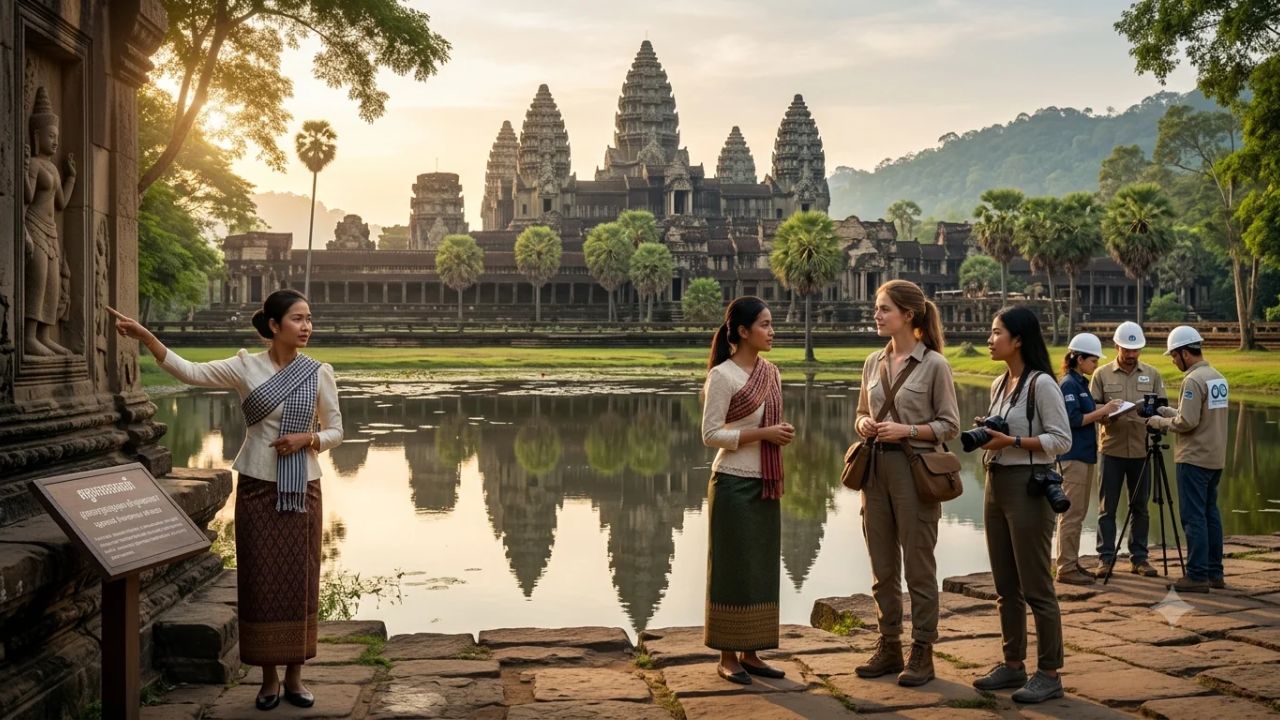
Angkor Archaeological Park (Cambodia)
In Cambodia, the cooperation builds upon a celebrated tradition of Franco-Cambodian scientific collaboration spearheaded by the École française d'Extrême-Orient (EFEO), which has worked for over a century alongside the APSARA National Authority to document and restore the vast Khmer temples.
The renewed initiative focuses on stabilizing porous sandstone blocks at the Baphuon, the Bayon, and Angkor Wat, where tropical monsoons, high humidity, and biological growth threaten intricate carvings.
Beyond structural restoration, the partnership introduces predictive visitor management algorithms. By distributing international tour groups toward secondary temples across the wider 400-square-kilometer archaeological park—such as Banteay Srei, Preah Khan, and Beng Mealea—the program mitigates localized physical wear and tear on central monument staircases while distributing economic revenue to rural village vendors throughout Siem Reap province.
Borobudur Temple Compounds (Central Java, Indonesia)
At Borobudur, the world’s largest 8th-century Mahayana Buddhist monument, the partnership supports Indonesian conservation authorities in managing severe surface weathering. The monument’s andesite stone blocks have suffered from exposure to corrosive volcanic ash eruptions from nearby Mount Merapi, exacerbated by millions of tourist footsteps eroding narrow stone terrace corridors.
Under the cooperation framework, French and Indonesian conservators are evaluating eco-friendly chemical consolidants to protect Borobudur's 2,672 relief panels and 504 Buddha statues.
Additionally, the program integrates with Indonesia's smart visitor ticketing system, which enforces strict daily quotas on travelers ascending the upper stupa platforms. Visitors are provided with traditional woven bamboo footwear (upanat) manufactured by local village artisans in Magelang, reducing abrasive friction on ancient stone floors while providing sustainable income for local craft cooperatives.
The Historic Town of Luang Prabang (Laos)
Positioned at the confluence of the Mekong and Nam Khan rivers, Luang Prabang represents a unique synthesis of traditional Lao timber architecture and 19th-century French colonial urban planning. The town confronts mounting commercial pressures as high-speed rail connectivity along the Laos-China Railway brings unprecedented passenger volumes.
The ASEAN-France initiative supports municipal planners in enforcing heritage zoning laws, preventing the demolition of historic wooden dwellings for modern concrete hotels. The program trains local carpenters in traditional wood-joinery techniques, promotes the sustainable restoration of Buddhist monasteries (wats), and helps local communities establish heritage walking trails that showcase traditional silk weaving, paper-making, and riverine culinary traditions.
Beyond these primary pilot complexes, the AF-DPC framework extends technical conservation assistance to other vulnerable cultural landscapes across Southeast Asia. In Vietnam, French conservation architects are working with authorities in Thừa Thiên Huế and Quảng Nam to protect the brick masonry of the Champa towers at Mỹ Sơn and the historic wooden shophouses of Hội An from recurrent seasonal river flooding.
In Thailand, joint technical teams are assisting the Fine Arts Department in deploying seismic and environmental sensors across the ancient capitals of Ayutthaya and Sukhothai, while in Malaysia, collaborative workshops in Melaka and George Town focus on preserving intangible trading-post heritage and maritime architectural vernaculars. By establishing a shared ASEAN Heritage Disaster Risk Management Protocol, the partnership ensures that ancient monuments across the region are systematically fortified against climate shocks, flash flooding, and tropical storms.
       COMMUNITY-BASED CREATIVE ECONOMY INTEGRATION (HERITAGE SITES)

  Historical Site Restoration  ======>  Local Artisan Cooperatives
  (EFEO / APSARA / Borobudur)           (Bamboo upanat shoes, silk weaving, crafts)
              |                                     |
              v                                     v
  Smart Visitor Dispersion     ======>  Decentralized Rural Spending
  (Secondary temple circuits)           (Homestays, family eateries, riverboat tours)
The Blue and Green Transition: Marine Conservation and Forest Ecosystems
Modern international travelers are demanding verified environmental stewardship from their destinations. Recognizing that Southeast Asia’s primary rainforests, mangrove estuaries, and coral reef ecosystems represent the foundational capital of its leisure economy, the AF-DPC accord embeds tourism development directly into regional environmental protection initiatives.
The Blue Economy and Coral Reef Defense
Southeast Asia forms the heart of the Coral Triangle, a marine expanse harboring more than 75 percent of the world’s known coral species and over 3,000 species of reef fish. However, this marine nursery faces severe threats from rising sea temperatures, coastal sediment runoff, plastic pollution, and destructive Illegal, Unreported, and Unregulated (IUU) fishing practices.
Through the partnership, the French Biodiversity Agency (Office Français de la Biodiversité - OFB) is collaborating with ASEAN marine park administrators across Thailand, Indonesia, the Philippines, and Malaysia. The initiative focuses on deploying eco-mooring buoy networks across popular dive destinations—including the Similan Islands, Raja Ampat, El Nido, and Sipadan—eliminating boat anchor damage on fragile coral heads.
Specialized training missions instruct local coast guard and maritime fisheries officers in satellite vessel monitoring to intercept illegal trawlers operating inside protected marine sanctuaries. Concurrently, dive operators are integrated into citizen-science coral restoration programs, where international leisure divers assist marine biologists in outplanting heat-resilient coral fragments on degraded reefs.
Complementing field interventions, the French Development Agency (Agence Française de Développement - AFD) is coordinating with the Coral Triangle Initiative on Coral Reefs, Fisheries, and Food Security (CTI-CFF) to pilot blue finance instruments. These innovative funding mechanisms allow marine protected areas to issue biodiversity conservation credits purchased by international resort groups and marine eco-tourism operators, establishing a self-sustaining financial stream that underwrites daily patrol vessels, scientific water sampling, and community-led reef surveillance.
           MARINE & ENVIRONMENTAL DEFENSE COOPERATION MATRIX

  Ecological Asset          Threat Category              Joint Strategic Intervention
  -----------------------------------------------------------------------------
  Coral Triangle Reefs      Anchor damage & IUU fishing  Eco-mooring buoys & satellite
  (Raja Ampat / Similans)                                vessel tracking networks

  Tropical Peatland Forests Seasonal wildfire burning    Hydrological canal blocking &
  (Sumatra / Kalimantan)    & transboundary haze         satellite thermal heat mapping

  Resort Island Ecosystems  Single-use plastic waste     Circular municipal recycling &
  (Phuket / Bali / Boracay) & untreated sewage runoff    zero-landfill hotel certifications
Transboundary Peatland Hydrology and Wildfire Prevention
Seasonal wildfire burning in drained tropical peatlands across parts of maritime Southeast Asia has historically generated transboundary smoke haze, blanketing regional skies, creating public health emergencies, and forcing widespread flight cancellations across international hubs like Singapore, Kuala Lumpur, and Bangkok. The economic fallout for regional airlines, hotels, and tour operators has previously reached billions of dollars in lost seasonal revenue.
The ASEAN-France cooperation tackles this environmental challenge through advanced satellite monitoring and peatland hydrological rehabilitation. Drawing upon meteorological telemetry from Météo-France and European Copernicus earth-observation satellites, the program provides ASEAN forestry departments with predictive heat-spot mapping, allowing fire suppression teams to extinguish subterranean peat fires before smoke plumes develop.
Additionally, engineering grants fund the construction of timber canal blocks (sekat kanal) across degraded peatlands in Riau and Central Kalimantan, re-wetting drained swamp soils and permanently reducing wildfire susceptibility.
Circular Economy and Single-Use Plastic Reduction
Across major coastal resort centers such as Phuket, Bali, Boracay, and Phu Quoc, the volume of plastic waste generated by tourism has overwhelmed municipal waste processing facilities, threatening coastal waters and marine life.
The AF-DPC framework promotes circular economy principles, partnering with regional hotel associations to eliminate single-use plastic water bottles, miniature amenity containers, and plastic packaging across the hospitality supply chain. French environmental engineering firms are assisting municipal authorities in establishing advanced recycling facilities and upgrading municipal wastewater treatment plants, ensuring that beachfront resorts meet stringent international water quality certifications.
Travel Security, Transnational Crime Disruption, and Clean Infrastructure
A thriving international tourism ecosystem cannot function without guaranteed traveler safety, transparent digital infrastructure, and physical resilience. The Jakarta discussions directly addressed contemporary transnational security threats that undermine traveler confidence across the Asia-Pacific corridor.
TRANSNATIONAL SECURITY & INFRASTRUCTURE PILLARS
| Column 1 |
|---|
| CRIME DISRUPTION: |
| - Joint Intelligence Sharing Targeting Cross-Border Cyber Fraud Compounds |
| - Protection of Independent Travelers & Digital Nomads from Human Trafficking |
| - Coordinated Law Enforcement Operations via INTERPOL & ASEANAPOL Channels |
| DIGITAL TRUST & SMART CONNECTIVITY: |
| - Encrypted Biometric Aviation Processing at Regional Transit Hubs |
| - Advanced Cybersecurity Standards for Online Tourism Reservation Platforms |
| - Secure Cloud Infrastructure Protecting Traveler Passport & Payment Data |
| CLEAN ENERGY FOR TOURISM MOBILITY: |
| - Integration with the ASEAN Power Grid (APG) to Decarbonize Hospitality |
| - Electrified Ground Transit Corridors Linking Airports to Cultural Sites |
| - Off-Grid Solar & Micro-Hydro Installations for Remote Rainforest Lodges |
Dismantling Cross-Border Digital Scams and Cyber Syndicates
In recent years, the emergence of sophisticated transnational cyber-fraud compounds and human-trafficking syndicates operating in border enclaves has damaged the global security reputation of the region. Independent travelers, remote workers, and job seekers have been targeted by deceptive online recruitment schemes, raising international travel security concerns.
The AF-DPC accord establishes coordinated law enforcement cooperation between French internal security services, INTERPOL, and ASEANAPOL. Joint working groups share operational intelligence, track cross-border illicit cryptocurrency flows, and strengthen border interdiction protocols. By actively dismantling these cyber-criminal syndicates, both partners are restoring safety guarantees for international visitors, backpackers, and digital nomads exploring Southeast Asia.
Digital Trust, Smart Cities, and Biometric Border Transit
To support frictionless, secure travel, France is providing technical assistance in cybersecurity and smart city architecture. The initiative assists ASEAN civil aviation authorities in deploying encrypted passenger data networks and biometric automated border control gates at major international airports, including Jakarta Soekarno-Hatta (CGK), Bangkok Suvarnabhumi (BKK), and Manila Ninoy Aquino (MNL).
These digital upgrades accelerate traveler processing, reduce international arrival queues, and safeguard personal payment information against cyber theft, building confidence among international holidaymakers booking trips online.
The ASEAN Power Grid and Green Tourism Mobility
Decarbonizing the regional travel economy requires transforming energy generation. The partnership actively supports the acceleration of the ASEAN Power Grid (APG), an ambitious multilateral initiative interconnecting national electrical grids across the ten member states to trade clean, renewable energy.
By integrating renewable solar, geothermal, and hydroelectric power into the regional grid, the partnership enables hospitality properties, electric vehicle rental fleets, and electrified rail corridors to operate on zero-emission electricity.
In remote tourism enclaves—such as the Cardamom Mountains in Cambodia or the diving islands of Komodo—the program finances decentralized solar micro-grids and mini-hydro installations, allowing boutique eco-lodges to eliminate noisy, diesel-burning generators in favor of clean solar energy.
Human Capital: Vocational Training and Academic Mobility
The long-term success of sustainable tourism depends on the skills and professional standards of local hospitality workers. Technical and Vocational Education and Training (TVET) forms a central component of the ASEAN-France Practical Cooperation Areas.
Drawing upon France’s prestigious hospitality institutions—including the renowned Institut Lyfe (formerly Institut Paul Bocuse) and the Ferrandi Paris school of culinary arts—the partnership establishes train-the-trainer workshops across Southeast Asian vocational institutes.
Local hospitality instructors receive advanced training in sustainable food waste management, energy-efficient culinary techniques, classical service standards, and eco-certified hotel management. This knowledge transfer elevates service quality across regional family-owned guesthouses, boutique heritage hotels, and ecotourism lodges, ensuring that local workers can attain high-paying managerial positions within the hospitality sector.
       HUMAN CAPITAL & VOCATIONAL EXCELLENCE PATHWAY

  [ French Hospitality Institutions ] ======> [ ASEAN TVET Vocational Centers ]
  (Institut Lyfe / Ferrandi Paris)            (SEAMEO VOCTECH / Regional Academies)
                 |                                          |
                 +-------------------+----------------------+
                                     |
                                     v
                 [ Certified Hospitality Workforce ]
                 - Sustainable culinary techniques & food waste reduction
                 - Heritage site guiding & multilingual customer care
                 - Eco-certified boutique hotel management
Concurrently, academic mobility programs managed by Campus France and the Southeast Asian Ministers of Education Organization (SEAMEO) are expanding bilateral university scholarships and dual-degree programs.
Young Southeast Asian tourism professionals, architectural conservators, and marine biologists are provided with research grants to study at leading French universities, while French students conduct field research across ASEAN biosphere reserves. This educational exchange fosters cultural affinity and builds professional networks that stimulate long-term travel flows between Europe and Southeast Asia.
In tandem, the partnership aligns with the ASEAN Mutual Recognition Arrangement on Tourism Professionals (MRA-TP), an institutional mechanism designed to facilitate the cross-border mobility of certified tourism workers across member states. By integrating French and European certification standards into the MRA-TP framework, the initiative ensures that graduates of ASEAN vocational programs in hotel management, culinary arts, and eco-tour guiding hold recognized credentials.
This enables skilled professionals from countries like the Philippines, Indonesia, and Vietnam to access equitable employment opportunities throughout the regional leisure economy, reducing labor exploitation and creating a resilient foundation of homegrown talent dedicated to sustainable destination stewardship.
Geopolitical Synergy: Harmonizing the AOIP and France’s Indo-Pacific Strategy
Beyond technical tourism metrics, the Sixth AF-DPC Meeting holds substantial geopolitical importance, reflecting the convergence between the ASEAN Outlook on the Indo-Pacific (AOIP) and France’s national Indo-Pacific Strategy.
France occupies a unique position as a resident Indo-Pacific power. With sovereign overseas territories in the Indian Ocean (La Réunion and Mayotte) and the Pacific Ocean (New Caledonia, French Polynesia, and Wallis and Futuna), France maintains 1.6 million French citizens and over 90 percent of its exclusive economic zone (EEZ) across the Indo-Pacific region. Consequently, maritime security, freedom of navigation, and political stability across Southeast Asian sea lanes—particularly through the Strait of Malacca, the Singapore Strait, and the South China Sea—are vital national interests for Paris.
       CONVERGENCE OF REGIONAL INDO-PACIFIC VISIONS

  ASEAN Outlook on the Indo-Pacific (AOIP):
  - Inclusivity, ASEAN Centrality, open maritime cooperation, sustainable connectivity
                         ^
                         |  (Shared Multilateral Principles)
                         v
  France's Indo-Pacific Strategy:
  - Multipolar balance, rules-based international order, environmental transition
The Jakarta accord confirms that sustainable tourism serves as an effective instrument of soft diplomacy, linking civil society, commercial enterprise, and state governance. By supporting ASEAN Centrality and championing inclusive, open multilateralism, France offers Southeast Asian nations an alternative partnership model that balances development needs with cultural sovereignty and environmental preservation.
As Southeast Asia prepares for expanding international visitor arrivals over the coming decade, the comprehensive alliance forged at the Jakarta Secretariat provides a balanced blueprint for destination development.
By uniting French conservation expertise and capital with the cultural richness and natural biodiversity of ASEAN, the partnership ensures that the future of travel across Southeast Asia will be defined by sustainable growth, empowered local communities, and the enduring protection of the historic wonders that inspire travelers worldwide.
Related Travel Guides
- Royal Brunei Airlines Debuts Discover Brunei Platform at WTM London to Turn Stopovers into Stayover Tourism
- Spain Sustainable Tourism Accord: Seville, Benidorm, Calvià, and Lloret de Mar Partner with British Travel Industry
- Paris, Madrid, and London Anchor European City Breaks as Early 2027 Bookings Reveal Shifting Urban Travel
- Europe Solo Travel Rankings 2026: Prague Leads While Zürich Ranks Lowest as Cost and Safety Reshape Journeys
This article is for informational purposes. Flight routes, passenger regulations, visa rules, and transit advisories are subject to change by airlines and aviation authorities. Readers are advised to verify schedules and travel documentation with relevant carriers and border agencies before departure.
Related Stories
Qatar Joins PATA and Doha Named GCC Tourism Capital 2026: Logistics Guide for Asia-Pacific Travelers

US November 2026 Tourism Trends: Festive Festivals and Passenger Rights for Holiday Travel