Direct Dubai to Pokhara Flights Open Nepal's Annapurna Gateway: Complete Travel and Trekking Guide

More than 76 percent of foreign visitors traveling through Nepal's Gandaki Province arrange their journeys entirely on their own, yet until recently, virtually every traveler had to endure a grueling eight-to-ten-hour mountain highway crawl or an unpredictable domestic hop from Kathmandu.
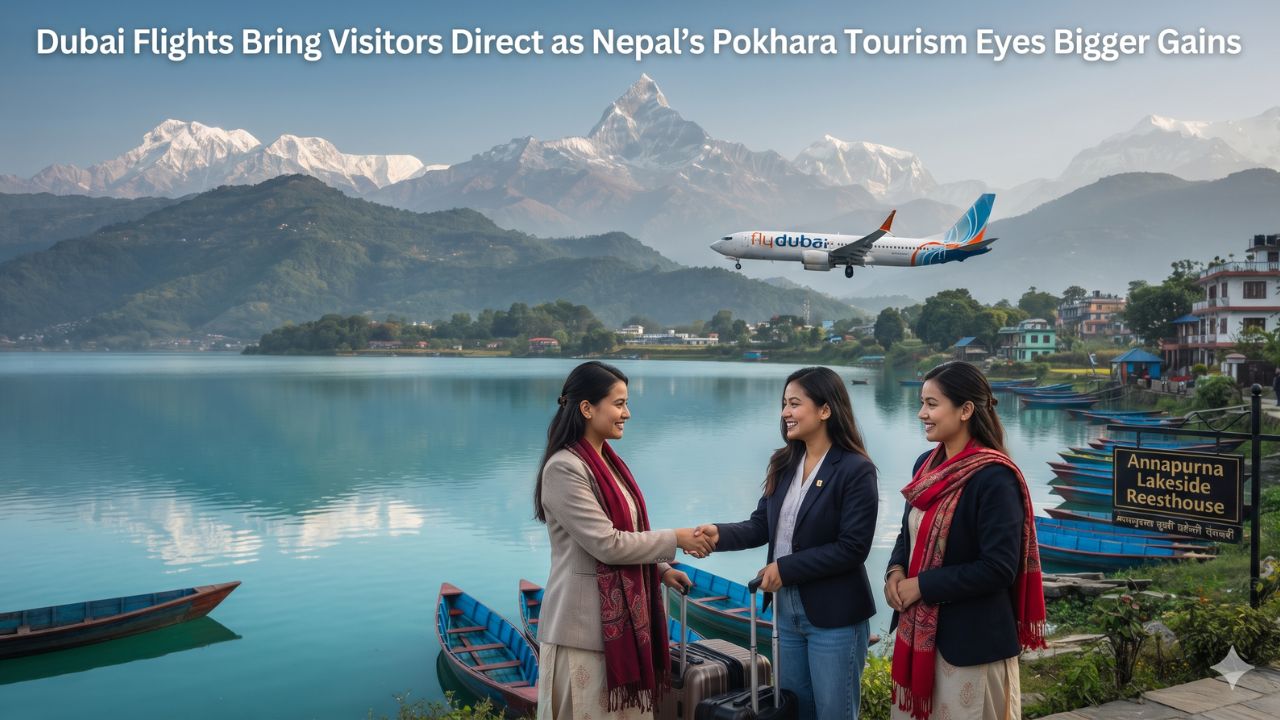
The inauguration of scheduled international services directly into Pokhara International Airport has fundamentally altered the geography of Himalayan expeditions. With low-cost carrier flydubai inaugurating daily scheduled non-stop operations out of Dubai International Airport's Terminal 3, international trekkers and cultural travelers can bypass the congested Kathmandu valley altogether. Stepping off an aircraft onto the tarmac beneath the shadows of Machapuchare and the Annapurna massif brings travelers directly into Nepal's adventure capital, altering arrival logistics, local commerce, and trail access across western Nepal.
The Direct Flight Revolution: Dubai to the Annapurna Foothills
Following carrier operations that commenced on 23 September 2026 and formal route confirmations on 25 September 2026, flydubai introduced daily scheduled flights utilizing a 166-seat Boeing 737 MAX 8 aircraft. According to the Nepal Tourism Board, this nonstop connection links Pokhara with Dubai International's Terminal 3, backed by an Emirates codeshare agreement that enables through-checked baggage and single-ticket global connections across Europe, North America, and the Gulf.
For decades, getting to Phewa Lake or the trailheads of the Annapurna Sanctuary required an international arrival at Tribhuvan International Airport in Kathmandu, followed by transferring terminals for a 25-minute propeller flight across mountain ridges or braving the landslide-prone Prithvi Highway. The direct international corridor bypasses that logistical choke point. Travelers landing at Pokhara International Airport can clear immigration, complete visa formalities, and reach their lakeside guesthouses in less than thirty minutes.
Gandaki Visitor Spending and Economic Realities
While arriving directly cuts travel transit by an entire day, regional authorities and local businesses are watching closely to see how tourism revenue circulates through the valley.
A benchmark study conducted by Nepal Rastra Bank, published on 26 July 2024, examined spending patterns across 400 foreign tourists in six districts of Gandaki Province before direct international flights commenced. After removing 16 statistical outliers, the bank evaluated 384 detailed responses, revealing an average regional stay of 11.92 days and a weighted average daily expenditure of NPR 8,355.29, equivalent to US$62.89 at the study's exchange rate.
| Gandaki Tourism Metric | Nepal Rastra Bank Survey Baseline | Practical Traveler Takeaway |
|---|---|---|
| Independent Travelers | 76% of surveyed foreign visitors | Majority book accommodation and guides independently on arrival |
| Package Tour Travelers | 24% of surveyed foreign visitors | Pre-arranged group itineraries through agency networks |
| Local Agency Share (Packages) | 53.12% booked through Nepali companies | Direct community impact through domestic tour coordinators |
| Foreign Agency Share (Packages) | 46.88% booked through international firms | Portion of holiday expenditure retained outside Nepal |
| Average Length of Stay | 11.92 days in Gandaki Province | Extended stays concentrated in trekking routes and lakeside rest |
| Weighted Average Daily Spend | NPR 8,355.29 (US$62.89) per visitor | Covers lodging, teahouse dining, park fees, and local transport |
Historically, 53.12 percent of packaged travelers booked through Nepali tour operators, while 46.88 percent booked through foreign agencies. With direct flights depositing passengers right into Pokhara, local guides, independent guesthouses, and regional craft cooperatives now have an unprecedented opportunity to capture holiday spending directly rather than operating as subcontractors to agencies based elsewhere.
What Makes Pokhara Different
Pokhara has never felt like Kathmandu. Where the capital is dense, ancient, and relentless, Pokhara is defined by open water, mountain reflections, and subtropical green hills. Sitting at an altitude of just 822 meters, the city provides an astonishing view of peaks exceeding 8,000 meters—most notably Annapurna I and Dhaulagiri—rising dramatically within a linear distance of barely thirty kilometers.
Life centers around Lakeside, where wooden rowing boats called doongas drift across Phewa Lake toward the Tal Barahi Temple set on an island sanctuary. Beyond the waterfront, the town transitions into traditional Gurung and Magar settlements along the hill ridges of Sarangkot and Kahun Danda. The subtropical climate allows travelers to sip freshly harvested Himalayan Arabica coffee grown in surrounding micro-plantations while watching paragliders descend from Sarangkot against the backdrop of snow-capped granite spires.
Visitor Insider Tips
- Immigration and Visa Clearance: The Nepal Tourism Board confirms that eligible foreign passport holders can obtain an official tourist visa on arrival directly at Pokhara International Airport. Bring cash in pristine US dollars to settle visa charges quickly.
- Trekking Documentation Rules: Flying direct does not exempt you from mandatory trekking regulations. Treks into the Annapurna Conservation Area, including the Annapurna Circuit and Mardi Himal, legally require a government-licensed mountain guide and an agency-issued Trekkers' Information Management System (TIMS) card arranged through a registered agency.
- Where to Base Yourself: Stay in northern Lakeside (Khahare area) rather than the bustling southern strip. Khahare offers quiet boutique lodges, views across the quietest stretch of Phewa Lake, and direct access to hiking paths leading up to Methlang.
- Culinary Specialties: Skip Western café menus for dinner and seek out small Thakali kitchens along the side alleys of Lakeside. A traditional Thakali thali features slow-cooked black lentils (jimbu-tempered daal), buckwheat flatbreads, and dried fermented mustard greens (gundruk), recipes developed by trade caravanners along the Kali Gandaki gorge.
- Timing and Microclimates: The clearer mountain views occur between 06:00 and 09:30. By midday, thermal updrafts create cloud cover around the peaks. Wake up early for lakeside strolls or ridge viewpoints.
Cultural and Environmental Context
The arrival of scheduled international wide-body and narrow-body flights into Pokhara brings complex environmental and civic responsibilities. The city sits adjacent to the fragile Phewa watershed and under the flight path of migratory raptors navigating the Himalayan foothills. Rapid urban expansion along the lakeside has strained waste disposal systems and lowered water quality in the southern wetlands.
Culturally, Pokhara functions as the historic gateway for mountain ethnic groups whose livelihoods depend heavily on mountain trail porterage and guiding. The requirement for licensed local guides on routes like Mardi Himal and the Annapurna Circuit ensures that safety standards remain rigorous while preserving vital income streams for indigenous trail communities. When travelers book licensed guides directly from registered agencies in Pokhara rather than booking all-inclusive packages abroad, a much larger portion of every dollar directly funds children's schooling, medical clinics, and teahouse maintenance throughout the high alpine valleys.
FAQ: Visiting Pokhara 2026
Can I fly directly from Dubai to Pokhara without stopping in Kathmandu?
Yes. flydubai operates daily scheduled non-stop flights between Dubai International Airport's Terminal 3 and Pokhara International Airport aboard Boeing 737 MAX 8 aircraft.
Can international visitors obtain a Nepal visa on arrival in Pokhara?
Yes. Eligible foreign visitors can complete entry formalities and obtain a tourist visa on arrival at Pokhara International Airport.
Do I still need a trekking permit and guide when arriving directly?
Yes. Nepal Tourism Board regulations require all foreign trekkers on specified routes like Annapurna Circuit and Mardi Himal to hire a licensed guide and obtain a valid TIMS card.
How much do travelers typically spend per day in the Pokhara region?
Nepal Rastra Bank's comprehensive Gandaki survey found travelers spent a weighted average of NPR 8,355.29 (approximately US$62.89) per day across an average 11.92-day stay.
Related Travel Guides
- Vietnam Airlines Launches Delhi and Bengaluru Nonstop Flights to Hanoi
- Cozumel and Milan Nonstop Flights and Western Caribbean Travel Guide
- Air Arabia Direct Dammam to Damascus Routes and Ancient Syria Guide
By stepping off the jetway directly beneath the Annapurnas and spending with local operators, travelers can discover the Himalaya with fewer transit delays and greater local benefit.
This article is for informational purposes. Flight routes, passenger regulations, visa rules, and transit advisories are subject to change by airlines and aviation authorities. Readers are advised to verify schedules and travel documentation with relevant carriers and border agencies before departure.
Related Stories
Nepal's Pokhara Seeks Tourism Breakthrough: Overcoming Highway Bottlenecks, Airport Debt, and Operating Cost Pressures
Poland to Hungary Winter Flight Guide 2026: Cheap Routes, Festive Markets, and Central European Travel