
Flight Operations Disrupted Across Japan as Airlines Suspend Services Amid Powerful Twin Typhoons Threatening Okinawa, Kyushu and Major Airport Networks With Severe Weather Impact
Twin typhoons trigger 100+ flight cancellations in Japan. Severe disruptions hit Okinawa and Kyushu airports as ANA and

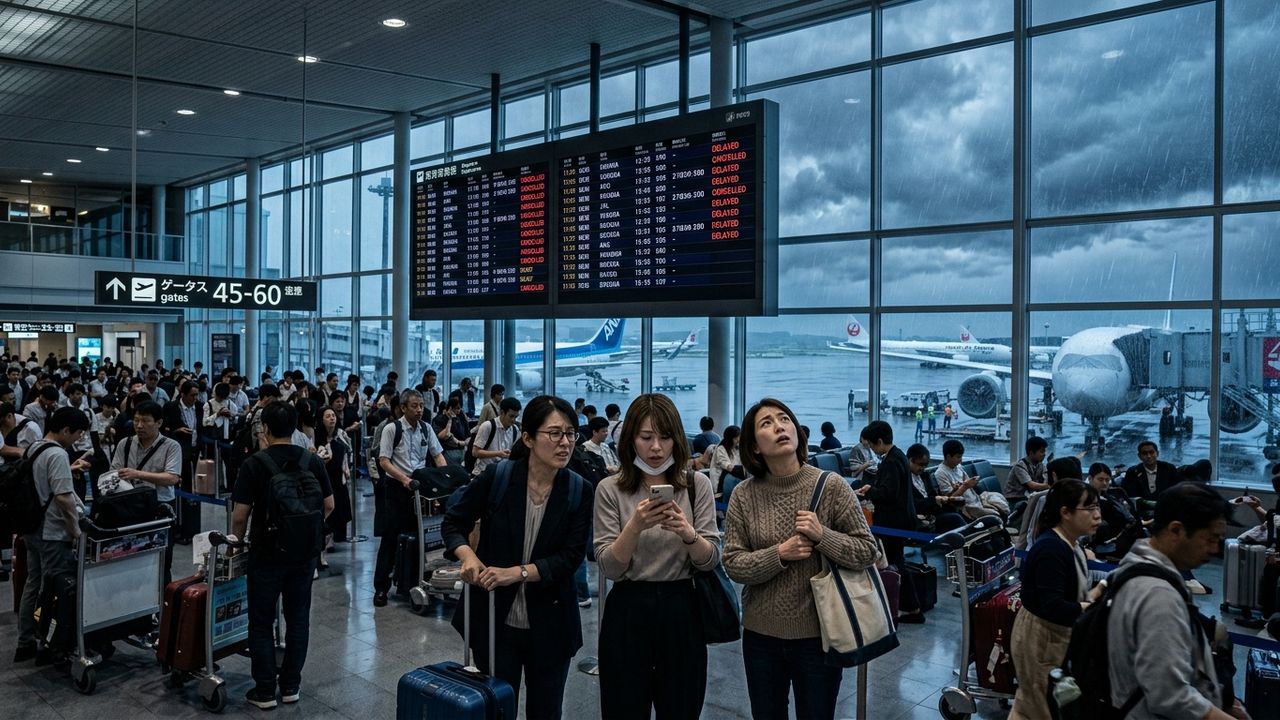
Image generated by AI
[Tokyo, June 26, 2026] — Japan’s aviation infrastructure is facing severe operational strain as airlines have cancelled more than 100 flights to mitigate the risks posed by two powerful tropical storm systems. The twin weather events are currently targeting the southern regions of the country, creating hazardous conditions across Okinawa, Kyushu, and several critical airport networks.
Meteorological Crisis Triggers Aviation Shutdowns
The Japan Meteorological Agency (JMA) has confirmed that the convergence of two active tropical systems is generating intense rainfall bands, violent wind gusts, and significant atmospheric instability. This atmospheric volatility is most acute across the Ryukyu Islands, where the combination of the two storms has elevated operational risks to a level that necessitates immediate flight suspensions.
In response to these warnings, major Japanese carriers, including All Nippon Airways (ANA) and Japan Airlines, have implemented precautionary schedule reductions. Flight tracking data and official updates indicate that dozens of domestic routes connecting the primary hubs of Tokyo Haneda and Osaka Kansai to southern destinations like Kagoshima and Okinawa have been scrubbed from the schedule.
Industry observers note that these decisions are governed by strict safety protocols. When wind shear, extreme turbulence, and storm cells exceed established safety thresholds, airlines are mandated to suspend operations to ensure the safety of passengers and crew.
Okinawa and Kyushu Airports Face Severe Operational Hazards
The Okinawa archipelago has become the epicenter of the current aviation crisis. Multiple airfields in the region are reporting intermittent shutdowns as visibility drops and runway hazards increase due to the storm's intensity. Specifically, airports in Naha, Kagoshima, and Miyazaki have seen repeated cancellations as the weather deteriorates.
The southern aviation corridor of Kyushu is similarly compromised. Regional airlines are currently grounding aircraft or attempting to reroute flights based on the latest trajectory data provided by meteorological services. Ground handling operations—including baggage loading and refueling—have slowed dramatically, as high wind gusts make it unsafe for personnel to work on the tarmac.
Local government authorities have issued urgent travel advisories, pleading with the public to avoid all non-essential travel to the southern islands. Because these regions rely heavily on a limited combination of air and ferry connectivity, the weather-driven shutdown has effectively isolated several communities.
Japan Meteorological Agency Warns of Escalating Weather Risks
The JMA continues to issue high-level alerts for southern Japan, warning of a high probability of landslides, flash flooding, and coastal storm surges. Current weather modeling suggests that the rainfall bands feeding the Ryukyu Islands may intensify as the storm systems move closer to the Japanese mainland.
A significant challenge for aviation planners is the unpredictable nature of these twin systems; officials have warned that sudden shifts in storm direction could create new "no-fly" zones on short notice. This uncertainty has forced airlines to move beyond simple delays, opting instead for pre-emptive cancellations to prevent aircraft from becoming stranded at outstations.
The impact is extending beyond the skies. Rail operators and highway authorities have entered a state of precautionary monitoring, anticipating that the storm's landfall will disrupt ground transportation networks across the southern prefectures.
Emergency Rebooking and Passenger Management Protocols
To manage the fallout, All Nippon Airways and Japan Airlines have activated emergency response protocols. These measures include the provision of flexible rebooking options, full refunds for affected passengers, and the search for alternative routing where safety permits.
Operational control centers are currently in constant communication with airport authorities, updating flight manifests on an hourly basis. To avoid the "displacement" of aircraft—where planes are stuck in the wrong city for subsequent scheduled flights—many carriers have cancelled flights departing from Tokyo Haneda and Osaka Kansai before the planes even leave the hub.
This mass disruption has led to significant passenger congestion at Japan's largest airports. The timing is particularly challenging, as the storms coincide with peak summer travel demand, putting immense pressure on customer service desks and digital rebooking platforms.
Regional Connectivity Risks Across Asia-Pacific
The atmospheric disturbance is creating ripple effects that extend beyond Japan's borders. Regional connectivity across the Asia-Pacific corridor is experiencing instability, particularly for international routes linking Japan with Hong Kong, Taiwan, and South Korea.
Industry analysts point out that Japan’s aviation resilience is frequently tested during the summer months. The convergence or stalling of multiple typhoon systems over coastal waters often leads to hundreds of cancellations. The current situation highlights a recurring vulnerability in island-based airport networks, where the lack of alternative transport makes air travel an absolute necessity.
Summary of Affected Regions and Hubs
| Affected Region | Key Airports Impacted | Primary Weather Threats | Operational Status |
|---|---|---|---|
| Okinawa | Naha Airport | Low visibility, storm cells | Intermittent Shutdowns |
| Kyushu | Kagoshima, Miyazaki | High wind gusts, heavy rain | Severe Reductions |
| Kanto/Kansai | Tokyo Haneda, Osaka Kansai | Displacement risks | Pre-emptive Cancellations |
| Ryukyu Islands | Regional Airstrips | Flooding, unstable pressure | High Risk / Suspended |
Critical Travel Guidance for Passengers
Travelers are urged to maintain a constant watch over airline notifications and avoid traveling to the southern regions unless the journey is critical. Passengers should expect rolling delays, frequent gate changes, and short-notice cancellations at airports throughout Kyushu and Okinawa.
Aviation officials have confirmed that all operational decisions will remain dynamic, shifting in real-time as the storms' intensity and trajectory evolve. The strongest recommendation for travelers is to verify flight status immediately prior to departing for the airport and to utilize flexible ticketing options.
The current crisis underscores the inherent risks associated with Pacific tropical cyclone activity. With two storm systems currently influencing the southern air corridors, the priority for the aviation industry has shifted entirely toward safety and risk mitigation over schedule adherence. As the systems move north, further widespread disruptions across the Japanese archipelago remain highly probable.
Related Travel Guides
Disclaimer
This article is for informational and educational purposes only. It does not constitute legal, financial, or professional advice. While we strive to provide accurate and up-to-date information, travel policies, regulations, and conditions change rapidly. Always verify information with official sources before making travel decisions. Nomad Lawyer makes no representations about the accuracy, reliability, completeness, or suitability of the information provided. Readers should consult qualified professionals for advice specific to their circumstances. The views expressed in this article are those of the author and do not necessarily reflect the views of Nomad Lawyer.
Raushan Kumar
Founder & Lead Developer
Full-stack developer with 11+ years of experience and a passionate traveller. Raushan built Nomad Lawyer from the ground up with a vision to create the best travel and law experience on the web.
Learn more about our team →