
Finnish Lapland Accelerates Luxury Winter Expansion as UK and European Airlift Expands for 2026–27
Finnish Lapland captures 71% of Nordic Arctic stays as direct flights from the UK, Germany, France, and Spain fuel new glass igloos, sky villas, and wilderness retreats for winter 2026–27.

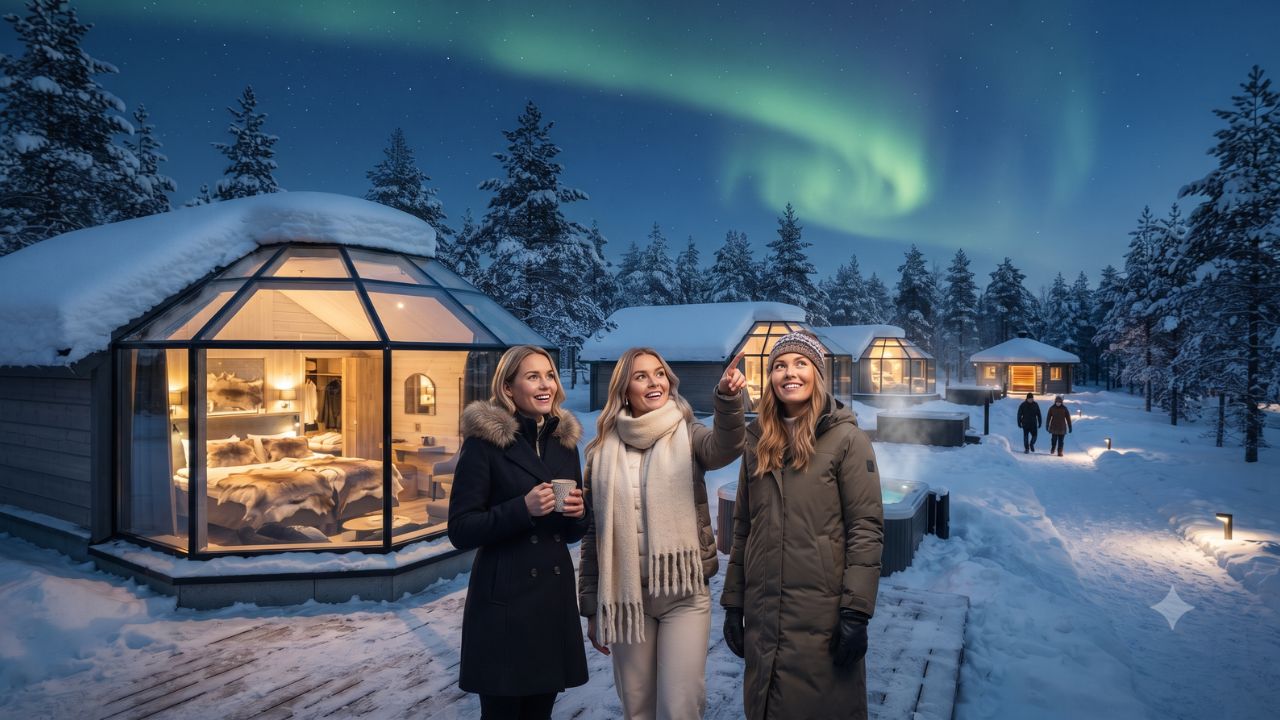
Capturing 71% of all foreign overnight stays across Nordic Lapland and generating 1.5 million international bed-nights during the winter 2025–26 baseline, Finnish Lapland is accelerating its transition into an ultra-premium Arctic retreat for the 2026–27 season. Official figures from Visit Finland confirm that foreign visitors generated 2.4 million registered overnight stays nationwide between December 2025 and February 2026, marking a 6% annual expansion. With Lapland absorbing approximately 60% of that total, regional developers and European airlines are aligning capacity to capture high-spending travelers from the United Kingdom, Germany, France, and Spain.
The upcoming winter cycle marks a strategic departure from short, mass-market family excursions centered strictly around Santa Claus Village in Rovaniemi. Instead, the northern territory is introducing architecturally striking glass igloos, private wellness compounds, panoramic sky villas, and invitation-only wilderness lodges across Muonio, Raattama, Lake Miekojärvi, and Enontekiö. Supported by point-to-point airline links that bypass Helsinki-Vantaa Airport, this development pipeline is reshaping the logistics and pricing dynamics of European Arctic vacations.
Premium Accommodation Diversification Across the Finnish Arctic
The 2026–27 accommodation pipeline addresses rising international demand for seclusion, aurora viewing, and authentic Finnish wellness traditions. In Rovaniemi, Santa's Hotel Noelle adds high-end central inventory, while the Halo Riverside Resort introduces 39 panoramic glass igloos equipped with private hot tubs and wellness suites. Simultaneously, Aava Glass Igloos combines automated Northern Lights alert systems with family-sized living spaces near Vikäköngäs and Ollerovaara Hill, blending modern construction with dark-sky preservation.
Beyond the regional capital, developers are establishing boutique outposts deeper in the Arctic wilderness. In Muonio, Arcora Boutique Hotel & Villas provides tailored wellness facilities with immediate access to Pallas-Yllästunturi National Park. In Raattama, Kelo Sky Villas offers private fellside retreats centered on regional Lappish gastronomy, giving travelers an alternative to busy municipal centers. Near the Swedish border, North Resort at Lake Miekojärvi introduces an all-inclusive wilderness retreat focused on guided ice-fishing and snow safaris, while Enontekiö welcomes Octola III, an ultra-exclusive, invitation-only estate designed for ultra-high-net-worth travelers demanding absolute privacy.
| Destination & Property | Development Concept | Key Facilities & Tourism Focus | Regional Accessibility |
|---|---|---|---|
| Rovaniemi: Halo Riverside Resort | 39 glass igloos | Panoramic heated glass roofs, private outdoor wellness, aurora alerts | Direct access via Rovaniemi Airport (RVN) |
| Rovaniemi: Aava Glass Igloos | Family glass chalets | Private saunas, skyward views, automated geomagnetic aurora monitors | Vikäköngäs & Ollerovaara Hill dark-sky corridors |
| Rovaniemi: Santa's Hotel Noelle | City-center luxury hotel | Urban luxury suites, direct access to festive culinary venues | Central Rovaniemi commercial district |
| Muonio: Arcora Boutique Hotel | Boutique hotel & villas | Spa wellness programs, guided snowshoeing, national park access | Serviced primarily via Kittilä Airport (KTT) |
| Raattama: Kelo Sky Villas | Architectural fell villas | Panoramic timber architecture, Arctic dining, secluded wilderness | Western Lapland fell district via Kittilä |
| Lake Miekojärvi: North Resort | All-inclusive wilderness lodge | Lakeside accommodation, private snowmobile expeditions, ice fishing | Remote western border corridor |
| Enontekiö: Octola III | Ultra-luxury private estate | Invitation-only Arctic chalets, bespoke private chef services | Extreme northwestern Lapland via Kittilä/Ivalo |
These properties reflect a structural shift within Finnish hospitality. Instead of relying on mass dining halls and standardized coach tours, newly opened resorts emphasize hyper-localized culinary sourcing, private electric-snowmobile excursions, and wood-fired saunas. This allows operators to command premium room rates while extending visitor lengths of stay beyond traditional 72-hour weekend breaks.
Inbound European Demand and Regional Aviation Expansion
The growth in premium lodging is directly supported by expanding point-to-point air services. Airport operator Finavia reported that Lapland's regional airports will host dozens of international routes during the peak 2026–27 winter season. Rovaniemi leads the network with 37 scheduled routes, connecting to up to 36 direct international airports during peak holiday weeks. Kittilä features 15 routes, Kuusamo operates nine, Ivalo manages eight, and Kemi-Tornio maintains two, giving travelers direct access to distinct sub-regions.
Source-market metrics underline the strength of European demand. The United Kingdom represents Finland's largest inbound winter market, generating over 404,000 overnight stays nationwide during the 2025–26 baseline. For the 2026–27 season, easyJet is launching direct flights to Rovaniemi from Newcastle on 25 November 2026, alongside new Kittilä connections from London Luton on 24 November and Liverpool on 25 November. BA Euroflyer will introduce London Gatwick–Rovaniemi service on 4 December 2026, supplementing existing Manchester routes operated by easyJet and Ryanair.
Germany and France each contributed more than 200,000 overnight stays nationwide during the prior winter, and both markets are adding capacity. Lufthansa introduces a direct Munich–Rovaniemi service on 4 December 2026, complementing its Frankfurt connections and flights to Kittilä, while Eurowings operates routes from Berlin and Düsseldorf to Rovaniemi and Ivalo. French travelers gain direct connections from Paris Charles de Gaulle via Air France and easyJet, Paris Orly via Transavia and Vueling, Paris Beauvais via Ryanair, and Lyon via easyJet. Spain is also expanding Arctic accessibility, with direct winter flights to Rovaniemi operated by Norwegian and Vueling from Barcelona, and Iberia from Madrid.
Expert Analysis: The High-Yield Logistics and Operational Realities of Arctic Luxury Travel
For travelers booking Arctic luxury retreats, the direct consequence of decentralized airport capacity is the need for careful transit planning. While Rovaniemi functions as the commercial gateway for central Lapland, booking secluded villas in Muonio or Enontekiö requires arriving via Kittilä or Ivalo to avoid multi-hour road transfers across snow-covered highways during polar night conditions. When international travelers land during severe blizzards, ground transport connections between airports and wilderness resorts can face delays, making coordinated private lodge transfers essential.
The pricing pressure this creates means that early booking windows have compressed. Because bespoke properties like Octola III, Kelo Sky Villas, and North Resort operate with minimal room counts to preserve exclusivity, inventory for peak aurora viewing months between December and February sells out months in advance. With nightly room tariffs at top-tier glass igloo resorts routinely exceeding €1,000, travelers must evaluate the inclusions of their booking packages, particularly whether private sauna sessions, specialized thermal outerwear, and guided excursions are bundled into the base rate.
Furthermore, guidance from the Ministry of Economic Affairs and Employment of Finland highlights the delicate balance between rapid tourism expansion and environmental preservation. Operating heated glass structures in sub-zero Arctic climates demands substantial energy consumption, prompting forward-thinking operators to invest in geothermal heating and local wood-pellet systems. Travelers seeking authentic Arctic immersion increasingly favor properties that respect indigenous Sámi cultural heritage and minimize light pollution, ensuring that the natural wilderness remains protected.
Key Takeaways
- Finnish Lapland accounted for 1.5 million foreign overnight stays during winter 2025–26, capturing 71% of all international visitor stays across Nordic Lapland.
- Visit Finland registered 2.4 million foreign stays nationwide (+6% YoY), driven by the UK (>404,000 stays), Germany (>200,000 stays), and France (>200,000 stays).
- Finavia's winter 2026–27 schedule features 37 routes at Rovaniemi, 15 at Kittilä, nine at Kuusamo, and eight at Ivalo.
- New airline routes include Lufthansa from Munich, BA Euroflyer from Gatwick, and easyJet from Newcastle, Luton, and Liverpool.
- New boutique properties such as Halo Riverside Resort, Arcora, Kelo Sky Villas, and Octola III expand luxury wellness and aurora viewing options.
FAQ: Finnish Lapland Luxury Winter Tourism 2026–27
How many direct international flights serve Finnish Lapland in winter 2026–27?
Finavia airports host extensive European connections, with Rovaniemi connecting to 37 routes and up to 36 direct international destinations during peak weeks, alongside 15 routes at Kittilä and eight at Ivalo.
Which European nations generate the highest winter visitor volumes in Lapland?
The United Kingdom leads international inbound demand with over 404,000 overnight stays, followed closely by Germany and France with over 200,000 stays each.
What is the best airport to fly into for secluded luxury resorts in Lapland?
While Rovaniemi serves central attractions and festive tours, Kittilä is the preferred airport for western wilderness resorts in Muonio and Raattama, while Ivalo serves northeastern retreats.
What unique features do new 2026–27 Lapland glass igloos offer?
New properties like Halo Riverside Resort and Aava Glass Igloos integrate heated panoramic glass roofs, private outdoor wellness spas, Finnish saunas, and automated aurora alert systems.
By pairing targeted direct European flights with high-end architectural retreats, Finnish Lapland is setting a new global standard for sustainable Arctic luxury.
Related Travel Guides
Disclaimer
This article is for informational and educational purposes only. It does not constitute legal, financial, or professional advice. While we strive to provide accurate and up-to-date information, travel policies, regulations, and conditions change rapidly. Always verify information with official sources before making travel decisions. Nomad Lawyer makes no representations about the accuracy, reliability, completeness, or suitability of the information provided. Readers should consult qualified professionals for advice specific to their circumstances. The views expressed in this article are those of the author and do not necessarily reflect the views of Nomad Lawyer.
Naina Thakur
Contributor & Travel Specialist
Travel enthusiast and legal writer covering visa regulations, responsible tourism, and cultural journeys across global destinations.
Learn more about our team →