
Fall Travel Escape: Southwest Michigan Gains Attention Through Niles Scream Park Return
Niles Scream Park celebrates over fifty years of operations across 44 acres, driving millions in charitable impact and anchoring Southwest Michigan's autumn travel economy.

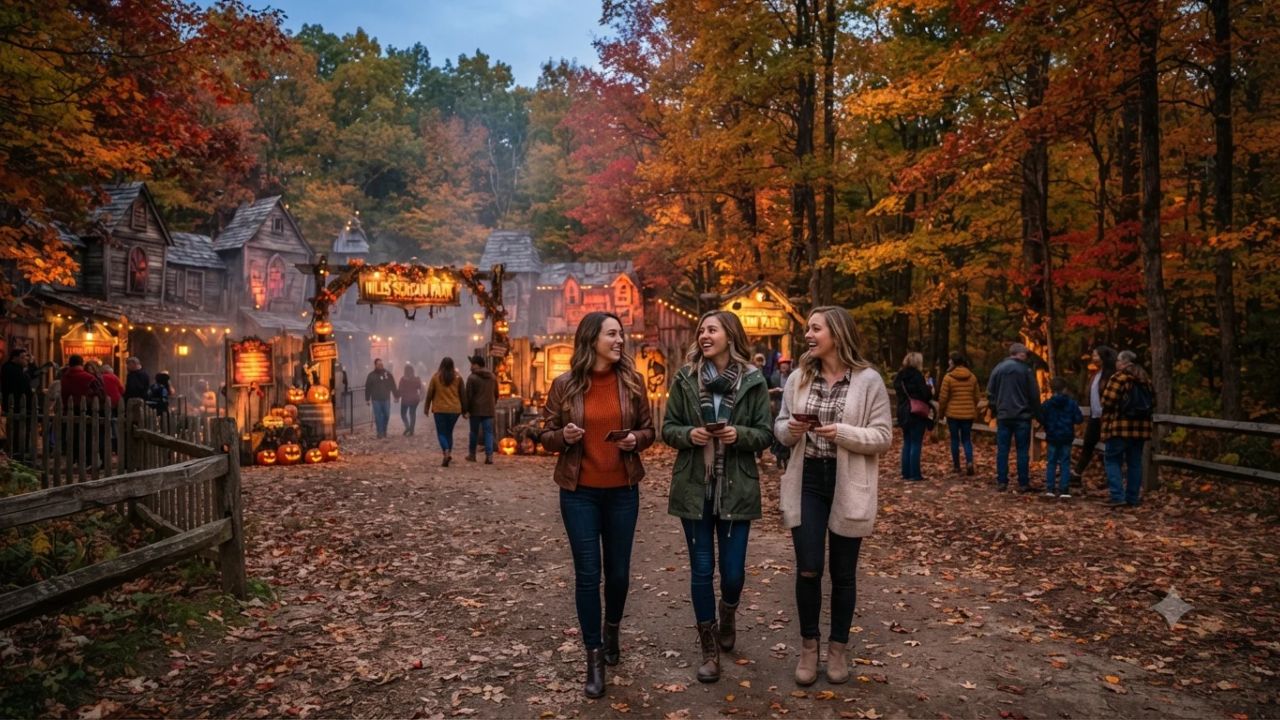
Image generated by AI
$2.8 million in total donations since 1996 marks the financial footprint of Niles Scream Park, a figure that transforms a seasonal haunt into a critical economic engine for the Michiana region. This level of philanthropic output indicates that the attraction is not merely a commercial enterprise but a sophisticated community-funding mechanism. By leveraging the growing trend of "experience tourism," the park has scaled its operations across 44 acres to capture a specific segment of the autumn travel market that prioritizes social impact alongside entertainment.
The Five-Decade Evolution of Michiana's Halloween Tourism Economy
The enduring success of the Niles attraction stems from an operational structure that stands apart from standard commercial amusement parks. While corporate haunted houses rely heavily on paid seasonal labor and centralized equity models, Niles Scream Park operates as a community-driven nonprofit venture. Each autumn, hundreds of dedicated local volunteers construct, manage, and perform across the sprawling 44-acre property. In exchange for their operational support, the organization distributes funds directly to the civic entities, school booster programs, and charities represented by those volunteer teams.
This civic-minded architecture creates deep local pride and operational durability. Having operated continuously for more than fifty years, the park has built multi-generational brand loyalty that draws repeat visitors from across Michigan, Indiana, Illinois, and Ohio. This sustained attendance has established the attraction as an anchor tenant of the Michiana tourism calendar, working in close harmony with state promotional initiatives led by the Michigan Economic Development Corporation / Pure Michigan to disperse traveler spending away from congested metropolitan centers and into rural agricultural districts.
The seasonal draw is reinforced by Southwest Michigan’s complementary autumn attractions:
- Viticulture and craft brewing trails, where historic wine estates in Buchanan and Berrien County showcase local harvest tastings alongside scenic country drives.
- Nature and orchard agritourism, providing apple picking, pumpkin patches, and cider mills that draw daytime family crowds prior to evening haunted tours.
- Cultural exploration in neighboring urban centers, linking the rural charm of Niles directly to museum circuits, dining, and collegiate events in South Bend, Indiana.
- Outdoor recreation along Lake Michigan coastal corridors, where dunes, state parks, and wooded nature preserves display vibrant fall foliage transitions.
Quantitative Assessment: Philanthropic Flow and Regional Tourism Multipliers
To understand how a seasonal haunted attraction sustains a regional hospitality network, economists analyze the financial distributions and visitor foot traffic generated by the complex.
| Operational & Economic Dimension | Reported Performance Metric | Regional Mechanism & Distribution | Primary Tourism Beneficiary |
|---|---|---|---|
| Cumulative Philanthropy | $2,800,000+ Distributed (Since 1996) | Direct grants, high school scholarships, civic projects | Regional educational and charitable infrastructure |
| 2025 Charitable Volume | $153,300+ Generated in Single Season | Allocated across 70+ distinct community organizations | Youth sports, civic clubs, emergency services |
| Operational Landmass | 44 Contiguous Acres | Multi-maze outdoor footprint and parking distribution | Local agricultural land preservation |
| Institutional Longevity | 50+ Consecutive Years of Operation | Half-century of multi-generational repeat travel | Regional brand recognition and autumn loyalty |
| Workforce Model | Hundreds of Seasonal Volunteers | Sweat-equity revenue sharing with volunteer-backed charities | Michiana civic groups and nonprofit programs |
The 44-Acre Complex and Themed Storytelling
The physical scale of the park dictates its visitor appeal. Spanning 44 acres of wooded terrain, the facility avoids the cramped confines of traditional urban haunted houses by dispersing attendees across multiple outdoor environments, multi-story mazes, and darkened forest paths. Each year, creative directors completely redesign the interior layouts, storylines, and special effects across its flagship haunted houses, ensuring that even veteran attendees experience entirely fresh scares. This annual architectural transformation drives consistent repeat visitation, pulling travel parties back to Berrien County on an annual schedule.
Southwest Michigan Agritourism Synergy
For visiting travelers, the scream park rarely serves as a standalone destination. Instead, tourists incorporate the evening attraction into broader weekend itineraries exploring the rolling hills of Berrien County. In nearby Buchanan, visitors explore award-winning regional wineries and craft cideries that process locally harvested grapes and apples. During daylight hours, families navigate scenic backroads flanked by fiery maple and oak trees, frequenting farm stands, antique stores, and historic downtown districts. This agricultural synergy ensures that tourism expenditures circulate broadly throughout local restaurants, bed-and-breakfasts, and independent retail storefronts.
Cross-Border Intercity Spillover
The park's location along the Michigan-Indiana border creates powerful interstate transit advantages. Situated just twenty minutes north of South Bend, Indiana, the attraction capitalizes on the massive sports, conference, and university traffic moving through the collegiate hub. Visitors traveling to regional football games or academic conferences routinely extend their stays into Southwest Michigan, utilizing hotels and dining establishments on both sides of the state line. Coordinated marketing through regional partners like Visit South Bend Mishawaka demonstrates how municipal borders blur when compelling entertainment hubs anchor regional leisure itineraries.
Expert Analysis: The Economics of Niche Agritourism and Seasonal Anchors
For travelers booking this route, the direct consequence of Michiana's concentrated Halloween draw is a noticeable compression of regional lodging capacity and weekend highway volume throughout October. Unlike metropolitan destinations with thousands of surplus hotel rooms, Berrien County and northern St. Joseph County possess finite boutique hotel, bed-and-breakfast, and short-term rental inventories. When peak autumn foliage coincides with weekend operations at the 44-acre Niles Scream Park, nightly lodging rates across Niles, Buchanan, and South Bend escalate rapidly, requiring travelers to secure reservations weeks in advance.
The pricing pressure this creates means that regional hospitality operators experience high-margin yield management during what was traditionally considered an off-peak shoulder period. Rather than dropping rates following the summer Lake Michigan beach rush, local hoteliers maintain robust average daily rates through late October. In parallel, independent service businesses—including gas stations along the US-31 and US-12 corridors, casual dining establishments, and rural farm markets—capture high-density discretionary spending that sustains cash flows into the quiet winter season.
From an operational perspective, the volunteer-based structure represents an ingenious hedge against the labor shortages currently plaguing the broader leisure and hospitality industry. By aligning corporate performance with charitable payouts to 70 distinct civic groups, the park maintains an enthusiastic, reliable volunteer workforce numbering in the hundreds. This community buy-in guarantees operational consistency that purely commercial operations struggle to maintain, insulating the attraction from rising wage pressures and operational instability.
In parallel, the success of the Niles model underscores a growing consumer preference for travel experiences that carry clear ethical and social value. Modern travelers are increasingly conscious of their tourism footprint, showing measurable willingness to support ventures where ticket revenues enrich the host community rather than corporate balance sheets. By generating over $153,300 for local charities in 2025 and crossing $2.8 million in lifetime contributions, Niles Scream Park proves that experiential leisure and civic philanthropy can merge into a sustainable, highly lucrative regional tourism model.
Key Takeaways
- Niles Scream Park generated over $153,300 for more than 70 regional community groups in 2025, lifting its cumulative charitable contributions beyond $2.8 million since 1996.
- Operating continuously for over fifty years across a 44-acre property, the volunteer-powered attraction anchors Southwest Michigan's lucrative autumn travel economy.
- Visitors routinely combine the evening haunted attraction with daytime wine tastings in Buchanan, farm-to-table apple orchards, and fall foliage drives throughout Berrien County.
- Cross-border proximity to South Bend, Indiana, drives significant multi-state visitor flows, boosting hotel occupancy and dining receipts across the Michiana corridor.
- October travelers must book regional accommodations well in advance due to lodging compression caused by the convergence of peak fall foliage, collegiate events, and Halloween tourism.
FAQ: Southwest Michigan Halloween Travel 2026
How large is Niles Scream Park and how long has it operated? Niles Scream Park covers 44 outdoor acres in Southwest Michigan and has operated continuously for more than fifty years, making it one of the oldest and largest haunted attractions in the United States.
How does ticket purchasing support the local Michigan community? The park operates as a nonprofit project staffed by hundreds of community volunteers. In 2025 alone, it raised over $153,300 for 70 local charities, schools, and civic groups, with total donations exceeding $2.8 million since 1996.
What daytime activities complement an evening visit to the park? Visitors can explore boutique wineries and craft cideries in Buchanan, pick fresh fruit at Berrien County orchards, take scenic drives to view autumn foliage, or visit cultural museums and historic landmarks in nearby South Bend, Indiana.
When is the best time to plan an autumn trip to the Michiana region? The optimal travel window spans the entire month of October. This period coincides with peak fall color transitions, operational hours at Niles Scream Park, and seasonal harvest festivals throughout Southwest Michigan.
In the quiet woods of Southwest Michigan, turning fear into philanthropy proves that a great journey leaves the host community stronger than it was before.
Related Travel Guides
Disclaimer
This article is for informational and educational purposes only. It does not constitute legal, financial, or professional advice. While we strive to provide accurate and up-to-date information, travel policies, regulations, and conditions change rapidly. Always verify information with official sources before making travel decisions. Nomad Lawyer makes no representations about the accuracy, reliability, completeness, or suitability of the information provided. Readers should consult qualified professionals for advice specific to their circumstances. The views expressed in this article are those of the author and do not necessarily reflect the views of Nomad Lawyer.
Kunal K Choudhary
Co-Founder & Contributor
A passionate traveller and tech enthusiast. Kunal contributes to the vision and growth of Nomad Lawyer, bringing fresh perspectives and driving the community forward.
Learn more about our team →