
FAA Ground Stop at Newark Liberty Airport Triggers 140 Cancellations Amid Severe Storms 2026
Severe thunderstorms in the New York City region forced an FAA ground stop at Newark Liberty International Airport, resulting in 140 cancellations and over 500 delays on August 27, 2026.

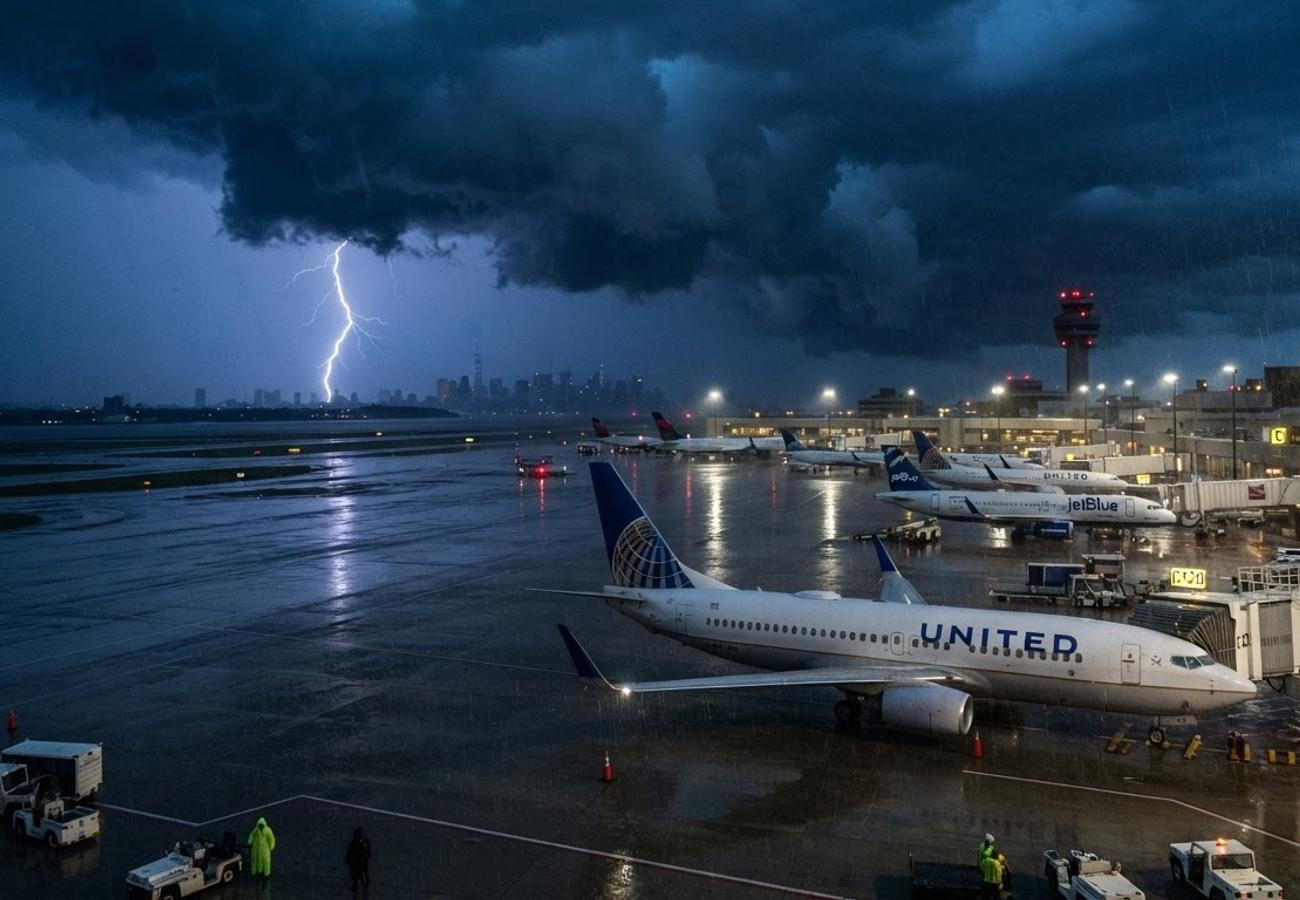
Image generated by AI
Severe thunderstorms across the New York City tri-state region have forced the Federal Aviation Administration (FAA) to implement a ground stop at Newark Liberty International Airport (EWR), resulting in triple-digit cancellations and systemic delays across the Northeast corridor.
The disruption began on August 27, 2026, as convective weather cells moved through the airspace, prompting the FAA to restrict inbound traffic to maintain safety and prevent runway saturation. This tactical halt on arrivals has created a ripple effect, stalling departures from feeder airports and trapping aircraft on the tarmac at Newark.
Operational Breakdown: The Ground Stop Mechanism
According to FAA air traffic management data, the ground stop program was deployed specifically to manage congestion as storm cells intersected key approach corridors. This measure prevents "heavy arrival banks"—large groups of aircraft arriving simultaneously—from overwhelming the limited runway capacity during periods of reduced visibility and volatile wind conditions.
While the ground stop targeted inbound flights, outbound operations suffered equally. Real-time FAA command center data indicates that departing flights faced significant gate holds and taxiway delays. This was largely due to "storm avoidance programs," where controllers reroute aircraft around active thunderstorm cells, effectively narrowing the available departure windows and increasing the spacing required between aircraft.
Quantifying the Disruption
Data provided by FlightAware confirms the scale of the operational collapse at Newark Liberty. By late afternoon on August 27, the figures reached critical levels:
- Cancellations: Approximately 140 flights.
- Delays: Over 500 flights.
- Primary Cause: Severe thunderstorms and subsequent FAA traffic management initiatives.
- Scope: Heavily concentrated on domestic routes, with international schedules reshuffled to accommodate tightened arrival rates.
The high cancellation count is a result of two factors: "scrubbed" rotations (flights canceled at the origin airport before takeoff) and aircraft already on the ground at EWR that could not be turned around due to crew time-outs or gate congestion.
Systemic Vulnerabilities at EWR
Newark has historically struggled with on-time performance. Federal Register notices have previously detailed operating limitations and periodic flight reductions intended to mitigate peak-hour congestion. Despite these previous attempts to trim schedules for better resilience, the events of August 27 demonstrate that the airport remains highly susceptible to "compounding delays."
Because Newark serves as a primary transatlantic and transcontinental hub, the disruption extended beyond the local region. The loss of inbound feeder flights broke onward itineraries for thousands of passengers, while widebody aircraft destined for long-haul routes were left without connecting passengers, forcing carriers to consolidate services or alter evening departure banks.
Impact on the New York Metro Airspace
The crisis was not isolated to Newark. FAA national summaries indicate concurrent weather-related programs at LaGuardia Airport, confirming that the entire New York metro airspace was under stress. The overlapping nature of the airspace in this region means that a ground stop at one hub often forces diversions or holds that impact neighboring fields, creating a regional gridlock.
For passengers, this volatility manifests as shifting departure times and last-minute gate changes. Once cancellations at a major hub exceed 100, airlines typically shift to "preemptive trimming," canceling later flights to prevent crews from exceeding their legal working hours (timing out) while waiting on the tarmac.
Newark Operational Impact Summary
| Metric | Status/Value |
|---|---|
| FAA Action | Traffic Management Ground Stop |
| Date of Event | August 27, 2026 |
| Total Cancellations | ~140 Flights |
| Total Delays | 500+ Flights |
| Primary Driver | Severe Thunderstorms (NYC Region) |
| Impacted Hubs | Newark (EWR), LaGuardia (LGA) |
Why This Matters: The Logistical Analysis
From a logistical perspective, this event highlights a critical failure in "buffer capacity" within the Northeast corridor. For travelers, the real impact is not the initial delay, but the cascading failure of the hub-and-spoke model. When a primary hub like Newark freezes, the "spokes" (smaller regional airports) have nowhere to send their aircraft, leading to ground congestion nationwide.
Our analysis of the route map suggests that Newark's role as a transatlantic gateway makes these weather events economically significant. When widebody aircraft are displaced, the cost of recovery is exponentially higher than with narrow-body domestic jets, as it involves coordinating international crew rotations and high-capacity passenger rebookings.
Industry Outlook
Expect a slow recovery period extending into the next operational day. Because aircraft and crews were displaced by the August 27 ground stop, airlines will struggle to reposition assets to their scheduled starting points.
Market trends suggest that regulators will likely revisit the "targeted scheduling caps" mentioned in recent policy documents. To prevent triple-digit cancellations from becoming a recurring weather-related norm, the FAA may move toward more aggressive pre-emptive scheduling reductions during the peak Atlantic hurricane and thunderstorm seasons.
Operational stability at EWR remains fragile until infrastructure improvements can decouple peak traffic flows from weather-induced volatility.
Related Travel Guides
Disclaimer
This article is for informational and educational purposes only. It does not constitute legal, financial, or professional advice. While we strive to provide accurate and up-to-date information, travel policies, regulations, and conditions change rapidly. Always verify information with official sources before making travel decisions. Nomad Lawyer makes no representations about the accuracy, reliability, completeness, or suitability of the information provided. Readers should consult qualified professionals for advice specific to their circumstances. The views expressed in this article are those of the author and do not necessarily reflect the views of Nomad Lawyer.
Preeti Gunjan
Contributor & Community Manager
A passionate traveller and community builder. Preeti helps grow the Nomad Lawyer community, fostering engagement and bringing the reader experience to life.
Learn more about our team →