
Jets United States: Why F-22 Raptor Still Dominates Air Combat in 2026
Defense analysis reveals why jets United States military deploys—specifically the F-22 Raptor—maintains air-to-air superiority despite the F-35's advanced multirole capabilities entering widespread service across North American airspace in 2026.

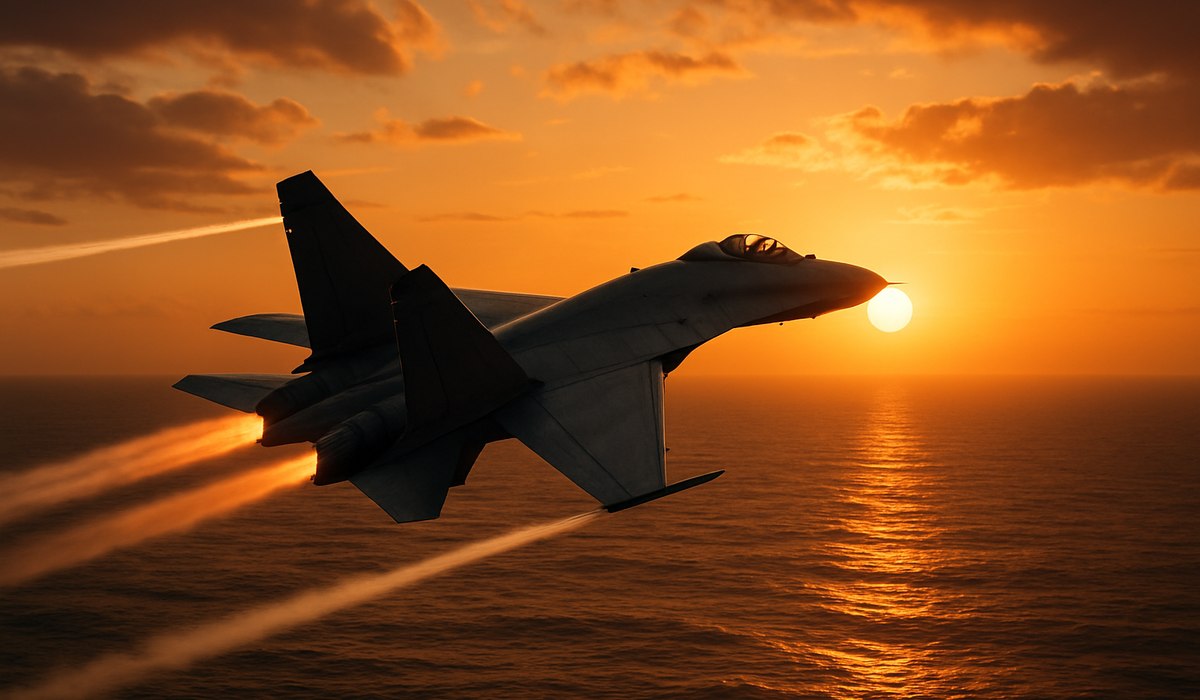
Image generated by AI
Commercial Aviation Protection: F-22 Raptor Continues U.S. Air Superiority Role
The Lockheed Martin F-22 Raptor remains the world's premier air-to-air fighter despite the operational expansion of the F-35 Lightning II across United States military bases and civilian airspace corridors. While newer multirole jets like the F-35 offer broader capabilities, the F-22's specialized design for air dominance keeps it unmatched in intercepting threats to commercial routes and civil aviation infrastructure. This technological advantage protects the millions of passengers flying daily across North American skies in 2026.
Air Dominance Specialization: Purpose-Built Fighter Design
The F-22 Raptor was engineered as a dedicated air superiority platform, meaning its entire architecture prioritizes winning dogfights and controlling airspace. Every component—from its twin engines producing 35,000 pounds of thrust to its advanced avionics suite—serves the singular mission of dominating enemy aircraft. This specialization contrasts sharply with the F-35's multirole design, which balances air combat, ground attack, and naval operations into one airframe.
The Raptor's focused engineering delivers uncompromising performance in the air-to-air role. Its supercruise capability allows sustained supersonic flight without afterburners, enabling longer patrol periods protecting airways. Stealth coating materials and shaping reduce radar cross-section to fighter-sized targets. When commercial aviation security requires immediate air response, the F-22's single-purpose optimization proves decisive. This specialization explains why the U.S. Air Force maintains active F-22 squadrons despite F-35 production exceeding 900 aircraft globally.
F-22 vs F-35: Role-Based Performance Comparison
Comparing these jets United States operates requires understanding their different missions. The F-35 Lightning II excels as a multirole platform, executing bombing runs, coordinating ground forces, and conducting electronic warfare simultaneously. Its sensor fusion capabilities synthesize data from multiple sources, providing battlefield awareness that surpasses the F-22.
However, in pure air-to-air engagement scenarios, the F-22 outperforms. Its sustained turn rate, acceleration, and vertical climb rate exceed F-35 capabilities. A 2025 Pentagon analysis confirmed the F-22 maintains a superior air combat probability of kill percentage against current threat aircraft. The F-35's strength lies in detecting enemies first through advanced sensors and engaging from beyond-visual-range distances, leveraging information advantage rather than dogfighting superiority.
For commercial aviation protection missions—intercepting unidentified aircraft near airports or escorting suspicious contacts—the F-22's acceleration and maneuverability remain tactically superior. Commercial air traffic control coordination benefits from the Raptor's rapid response profile and extended loiter times over protected airspace.
| Performance Metric | F-22 Raptor | F-35 Lightning II | Advantage |
|---|---|---|---|
| Maximum Speed | Mach 2.25+ | Mach 1.60+ | F-22 |
| Sustained Turn Rate | 22.5 degrees/second | 18 degrees/second | F-22 |
| Service Ceiling | 50,000+ feet | 43,000+ feet | F-22 |
| Supercruise Capability | Yes (sustained Mach 1.5) | Limited | F-22 |
| Sensor Fusion Integration | Advanced radar | Multi-sensor fusion | F-35 |
| Multirole Flexibility | Air dominance only | Air/ground/naval | F-35 |
Why Air-to-Air Superiority Still Matters in 2026
Commercial aviation security professionals emphasize air-to-air dominance remains critical despite advances in beyond-visual-range missiles and sensor technology. When unidentified aircraft approach restricted airspace near major airports—Chicago O'Hare, Los Angeles International, or Atlanta Hartsfield-Jackson—response times measure in minutes. The F-22's ability to accelerate to patrol altitude, identify targets visually, and execute defensive maneuvers faster than competing platforms prevents potential threats from reaching civilian airspace.
Terrorist organizations and state actors occasionally probe North American air defenses with unmanned systems or rogue aircraft. The F-22's superior climb rate and acceleration allow interception before incursions reach populated areas. Additionally, geopolitical tensions periodically bring foreign military aircraft to international waters near U.S. airspace. The Raptor's extreme agility and energy management allow safe separation and intercept procedures that newer jets like the F-35 would require more time executing, potentially allowing dangerous approach distances.
Modern air defense doctrine still values air superiority. Electronic warfare capabilities, cyber attacks, and sensor saturation may eventually neutralize traditional advantages, but current threat assessments validate sustained F-22 operations. The Air Force projects continued F-22 deployment through 2030, suggesting no imminent technological replacement despite F-35 production expansion. This commitment reflects real-world security assessments rather than legacy preferences.
Future Fighter Jet Development and Technological Evolution
Development of sixth-generation fighters—designated Next Generation Air Dominance (NGAD) platforms—underway within the U.S. Air Force indicates recognition that even the F-22 faces eventual obsolescence. These platforms will integrate artificial intelligence, directed energy weapons, and hypersonic capabilities beyond current jet design parameters.
Defense contractors including Lockheed Martin, Northrop Grumman, and Boeing are competing for NGAD contracts worth billions. Expected operational deployment approaches 2030-2035 timeframes. These experimental platforms promise to leapfrog F-35 and F-22 capabilities entirely, though specific performance details remain classified for security reasons.
Commercial aviation benefits indirectly from this evolutionary cycle. Enhanced air defense capabilities protecting military installations and airspace typically transfer to civil aviation security infrastructure. Advanced radar systems, automated threat detection, and rapid-response protocols developed for fighter aircraft enhance airport security systems and air traffic management networks. Travelers benefit from technology cascading downward from military aviation innovation.
Current F-22 operations represent a transitional phase between fourth-generation aircraft like the F-15 and next-generation platforms under development. For immediate and near-term aviation security (2026-2030), the Raptor's air dominance specialization remains unmatched, making continued operations strategically sound despite newer F-35 deployment.
Traveler Action Checklist
Understanding military aviation capabilities helps travelers appreciate modern airspace security measures and respond appropriately during unusual flight situations:
- Monitor flight status through FlightAware before departure; military training exercises occasionally cause minor delays or route adjustments
- Review current FAA notices at FAA.gov for airspace restrictions near military ranges and testing areas
- Know your passenger rights through the U.S. Department of Transportation consumer protection resources
- Arrive early on days with significant military activity near your departure airport
- Request flight updates from gate agents if military aircraft operations cause delays exceeding 30 minutes
- Document delays with flight numbers and times for potential compensation claims under DOT regulations
- Contact your airline within 14 days if you experienced weather-related military airspace impacts affecting your journey
FAQ: Jets United States and Commercial Aviation Impact
Q: Do F-22 Raptors operate near major commercial airports? A: F-22 Raptors operate from dedicated military bases including Nellis Air Force Base (Nevada), Langley Air Force Base (Virginia), and Elmendorf Air Force Base (Alaska). Military training routes occasionally intersect with civilian airways, but air traffic control protocols maintain safe separation distances
Disclaimer
This article is for informational and educational purposes only. It does not constitute legal, financial, or professional advice. While we strive to provide accurate and up-to-date information, travel policies, regulations, and conditions change rapidly. Always verify information with official sources before making travel decisions. Nomad Lawyer makes no representations about the accuracy, reliability, completeness, or suitability of the information provided. Readers should consult qualified professionals for advice specific to their circumstances. The views expressed in this article are those of the author and do not necessarily reflect the views of Nomad Lawyer.
Raushan Kumar
Founder & Lead Developer
Full-stack developer with 11+ years of experience and a passionate traveller. Raushan built Nomad Lawyer from the ground up with a vision to create the best travel and law experience on the web.
Learn more about our team →