
EU Schengen Biometric Crackdown: Greece, Spain, France Join Border Chaos
The EU's new Entry-Exit System (EES) has triggered massive airport delays across Greece, Spain, and France, leaving UK travellers facing unprecedented border queues and mandatory biometric checks.

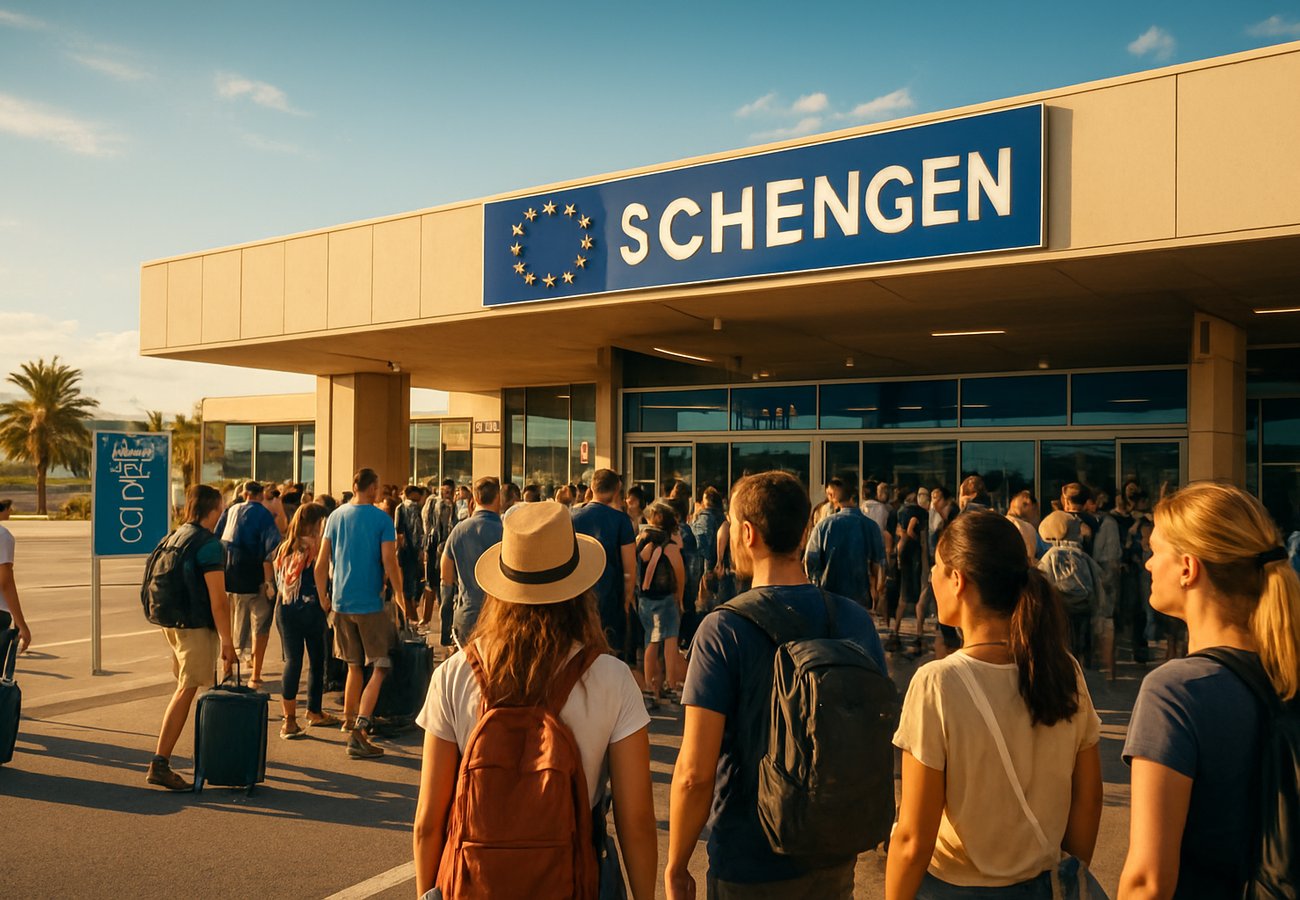
Image generated by AI
The Perfect Storm: How the EU's New Biometric System Broke European Borders
Something unprecedented is happening at European borders right now, and if you're a British traveller, you need to know about it.
As of April 10, 2026, the Entry-Exit System (EES) went fully operational across all 29 Schengen countries—and the results have been chaotic. Airports in Greece, Spain, and France are now ground zero for massive delays, serpentine queues, and mandatory biometric processing that has caught thousands of UK nationals completely off guard.
This isn't a minor hiccup. This is a complete overhaul of how non-EU citizens cross European borders, and the transition has exposed critical gaps between regulatory ambition and real-world travel experience.
What Is the EES? Understanding the System That Changed Everything
Let me break down exactly what happened and why it matters to you.
The Entry-Exit System, managed by eu-LISA (the EU's agency for large-scale IT infrastructure), replaced the old manual passport-stamping process with a fully digital, biometric-based border registration system. Instead of a simple ink stamp, non-EU travellers—including all UK passport holders—now face mandatory capture of their facial biometrics and fingerprints at every external Schengen border crossing.
The EU's official position is clear: this system is designed to strengthen border security, detect overstays with precision, combat identity fraud, and modernise the Schengen regime. On paper, it makes sense. In practice, it's created operational chaos.
"The system was meant to streamline borders, but instead it's created the opposite effect," according to travel industry analysts monitoring the rollout. The infrastructure simply wasn't ready for simultaneous biometric registration of hundreds of thousands of travellers per day.
The Timeline: How We Got Here
The phased rollout began in October 2025 at select border crossing points. Then, on April 10, 2026, eu-LISA declared full deployment across all Schengen external borders complete. This was supposed to be the moment when everything transitioned smoothly.
It wasn't.
The six-month implementation window was supposed to give member states time to install kiosks, train personnel, and prepare infrastructure. But the reality hitting airports in Greece, Spain, and France tells a different story entirely. Border officials are overwhelmed. Technology is malfunctioning. Queues are backing up into terminals.
UK government travel guidance, updated post-April 10, now explicitly warns travellers to expect "extended processing times" and advises arriving hours earlier than normal. That's bureaucratic speak for: "You're going to wait a very long time."
The Real-World Chaos: What Travellers Are Actually Experiencing
Let me be direct about what's happening on the ground.
British nationals arriving at major airports are now facing waits of 30 minutes to over two hours at biometric registration points alone. The system requires everyone—every single non-EU traveller—to submit to:
- Facial image capture
- Fingerprint scanning
- Digital registration of biographical data
- Verification cross-checks against centralised EU databases
This happens at every external Schengen border crossing, whether you're arriving or departing. There is no fast-track option. There is no exemption for frequent travellers.
Reddit: "Arrived in Athens yesterday and spent 90 minutes in biometric queues. The kiosks kept crashing and staff had no idea what they were doing. I missed my connection." — r/travel
Seaports and international coach terminals are experiencing similar disruptions. The infrastructure simply wasn't scaled to handle real-world volume.
Why Greece, Spain, and France Are the Epicentres
These three countries are experiencing the worst delays for a specific reason: they handle the highest volume of non-EU tourist and business travellers in the Schengen area.
Spain receives over 80 million visitors annually. France welcomes roughly 90 million. Greece sees millions of summer travellers. When you concentrate hundreds of thousands of biometric registrations through inadequately prepared systems, you get gridlock.
The Spanish government has deployed additional kiosks at Madrid-Barajas and Barcelona-El Prat airports, but infrastructure additions are running weeks behind demand. French authorities are monitoring queues at Paris Charles de Gaulle, while Greek officials at Athens International are reporting capacity strain during peak travel hours.
The Official Story vs. The Traveller Reality
Here's where it gets interesting from a legal and regulatory perspective.
The European Commission and eu-LISA maintain that the EES is functioning as designed and that delays are expected during the "adjustment period." Their official statements emphasise security objectives: detecting irregular migration, preventing overstays, and maintaining border integrity.
The UK government's travel guidance confirms biometric checks are mandatory and that "additional wait times should be expected."
But there's a critical gap between what regulators predicted and what's actually happening. Official documentation acknowledged a "transitional adjustment period," but nobody predicted queues this severe or technical failures this frequent. Biometric scanners are malfunctioning. Staff are undertrained. System capacity wasn't stress-tested against real peak loads.
For UK travellers, this creates a legal grey area: you have no right to expedited processing, no compensation for delays, and no alternative route that avoids biometric registration entirely. The EES is mandatory. The delays are acknowledged. But the responsibility for mitigation sits nowhere clearly defined.
What This Means for Your Travel Plans
If you're planning to travel through the Schengen area—particularly to Greece, Spain, or France—you need a new strategy.
Arrive at the airport 4-5 hours early instead of the standard 2-3 hours. The extra buffer isn't excessive given current conditions.
Have your travel documents ready and easily accessible. The system requires your passport and any residence documentation you might have.
Expect extended biometric processing. This is non-negotiable and will likely take 30-90 minutes depending on the airport and time of day.
Check eu-LISA's official EES information portal before departure for updated guidance and any technical announcements.
Consider travel insurance that covers delays caused by border processing failures—an increasingly relevant policy feature as the transition continues.
The system is working, technically. But it's working at a level of efficiency that's significantly degraded from pre-EES travel patterns.
When Will This Stabilise?
According to industry analysts and EU officials, the transition period should stabilise by Q3 2026 as infrastructure catches up, staff training is completed, and the novelty of the system wears off. By late summer, biometric processing times are projected to decrease to 15-20 minutes per traveller under normal conditions.
But we're still in the acute phase. The next 3-4 months will be rough. If you can defer non-essential travel to the Schengen area until September 2026, that's the smart play from a travel planning perspective.
The Bigger Picture: What This Reveals About EU Border Policy
The EES implementation reveals a fundamental challenge in modern EU governance: the gap between regulatory objectives and operational capacity.
The system's security goals are legitimate. Detecting overstays, combating identity fraud, and modernising border management are sensible policy objectives. But regulators underestimated the infrastructure requirements and overestimated member states' readiness to implement.
This pattern—ambitious policy coupled with inadequate implementation planning—is increasingly common in EU digital initiatives. The lesson here isn't unique to the EES. It applies to any major regulatory system rollout affecting millions of people.
For travellers, it's a reminder that EU-wide mandates can create very real disruptions in your travel plans, and you have limited recourse when infrastructure fails to match regulatory timelines.
The EES will stabilise, but until then, book your flights with realistic expectations and give yourself extra time at borders—lots of it.
Related Travel Guides
Oceanwide Expeditions Orders Two Eco-Sail Ships for Arctic and Antarctic Polar Cruises by 2030
Vietnam Asia Airlines Boeing Deal: Multi-Billion Agreement Reshapes SE Aviation
Airbus A350-1000 Significantly Outsize Boeing 787-10 in Head-to-Head Aircraft Comparison
Disclaimer
This article is for informational and educational purposes only. It does not constitute legal, financial, or professional advice. While we strive to provide accurate and up-to-date information, travel policies, regulations, and conditions change rapidly. Always verify information with official sources before making travel decisions. Nomad Lawyer makes no representations about the accuracy, reliability, completeness, or suitability of the information provided. Readers should consult qualified professionals for advice specific to their circumstances. The views expressed in this article are those of the author and do not necessarily reflect the views of Nomad Lawyer.
Raushan Kumar
Founder & Lead Developer
Full-stack developer with 11+ years of experience and a passionate traveller. Raushan built Nomad Lawyer from the ground up with a vision to create the best travel and law experience on the web.
Learn more about our team →