
Emirates, Delta, United Lead 2025 Aviation Boom: Record Profits as Global Airlines Shatter Pre-Pandemic Benchmarks
Emirates, Delta, United, and major carriers report unprecedented 2025 profits amid surging travel demand, fleet expansion, and operational efficiency gains reshaping global aviation.

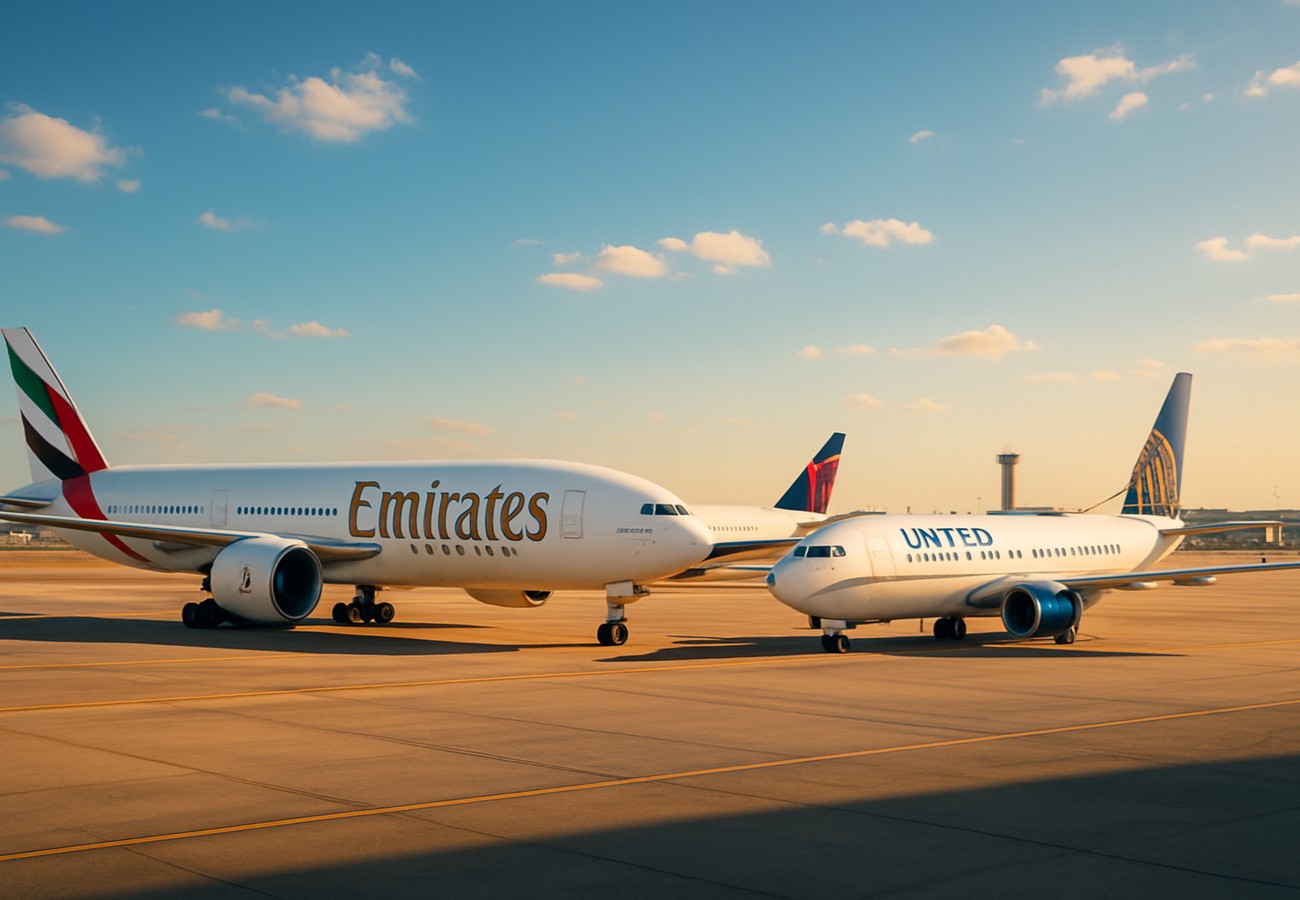
Image generated by AI
The global aviation sector has entered a golden era of profitability, with Emirates, Delta Air Lines, United Airlines, American Airlines, Air France-KLM, Air China, and Southwest Airlines shattering financial records throughout 2025. This unprecedented surge marks a dramatic reversal from pandemic-era losses, as carriers worldwide capitalize on explosive travel demand recovery and implement aggressive cost-optimization strategies that are fundamentally reshaping the industry landscape.
The 2025 aviation recovery represents far more than a simple rebound—it signals a structural shift in how major carriers operate globally. Airlines have leveraged fleet modernization, advanced route optimization, and premium service expansion to unlock new revenue streams while simultaneously reducing operational friction. According to data from the International Air Transport Association (IATA), global passenger traffic reached record levels in 2025, with international routes experiencing particularly robust growth across Asia-Pacific, Europe, and transatlantic corridors.
Emirates emerged as the standout performer among Middle Eastern carriers, reporting record-breaking profits of $5.80 billion on revenues of $34.90 billion. The Dubai-based airline's dominance stems from its strategic positioning on high-yield international routes, aggressive cargo service expansion, and continuous fleet modernization. The carrier's integration of the Boeing 777X aircraft—featuring superior fuel efficiency and extended range capabilities—has proven instrumental in capturing market share on premium long-haul segments. Emirates' dual-revenue model, combining passenger operations with booming cargo services, insulated the carrier from demand volatility that affected competitors relying primarily on passenger traffic.
Delta Air Lines claimed the top position globally with staggering financial metrics: $62.92 billion in revenue paired with $6.57 billion in profit. The Atlanta-based carrier's dominance reflects its unmatched domestic network density combined with strategic international expansion into high-growth Asian markets. Delta's operational excellence—measured by industry-leading on-time performance and minimal disruption rates—translated directly into customer loyalty and pricing power. The airline's commitment to sustainable aviation fuel (SAF) investments and carbon-neutral growth initiatives also resonated with corporate travel buyers increasingly factoring environmental criteria into procurement decisions.
United Airlines captured $5.49 billion in pre-tax profit on revenues of $58.36 billion, positioning itself as the second-most profitable U.S. carrier. United's strategy centered on aggressive international route expansion, particularly across Pacific and Atlantic corridors where premium cabin demand remained exceptionally strong. The carrier's focus on network optimization—eliminating unprofitable regional routes while doubling down on high-yield city pairs—demonstrated sophisticated revenue management that competitors struggled to replicate. United's customer experience enhancements, including expanded premium cabin offerings and modernized in-flight entertainment systems, commanded pricing premiums that directly boosted profitability metrics.
American Airlines reported $54.29 billion in revenue with $2.60 billion in profit, reflecting a more challenging recovery trajectory compared to peers. However, the Dallas-based carrier's fleet modernization initiatives—retiring older, fuel-inefficient aircraft while introducing next-generation narrowbody and widebody aircraft—positioned it for sustained margin expansion. American's cargo operations, leveraging its extensive domestic network for time-sensitive shipments, provided crucial profit cushioning during periods of passenger demand softness.
The Air France-KLM Group generated $35.90 billion in revenue with $2.76 billion in profit, maintaining its position as Europe's most profitable airline group. The Franco-Dutch carrier's hub strategy—leveraging Paris Charles de Gaulle and Amsterdam Airport Schiphol as global connection points—proved resilient against point-to-point competition. Southwest Airlines, despite its smaller scale with $27.55 billion in revenue and $610 million in profit, demonstrated the viability of focused domestic strategies, while Air China captured $24.49 billion in revenue with $670 million in profit as international traffic recovered dramatically across Asian markets.
What This Means for Travelers
The aviation industry's profitability surge carries mixed implications for passengers. While carriers' financial strength ensures network stability and continued aircraft investment, travelers should expect sustained or elevated airfares across premium segments. Airlines are deploying sophisticated revenue management systems that capture maximum value from high-demand routes and peak travel periods. However, increased competition on specific routes—particularly where carriers have added capacity—may create pricing opportunities for flexible travelers. The industry's focus on premium cabin expansion means economy passengers may face reduced seat pitch and amenity standards on some aircraft, though new aircraft introductions offer incremental comfort improvements. Frequent flyer programs have become increasingly valuable as carriers leverage loyalty programs to drive ancillary revenue, making elite status more rewarding for committed travelers.
Industry analysts note that airline profitability cycles historically precede capacity additions that eventually moderate pricing power—suggesting current high fares may not persist indefinitely.
Looking ahead, the aviation sector's 2025 performance establishes a new baseline for industry expectations. Carriers have demonstrated that strategic fleet investment, operational discipline, and premium service differentiation can generate returns that satisfy shareholders while funding the massive capital expenditures required for fleet renewal and sustainability initiatives. However, external risks—including potential fuel price volatility, geopolitical disruptions affecting key routes, and economic slowdown in major markets—could rapidly alter this favorable trajectory. Airlines that have built financial resilience through 2025's profitability windfall will be better positioned to weather inevitable cyclical downturns, while those that prioritize shareholder returns over balance sheet strengthening may face vulnerability when market conditions inevitably shift.
Related Travel Guides
Disclaimer
This article is for informational and educational purposes only. It does not constitute legal, financial, or professional advice. While we strive to provide accurate and up-to-date information, travel policies, regulations, and conditions change rapidly. Always verify information with official sources before making travel decisions. Nomad Lawyer makes no representations about the accuracy, reliability, completeness, or suitability of the information provided. Readers should consult qualified professionals for advice specific to their circumstances. The views expressed in this article are those of the author and do not necessarily reflect the views of Nomad Lawyer.
Kunal K Choudhary
Co-Founder & Contributor
A passionate traveller and tech enthusiast. Kunal contributes to the vision and growth of Nomad Lawyer, bringing fresh perspectives and driving the community forward.
Learn more about our team →