Emirates Deploys Airbus A350 with Premium Economy on Durban–Dubai Route Starting March 2027

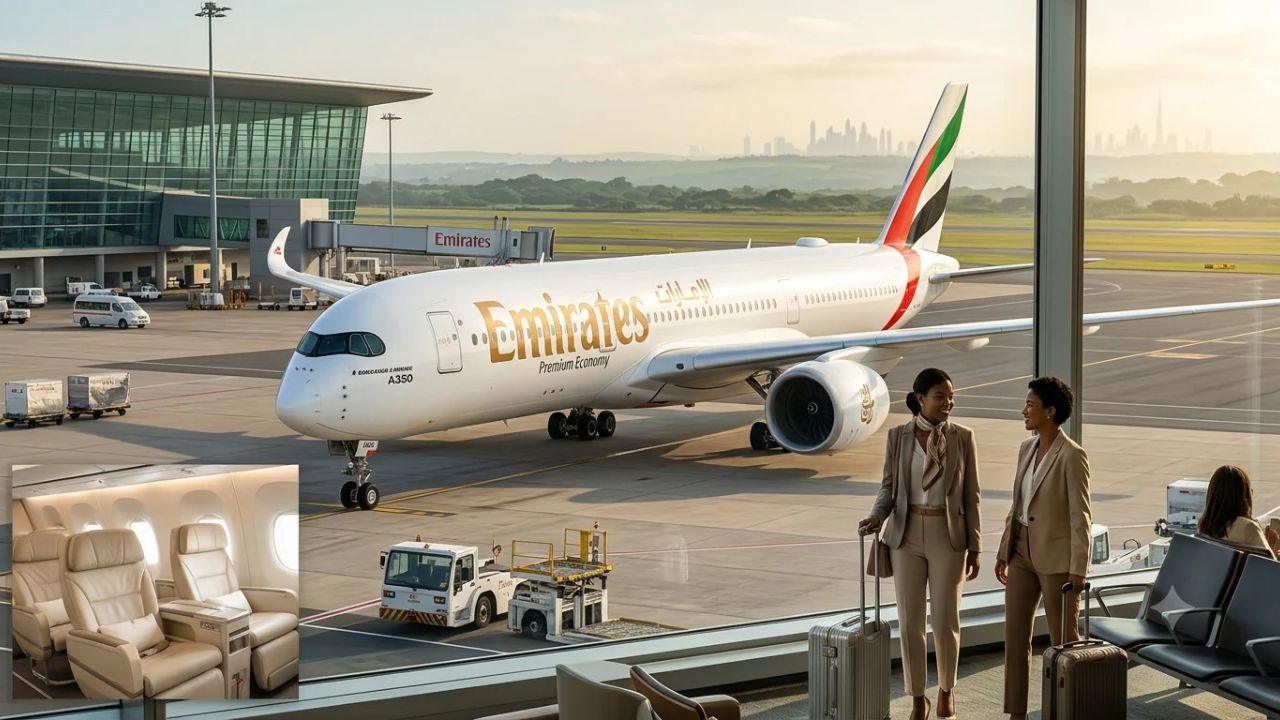
Emirates will introduce its state-of-the-art Airbus A350 aircraft and Premium Economy cabin on daily Durban–Dubai flights starting March 1, 2027.
DURBAN, November 3, 2026 — Emirates has officially scheduled the deployment of its flagship Airbus A350-900 aircraft on the daily Durban–Dubai route starting March 1, 2027, marking the historic debut of its acclaimed Premium Economy cabin in KwaZulu-Natal. The widebody gauge transition represents a major technological and service leap for South Africa's eastern coastal gateway, enhancing passenger comfort while opening seamless onward connectivity through Dubai International Airport (DXB) to premier commercial and leisure markets across Europe, Asia, and the Indian subcontinent.
[!NOTE] Effective March 1, 2027, Emirates will upgrade its daily nonstop service between King Shaka International Airport (DUR) in Durban and Dubai International Airport (DXB) from older widebody equipment to the next-generation Airbus A350-900. The aircraft features a sophisticated three-class configuration comprising Business Class, the route's first-ever Premium Economy cabin, and spacious Economy Class seating, powered by ultra-efficient Rolls-Royce Trent XWB-84 engines and advanced environmental cabin controls.
EMIRATES DURBAN–DUBAI AIRCRAFT FLEET TRANSITION
| Operational Metric Existing Route Baseline Airbus A350 Deployment |
|---|
| Effective Launch Date Active Schedule March 1, 2027 |
| Flight Frequency Daily Nonstop (7 Weekly) Daily Nonstop (7 Weekly) |
| Aircraft Generation Legacy Widebody Twinjet Next-Gen Carbon-Composite |
| Cabin Classes Two-Class / Three-Class Config Three-Class Standardized |
| Premium Economy Not Available on Route Full Dedicated Cabin Debut |
| Engine Architecture High-Bypass Turbofans Rolls-Royce Trent XWB-84 |
| Cabin Environmental Sys. Standard Bleed-Air Systems Continuous HEPA Filtration |
| Inflight Entertainment Standard Digital ice System Next-Gen 4K HDR ice Suites |
| Key Connecting Gateways: London, Paris, Bangkok, Bali, Mumbai, Delhi, Manchester |
Fleet Evolution: The Strategic Role of the Airbus A350 in Emirates' Southern African Network
The scheduled arrival of the Airbus A350 on the Durban route signals a fundamental realignment of Emirates' fleet deployment strategy across the African continent. Historically, the Dubai-based global carrier served its South African gateways—Johannesburg (O.R. Tambo International), Cape Town International, and Durban (King Shaka International)—primarily utilizing a mix of Boeing 777-300ER and Airbus A380 superjumbo aircraft. While the massive seating capacity of the A380 and high-density Boeing 777s proved ideal for the dense corporate and leisure corridors connecting Johannesburg and Cape Town to the Middle East, secondary trunk routes like Durban demanded a more refined balance between passenger capacity, fuel efficiency, and premium yields.
The Airbus A350-900 fills this operational niche with unprecedented precision. Constructed with more than 70 percent advanced materials—including carbon-fiber reinforced polymers, titanium, and advanced aluminum alloys—the A350 airframe delivers an immediate 25 percent reduction in fuel consumption and carbon dioxide emissions compared to previous-generation competing widebodies. Powered by twin Rolls-Royce Trent XWB-84 engines, the aircraft combines exceptional high-altitude takeoff performance with whisper-quiet acoustic footprints, satisfying strict noise abatement standards while optimizing direct operating costs for the carrier.
For Durban, maintaining daily scheduled widebody service to Dubai has long provided a vital economic lifeline connecting the KwaZulu-Natal province with international commerce. By assigning the newly delivered A350 to the Durban corridor starting March 1, 2027, Emirates reaffirms its long-term commercial commitment to South Africa's third-largest metropolitan economy. The transition ensures that Durban travelers receive the exact same cutting-edge hardware, modern cabin architecture, and premium service standards currently deployed on the airline's premier European and transpacific trunk routes.
The Premium Economy Debut: Reshaping the Intermediate Cabin Experience for South African Travelers
The centerpiece of the forthcoming equipment upgrade is the long-awaited introduction of Emirates' dedicated Premium Economy cabin on flights departing King Shaka International Airport. Since its global introduction, the airline's Premium Economy product has earned widespread international acclaim, establishing a distinct travel tier that bridges the substantial price and comfort gulf between Economy and Business Class.
The physical architecture of the A350 Premium Economy cabin is designed to deliver superior ergonomic comfort on medium- and long-haul intercontinental sectors:
- Generous Spatial Dimensions: Premium Economy seats provide a generous seat pitch of up to 40 inches and a width of 19.5 inches, offering passengers abundant legroom and shoulder clearance.
- Enhanced Ergonomic Recline: Featuring an 8-inch recline, each seat cradles the passenger in customized comfort, supported by six-way adjustable headrests, deployable calf rests, and fold-out footrests engineered to reduce circulatory fatigue during eight-hour flight segments.
- Aesthetic Refinement: Upholstered in anti-stain cream leather with delicate stitching details and wood-grain panel finishing reminiscent of the carrier's flagship Business Class cabins, the environment exudes understated elegance.
- Dedicated Dining Experience: Passengers enjoy an elevated culinary journey served on fine Royal Doulton china tableware with stainless steel cutlery, accompanied by linen napkins, hot towel service, and a curated beverage list featuring premium sparkling wines, vintage vintages, and gourmet spirits.
The debut of this intermediate class addresses a surging demographic in Southern Africa's corporate and leisure travel sectors. For regional business executives, public sector officials, and corporate professionals governed by strict corporate travel policies that prohibit long-haul Business Class expenditures, Premium Economy offers a compliant, productive workspace equipped with generous laptop charging ports, in-seat power, and expansive cocktail tables. Concurrently, for affluent leisure holidaymakers, retirees, and families traveling with children, the cabin provides an affordable luxury upgrade that transforms long-haul transit into an enjoyable component of the vacation.
Engineering Excellence and Passenger Well-being: Inside the A350's Next-Generation Cabin Environment
Beyond seat dimensions, the Airbus A350 delivers transformative physiological benefits that fundamentally alter how passengers experience long-distance air travel. Long-haul intercontinental flights frequently induce dehydration, fatigue, and spatial disorientation due to the low atmospheric pressures and dry recycled air typical of older aluminum aircraft. The advanced carbon-composite fuselage of the A350 allows engineers to overcome these structural constraints, introducing a passenger cabin pressurized to an equivalent altitude of 6,000 feet—significantly lower than the 8,000-foot cabin altitudes standard on traditional metal airliners.
This lower cabin altitude facilitates superior oxygen absorption in the human bloodstream, dramatically reducing the incidence of post-flight headaches, physical lethargy, and jet lag. The cabin's environmental control system continuously purifies the atmosphere, utilizing hospital-grade High-Efficiency Particulate Air (HEPA) filters that remove 99.97 percent of airborne viruses, bacteria, and microscopic particulates while completely exchanging the entire volume of cabin air every two to three minutes. Advanced moisture-control systems maintain higher relative humidity levels, preventing the dry eyes, throat irritation, and skin dehydration commonly experienced on intercontinental transits.
The sensory journey is further enhanced by cutting-edge acoustics and intelligent lighting design:
- Whisper-Quiet Cabin Acoustics: The combination of aerodynamic wing design, quiet Trent XWB engines, and extensive composite sound-dampening insulation makes the A350 cabin one of the quietest passenger enclosures in commercial aviation, allowing travelers to converse naturally or sleep without intrusive engine drone.
- Circadian Mood Lighting: Sophisticated full-spectrum LED lighting arrays simulate natural diurnal light cycles, gently transitioning through soothing sunrises, ambient daylight, warm sunset glows, and starlit night skies to assist the human body in synchronizing its internal clock with destination time zones.
- Next-Generation Inflight Entertainment: Every seat aboard the A350 is outfitted with the latest iteration of Emirates' award-winning ice system, offering up to 6,500 channels of on-demand movies, television box sets, live sports broadcasts, and international music played on ultra-responsive 4K HDR touchscreens.
- Seamless Connectivity: The fleet is equipped with high-speed satellite broadband connectivity, enabling travelers to stream entertainment, browse the web, and send instant messages throughout the flight, backed by fast-charging USB-A and USB-C ports alongside universal AC electrical outlets.
Connecting KwaZulu-Natal to the World: DXB Transit Banks to Europe, Asia, and the Subcontinent
While the aircraft itself represents a triumph of modern aeronautical design, the true strategic power of the Durban–Dubai route lies in the global network it unlocks. Operating through Emirates' primary hub at Dubai International Airport (DXB), passengers departing Durban gain synchronized access to extensive transit banks connecting more than 140 destinations across six continents.
The daily morning arrival bank at DXB is meticulously timed to facilitate rapid, friction-free connections across high-demand geographic corridors:
1. The European Gateway: Business, Education, and Heritage Travel
Durban travelers maintain deep commercial, familial, and academic ties with Western Europe. Through Dubai, passengers achieve single-stop transit to premier gateways across the United Kingdom, including London Heathrow (LHR), London Gatwick (LGW), London Stansted (STN), Manchester (MAN), Birmingham (BHX), and Glasgow (GLA). In Continental Europe, the network provides rapid connections to Paris Charles de Gaulle (CDG), Nice (NCE), Lyon (LYS), Frankfurt (FRA), Munich (MUC), Zurich (ZRH), and Amsterdam (AMS). These links support South African professionals attending international corporate conferences, students pursuing overseas tertiary education, and families visiting diaspora communities.
2. Tropical Southeast Asia: High-Yield Leisure and Cultural Corridors
For South African holidaymakers seeking tropical island escapes, Emirates' Dubai hub provides smooth onward connections to Southeast Asia's most coveted leisure destinations. Flights connect seamlessly to Thailand's primary leisure corridors, including Bangkok Suvarnabhumi (BKK) and Phuket (HKT), alongside Indonesia's cultural and beach sanctuaries in Bali Denpasar (DPS) and Jakarta (CGK). In addition, connections extend to Singapore Changi (SIN), Kuala Lumpur (KUL), and Vietnam, providing seamless access to multi-destination Asian itineraries without the necessity of backtracking through European or East Asian hubs.
3. The Indian Subcontinent: Deep Diasporic and Commercial Integration
Durban is home to the largest concentration of people of Indian descent outside of India itself, creating immense, year-round demand for air travel between KwaZulu-Natal and South Asia. The daily A350 connection into Dubai allows passengers to tap into Emirates' comprehensive Indian network, spanning nine major commercial and regional destinations: Mumbai (BOM), Delhi (DEL), Ahmedabad (AMD), Chennai (MAA), Kochi (COK), Hyderabad (HYD), Bengaluru (BLR), Kolkata (CCU), and Thiruvananthapuram (TRV). Beyond visiting family and participating in religious pilgrimages, these air links catalyze bilateral trade between South African industrial manufacturers and India's rapidly expanding pharmaceutical, textile, and technology sectors.
EMIRATES DUBAI GLOBAL CONNECTIVITY TRANSIT MATRIX
| Origin Gateway: King Shaka International Airport, Durban (DUR) |
|---|
| Intermediate Hub: Dubai International Airport (DXB) [Central Hub Processing] |
| Key Connecting Destination Corridors: |
| - United Kingdom & Europe ---> London, Manchester, Paris, Frankfurt, Zurich |
| - Indian Subcontinent -------> Mumbai, Delhi, Ahmedabad, Chennai, Kochi |
| - Southeast Asian Leisure ---> Bangkok, Phuket, Bali Denpasar, Singapore |
| - Far East Commercial -------> Tokyo, Seoul, Hong Kong, Shanghai |
| Passenger Experience: Single Baggage Check-Through & Seamless Boarding Pass Issuance |
Clean Data Table: Emirates Durban–Dubai Route Profile & Aircraft Comparison
The following structured table provides a comprehensive operational overview of the Durban–Dubai route, highlighting key technical and service differences introduced by the Airbus A350 deployment:
| Operational Parameter | Previous Operational Baseline | Airbus A350-900 Deployment | Commercial & Strategic Value |
|---|---|---|---|
| Route Designation | Durban (DUR) – Dubai (DXB) | Durban (DUR) – Dubai (DXB) | Core South African trunk corridor |
| Effective Deployment Date | Active Historical Schedule | March 1, 2027 | Formal transition to next-gen fleet |
| Weekly Flight Frequency | Daily Service (7 flights/week) | Daily Service (7 flights/week) | Consistent year-round frequency |
| Aircraft Airframe | Boeing 777-300ER / 777-200LR | Airbus A350-900 | 70%+ composite fuselage & wings |
| Engine Configuration | GE90-115B Turbofans | Rolls-Royce Trent XWB-84 | 25% reduction in fuel consumption |
| Cabin Classes Offered | Two-Class / Three-Class Config | Three-Class Standardized | Premium Economy introduced to route |
| Premium Economy Cabin | Not Available on Route | Dedicated Full Cabin | 40-inch pitch, 19.5-inch width, 8" recline |
| Cabin Pressure Altitude | ~8,000 feet equivalent | ~6,000 feet equivalent | Mitigates dehydration and travel fatigue |
| Air Filtration System | Conventional bleed air cycle | Continuous HEPA Renewal | Cabin air replaced every 2–3 minutes |
| Inflight Entertainment | Digital ice touchscreens | 4K HDR ice System | 6,500+ channels on ultra-HD displays |
| Belly-Hold Cargo Uplift | Heavy commercial cargo capacity | Optimized LD3 Cargo Hold | High-value automotive & agricultural exports |
The Evolution of King Shaka International Airport: From World Cup Legacy to Modern Air Hub
To fully understand the significance of Emirates' Airbus A350 deployment, one must examine the transformative development of Durban's aviation infrastructure over the past two decades. In May 2010, ahead of the FIFA World Cup hosted by South Africa, the coastal city completed the decommissioning of the old Durban International Airport (historically known as Louis Botha Airport) in the southern industrial basin, relocating all commercial operations thirty-five kilometers north to the newly constructed King Shaka International Airport. The former airport was severely constrained by a short 2,400-meter runway hemmed in by industrial refineries, a canal, and railway tracks, which prevented international long-haul widebody aircraft from departing with full fuel tanks and commercial cargo payloads.
The construction of King Shaka International Airport resolved these structural limitations by providing a world-class 3,700-meter paved runway capable of handling any modern commercial passenger or freighter aircraft without performance penalties, including the Airbus A380, the Airbus A350, and the Boeing 777-300ER. Additionally, the passenger terminal was designed with dedicated widebody gates, dual-level boarding bridges, automated baggage sorting systems, and expansive customs and border control facilities capable of processing hundreds of international arrivals simultaneously.
Over the subsequent decade and a half, provincial economic agencies, spearheaded by the KwaZulu-Natal Route Development Committee, worked tirelessly to attract international scheduled carriers to King Shaka International. While airlines historically treated Durban as a secondary domestic spoke requiring feeder transfers through Johannesburg's O.R. Tambo International Airport, Emirates recognized the latent commercial potential of the coastal province, establishing direct daily services to Dubai. The deployment of the Airbus A350-900 represents the realization of King Shaka's foundational vision: a high-efficiency international aviation hub capable of hosting the world's most sophisticated widebody airliners and connecting KwaZulu-Natal directly to global commerce.
The Technical Architecture of the Airbus A350-900: Materials, Aerodynamics, and Environmental Credentials
The Airbus A350-900 is widely recognized as one of the most technologically advanced commercial aircraft ever engineered, incorporating revolutionary advances in materials science, aerodynamic design, and propulsion technology. Unlike older aluminum aircraft, more than 53 percent of the A350 airframe is constructed from carbon-fiber reinforced plastics, with an additional 14 percent composed of high-strength titanium and composite alloys. This advanced material composition eliminates the risk of metal fatigue and corrosion, allowing engineers to design an airframe that is simultaneously lighter, structurally stiffer, and capable of enduring rigorous intercontinental duty cycles with lower maintenance overheads.
Aerodynamically, the A350 draws inspiration from the natural flight mechanics of birds of prey. The aircraft's sweeping composite wings feature distinctive, upward-curved sharklet wingtips that measure more than four meters in height. During cruising flight, the onboard flight control computers continuously modulate the wing flap mechanisms through an adaptive droop and camber function, minutely altering the physical profile of the wing to minimize aerodynamic drag, optimize fuel burn, and adapt dynamically to shifts in aircraft weight as fuel is consumed during the eight-hour transit between Durban and Dubai.
At the heart of the aircraft's propulsion system are two Rolls-Royce Trent XWB-84 turbofan engines, engineered specifically for the A350 family. Delivering 84,000 pounds of takeoff thrust per engine, the Trent XWB features an exceptionally high bypass ratio of 9.3:1 and utilizes advanced single-crystal turbine blades cooled by ceramic thermal barrier coatings. This thermal efficiency enables the engine to operate at peak internal temperatures while achieving an immediate 25 percent reduction in specific fuel consumption and carbon dioxide emissions compared to previous-generation widebody twinjets. The resulting acoustic signature is remarkably quiet, ensuring that Emirates' daily operations at King Shaka International Airport comply comfortably with global airport noise regulations while minimizing environmental impact on adjacent residential communities.
The Frequent Flyer Calculus: Skywards Miles, Upgrades, and Tier Progression on South African Routes
For members of Emirates Skywards—the carrier's award-winning loyalty program—the arrival of the Airbus A350 and the debut of the Premium Economy cabin introduce sophisticated new strategies for mileage accrual, tier progression, and flight upgrades across Southern Africa.
Historically, passengers booking flights between Durban and Dubai faced a stark loyalty choice between Economy Class and Business Class. Travelers on Economy tickets earned baseline Skywards Miles according to fare families (Special, Saver, Flex, and Flex Plus), but found the mileage requirement for upgrading into Business Class substantial, often exceeding 50,000 miles per one-way sector. The introduction of Premium Economy establishes an accessible intermediate tier in the loyalty architecture. Passengers holding eligible Economy Flex and Flex Plus tickets can utilize moderate Skywards mileage balances to upgrade directly into the spacious Premium Economy cabin, securing priority boarding, elevated dining, and 40-inch legroom without depleting their mileage reserves.
EMIRATES SKYWARDS MILEAGE & CABIN TIER DYNAMICS
| Column 1 |
|---|
| Cabin Class Selection Mileage Earning Velocity Tier Point Multipliers |
| Economy Class Baseline Mileage (Saver/Flex) Standard Tier Miles |
| Premium Economy Accelerated Mileage Accrual Elevated Tier Points |
| Business Class Maximum Commercial Mileage Premium Tier Acceleration |
| Upgrade Pathway: Economy Flex/Flex Plus ----> Premium Economy Cabin (Accessible Miles) |
| Regional Bank Integration: Standard Bank, Nedbank, FNB Points Conversion to Skywards |
Concurrently, travelers purchasing published Premium Economy fares earn accelerated Skywards Miles and Tier Miles compared to standard Economy tickets, enabling frequent flyers to achieve or retain elite Silver, Gold, or Platinum status with fewer annual sectors. Elite status delivers substantial real-world travel privileges, including complimentary access to Emirates' worldwide network of luxury business lounges, elevated checked baggage allowances, priority baggage delivery, and dedicated customer service handling. In addition, through strategic partnership agreements with leading South African financial institutions—including credit card loyalty programs operated by Standard Bank, Nedbank, and First National Bank—travelers across KwaZulu-Natal can seamlessly convert everyday domestic banking rewards into Skywards Miles, accelerating their ability to experience next-generation A350 travel.
Economic and Tourism Catalysts: Elevating KwaZulu-Natal's Global Investment and Visitor Profile
The commercial dividends generated by upgraded international air services extend far beyond airline passenger manifests. In regional economics, direct long-haul aviation links function as powerful economic multipliers, facilitating foreign direct investment, expanding international business partnerships, and catalyzing inbound tourism.
King Shaka International Airport forms the core anchor of the Dube TradePort Special Economic Zone, an advanced industrial and manufacturing zone situated thirty kilometers north of Durban. As a designated industrial development zone offering tax incentives, bonded warehousing, and cold-storage logistics facilities, Dube TradePort relies heavily on scheduled widebody air services to move high-value, time-sensitive exports into global markets. The Airbus A350's modern belly-hold cargo capacity provides dependable cargo space for KwaZulu-Natal's export industries:
- Automotive Component Manufacturing: Durban serves as South Africa's premier automotive assembly hub, housing major international manufacturing plants. Daily flights to Dubai provide critical supply chain links for the rapid delivery of precision automotive parts, electronic control modules, and specialized tooling components.
- High-Value Agricultural Exports: KwaZulu-Natal's fertile agricultural hinterlands produce world-renowned horticultural goods, including avocados, fresh citrus, macadamia nuts, and cut flowers. The A350's temperature-controlled cargo compartments ensure that perishable exports reach retail markets in the United Arab Emirates, Europe, and Asia in pristine condition.
- Pharmaceutical and Specialized Cargo: The availability of modern cargo facilities at King Shaka International allows regional medical manufacturers to distribute temperature-sensitive pharmaceuticals and healthcare equipment across the African continent and the Middle East.
On the inbound tourism front, the introduction of the A350 and Premium Economy significantly elevates Durban's appeal among high-spending international travelers. KwaZulu-Natal offers an extraordinary diversity of tourism assets, including the sub-tropical Golden Mile beaches of Durban, the UNESCO World Heritage-listed uKhahlamba-Drakensberg Park with its soaring mountain amphitheatres and ancient San rock art, and legendary Big Five safari reserves in Hluhluwe-iMfolozi and Phinda. By providing an ultra-comfortable intermediate cabin option, Emirates makes these regional attractions considerably more accessible to mature travelers and wildlife enthusiasts from Europe and North America who prioritize flight comfort but avoid top-tier Business Class pricing.
Competitive Dynamics in the Southern African Aviation Market
The deployment of the Airbus A350 onto the Durban route represents a decisive tactical maneuver in the intensely competitive Southern African aviation landscape. For decades, international airlines concentrated their premier flagship aircraft and newest cabin products almost exclusively on Johannesburg's O.R. Tambo International Airport, treating Durban as a secondary feeder station that received older widebody equipment or required domestic transfers via Johannesburg.
Emirates' deployment of the A350 with Premium Economy fundamentally disrupts this dynamic. Rival Gulf carriers, including Qatar Airways, operate scheduled services into Durban but have not consistently offered a dedicated Premium Economy product on the route. Concurrently, European legacy carriers such as British Airways, Virgin Atlantic, KLM, and Lufthansa require Durban passengers to book multi-ticket domestic connections through Johannesburg or Cape Town on regional carriers like Airlink, FlySafair, or South African Airways to access European flights.
SOUTHERN AFRICAN LONG-HAUL CARRIER COMPETITIVE MATRIX
| Airline Operator Durban Flight Status Intermediate Cabin Status |
|---|
| Emirates Daily Nonstop (A350 from 2027) Dedicated Premium Economy |
| Qatar Airways Scheduled Service via Doha Standard Economy/Business |
| Turkish Airlines Direct Service via Istanbul Standard Economy/Business |
| European Legacy Carriers No Direct Durban Flights Domestic Interline at JNB |
| Domestic Feeder Airlines Domestic Shuttles to JNB/CPT Single-Class Economy Only |
By providing direct nonstop widebody service from King Shaka International paired with a dedicated Premium Economy cabin, Emirates establishes a commanding competitive advantage. Durban residents and regional travelers from Pietermaritzburg, the North Coast, and the Midlands can bypass the hassle, luggage re-checking, and potential delay risks of transiting through Johannesburg, stepping directly onto a next-generation airliner in Durban and waking up in Dubai.
The regulatory architecture governing South African international air transport further illuminates the strategic significance of this route. Under bilateral air services agreements negotiated between South Africa's Department of Transport and the United Arab Emirates General Civil Aviation Authority, scheduled frequency rights into secondary provincial gateways are carefully allocated to stimulate decentralized regional growth. While foreign legacy airlines frequently limit their operations to Johannesburg due to crew layover costs and aircraft rotation constraints, Emirates' commitment to a daily widebody service at King Shaka International Airport validates the commercial maturity of the KwaZulu-Natal catchment basin. This sustained operational presence not only prevents the monopolization of long-haul traffic through Gauteng but also provides essential price competition and premium service alternatives for provincial consumers.
Why This Matters: The Practical Traveler's Guide to Flying Emirates from Durban in 2027
The introduction of the Airbus A350 on March 1, 2027, redefines the travel planning equation for anyone flying out of KwaZulu-Natal:
- For the South African business traveler, the arrival of Premium Economy represents the ultimate corporate productivity upgrade. Executives can book compliant corporate travel that delivers priority airport processing, generous working space, and whisper-quiet flight environments, arriving in Dubai, London, or Mumbai refreshed and ready for commercial negotiations.
- For holidaymakers and visiting families, the new aircraft elevates long-haul travel from an exhausting ordeal into an enjoyable holiday highlight. The combination of lower cabin altitude, higher humidity, 6,500 entertainment channels on 4K screens, and spacious seating eliminates the physical discomfort of international transits.
- From a regional economic perspective, Emirates' investment reaffirms Durban's standing as a premier African commercial gateway. By connecting the region directly to global trade arteries through cutting-edge aviation hardware, the route supports local industrial manufacturing, expands agricultural exports, and attracts high-yield international tourism to the shores of KwaZulu-Natal.
From a logistical transit perspective, departing from King Shaka International Airport delivers substantial time savings compared to domestic routing via Gauteng. Passengers clear South African immigration and customs in Durban, check their luggage directly through to their ultimate global destination, and bypass domestic connection terminals in Johannesburg. At Dubai International Airport, dedicated transit channels and modern Concourse facilities ensure that connections to onward flights across Europe, the Far East, and South Asia remain fluid, reliable, and stress-free.
Travelers intending to experience Emirates' Airbus A350 and Premium Economy cabin on the Durban–Dubai route should plan their bookings early, as high demand for the new intermediate cabin is anticipated across peak holiday and corporate travel windows throughout 2027.
Related Travel Guides
- Singapore Airlines Airbus A380 Hong Kong Winter 2027 Schedule: Flight Pairs SQ882 and SQ883
- United Airlines Nonstop Newark to St. Croix Flights: US Virgin Islands Tourism Expansion 2026
- Southwest Airlines Bag Fees and Rising Fares Squeeze US Holiday Travel Budgets for Thanksgiving and Christmas 2026
This article is for informational purposes. Flight routes, passenger regulations, visa rules, and transit advisories are subject to change by airlines and aviation authorities. Readers are advised to verify schedules and travel documentation with relevant carriers and border agencies before departure.
Related Stories

Emirates Opens Refurbished Rome Travel Store in EUR: Italy Network and Global Advice Guide

Emirates Brings Airbus A350 to Durban in March 2027: Premium Economy Completes South Africa Trio