
Emirates Up-Gauges A380 Operations in Malaysia, Switzerland, and China: Strategic Fleet Allocations Reshape Long-Haul Capacity

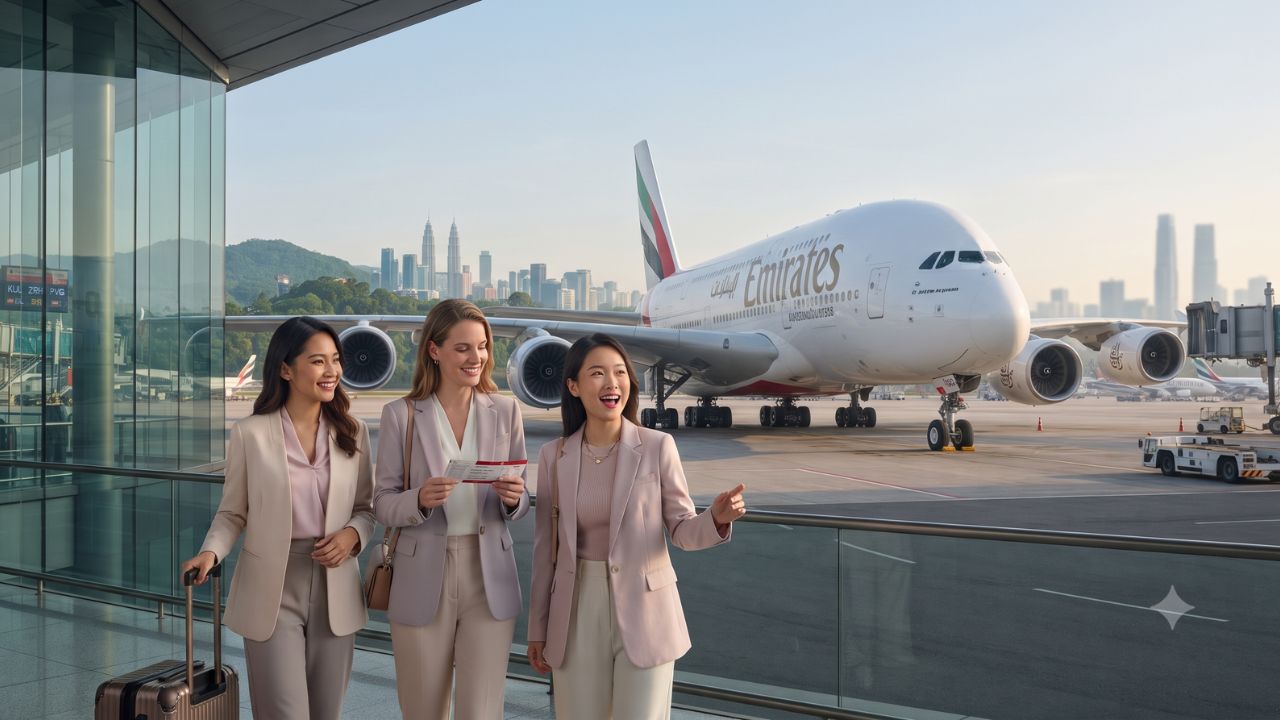
Executing more than 13,000 scheduled Airbus A380 departures in the fourth quarter of 2026 according to fleet schedule analytics from Cirium, Emirates has announced a coordinated widebody up-gauging initiative that restores double-daily superjumbo flights to Kuala Lumpur and Zurich while adding temporary dual-A380 schedules into Shanghai Pudong. Operating nearly 120 of the double-decker aircraft—representing the planet's largest A380 fleet—the Dubai carrier is capturing rising passenger volumes without consuming additional runway slots at constrained international hubs. By replacing twin-engine Boeing 777-300ER aircraft with high-capacity four-class A380s, Emirates is optimizing seat density on established trunk routes across Europe, Southeast Asia, and East Asia.
The tactical aircraft swaps reflect how sixth-freedom network carriers manage capacity during peak seasonal demand. Rather than negotiating costly new air traffic rights or adding marginal off-peak departure banks, up-gauging existing frequencies allows Emirates to deploy more premium cabins, expand its dedicated Premium Economy inventory, and maximize connecting feed into its Dubai International Airport (DXB) global hub.
Fleet Deployment Timetables: Kuala Lumpur, Zurich, and Shanghai
The up-gauging strategy rolls out across three primary international corridors with distinct operational timelines and market functions:
1. Kuala Lumpur International Airport (KUL)
Effective 1 December 2026, Emirates restores double-daily A380 operations to the Malaysian capital. Flights EK346 and EK347 transition from a Boeing 777-300ER to the Airbus A380, complementing the existing daily superjumbo rotation on EK342 and EK343.
The route currently supports three daily departures utilizing a mixed fleet comprising an A380, an Airbus A350-900 integrated in September 2026, and a Boeing 777-300ER. Emirates originally launched Kuala Lumpur operations in 1996 and introduced the A380 to Malaysia in 2012, operating up to three daily A380 services between 2018 and 2020. The December 2026 adjustment restores two daily double-deck rotations for the first time since 2020.
2. Zurich Airport (ZRH)
Also taking effect 1 December 2026, Switzerland’s commercial center receives a second daily A380 service. Emirates will replace the Boeing 777-300ER on flights EK85 and EK86 with an A380, running alongside established superjumbo services on EK87 and EK88.
The carrier currently provides two daily Dubai–Zurich services delivering over 25,000 one-way seats each month. The double-daily A380 configuration, which last operated during the summer 2024 season, is scheduled to remain active through the 2027 northern summer timetable.
3. Shanghai Pudong International Airport (PVG)
In East Asia, Shanghai receives a temporary capacity injection featuring two daily A380 flights operating between 25 October and 30 November 2026. The superjumbo replaces a Boeing 777-300ER on the EK302 and EK303 rotation, joining the existing A380 on flights EK304 and EK305.
Emirates returned the A380 to Shanghai in October 2025 following an 18-month hiatus. Unlike the permanent winter schedules allocated to Zurich and Kuala Lumpur, Shanghai's second daily A380 deployment is specifically calibrated for a five-week commercial surge before reverting to Boeing 777 equipment on 1 December 2026.
Flight Schedules and Equipment Transitions Across Key Hubs
The table below details the updated flight schedules, equipment reassignments, and operating windows for Emirates' fourth-quarter A380 expansion:
| Destination Airport | Flight Pairs | Departure Time (Local) | Arrival Time (Local) | Aircraft Equipment Transition | Effective Operating Dates |
|---|---|---|---|---|---|
| Kuala Lumpur (KUL) | EK346 / EK347 | DXB 03:10 / KUL 19:10 | KUL 14:25 / DXB 22:10 | Boeing 777-300ER to Airbus A380 | From 1 December 2026 (Permanent Winter) |
| Kuala Lumpur (KUL) | EK342 / EK343 | DXB 10:40 / KUL 01:25 | KUL 21:55 / DXB 04:40 | Retains Airbus A380-800 | Year-round scheduled service |
| Zurich (ZRH) | EK85 / EK86 | DXB 15:55 / ZRH 21:50 | ZRH 19:50 / DXB 07:05 (+1) | Boeing 777-300ER to Airbus A380 | From 1 December 2026 (Through Summer 2027) |
| Zurich (ZRH) | EK87 / EK88 | DXB 08:25 / ZRH 14:35 | ZRH 12:25 / DXB 23:45 | Retains Airbus A380-800 | Year-round scheduled service |
| Shanghai Pudong (PVG) | EK302 / EK303 | DXB 03:10 / PVG 23:00 | PVG 15:05 / DXB 05:10 (+1) | Boeing 777-300ER to Airbus A380 | 25 October – 30 November 2026 (Temporary) |
| Shanghai Pudong (PVG) | EK304 / EK305 | DXB 09:15 / PVG 06:15 | PVG 21:05 / DXB 12:05 | Retains Airbus A380-800 | Year-round scheduled service |
Sources: Compiled from official Emirates airline operational releases, slot filings, and global distribution system timetables.
Four-Class Cabin Architecture and Product Consistency
The deployment of refurbished four-class Airbus A380 aircraft substantially alters cabin real estate compared to the Boeing 777-300ERs they replace. A representative refurbished Emirates A380 accommodates 487 passengers in a four-tier arrangement:
- First Class (14 Suites): Located on the forward upper deck, featuring fully enclosed private suites with motorized sliding privacy doors, personal storage compartments, and access to the onboard Shower Spa.
- Business Class (76 Seats): Configured in a direct-aisle-access 1-2-1 layout on the upper deck, equipped with lie-flat seating, personal minibars, and direct access to the aft Onboard Lounge and bar.
- Premium Economy (56 Seats): Positioned on the forward main deck in a dedicated 2-4-2 cabin, featuring 40-inch pitch, 19.5-inch seat width, eight-inch recline, calf rests, and elevated dining service.
- Economy Class (341 Seats): Spanning the remainder of the main deck in an ergonomic 3-4-3 configuration with adjustable leather headrests and comprehensive in-flight entertainment screens.
By contrast, the Boeing 777-300ER carries fewer total passengers and typically lacks the dedicated Premium Economy cabin found on retrofitted A380s. The equipment upgrade therefore injects an additional 56 Premium Economy seats per flight onto each newly converted frequency.
Expert Analysis: Sixth-Freedom Flow Dynamics, Yield Management, and Fleet Longevity
Emirates' fleet decisions underscore a fundamental reality of contemporary long-haul aviation: the enduring commercial utility of ultra-large aircraft in an era of slot saturation. While competitors like Air France-KLM and Singapore Airlines retired or reduced their A380 sub-fleets, Emirates has doubled down on maintaining its nearly 120-strong superjumbo backbone through heavy structural maintenance and multi-billion-dollar interior retrofits.
According to economic assessments from the International Air Transport Association (IATA), international passenger demand across the Asia-Pacific and European corridors has rebounded to capacity thresholds where airport runway limits prevent airlines from scheduling additional flights during peak commercial banks. For travelers booking this route, the direct consequence is greater seat availability in premium cabins during peak holiday periods, reducing the frequency of sold-out flights and easing waitlists for award seat upgrades.
However, operating an A380 requires significant passenger volume to achieve break-even load factors. The pricing pressure this creates means Emirates' revenue management systems will aggressively discount mid-tier economy fares during off-peak mid-week departures to ensure the main deck remains filled, while commanding substantial premiums for upper-deck business and first-class suites from corporate travelers who demand access to the onboard lounge and direct lie-flat configurations.
In Zurich, the double-daily A380 schedule allows Emirates to capture lucrative pharmaceutical and private wealth corporate traffic transferring through Dubai toward South Asia and Australasia. In Kuala Lumpur, the second daily A380 supports heavy leisure flows and labor migration corridors connecting through the Gulf. Meanwhile, the temporary five-week up-gauging in Shanghai allows Emirates to absorb seasonal outbound travel surges ahead of winter trade slowdowns, demonstrating the flexibility of scheduling large aircraft for short, concentrated revenue campaigns.
Key Takeaways
- Targeted Double-Daily Restorations: Emirates reintroduces double-daily A380 services to Kuala Lumpur and Zurich starting 1 December 2026, alongside a five-week dual-A380 surge into Shanghai Pudong.
- Superjumbo Fleet Scale: Operating nearly 120 A380 aircraft, Emirates has planned over 13,000 superjumbo flights across its global network during Q4 2026.
- Substantial Seat Capacity Injections: Refurbished four-class A380s carry 487 passengers, adding 56 Premium Economy seats and 76 lie-flat Business Class suites per upgraded flight.
- Slot-Efficient Growth Strategy: Upgauging from Boeing 777-300ERs to Airbus A380s allows the carrier to expand seat capacity without adding restricted flight frequencies at congested hub airports.
- Defined Operating Boundaries: While Zurich and Kuala Lumpur represent permanent winter upgrades, the second daily Shanghai A380 expires on 30 November 2026.
FAQ: Emirates A380 Winter Upgrades 2026
When do the double-daily A380 flights to Kuala Lumpur and Zurich begin?
Emirates will launch second daily Airbus A380 services between Dubai and both Kuala Lumpur International Airport and Zurich Airport starting on 1 December 2026.
Why is the second Shanghai A380 flight temporary?
The additional daily A380 service to Shanghai Pudong operates exclusively between 25 October and 30 November 2026 to capture high seasonal autumn travel demand before reverting to a Boeing 777-300ER on 1 December.
How many seats does the refurbished Emirates A380 offer?
A typical retrofitted four-class Emirates A380 accommodates 487 passengers: 14 First Class private suites, 76 Business Class seats, 56 Premium Economy seats, and 341 Economy Class seats.
Does the A380 upgrade include Premium Economy cabins?
Yes. Retrofitted A380 aircraft deployed on these upgraded routes feature Emirates’ dedicated 56-seat Premium Economy cabin on the main deck in a 2-4-2 seating layout.
[In an aviation industry constrained by congested runways and delivery delays, the superjumbo remains the ultimate instrument of mass international connectivity.]
Related Travel Guides
- EZY Airlines Links U-Tapao With Hua Hin and Surat Thani: Point-to-Point Regional Aviation Bypasses Bangkok
- Delta Overhauls Business Class Hospitality: Comfort Cuisine, Missoni Amenities, and Transoceanic Service Strategy
- Emirates Reaches 30-Year Australia Milestone: 70 Weekly Flights, A350 Deployments, and Qantas Alliance Dynamics
Disclaimer
This article is for informational and educational purposes only. It does not constitute legal, financial, or professional advice. While we strive to provide accurate and up-to-date information, travel policies, regulations, and conditions change rapidly. Always verify information with official sources before making travel decisions. Nomad Lawyer makes no representations about the accuracy, reliability, completeness, or suitability of the information provided. Readers should consult qualified professionals for advice specific to their circumstances. The views expressed in this article are those of the author and do not necessarily reflect the views of Nomad Lawyer.
Raushan Kumar
Founder & Lead Developer
Full-stack developer with 11+ years of experience and a passionate traveller. Raushan built Nomad Lawyer from the ground up with a vision to create the best travel and law experience on the web.
Learn more about our team →