
Emirates A380 Flight EK302 Diverts to Hangzhou Leaving 370+ Passengers Stranded for 24 Hours in China 2026
An Emirates Airbus A380 operating flight EK302 from Dubai to Shanghai diverted to Hangzhou on July 22, 2026, leaving over 370 passengers stranded for nearly 24 hours amid thunderstorms and airport constraints.

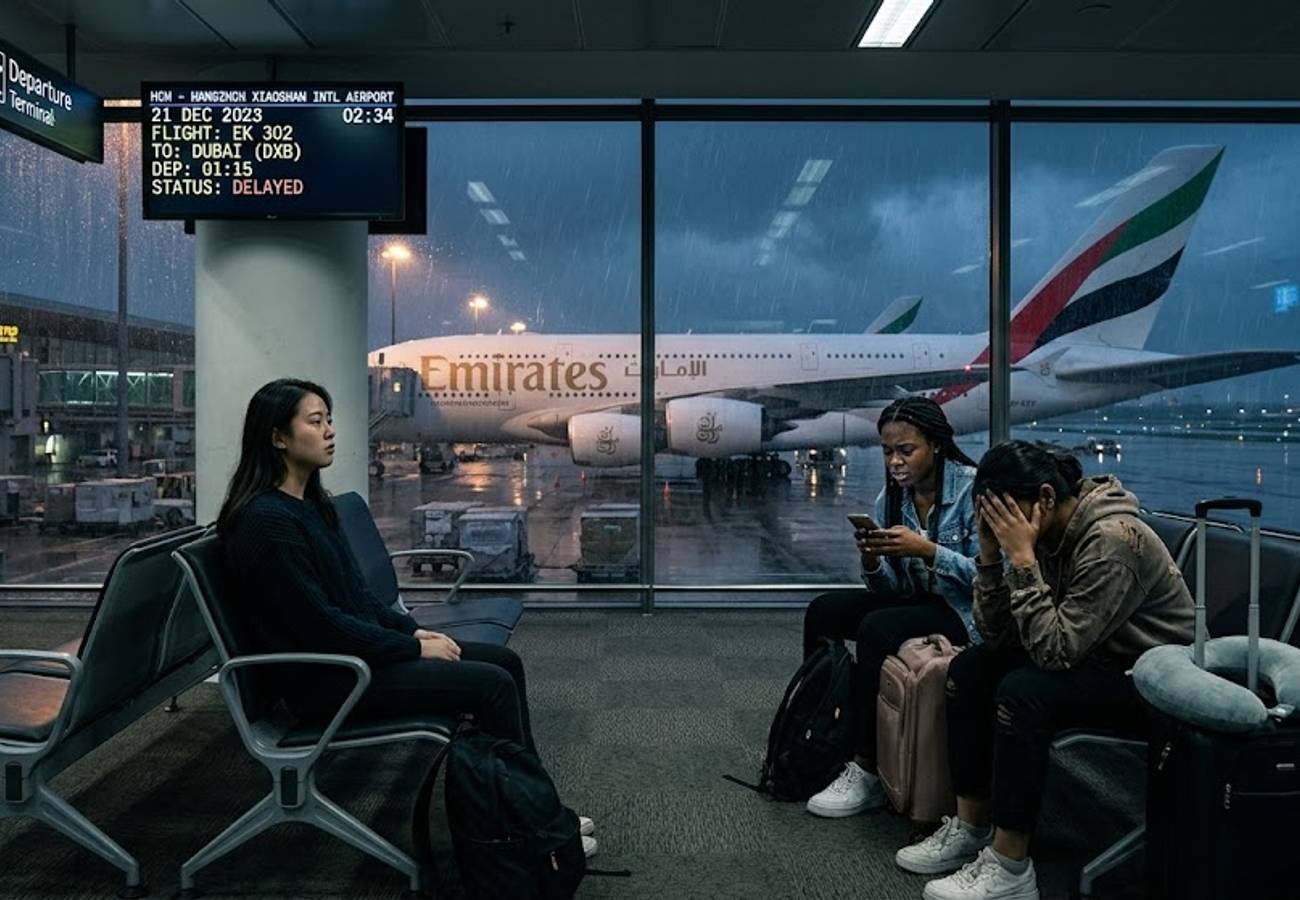
Image generated by AI
An Emirates Airbus A380 carrying more than 370 passengers diverted to Hangzhou Xiaoshan International Airport on July 22, 2026, after severe thunderstorms closed approaches to Shanghai Pudong. What followed was a near-24-hour ordeal on a remote apron stand with failing cabin cooling, a medical emergency, and mounting passenger frustration.
Weather Diversion Triggers Overnight Ordeal
Emirates flight EK302, operating the Dubai to Shanghai Pudong route, encountered severe thunderstorms near its destination on the night of July 22, 2026. Unable to land as scheduled, the Airbus A380 diverted to Hangzhou Xiaoshan International Airport, roughly 100 miles southwest of Shanghai. The widebody aircraft, carrying more than 370 passengers, was directed to a remote cargo apron stand where it remained parked for many hours while crew and ground teams waited for clearance and operational arrangements.
Passengers described remaining in their seats throughout the night as the airline evaluated options, including a potential onward flight to Shanghai once weather conditions improved. Local media accounts and social media posts referenced in Chinese news reports show crowded cabin scenes from both the upper and lower decks of the double-deck aircraft, highlighting how rapidly a diversion can escalate into an extended tarmac delay when weather, crew duty limits, and airport constraints converge.
By the time the final passengers left the aircraft and were moved into terminal facilities or local accommodation, many had been in the Emirates system for close to a full day. This span included the original flight time from Dubai, the diversion to Hangzhou, and the lengthy ground delay on the remote stand.
Cabin Conditions, Medical Emergency, and Communication Breakdown
Reports in Chinese business media and regional news outlets indicate that the air conditioning system on the parked A380 did not consistently cool the cabin during the delay. Passengers quoted in these reports said the temperature in some sections felt uncomfortably warm as the hours passed, compounding the stress of an overnight confinement.
One passenger reportedly fainted in the cabin, according to Chinese-language coverage that cited videos and posts from inside the aircraft. Cabin crew and airport medical personnel were said to have responded to the incident, which fueled further anxiety among travelers already weary from the prolonged disruption.
Videos circulating on Chinese social platforms show visibly agitated passengers questioning staff and expressing frustration about the lack of clear timelines. Many travelers had onward connections or commitments in Shanghai, and uncertainty over when the aircraft would depart again or when hotel arrangements would be provided intensified tensions on board. Publicly available information suggests that food and water were distributed during the delay, but passengers posting online argued that the frequency and communication around services did not meet expectations for such a long disruption on a long-haul flight.
Airport and Airline Responses Under Scrutiny
Subsequent reporting in mainland Chinese media includes a timeline attributed to Hangzhou airport authorities that outlines the diversion, ground handling steps, and eventual deplaning process. According to these published timelines, the aircraft landed in Hangzhou late on July 22 local time after thunderstorms closed or restricted operations at Shanghai Pudong. Constraints at both airports complicated the ability to move passengers onward quickly.
The aircraft was parked on a cargo or remote apron at Hangzhou, which limited the availability of boarding bridges and buses. This required coordination among multiple airport departments before passengers could disembark. Officials cited in domestic coverage noted that safety and immigration procedures had to be followed before any decision could be made on whether to allow passengers into the terminal or arrange hotels.
Emirates later apologized to affected passengers through public statements and customer service channels in China, acknowledging the length of the delay and the discomfort reported on board. The airline arranged hotel stays and meals for customers once they were able to leave the aircraft, and rebooked them on a rescheduled EK302 service or alternative options to Shanghai.
Diversion and Delay Specifications
| Parameter | Detail |
|---|---|
| Flight Number | EK302 |
| Airline | Emirates |
| Aircraft Type | Airbus A380 |
| Route | Dubai (DXB) to Shanghai Pudong (PVG) |
| Diversion Airport | Hangzhou Xiaoshan International Airport (HGH) |
| Diversion Distance | Approximately 100 miles southwest of Shanghai |
| Date of Incident | July 22, 2026 |
| Passenger Count | More than 370 |
| Total Time in Emirates System | Close to 24 hours |
| Cause | Severe thunderstorms near Shanghai Pudong |
| Aircraft Parking Position | Remote cargo apron stand |
| Medical Incidents | One passenger reportedly fainted |
| Airline Response | Hotel stays, meals, rebooking on rescheduled EK302 |
Traveler Logistics Guide: Navigating Diversions in China
From a ground-level perspective, the best way to navigate a situation like this is preparation before you ever board. If you are flying a long-haul route into a Chinese megacity during summer monsoon season, build a personal contingency plan.
Connection Buffer Times: When booking a long-haul flight into Shanghai Pudong or Beijing Capital during July through September, allow a minimum of four hours for any onward international connection. Domestic connections within China should have a buffer of at least three hours. Thunderstorms in eastern China frequently close approach corridors for two to six hours at a time.
Diversion Airport Awareness: Shanghai Pudong's primary diversion airports are Hangzhou Xiaoshan, Nanjing Lukou, and occasionally Qingdao. If your flight diverts, do not expect immediate terminal access. Chinese airports require immigration and customs clearance coordination before international passengers can deplane at a non-scheduled airport. This process can take several hours.
Digital Transit Policies: If you are transiting through China, ensure your visa or transit exemption documents cover diversion scenarios. The 144-hour visa-free transit policy applicable to Shanghai may not automatically apply at Hangzhou Xiaoshan unless that airport is also designated. Carry printed copies of your itinerary and any visa documentation, as digital systems may not be accessible at remote stands.
Passenger Rights in Non-EU, Non-US Jurisdictions: Unlike the United States, where federal rules limit tarmac delay times, and the European Union, where EU261 provides compensation frameworks, flights operating entirely outside these jurisdictions may have less clearly defined time limits. Emirates publishes a contingency plan for tarmac delays as required by US regulations, but enforcement on Chinese soil depends on local consumer protection rules. Document everything: timestamps, cabin conditions, communication from crew, and any services provided.
Accommodation and Rebooking: If stranded on a diverted international flight in China, request hotel accommodation in writing through the airline's customer service channels immediately upon landing, even while still on the aircraft. Chinese airports and international airlines typically coordinate hotel arrangements, but the process requires immigration clearance first. Keep your phone charged and use roaming or a local eSIM to maintain communication with your airline's global customer service, not just the local ground team.
Infrastructure Impact Assessment
The incident highlights a structural vulnerability in China's aviation infrastructure: large-aircraft diversions to secondary airports. The Airbus A380 requires specialized ground handling, including specific boarding bridges, wide-body taxiways, and high-capacity bus transport. Hangzhou Xiaoshan, while a major airport, was not the scheduled destination and its remote cargo apron lacked immediate access to passenger boarding bridges.
For Emirates, the disruption comes at a time when the carrier is investing heavily in its China network, promoting its flagship A380 on routes linking Dubai with major Chinese cities. Industry analysts note that Emirates has positioned itself as a premium option for long-haul connections between China, Europe, Africa, and the Middle East. Reports of passengers spending much of a day in a confined cabin, with inconsistent cooling and limited communication, risk undermining the brand image Emirates has cultivated among Chinese travelers.
Travel industry observers suggest that the incident may prompt Emirates and Chinese airports to revisit joint protocols on diversions involving large aircraft. Areas likely to be reviewed include access to air bridges and buses at alternative airports, rapid coordination with immigration and customs authorities, and clearer guidelines on when passengers should be moved into terminal facilities rather than held on board.
The broader regulatory question is whether global standards on tarmac delays and diversions should be harmonized. Aviation lawyers and consumer advocates note that on flights operating entirely outside the European Union and the US, compensation and specific time limits may be less clearly defined, leaving passengers reliant on airline policies and local consumer protection rules. The Hangzhou episode will likely be examined by regulators and consumer groups in China and abroad as part of this ongoing debate.
When a superjumbo sits on a remote stand for hours, the gap between airline promises and passenger reality becomes visible to everyone on board.
Related Travel Guides
Disclaimer
This article is for informational and educational purposes only. It does not constitute legal, financial, or professional advice. While we strive to provide accurate and up-to-date information, travel policies, regulations, and conditions change rapidly. Always verify information with official sources before making travel decisions. Nomad Lawyer makes no representations about the accuracy, reliability, completeness, or suitability of the information provided. Readers should consult qualified professionals for advice specific to their circumstances. The views expressed in this article are those of the author and do not necessarily reflect the views of Nomad Lawyer.
Preeti Gunjan
Contributor & Community Manager
A passionate traveller and community builder. Preeti helps grow the Nomad Lawyer community, fostering engagement and bringing the reader experience to life.
Learn more about our team →