Egypt Expands Red Sea Coastal Tourism Across 14 Specialised Centres as European Demand Surges

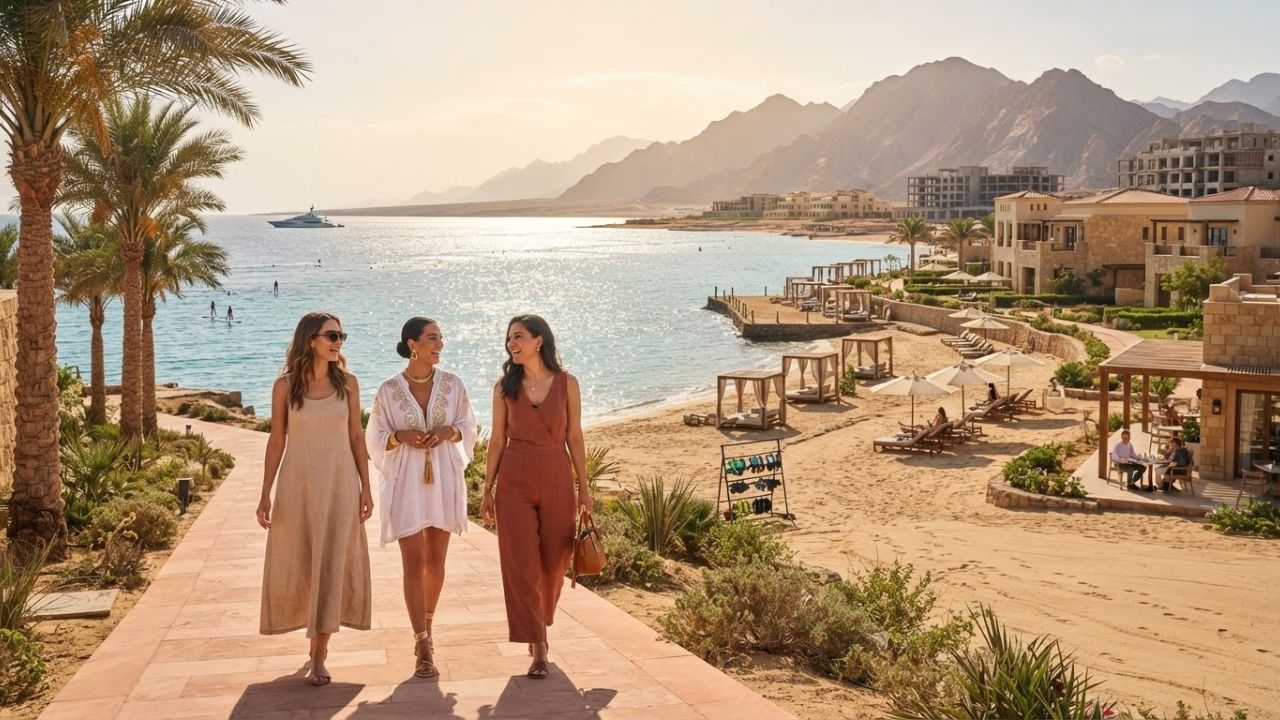
Egypt has unveiled a coastal development master plan establishing 14 specialised tourist centres distributed across three distinct shoreline clusters along the Red Sea, anchoring the multi-billion-dollar initiative at the mountain-coastal gateway of Al Galala. Designed to accelerate progress toward the national target of 30 million annual international visitors, this strategic framework couples shoreline hotel developments with inland residential and staff zones, supported by a 7% surge in arrivals reaching 6.1 million tourists in the first four months of 2026 and a 15% increase in Italian holidaymakers.
The governmental framework, formalized in September 2026 following inter-ministerial reviews by the Tourism Development Authority (TDA), marks a departure from traditional single-resort developments. Rather than replicating conventional beachfront hotels, each of the 14 designated centres will be tailored to its specific geographical and environmental assets, integrating beach leisure, ecotourism, and specialized wellness clinics.
With European outbound travel generating 69.2% of Egypt's international tourist arrivals between July 2025 and March 2026—led by Russia as the primary volume market, Germany ranking second with 11.4% growth in 2025, and Italy expanding rapidly across independent and cultural segments—the expansion addresses surging demand for high-value coastal travel.
The Local Trend Revealed: 14 Specialised Coastal Centres Across Three Clusters
The Red Sea development blueprint organizes shoreline development into three principal coastal clusters stretching south from the Gulf of Suez. By establishing Al Galala—a newly engineered coastal plateau city perched 700 meters above sea level—as the northern gateway, the master plan links maritime access with modern highway arteries connecting the New Administrative Capital and Greater Cairo in under 90 minutes.
A key feature of the September 2026 framework is its zoned land-use model:
- Prime Shoreline Allocation: Immediate coastal frontage is reserved exclusively for boutique hotels, eco-lodges, wellness retreats, and public beach clubs, preserving uninterrupted marine vistas.
- Hinterland Infrastructure Zoning: Secondary plots set back from the shoreline are dedicated to hotel-managed serviced apartments, holiday second homes, workforce housing, medical facilities, and commercial entertainment hubs.
| Planning Dimension | Official Development Baseline | Strategic Tourism Impact |
|---|---|---|
| Specialised Tourism Centres | 14 Dedicated Coastal Centres | Prevents uniform resort sprawl; diversifies product mix |
| Principal Coastal Clusters | 3 Geographic Shoreline Hubs | Zoned development from Gulf of Suez to southern Red Sea |
| Northern Development Gateway | Al Galala Plateau & Coastal Strip | High-speed links to Cairo and New Administrative Capital |
| National Hotel Room Inventory | Approximately 235,000 rooms | Scaling toward nearly 240,000 with 4,500–5,000 new rooms |
| Inbound Tourism Volume (Jan–Apr 2026) | 6.1 million international tourists | Up 7% from 5.7 million in Jan–Apr 2025 (20.5% growth in 2025) |
| Tourism Receipts (Jul 2025–Mar 2026) | Approximately US$14.4 billion | 14.9% revenue expansion supporting national economy |
| National Visitor Goal | 30 million annual tourists | Requires substantial room capacity and destination diversification |
In parallel with the Red Sea corridor, Egypt's Tourism Development Authority is advancing a northeastern Sinai development track. This parallel initiative features the West Arish tourism centre, planned across roughly 9,000 feddans, alongside eco-tourism initiatives at Arish and the Zaranik Protected Area near Lake Bardawil, pairing nature-based tourism with regional agricultural assets.
European Source Markets Fueling Coastal Expansion
The commercial foundation of the 14-centre initiative is anchored in robust, verified demand from Europe, which generated 69.2% of all international tourist arrivals during the July 2025 to March 2026 monitoring window.
- Russia (No. 1 Market): Retains its position as Egypt's largest overall source market. An eight-month digital promotional campaign on Yandex generated more than 26.4 million advertising impressions, sustaining winter sun charter demand into Red Sea resorts.
- Germany (No. 2 Market): Following an 11.4% arrival increase in 2025, German tour operator commitments secured at ITB Berlin 2026 (held March 3–5, 2026) continue to channel reliable year-round package and diving tourism.
- Italy (Rapid Growth & Independent Travel): Arrivals from Italy grew 15% from the start of 2026 through the first week of June compared to the same period in 2025. Italian holidaymakers increasingly combine Red Sea coastal stays with independent cultural itineraries across Luxor and Aswan.
- Integrated Tour Operators: Major distribution partners, such as Coral Travel, channel over one million tourists annually across aggregate source markets spanning Russia, Germany, Poland, the Baltic states, and Switzerland, providing immediate booking pipelines for newly opened coastal inventory.
Cultural & Environmental Value: Marine Ecosystem Stewardship and Bedouin Heritage
The Red Sea coastline contains some of the planet's most resilient marine habitats. Marine biologists have documented that the northern Red Sea's coral reefs exhibit extraordinary thermal tolerance compared to tropical reefs worldwide, earning them recognition as a vital global coral refuge.
To protect these sensitive underwater biomes, the 14-centre development framework incorporates rigorous environmental zoning overseen by the Egyptian Environmental Affairs Agency (EEAA) in partnership with the Hurghada Environmental Protection and Conservation Association (HEPCA). By concentrating development within designated clusters and pushing heavy utility infrastructure inland, the plan prevents unbroken ribbon development, controls desalination discharge, and preserves coastal mangrove estuaries.
Culturally, the expansion integrates indigenous coastal communities. In the southern Red Sea regions near El Qoseir and Marsa Alam, the initiative supports traditional Ababda and Bishari Bedouin tribes through community-managed desert guiding, medicinal plant heritage tours, and authentic handicraft cooperatives.
Travelers staying at newly designated ecotourism centres can visit ancient inland trade routes, such as the Roman gold and emerald workings at Wadi El Gemal National Park, ensuring tourism revenues directly benefit rural desert communities.
Visitor Insider Tips: Exploring Al Galala and the Red Sea Coast
Travelers planning a visit to Egypt's emerging Red Sea coastal centres can maximize their experience with these local insights:
- Al Galala's High-Altitude Vantage: When visiting the northern gateway of Al Galala, take the Galala Cable Car—one of the longest telepherique systems in the Middle East—which descends from the mountain plateau city down to the coastal marina and water park. The mountain plateau sits 700 meters above sea level, offering daytime temperatures 3°C to 5°C cooler than sea-level resorts.
- Reef Conservation Etiquette: When diving or snorkeling along Red Sea house reefs, choose dive centres that display official Green Fins or HEPCA certification. Never touch living coral polyps, avoid standing on reef flats, and use only mineral-based, non-nano zinc oxide sunscreen free of oxybenzone and octinoxate.
- Authentic Coastal Gastronomy: Skip international resort buffets to sample authentic coastal Egyptian dining. Order Sayadeya, a classic Red Sea specialty of fresh coastal whitefish baked in a rich tomato, cumin, and onion sauce, served over aromatic caramelized onion rice. In Bedouin desert camps, enjoy fresh Firasheh flatbread baked on hot sheet metal over tamarisk embers, accompanied by fragrant desert sage tea (Shai bil Maramiya).
- Under-the-Radar Mountain Monasteries: A short inland excursion from the coastal highway near Zafarana leads to the Monastery of Saint Anthony and the Monastery of Saint Paul the Anchorite. Dating to the 4th century AD, these cliffside sanctuaries represent the world’s oldest Christian monastic settlements, featuring ancient frescoed chapels and spring-fed desert gardens.
- Optimal Travel Windows: The Red Sea is a year-round destination, but the most pleasant conditions occur between October and April, when sunny daytime temperatures range between 22°C and 27°C, avoiding the intense dry heat of mid-summer.
Tourism Outlook: Realizing Egypt's 30-Million Visitor Vision
The planned network of 14 specialised tourist centres along the Red Sea reflects a mature evolution in Egypt's destination development model. Rather than relying solely on legacy resort towns, the state is actively shaping specialized travel corridors that balance economic growth with environmental conservation.
Supported by 6.1 million arrivals in early 2026, over US$14.4 billion in recent tourism revenues, and steady European demand from Italy, Germany, and Russia, the Red Sea expansion establishes the foundation needed to achieve Egypt’s ambitious national target of 30 million annual visitors by 2030.
Related Travel Guides
This article is for informational purposes. Flight routes, passenger regulations, visa rules, and transit advisories are subject to change by airlines and aviation authorities. Readers are advised to verify schedules and travel documentation with relevant carriers and border agencies before departure.
Related Stories
France Economic Stagnation: 2026 GDP Contraction and Travel Tourism Doubts

China's Liaoning Province Expands Inbound Tourism as Shenyang Convenes Global Travel Trade Summit Backed by 240-Hour Visa-Free Transit