
Economy Class Premium: How Airlines Maximize 2026 Cabin Revenue
Airlines deploy sophisticated cabin segmentation across economy class premium, business, and first-class tiers in 2026. Each cabin tier maximizes revenue through engineered passenger experience and strategic pricing.

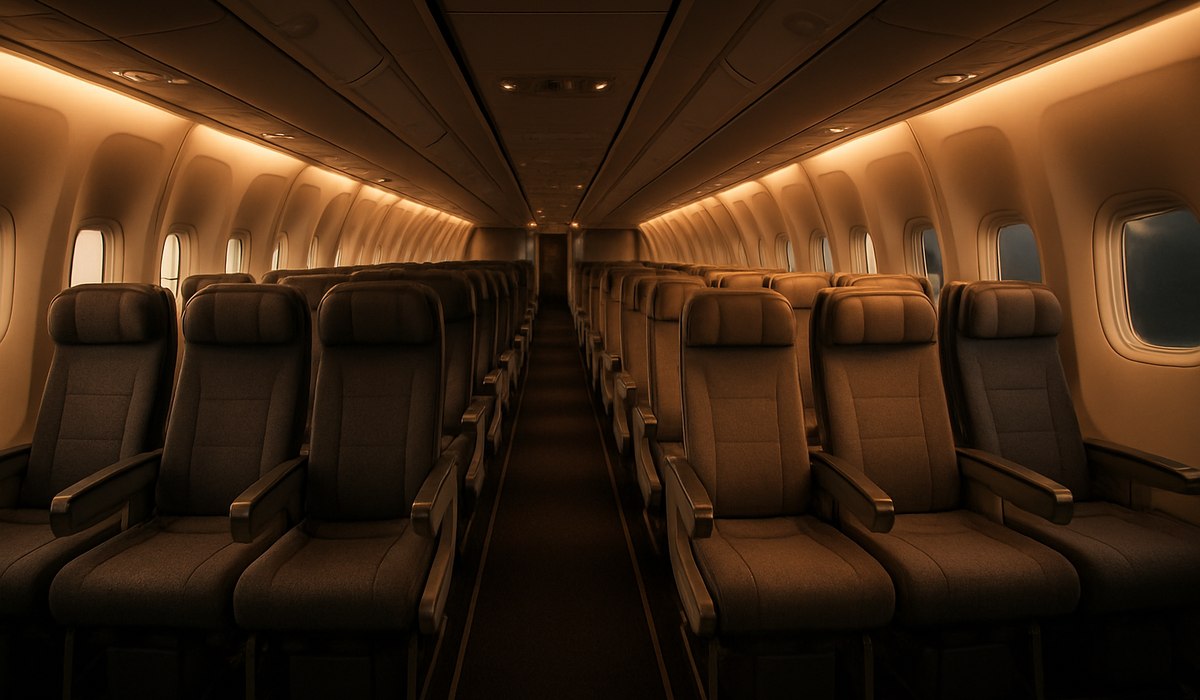
Image generated by AI
Modern Aircraft Cabins: The Four-Tier Revenue Strategy
Commercial aviation in 2026 operates within a precisely engineered four-cabin ecosystem. Airlines strategically partition fuselages into distinct passenger tiers—economy, economy class premium, business, and first class—each optimized to capture maximum revenue while delivering differentiated experiences. This cabin architecture represents decades of yield management evolution, where every square inch, amenity tier, and service protocol is designed to extract optimal value from diverse passenger segments.
The mathematics behind cabin division is unforgiving. A widebody aircraft like the Boeing 777 generates vastly different per-seat revenue depending on cabin assignment. Understanding these structural economics illuminates why airlines invest heavily in economy class premium positioning, often treating it as the underutilized profit center between budget economy and premium business segments.
Economy Class: The Foundation of Modern Air Travel
Economy class remains the volume engine driving airline profitability. Carriers pack 8-10 seats across narrow-body aircraft cabins, generating reliable revenue density through high passenger counts despite razor-thin per-seat margins.
Seat pitch in economy typically ranges from 28-32 inches, with modern configurations emphasizing seat width efficiency over recline functionality. Airlines have systematized the economy experience: standardized meal service for international routes, modest amenity kits, and basic entertainment systems. The revenue model depends on seat volume rather than ancillary monetization.
However, economy segmentation has intensified. Basic economy fares restrict carry-on luggage, boarding priority, and seat selection, pushing margin-conscious passengers toward premium economy alternatives. This tiered approach within economy itself creates psychological pricing traction. Passengers choosing between $200 basic economy and $280 economy class premium often rationalize the upgrade as reasonable value rather than comparing against the actual per-seat cost differential.
Airlines recognize economy as their lowest-friction passenger acquisition channel, accepting thin margins to fill capacity and ensure network viability. FlightAware tracking data shows economy seats represent 65-75% of typical widebody aircraft capacity across transatlantic and transpacific routes.
Premium Economy: The Middle Ground
Premium economy class emerged as airlines discovered a critical gap: business travelers unwilling to pay premium prices, but economy passengers willing to spend moderately more for comfort. This cabin tier has exploded globally since 2020.
Premium economy typically offers 38-40 inch seat pitch with direct aisle access, wider seats (18.5-20 inches), improved meal service, and exclusive amenity distributions. Revenue per seat runs 2.5-3.5× economy pricing while generating only 10-15% additional operational cost.
This makes economy class premium extraordinarily attractive from airline yield management perspectives. A 16-seat premium economy cabin might generate $400,000 monthly revenue on transatlantic service, whereas equivalent economy seats produce $180,000. The cabin requires minimal reconfiguration—airlines simply remove economy seats and retrofit new frames with superior pitch and cushioning.
Airlines increasingly market economy class premium as accessible luxury. Messaging emphasizes relative comfort gains rather than absolute positioning between economy and business. This psychological framing proves remarkably effective; passengers spending $800 on premium economy often feel they've achieved business-class comfort while justifying the expenditure against $2,400 business fares.
Carriers including British Airways, Qantas, and Lufthansa have expanded premium economy significantly, recognizing it as high-margin capacity capturing price-sensitive premium demand that business class pricing excludes.
Business Class: The Corporate Sweet Spot
Business class represents the profitability sweet spot for long-haul airlines. These cabins sacrifice volume for margin: a typical widebody carries 40-60 business seats generating 6-8× economy revenue per seat.
Cabin design for business emphasizes direct aisle access, lie-flat seats (72-80 inches in length), and premium service protocols. Airlines deploy dedicated cabin crews, multi-course meals with premium beverage programs, and amenity packages including noise-canceling headphones and luxury bedding.
Business class pricing anchors airline yield strategy. Published fares range $3,000-$8,000 depending on route distance, seasonality, and competitive dynamics. However, most business passengers travel on corporate contracts generating 40-60% discount from published rates. This enables airlines to offer competitive contract pricing while maintaining high average revenue per available seat mile (RASM).
The business cabin also drives premium brand positioning. Airlines invest disproportionately in business-class experience because it creates aspirational perception, justifying premium economy pricing and facilitating ancillary monetization. Business travelers experience first-class lounges, priority services, and premium ground handling—infrastructure the airline leverages across all premium segments.
Business class revenue supports narrow-margin economy operations. Without high-margin business cabins, most long-haul routes would operate at losses or require economy pricing increases that would further compress demand.
First Class: The Ultimate Luxury Experience
First class occupies a rarefied revenue segment, typically offering 8-14 seats on widebody aircraft. These cabins represent pure luxury positioning rather than volume profitability.
First-class configurations now emphasize individual suites with doors (on premium carriers), personal entertainment systems, vanities, and shower spas on ultra-long-range aircraft. Seat dimensions approach 8×6.5 feet with full lie-flat capacity. Service includes à la carte dining from Michelin-trained chefs, premium spirits, and white-glove ground handling.
Pricing reflects exclusivity rather than marginal cost. First-class fares routinely exceed $15,000 on transatlantic routes and reach $30,000+ on Asia-Pacific services. Per-seat revenue exceeds business class by 3-5×, despite modest seat counts.
Airlines maintain first-class cabins primarily for brand prestige and ancillary revenue. Few first-class cabins achieve profitability on per-seat basis when accounting for crew ratios, service intensity, and catering complexity. Instead, they anchor premium positioning that justifies business-class pricing and drives loyalty program prestige.
Cabin Economics: Revenue Data Comparison
| Metric | Economy | Premium Economy | Business Class | First Class |
|---|---|---|---|---|
| Typical Seat Count (777) | 246 | 28 | 48 | 8 |
| Average Seat Pitch | 31 inches | 38 inches | 73 inches | 77 inches |
| Published Fares (NYC-LON) | $450-$650 | $800-$1,200 | $3,500-$7,000 | $12,000-$18,000 |
| Corporate Contract Average | $350 | $680 | $2,100-$2,800 | $14,000+ |
| Revenue Per Seat (Monthly) | $2,400 | $6,200 | $18,500 | $28,000+ |
| Meal Service Level | Light | Standard | Premium | À la Carte |
| Average Ancillary Revenue | $12 | $32 | $180 | $240 |
What This Means for Travelers
The four-cabin structure creates strategic opportunities for conscious travelers. Here's how to optimize your cabin selection:
-
Assess true cost differential. Premium economy rarely justifies the expenditure on domestic or short-haul routes. Calculate per-mile cost savings rather than absolute price differences.
-
Leverage corporate negotiation. If your employer contracts business travel, ask your travel manager about discounted fares. Airlines often price business class 30-50% below published rates for enterprise agreements.
-
Monitor economy class premium positioning. On long-haul routes (6+ hours), premium economy delivers measurable comfort gains compared to economy, particularly seat pitch and service levels.
-
Evaluate first-class access through loyalty. Premium cabin positioning through frequent flyer miles offers exceptional value relative to cash
Disclaimer
This article is for informational and educational purposes only. It does not constitute legal, financial, or professional advice. While we strive to provide accurate and up-to-date information, travel policies, regulations, and conditions change rapidly. Always verify information with official sources before making travel decisions. Nomad Lawyer makes no representations about the accuracy, reliability, completeness, or suitability of the information provided. Readers should consult qualified professionals for advice specific to their circumstances. The views expressed in this article are those of the author and do not necessarily reflect the views of Nomad Lawyer.
Preeti Gunjan
Contributor & Community Manager
A passionate traveller and community builder. Preeti helps grow the Nomad Lawyer community, fostering engagement and bringing the reader experience to life.
Learn more about our team →