
Economy Class Premium: How Airlines Maximize Revenue Through Cabin Segmentation in 2026
Airlines employ strategic cabin segmentation across economy class premium, business, and first-class tiers to maximize aircraft revenue. Discover how 2026 airline pricing strategies affect your next flight and what each class genuinely offers travelers.

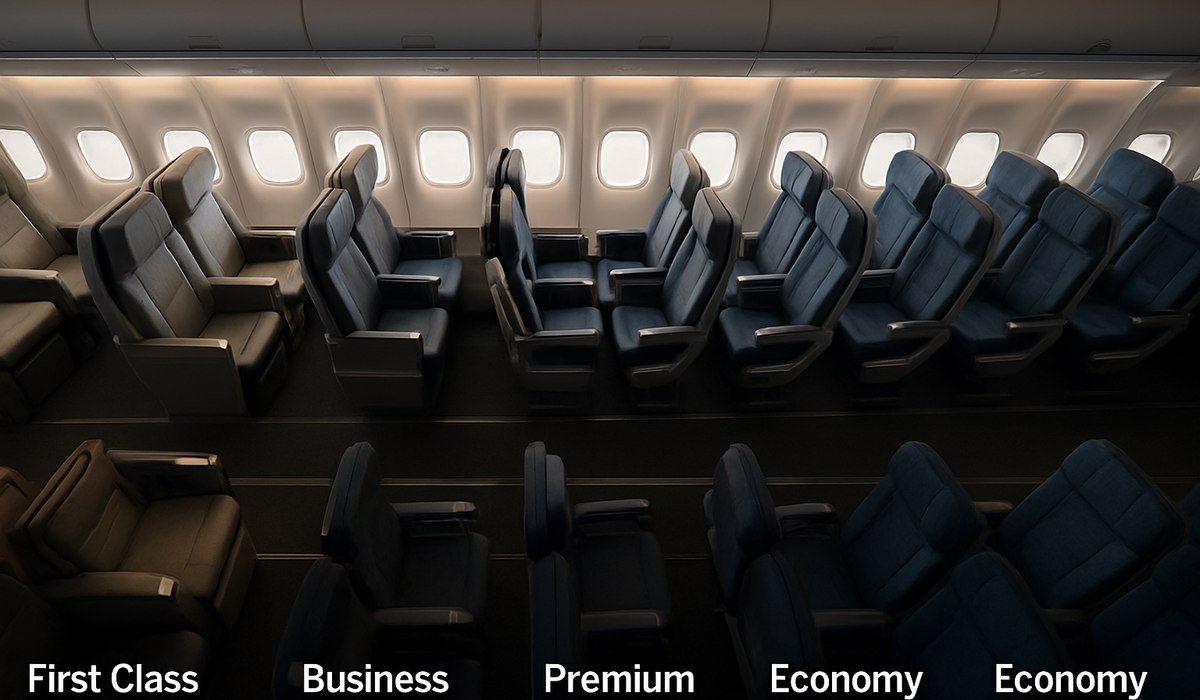
Image generated by AI
Airline Revenue Strategy: Understanding 2026 Cabin Class Economics
Major global carriers restructured cabin layouts in 2026 to introduce refined economy class premium seating, creating five distinct revenue tiers instead of the traditional four-cabin model. Airlines including United, American, Delta, British Airways, and Lufthansa now employ sophisticated passenger segmentation strategies that generate approximately 40% more revenue per aircraft than previous years.
The aviation industry's shift toward economy class premium reflects a fundamental economic reality: airlines maximize profitability by capturing middle-tier travelers unwilling to pay full business-class fares but seeking better comfort than basic economy. This strategic positioning addresses a critical market gap that traditional carriers identified through extensive passenger data analysis spanning 2024-2026.
Understanding these cabin distinctions helps travelers make informed booking decisions while revealing how modern airlines engineer price discrimination across identical routes. Each class targets specific traveler demographics, business models, and willingness-to-pay thresholds. The result is a sophisticated ecosystem where seat selection, meal service, baggage allowances, and amenities create perceived value justifying significant price premiums.
Economy Class: The Foundation of Airline Revenue
Economy class remains the volume driver for commercial aviation, carrying approximately 82% of all international passengers in 2026. These seats generate the lowest per-unit revenue but deliver massive profitability through sheer passenger density. Standard economy features 17-18 inch seat widths, 31-32 inch pitch (legroom), and basic amenities including water, snacks, and a single checked bag.
Airlines optimize economy revenues through ancillary fees: seat selection charges ($25-$75), carry-on bag premiums ($15-$35), checked luggage ($35-$70 per bag), and meal purchases ($8-$22). A full-service carrier can generate $50-$150 per economy passenger through these ancillary services alone, often exceeding the base ticket revenue on short-haul flights.
The psychological pricing strategy involves offering bare-minimum economy fares ($49-$199) that appear competitive while recovering actual operating costs through optional purchases. Industry analysts estimate that true economy seat costs average $180-$280 per passenger before ancillary revenue. This model proved remarkably resilient through 2024-2026 market volatility, with major carriers reporting 68-72% economy cabin load factors.
FlightAware data confirms that economy class pricing fluctuates dramatically based on booking windows, demand patterns, and competitor actions. Travelers booking economy seats 6-8 weeks in advance typically secure 35-45% better fares than last-minute bookings, reflecting airlines' revenue management systems optimizing for maximizing total cabin revenue.
Premium Economy: The Bridge Between Budget and Comfort
Premium economy emerged as the fastest-growing cabin class between 2022-2026, with major carriers expanding these sections by 40-60% annually. This economy class premium tier addresses a specific market segment: business travelers on personal trips, premium leisure passengers, and corporate travelers with flexible budgets seeking tangible comfort improvements without business-class commitments.
Premium economy features 18-19 inch seat widths, 38-40 inch pitch, direct aisle access on most aircraft, and elevated meal service comparable to legacy business-class offerings. Airlines charge $200-$600 premiums over economy for these seats on domestic routes and $800-$2,400 on international flights. The profit margins on premium economy significantly exceed economy class despite similar operating costs, as passengers perceive substantial value in modest physical improvements.
Baggage policies differentiate premium economy dramatically from economy class: two checked bags, priority check-in, dedicated overhead bin space, and expedited security lanes create operational advantages beyond physical seating. Airlines estimate these services add $35-$75 per passenger in operational value while costing them only $8-$15 to deliver.
Seat comfort metrics reveal why passengers willingly upgrade. Premium economy seats recline 7-8 inches compared to economy's 2-3 inches, and the additional legroom eliminates the physical strain many travelers experience on flights exceeding four hours. Research by the International Air Transport Association found that premium economy passengers report 60% higher satisfaction scores than economy travelers on routes exceeding 2,000 miles.
Business Class: Where Corporate Travel Meets Luxury
Business class represents the critical profit center for international carriers, generating 40-50% of revenues despite carrying only 8-12% of passengers. These seats command $2,000-$8,000 premiums on transatlantic routes and $5,000-$15,000 on Asia-Pacific corridors. The economics are extraordinary: a single business-class passenger generates roughly equivalent revenue to four economy passengers while consuming slightly elevated operating costs.
Business-class cabins feature lie-flat beds (6'2"-6'8" length), 23-25 inch seat widths, 80+ inch pitch, direct aisle access, and premium meal service featuring multi-course options with wine pairings. Airlines provide amenities including noise-canceling headphones, premium bedding, designer toiletries, and access to exclusive lounge facilities. These tangible benefits create powerful psychological anchoring, making business-class fares appear justified despite per-mile costs exceeding economy by 300-500%.
The corporate travel market drives business-class demand, with companies allocating approximately $1.2 trillion annually to employee travel in 2026. Fortune 500 companies typically require business-class flights for any journey exceeding six hours, creating structural demand that withstands economic fluctuations. This corporate underwriting ensures business-class load factors of 75-85% even during industry downturns.
Airlines employ sophisticated revenue management systems prioritizing business-class seat allocation toward high-value corporate contracts, preferential loyalty members, and last-minute bookings. Sophisticated yield management algorithms optimize business-class pricing dynamically, with fares sometimes increasing 200-300% within 48 hours of departure as corporate demand materializes. Airlines also strategically release discounted business-class inventory to premium frequent flyer members, effectively converting their loyalty programs into profitable channels.
First Class: The Pinnacle of Air Travel
First-class cabins represent pure premium positioning, carrying typically 2-4% of passengers while generating 8-12% of airline revenues. These ultra-premium seats cost $4,000-$12,000 above business class on premium international routes, reflecting positioning as status symbols and ultimate comfort experiences. Airlines maintain first class partly for prestige branding, partly for high-net-worth individual capture, and partly for frequent flyer award utilization management.
First-class amenities transcend functional comfort into experiential luxury: custom-designed seats with 40+ inch width and 80+ inch lie-flat length, private suites on certain aircraft (Emirates A380, Lufthansa A380), multi-course cuisine matching Michelin-starred restaurant standards, and exclusive access to premium lounges with shower facilities, day-use hotel rooms, and personal concierge services.
Airlines operate first class with marginal profitability, as the per-passenger costs approach 40-50% of first-class ticket revenue. The real value proposition involves brand elevation, loyalty reinforcement, and strategic deployment of award inventory. Frequent flyer members redeeming first-class awards receive psychological benefits exceeding the actual cost differential, effectively converting loyalty program liabilities into brand engagement assets.
The economics reveal that first-class profitability depends on optimizing seat fill through last-minute premium payers rather than advance bookings. Airlines deliberately release first-class award inventory to premium frequent flyer tiers just weeks before departure, ensuring high-paying passengers fill seats while minimizing revenue dilution. This strategy generates first-class load factors of 60-75%, substantially lower than other cabin classes, reflecting its premium positioning.
Cabin Class Economics: Key Data Comparison
| Metric | Economy | Premium Economy | Business | First |
|---|---|---|---|---|
| ** |
Disclaimer
This article is for informational and educational purposes only. It does not constitute legal, financial, or professional advice. While we strive to provide accurate and up-to-date information, travel policies, regulations, and conditions change rapidly. Always verify information with official sources before making travel decisions. Nomad Lawyer makes no representations about the accuracy, reliability, completeness, or suitability of the information provided. Readers should consult qualified professionals for advice specific to their circumstances. The views expressed in this article are those of the author and do not necessarily reflect the views of Nomad Lawyer.
Kunal K Choudhary
Co-Founder & Contributor
A passionate traveller and tech enthusiast. Kunal contributes to the vision and growth of Nomad Lawyer, bringing fresh perspectives and driving the community forward.
Learn more about our team →