
US and Dubai Race to Launch World's First Commercial Electric Air Taxi Service by 2026
Dubai and leading US metropolitan hubs are competing to launch the first commercial electric air taxi services by 2026, driven by Joby and Archer Aviation.

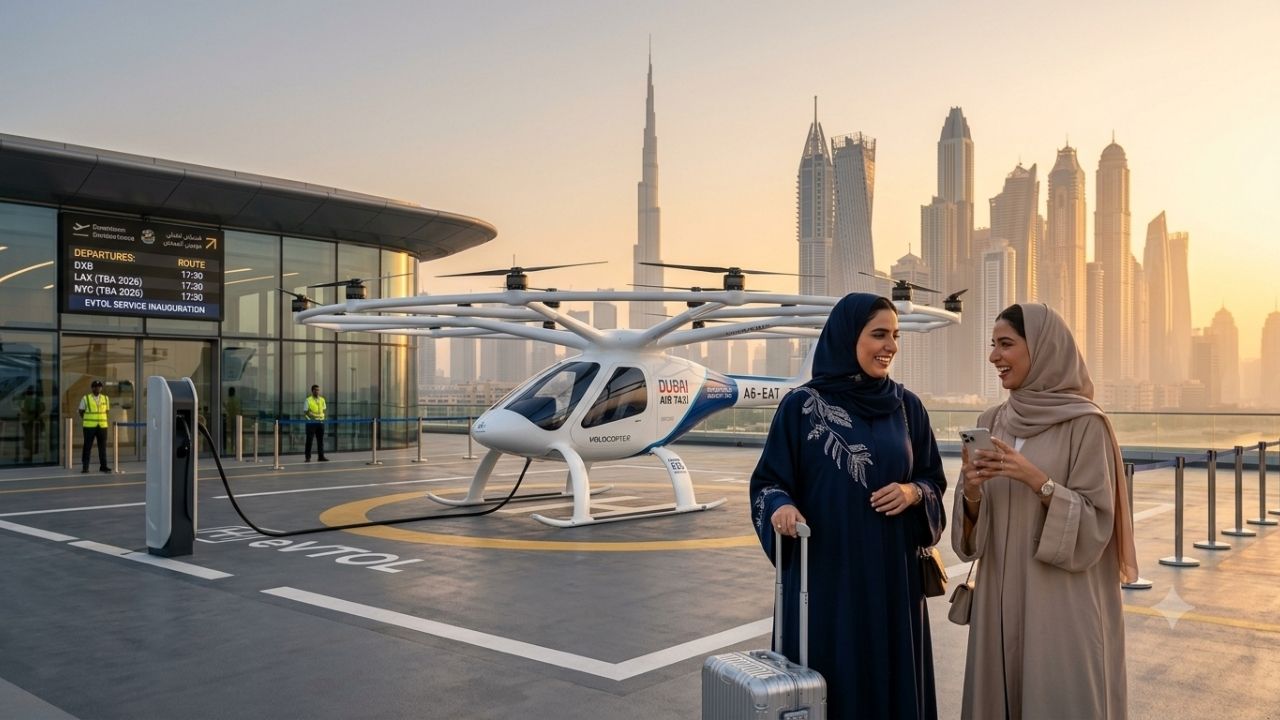
Image generated by AI
The United Arab Emirates and the United States are locked in a high-stakes race to launch the world’s first commercial electric air taxi service by 2026. As electric vertical take-off and landing (eVTOL) aircraft near safety certification, Dubai and major US metropolitan centers are competing to deploy next-generation urban mobility networks.
US and Dubai Compete for Commercial eVTOL Relaunch Milestones
[DUBAI, United Arab Emirates] — The global aviation sector is reaching a critical inflection point as the United Arab Emirates and the United States compete to launch the world's first commercial electric air taxi network. Driven by rapid technological developments in electric vertical take-off and landing (eVTOL) aircraft, both markets are targeting 2026 to inaugurate passenger operations that bypass urban traffic congestion.
Dubai has established an early lead in infrastructure deployment by constructing dedicated vertiports, integrating high-speed charging systems, and implementing supportive government regulations. Meanwhile, the United States remains a formidable competitor because leading aircraft manufacturers, including Joby Aviation and Archer Aviation, are conducting extensive flight testing while working toward Federal Aviation Administration (FAA) commercial certification.
The initial commercial rollouts will not replace traditional commercial airlines or city taxis overnight. Industry plans indicate that early operations will feature small fleets, limited point-to-point routes, and premium pricing tailored for airport transfers and executive city connections.
Dubai Leverages Vertiport Infrastructure to Lead Global eVTOL Race
Dubai’s strategic push into advanced air mobility aligns with the emirate's broader urban transit modernization goals. Municipal authorities have partnered with infrastructure developers to build dedicated vertiport facilities connected directly to Dubai International Airport (DXB), financial centers, and major tourism landmarks.
A key player in Dubai’s launch timeline is California-based Joby Aviation. The company has signed definitive agreements to operate commercial air taxi services in the emirate, targeting initial passenger flights by 2026. The planned vertiport network aims to reduce travel times between Dubai International Airport and Palm Jumeirah from 45 minutes by car to less than 10 minutes by air.
While Dubai's streamlined regulatory framework and state-backed infrastructure provide a timing advantage, the final launch date remains dependent on completing rigorous flight safety evaluations and operational testing.
United States Relies on Developer Leadership and FAA Certification
The United States remains a primary contender in the global air taxi race due to its concentration of leading aerospace manufacturers. Companies including Joby Aviation, Archer Aviation, Wisk Aero, Eve Air Mobility, Beta Technologies, and Vertical Aerospace are driving aircraft design and commercialization efforts.
US commercial deployment centers on major metropolitan hubs facing heavy highway congestion. Initial flight corridors are planned for New York (JFK Airport to Manhattan), Miami (Miami International Airport to downtown), and Los Angeles (LAX to regional coastal centers).
However, US commercial launches must satisfy stringent Federal Aviation Administration safety standards. The FAA’s eVTOL Integration Pilot Program (eIPP) enables manufacturers to conduct operational trials while completing multi-stage airworthiness certifications. While regulatory thoroughness may extend approval timelines, clearance by the FAA will immediately validate commercial air taxi operations globally.
The table below compares the strategic advantages, primary locations, key developers, and regulatory frameworks governing the US and UAE air taxi markets:
| Market / Region | Primary Operating Hubs | Key Aircraft Developers | Primary Competitive Advantage | Current Regulatory Framework |
|---|---|---|---|---|
| Dubai (UAE) | DXB Airport, Palm Jumeirah, Downtown Dubai | Joby Aviation | Advanced vertiport construction & government backing | Streamlined UAE General Civil Aviation Authority protocols |
| United States | New York, Miami, Los Angeles, Chicago | Joby Aviation, Archer Aviation, Wisk Aero, Eve | Home to leading eVTOL manufacturers & tech capital | Rigorous FAA Airworthiness & eIPP Certification |
From 2016 Uber Elevate Vision to Commercial FAA Certification
The commercialization of electric air taxis represents the culmination of a decade of intensive research and venture capital investment. The sector gained global momentum in 2016 when Uber introduced its Uber Elevate concept, inspiring over 1,200 eVTOL designs worldwide.
While early startup concepts promised widespread flying cars by the mid-2020s, technical and regulatory realities forced the industry to consolidate. Developers shifted focus from theoretical concepts toward building certified, low-noise, zero-emission aircraft capable of safe commercial operation.
Today, leading manufacturers are conducting thousands of test flights, validating battery endurance, and demonstrating low acoustic signatures to satisfy municipal noise guidelines. The transition from experimental flight testing to scheduled passenger operations marks the most significant architectural shift in short-haul aviation in decades.
Initial Fleet Profiles, Premium Pricing, and 2050 Market Outlook
Early commercial air taxi flights will operate as specialized shuttle services rather than mass-transit substitutes. Initial aircraft configurations feature four-passenger passenger cabins managed by a single pilot, with autonomous pilotless operations planned for later stages.
Potential initial routes include:
- Airport Shuttles: Express transfers connecting major international hubs directly to downtown financial districts
- Event Transit: Premium transit serving major international sporting events, trade conventions, and entertainment summits
- Regional Corridors: Point-to-point connections between neighboring business centers separated by water or heavy traffic
Due to limited early aircraft production, initial ticket prices will carry a premium over ground rideshare services. However, market analysts project that as manufacturing scales up and operational automation increases, flight costs will decrease toward standard premium ground transport rates.
Financial forecasts suggest that the global Advanced Air Mobility (AAM) market could reach $1 trillion by 2050. While 2026 marks the inaugural commercial launch window, the 2030s are expected to bring widespread fleet expansion across major international cities.
Why This Matters for Passengers and Urban Travellers
For business executives and international travelers, the commercial arrival of electric air taxis promises to eliminate the most frustrating aspect of air travel: urban traffic gridlock between city centers and airports. Passengers landing at major hubs will soon have the option to bypass hour-long highway jams via 10-minute zero-emission aerial flights. While early ticket prices will reflect premium positioning, the deployment of vertiport networks in Dubai, New York, and Los Angeles signals a practical transformation in how travelers navigate congested global metropolises.
Frequently Asked Questions
Which location is expected to launch the world's first commercial electric air taxi service?
Dubai in the United Arab Emirates is currently considered the frontrunner due to its advanced vertiport construction and state regulatory support. However, US cities like New York and Miami remain close competitors as American manufacturers complete FAA certification testing.
What are the primary routes planned for early electric air taxi flights?
Initial operations will focus on high-demand short routes, such as airport-to-downtown shuttles (e.g., JFK Airport to Manhattan or Dubai International Airport to Palm Jumeirah) and express connections between major commercial districts.
Will electric air taxis replace traditional commercial airlines?
No. Electric air taxis are designed for short-distance urban and regional transit (typically under 100 miles), complementing commercial airlines and ground transportation rather than replacing long-haul flights.
Related Travel Guides
Dubai International Airport Passenger Traffic Records and Infrastructure Masterplan
Electric Aviation Advances: Battery-Powered Aircraft Reshape Regional Routes
10 Best Future Airport Transit Innovations and Air Taxi Vertiports, According to Reddit
Disclaimer
This article is for informational and educational purposes only. It does not constitute legal, financial, or professional advice. While we strive to provide accurate and up-to-date information, travel policies, regulations, and conditions change rapidly. Always verify information with official sources before making travel decisions. Nomad Lawyer makes no representations about the accuracy, reliability, completeness, or suitability of the information provided. Readers should consult qualified professionals for advice specific to their circumstances. The views expressed in this article are those of the author and do not necessarily reflect the views of Nomad Lawyer.
Raushan Kumar
Founder & Lead Developer
Full-stack developer with 11+ years of experience and a passionate traveller. Raushan built Nomad Lawyer from the ground up with a vision to create the best travel and law experience on the web.
Learn more about our team →